PRACTICE TEST: Clinical: Medical Device
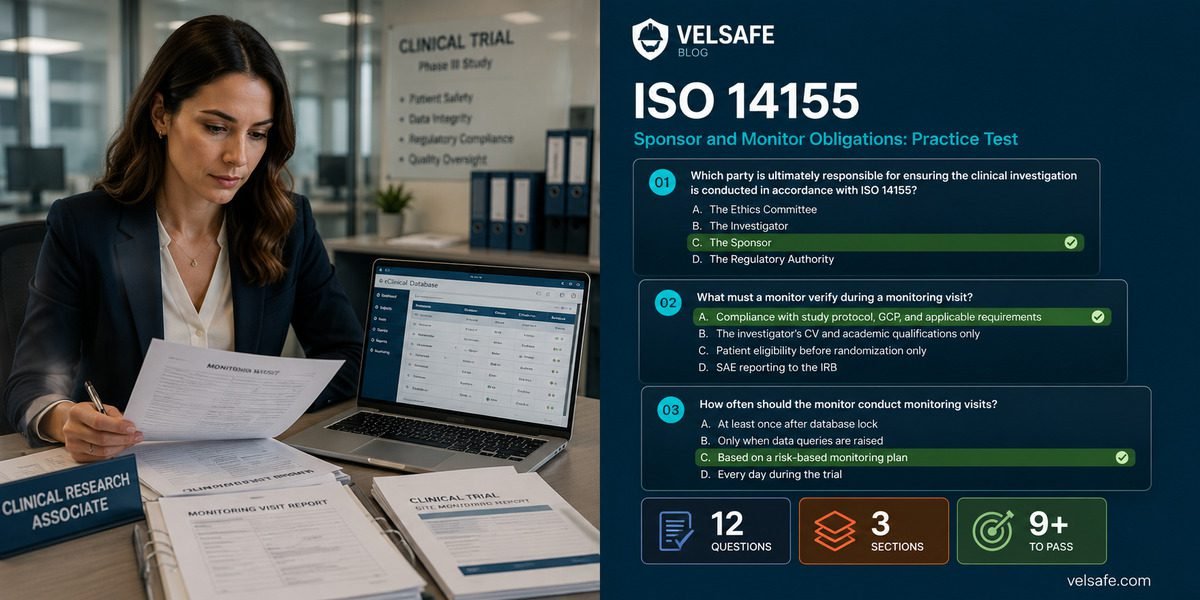
Test your knowledge of sponsor and monitor obligations under ISO 14155:2020. Twelve questions across sponsor duties, monitoring requirements, and adverse event reporting.
12
Questions
Covering sponsor obligations, monitoring duties, and adverse event reporting under ISO 14155:2020
ISO 14155:2020, ISO.org
3
Sections
Sponsor responsibilities, monitoring requirements, and adverse event and deviation reporting
ISO 14155:2020, Sections 5-8
9+
Pass Score
A score of 9 or above out of 12 demonstrates solid working knowledge of sponsor and monitor obligations
ISO 14155:2020
ISO 14155:2020 is the international standard for Good Clinical Practice (GCP) in clinical investigations of medical devices in human participants. Sponsors and monitors carry the heaviest regulatory burden under this standard: sponsors are responsible for the design, conduct, and oversight of the investigation, while monitors are the sponsor’s primary mechanism for verifying that the investigation is being conducted to protocol and to GCP.
This practice test focuses specifically on the obligations of sponsors and monitors: what they must do before an investigation begins, what ongoing duties apply during conduct, how monitoring visits must be conducted and documented, and how adverse events and deviations must be handled. Each question is followed by the correct answer and a concise explanation grounded in ISO 14155:2020.
Section 1 of 3: Sponsor Responsibilities (Questions 1-4)
1. Under ISO 14155:2020, which document must the sponsor prepare before the clinical investigation begins and submit to ethics committees and competent authorities?
A. The Clinical Evaluation Report (CER)
B. The Clinical Investigation Plan (CIP)
C. The Investigational Device Brochure (IDB)
D. The Subject Identification Log
Correct Answer: B
The Clinical Investigation Plan (CIP) is the sponsor’s primary planning document under ISO 14155:2020. It defines the objectives, design, methodology, statistical considerations, and conduct of the investigation. It must be reviewed by the ethics committee and submitted to competent authorities before any investigation activity begins. The CER is a post-market document; the IDB provides device information to investigators but is not the primary submission document.
2. Which of the following is the sponsor’s responsibility regarding investigator qualification under ISO 14155:2020?
A. The sponsor may rely on the ethics committee to verify investigator qualifications
B. The sponsor must verify that each investigator has adequate qualifications, resources, and facilities before site initiation
C. Investigator qualification is the competent authority’s responsibility
D. The sponsor only needs to verify investigator qualifications if the competent authority requests it
Correct Answer: B
ISO 14155:2020 places the obligation for investigator qualification directly on the sponsor. Before initiating any site, the sponsor must verify that each principal investigator has the necessary training, experience, and resources to conduct the investigation per the CIP. This verification should be documented. The ethics committee and competent authority may also review qualifications, but this does not relieve the sponsor of its independent obligation.
3. When a sponsor delegates clinical investigation tasks to a Contract Research Organisation (CRO) under ISO 14155:2020, what responsibility does the sponsor retain?
A. The sponsor’s responsibilities transfer fully to the CRO for delegated tasks
B. The sponsor retains overall responsibility regardless of what tasks are delegated
C. The CRO and sponsor share equal regulatory responsibility for delegated tasks
D. The sponsor is only responsible for tasks explicitly excluded from the CRO agreement
Correct Answer: B
ISO 14155:2020 is explicit: the sponsor retains ultimate responsibility for the quality and integrity of the clinical investigation even when tasks are delegated to a CRO. The sponsor must ensure that any CRO has appropriate systems and capabilities, must define the scope of delegation in writing, and must maintain oversight of delegated activities. Regulatory obligations cannot be contractually transferred away from the sponsor.
4. Under ISO 14155:2020, the sponsor must ensure that the Investigational Device Brochure (IDB) is updated when new information becomes available. What is the primary purpose of the IDB?
A. To serve as the regulatory submission dossier for competent authorities
B. To provide investigators with the current clinical and non-clinical information needed to conduct the investigation safely
C. To document the manufacturing process of the investigational device
D. To replace the Clinical Investigation Plan when the device design changes
Correct Answer: B
The IDB compiles all relevant preclinical and clinical information about the investigational device into a single reference document for investigators. It enables investigators to make informed decisions about subject safety, understand the device’s known risk profile, and conduct the investigation appropriately. The sponsor must keep the IDB current: when significant new safety information emerges, the IDB must be updated and investigators notified promptly.
Section 2 of 3: Monitor Obligations (Questions 5-8)
5. Under ISO 14155:2020, what qualification must a monitor possess before being assigned to a clinical investigation?
A. A medical degree or equivalent clinical qualification
B. Training and experience in clinical investigations, GCP, and the scientific and medical aspects of the investigation
C. Regulatory Affairs certification from a recognised body
D. At least five years of experience in medical device manufacturing
Correct Answer: B
ISO 14155:2020 requires that monitors be trained and experienced in clinical investigations and GCP, and that they have sufficient scientific and medical knowledge to understand and evaluate the investigation they are monitoring. A medical degree is not required. The standard focuses on relevant training and experience, which must be documented. The sponsor is responsible for ensuring that monitors meet these requirements before assignment.
6. Which of the following is a core monitoring activity required by ISO 14155:2020 during site visits?
A. Performing statistical analysis of the data collected at the site
B. Verifying that source data in medical records are consistent with data recorded in the Case Report Forms
C. Administering the investigational device to subjects under investigator supervision
D. Providing medical advice to subjects enrolled in the investigation
Correct Answer: B
Source data verification (SDV) is one of the primary activities of the monitor during site visits. The monitor must compare data recorded in Case Report Forms (CRFs) against source documents such as medical records, laboratory reports, and imaging to confirm accuracy, completeness, and consistency. This is the mechanism by which the sponsor verifies data integrity at the site level. Statistical analysis is performed centrally; monitors do not administer devices or provide medical advice to subjects.
7. After each monitoring visit, the monitor must prepare a written report. According to ISO 14155:2020, what must this report contain?
A. A summary of subject medical histories reviewed during the visit
B. A description of findings, deviations, deficiencies, conclusions, actions taken, and actions required
C. A financial reconciliation of site costs against the clinical investigation budget
D. A list of subjects who did not complete the informed consent process
Correct Answer: B
ISO 14155:2020 requires that monitoring visit reports contain a comprehensive account of findings: what was reviewed, any deviations or deficiencies identified, the monitor’s conclusions, actions already taken to address issues, and actions still required with responsible parties and timelines. These reports are the primary accountability record between the monitor and sponsor and must be submitted to the sponsor promptly after each visit. They are also subject to inspection by competent authorities.
8. If a monitor identifies a serious non-compliance at a clinical investigation site, what is the correct sequence of actions under ISO 14155:2020?
A. Notify the ethics committee directly without involving the sponsor first
B. Document the finding in the monitoring report only and allow the sponsor to decide on further action at the next review meeting
C. Notify the sponsor immediately, take immediate action where possible, and ensure the sponsor evaluates whether the non-compliance requires reporting to ethics committees or competent authorities
D. Suspend the investigation unilaterally and notify all enrolled subjects
Correct Answer: C
When a monitor identifies serious non-compliance, ISO 14155:2020 requires immediate notification to the sponsor, immediate remedial action where within the monitor’s authority, and sponsor-led evaluation of whether the non-compliance triggers mandatory reporting to ethics committees or competent authorities. The monitor cannot unilaterally suspend a clinical investigation or directly notify external bodies; these decisions rest with the sponsor. Deferring action to a future review meeting is not acceptable for serious non-compliance.
Section 3 of 3: Adverse Events and Deviations (Questions 9-12)
9. Under ISO 14155:2020, which of the following best describes a Serious Adverse Device Effect (SADE)?
A. Any undesirable clinical occurrence in a subject, regardless of device relationship
B. An adverse device effect that resulted in death, serious injury, or a life-threatening condition and was caused or potentially caused by the investigational device
C. Any device malfunction that required repair or replacement during the investigation
D. An adverse event that caused a protocol deviation
Correct Answer: B
A Serious Adverse Device Effect (SADE) is an adverse effect related to the use of the investigational device that meets the seriousness criteria: death, serious deterioration in health, life-threatening illness, permanent impairment, foetal distress, or hospitalisation. The key distinction from a Serious Adverse Event (SAE) is the attribution to the device. ISO 14155:2020 has distinct reporting requirements for SADEs versus SAEs because device attribution determines regulatory significance for the investigation.
10. Under ISO 14155:2020, what is the sponsor’s reporting obligation when an Unanticipated Serious Adverse Device Effect (USADE) is identified?
A. Report to all investigators and the ethics committee within 30 days
B. Report to competent authorities and ethics committees as soon as possible, without undue delay
C. Suspend enrolment until internal review is complete, then report at the next scheduled submission
D. Report only to the principal investigator and await their assessment before notifying authorities
Correct Answer: B
An Unanticipated Serious Adverse Device Effect (USADE) is a SADE not identified in the IDB or not expected given the known risk profile of the device. ISO 14155:2020 requires the sponsor to report USADEs to all competent authorities and ethics committees as soon as possible, without undue delay. The investigator must also be informed. Many national regulations specify exact timelines (commonly 7 or 15 days depending on lethality). Awaiting internal review before external reporting is not compliant.
11. A subject experiences a device malfunction that did not cause harm but could have caused serious injury if not corrected. How should this event be classified under ISO 14155:2020?
A. Non-serious adverse event, reportable at the end of the investigation
B. Device deficiency requiring documentation and assessment for potential SADE impact
C. Adverse device effect, requiring immediate site suspension
D. Protocol deviation, requiring ethics committee notification only
Correct Answer: B
ISO 14155:2020 defines a device deficiency as any inadequacy of an investigational device related to its identity, quality, durability, reliability, safety, or performance. A malfunction that did not cause harm but could have led to serious injury meets this definition. Device deficiencies must be documented, assessed for their potential to constitute or contribute to a SADE, and evaluated for reportability. The standard specifically addresses near-miss device malfunctions to ensure they are not dismissed simply because no harm occurred.
12. Under ISO 14155:2020, what is the difference between a protocol deviation and a protocol amendment?
A. A protocol deviation is planned and approved in advance; a protocol amendment occurs unintentionally
B. A protocol deviation is an unintentional or unavoidable departure from the CIP; a protocol amendment is a deliberate planned change to the CIP requiring prior approval
C. Protocol deviations and amendments are interchangeable terms in ISO 14155:2020
D. A protocol amendment applies only to changes affecting subject safety; all other changes are protocol deviations
Correct Answer: B
ISO 14155:2020 distinguishes clearly between these two. A protocol deviation is an unintentional or unavoidable departure from the approved CIP. It must be documented, assessed for impact on subject safety and data integrity, and reported to the sponsor and potentially to ethics committees or competent authorities if significant. A protocol amendment is an intentional, planned change to the CIP. Amendments require sponsor approval and, depending on scope, prior ethics committee and competent authority approval before implementation. Implementing a planned change without approval is itself a protocol deviation.
Delegation does not transfer sponsor accountability
The sponsor retains ultimate responsibility for every aspect of a clinical investigation under ISO 14155:2020, regardless of what tasks are assigned to CROs, monitors, or investigators. Delegation must be documented and oversight must be maintained. Regulatory authorities hold the sponsor accountable even when a third party caused the failure.
Monitoring reports are legal records, not internal memos
Every monitoring visit must produce a written report covering findings, deviations, actions taken, and actions required. These reports are subject to inspection by competent authorities and ethics committees. A monitoring programme that generates comprehensive reports consistently is the sponsor’s primary defence against regulatory findings of inadequate oversight.
USADE reporting speed is a compliance obligation, not a judgment call
Unanticipated Serious Adverse Device Effects must be reported to competent authorities and ethics committees as soon as possible, without undue delay. This is one of the most frequently cited areas of non-compliance in device clinical investigation inspections. The assessment of whether an event qualifies as a USADE should be completed rapidly, and when in doubt, the conservative approach is to report and correct later rather than delay and investigate first.
What is the difference between ISO 14155 and ICH E6 GCP?
ISO 14155 is the GCP standard for medical device clinical investigations. ICH E6 is the GCP standard for pharmaceutical clinical trials. Both share core principles around ethics, informed consent, data integrity, and adverse event reporting, but ISO 14155 addresses device-specific requirements such as device deficiency reporting, performance data, and the Investigational Device Brochure. In jurisdictions where both could apply, ISO 14155 takes precedence for device investigations.
Can the sponsor also serve as the principal investigator under ISO 14155?
ISO 14155:2020 permits sponsor-investigator arrangements where one entity assumes both roles. However, the combined entity must still fulfil all sponsor and investigator obligations independently. This arrangement is common in academic and early-feasibility investigations but creates a significant quality systems burden. The combined entity cannot waive obligations that would otherwise require independent oversight between sponsor and investigator.
How frequently must monitoring visits occur under ISO 14155?
ISO 14155:2020 does not specify a fixed monitoring frequency. The standard requires the sponsor to determine the nature, frequency, and extent of monitoring based on the complexity of the investigation, the number of subjects, the nature of the interventions, and the level of risk. Higher-risk or more complex investigations require more frequent monitoring. The monitoring plan, which documents the rationale for the chosen approach, must be maintained in the Trial Master File.
What is a device deficiency and does it always need to be reported externally?
A device deficiency is any inadequacy in the identity, quality, reliability, safety, or performance of the investigational device. Not all deficiencies require external reporting. They must be documented and assessed. If the deficiency led to or could have led to a SADE, reporting obligations are triggered. If the deficiency did not cause or have potential to cause serious harm, it is recorded in the investigation files and tracked in the safety database without mandatory external notification.
Who is responsible for obtaining informed consent: the sponsor or the investigator?
Under ISO 14155:2020, the investigator (or a delegated member of the investigation team) is responsible for obtaining informed consent from each subject before any investigation procedure is performed. The sponsor is responsible for ensuring that an adequate informed consent process is defined in the CIP, that the consent form is reviewed and approved, and that the process is correctly implemented at each site. The monitor verifies that consent documentation is complete during site visits.
What must the sponsor do when a clinical investigation is terminated early?
ISO 14155:2020 requires the sponsor to notify all investigators, ethics committees, and competent authorities of early termination, along with the reasons. Subjects must be informed and their clinical care transferred appropriately. Data collected up to termination must be secured and a final report produced. If termination is due to safety concerns, notification timelines may be governed by the same requirements that apply to USADE reporting.
How long must the sponsor retain clinical investigation records after completion?
ISO 14155:2020 requires retention of essential documents for at least two years after the last CE marking decision or the termination of the investigation, whichever is later. National regulations may impose longer retention periods. For devices intended for EU markets under the Medical Device Regulation (MDR), post-market clinical follow-up data requirements effectively extend the relevant retention periods beyond the minimum. The sponsor must also ensure that trial master file documents remain accessible for inspection throughout the retention period.
CONTINUE LEARNING
Know ISO 14155 Before the Inspection Does
Sponsor and monitor obligations under ISO 14155:2020 are primary inspection targets. A strong working knowledge of these requirements protects your investigation and your organisation. Find more clinical and regulatory resources at velsafe.com.
Explore More Practice Tests