

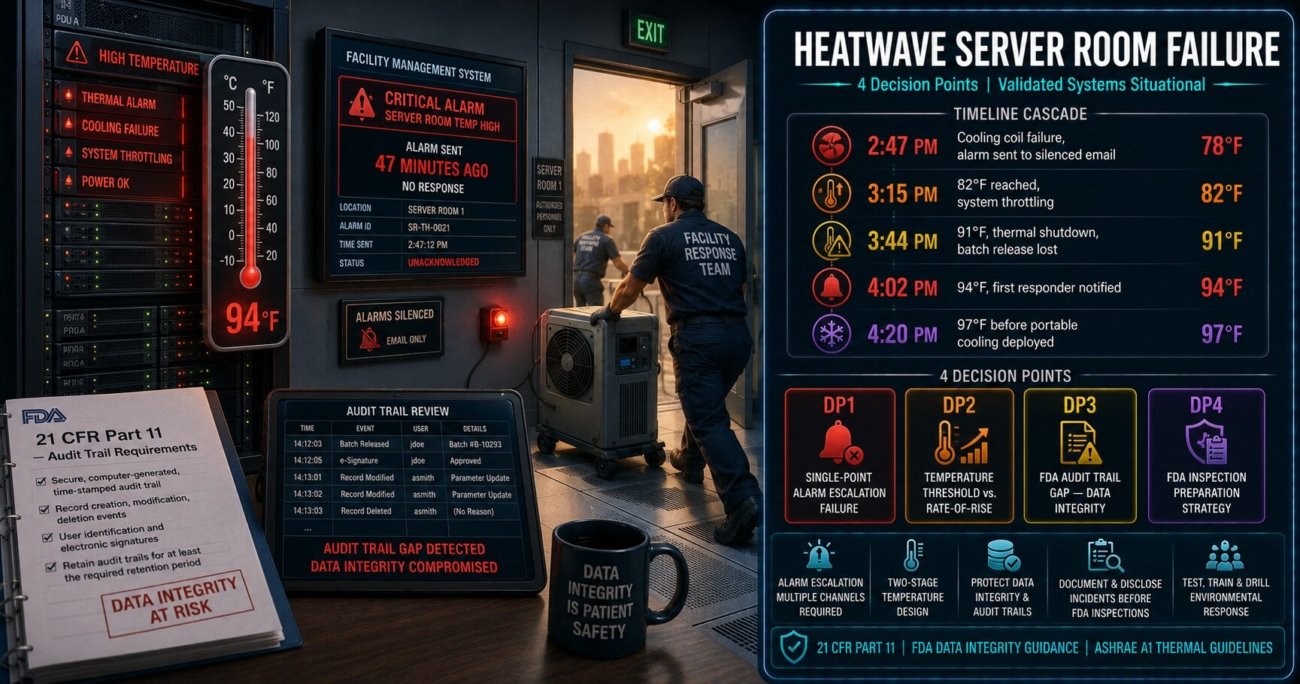
It is 2:47 PM on a Thursday in August. The ambient outdoor temperature at a pharmaceutical contract manufacturing site in the southwestern United States has reached 114 degrees Fahrenheit – the third consecutive day above 110. The building’s central HVAC system has been running at 100 percent capacity since 8:00 AM.
At 2:47 PM, the primary cooling coil in the unit serving the server room wing fails. The facility management system sends an alarm to the facilities director’s email. She is in an off-site meeting and has her email notifications silenced.
At 3:15 PM, the server room temperature sensor logs 82 degrees Fahrenheit. The validated data management system hosting the site’s electronic batch records begins throttling processing speed. A batch release that was in progress at 2:47 PM is now frozen in mid-process. At 3:44 PM, the server room reaches 91 degrees. The primary database server shuts down automatically on thermal protection. The in-progress batch release is lost. The electronic audit trail for the batch has a gap.
At 4:02 PM, a quality systems specialist notices that the batch release screen is unresponsive. She checks the server room and finds the temperature at 94 degrees. She calls facilities. The facilities director is still in the meeting. No backup contact was established for HVAC alarms during off-site absences.
The server room reaches 97 degrees before a portable cooling unit can be deployed. Two servers sustain thermal damage. The interrupted batch release requires a deviation report, a regulatory assessment, and re-execution of the release procedure. The audit trail gap requires a data integrity investigation. The investigation takes three weeks. A scheduled FDA inspection is two months away.
Setting: Pharmaceutical contract manufacturing site, southwestern US, during a sustained heatwave exceeding 110 degrees Fahrenheit for three consecutive days.
Critical failure: Primary HVAC cooling coil failure at 2:47 PM, alarm sent to facilities director’s silenced email. No backup escalation path.
Cascade: Server room temperature rise from ambient 72F to 97F over 75 minutes. Database server thermal shutdown at 91F. In-progress batch release lost. Audit trail gap.
Regulatory consequence: Deviation report, data integrity investigation, three-week remediation window before scheduled FDA inspection.
Root cause: No heatwave-specific HVAC redundancy plan, single escalation path for critical alarms, no temperature threshold for automated protective shutdown of non-essential systems.
Does your facility have a single point of failure for server room cooling? If your primary cooling unit fails during a heatwave, how long before someone who can act receives the alarm? What is the temperature at which your validated systems begin to sustain damage, and does your alarm threshold give you enough time to intervene before that temperature is reached? These four decision points work through the choices that determined the outcome of the scenario above.
Decision Point 1: The HVAC Alarm Reaches Only One Person's Silenced Email
The facility management system is configured to send cooling failure alarms to the facilities director’s email address. No secondary contact is configured. No SMS or phone alert is set up. No alarm escalation procedure specifies what happens when the primary recipient does not acknowledge the alarm within a defined timeframe.
At 2:47 PM, the alarm is generated and delivered. At 3:15 PM, when the server room temperature has already risen 10 degrees above normal operating range, the alarm has still not been acknowledged. The management system has no escalation trigger.
What alarm design principles should govern critical facility alarms during conditions of sustained environmental stress, and what does a single-point escalation path tell an auditor about the facility’s risk management approach?
A critical facility alarm that has a single delivery path to a single person who may be unavailable is not a functioning alarm system for risk management purposes. It is a logging system with aspirational notification.
Effective critical alarm design for server room environmental monitoring requires at minimum: a primary notification path (email and/or SMS to a designated responsible person), an acknowledgement timeout after which an escalation notification is triggered to a secondary contact, and a third-level escalation to a site emergency line or on-call responder if the secondary contact also fails to acknowledge within a defined window. The acknowledgement timeout for a cooling failure alarm in a server room housing validated systems should be measured in minutes, not hours.
During heatwave conditions specifically, alarm escalation protocols should be reviewed and tightened. A cooling coil failure during mild weather may allow 30 to 60 minutes of response time before temperatures reach critical thresholds. The same failure during a sustained heatwave with 114-degree outdoor temperatures may allow 15 to 20 minutes. The escalation timeout that is adequate under normal weather conditions is likely not adequate under heatwave conditions.
From a regulatory audit perspective, a single-point escalation path for a critical utility alarm at a pharmaceutical manufacturing site is a process control deficiency. FDA investigators reviewing the site’s data integrity investigation following the audit trail gap will examine the alarm configuration as part of the root cause analysis. A documented single point of failure in alarm escalation is a finding that supports a broader conclusion about the site’s approach to critical system risk management.
Decision Point 2: The Temperature Alarm Threshold Is Set Too Close to the Damage Threshold
The server room temperature sensor is configured to alert at 80 degrees Fahrenheit. The servers are rated for continuous operation up to 95 degrees Fahrenheit by the manufacturer. The facility’s IT team selected 80 degrees as the alert threshold because it is above normal operating range (68 to 72 degrees) but well below the rated operating maximum.
What the IT team did not account for is the rate of temperature rise during a cooling failure on a 114-degree day. From the point of cooling failure at 2:47 PM to the 80-degree alarm at 3:15 PM was 28 minutes. From 80 degrees to the thermal shutdown at 91 degrees was 29 minutes. The alarm gave the team approximately 29 minutes to respond and restore cooling before the server shut down – in a scenario where the only person who received the alarm had a silenced phone.
How should temperature alarm thresholds be calibrated for server rooms in facilities subject to heatwave conditions, and what is the relationship between the alarm threshold, the escalation timeout, and the available response time?
Temperature alarm thresholds must be set to provide sufficient response time between the alarm and the damage threshold, accounting for the maximum plausible rate of temperature rise in the specific environmental conditions the facility may experience.
The standard approach is to calculate the temperature rise rate under worst-case conditions (primary cooling failure during maximum ambient temperature) and set the alarm threshold to trigger at a temperature that provides at least the time required for the full escalation and response sequence. If the escalation sequence takes up to 15 minutes to reach someone who can act, and the response team needs 20 minutes to deploy a portable cooling unit, the alarm must trigger at least 35 minutes before the damage threshold is reached.
For this facility, with a temperature rise rate of approximately 1 degree per 2 to 3 minutes under heatwave conditions, a 35-minute buffer requires setting the alarm approximately 12 to 18 degrees below the damage threshold. An alarm at 77 degrees Fahrenheit (rather than 80) would have provided the same person 41 minutes of response time rather than 29 – still not adequate given the silenced phone, but a better starting position.
The more robust solution is a two-stage alarm: a warning alarm at a lower threshold that initiates escalation, and a critical alarm at a higher threshold that triggers an automated protective response (graceful shutdown of non-essential systems, activation of backup cooling, notification to on-call responder by phone call rather than email). Two-stage alarm design is standard practice in critical infrastructure and should be considered essential for validated system server rooms at any site subject to sustained high ambient temperatures.
Decision Point 3: The Batch Release Was in Progress When the Server Shut Down
The in-progress batch release at the time of the server shutdown creates the most significant regulatory consequence of the incident. The electronic batch record for the batch has a gap in the audit trail corresponding to the period from the system freeze at 3:15 PM to the thermal shutdown at 3:44 PM and the subsequent period when the system was offline. When the system is restored, the batch release workflow shows a status that does not reflect a completed release, a withdrawn release, or an error – it shows a mid-process state that the system did not handle gracefully under abnormal shutdown conditions.
The quality systems specialist reviewing the situation asks: can the batch release be resumed from the interrupted point? Can the audit trail gap be explained and documented in a way that satisfies FDA data integrity expectations?
What is the regulatory framework for handling audit trail gaps in validated pharmaceutical electronic record systems, and what does the incomplete batch release workflow status require from a data integrity perspective?
FDA’s data integrity guidance and 21 CFR Part 11 requirements do not provide a blanket prohibition on audit trail gaps caused by system failures, but they require that gaps be documented, explained, and assessed for their impact on the reliability and completeness of the record.
For this incident, the required steps are: document the timeline of the cooling failure, server shutdown, and system restoration with as much precision as the available logs provide; determine from the database logs whether any data was written during the period of degraded operation between 3:15 PM and 3:44 PM that may be incomplete or corrupted; assess whether the batch release workflow can be re-executed from the beginning (treating the interrupted attempt as void) or whether the state of the record at the time of shutdown can be confirmed to be complete enough to support a determination; and issue a formal deviation report covering the system outage, the audit trail gap, and the corrective and preventive actions.
The audit trail gap cannot be filled retroactively. Any attempt to enter data into the electronic batch record to cover the gap period without contemporaneous documentation of that data entry is itself a data integrity violation. The correct approach is to document the gap as a known limitation of the record, explain its cause and scope, and demonstrate through the deviation investigation that the batch’s quality status can be determined despite the gap.
FDA investigators assessing the site’s data integrity programme following this incident will want to see that the deviation was identified promptly, investigated thoroughly, and remediated in a way that prevents recurrence. A well-documented deviation report that explains the gap and confirms that the batch quality is determinable is a significantly better outcome than an unexplained gap discovered during inspection.
Decision Point 4: Preparing for the FDA Inspection Two Months Away
The facility has two months before the scheduled FDA inspection. The quality director must decide how to approach the three-week data integrity investigation and the CAPA programme arising from the incident. She is also aware that two additional heatwave events are possible before the inspection given the summer timeline.
She faces a choice about how much to document, how proactively to disclose to FDA during the inspection, and what infrastructure changes can realistically be completed before the inspection versus what must be documented as in-progress corrective actions.
What is the general principle for how pharmaceutical manufacturers should approach disclosing computer system incidents to FDA inspectors, and what CAPA programme elements would an investigator expect to see two months after this type of incident?
The general principle for FDA inspection disclosure of known incidents is that proactive, documented disclosure of a well-investigated incident with a credible CAPA is consistently a better outcome than an undisclosed incident discovered by the investigator during records review.
An FDA investigator reviewing electronic batch records during a routine inspection will encounter the audit trail gap and the deviation report. If the quality director has chosen not to proactively disclose the incident at the beginning of the inspection, the investigator discovers it in context of reviewing the records. This creates a narrative of concealment even if none was intended, and significantly elevates the investigator’s attention to the facility’s overall data integrity culture.
Proactive disclosure – providing the deviation report and investigation summary as part of the opening day document package – frames the incident as a known quality event that the site has investigated and corrected, rather than a hidden deficiency. This approach is consistent with FDA’s stated preference for transparency and with the data integrity guidance expectations for detecting, investigating, and remediating system failures.
The CAPA programme two months after the incident should include: completed root cause analysis documenting both the technical failure (HVAC cooling coil) and the systemic failure (single-point alarm escalation); completed implementation or committed timeline for multi-path alarm escalation with acknowledgement timeouts; completed or committed server room cooling redundancy assessment; and completed training for relevant staff on heatwave response procedures. CAPAs that are well-documented and showing measurable progress are more credible during an inspection than CAPAs that were only recently initiated.
Lessons Learned: What a Heatwave-Resilient Server Room Programme Looks Like
Alarm Architecture That Survives Unavailable Responders
Critical facility alarms for server room environments must be designed on the assumption that the primary recipient will periodically be unavailable. This means: multi-path delivery (email plus SMS plus automated phone call), timed escalation to a secondary contact if the primary does not acknowledge within a defined window, and a third escalation path to a site emergency line or on-call coordinator. The escalation timeout must be calibrated against the worst-case response time requirement, not the average response time. During heatwave season, escalation timeouts for cooling alarms should be shortened from their normal settings to reflect the faster thermal escalation rate.
Two-Stage Temperature Alarm With Automated Protective Response
A single temperature alarm set above normal range but below the damage threshold provides one intervention window. A two-stage system provides two: a warning alarm that initiates human escalation at a temperature 15 to 20 degrees below the damage threshold, and a critical alarm that triggers automated protective actions (graceful shutdown of non-essential systems, backup cooling activation) at a temperature 5 to 10 degrees below the damage threshold. The critical alarm automated response must not require human action to execute. If the only protective response is human intervention, the response fails whenever the human fails to respond in time.
Heatwave Season Pre-Review
Before the onset of heatwave season each year, server room cooling systems should receive a documented pre-season review: HVAC system inspection including coil condition, refrigerant charge, and filter status; portable cooling unit availability and deployment readiness; alarm system configuration review including escalation paths and timeout settings; UPS and generator testing confirming that cooling systems remain operational under backup power; and tabletop exercise with IT, facilities, and quality teams covering the first 30 minutes of a cooling failure response. This annual review is the single most effective control for preventing the category of incident described in this scenario.
Server Room Environmental Controls Quick Reference
Sources
- FDA: Data Integrity and Compliance With Drug CGMP – Questions and Answers Guidance (2018)
- 21 CFR Part 11: Electronic Records; Electronic Signatures
- ASHRAE: Thermal Guidelines for Data Processing Environments (A1-A4 classification, temperature envelopes)
- FDA: Guide to Inspections of Computerized Systems in Drug Processing
- OSHA: Heat Exposure Safety (ambient heat impact on facilities and workers)