
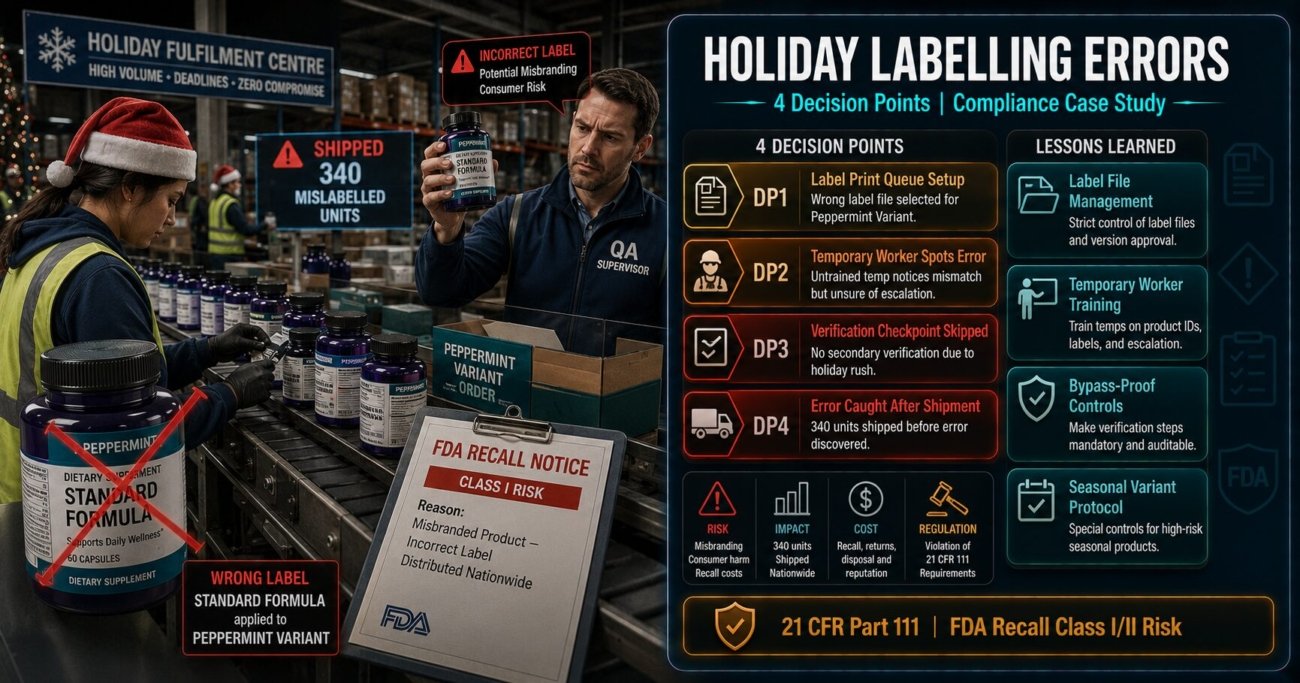
It is the third week of November. A dietary supplement fulfilment centre is processing four times its normal daily order volume. Two temporary workers hired for the holiday season are applying labels on the packaging line. The facility has three SKUs with nearly identical packaging: a standard formula, a seasonal peppermint variant with a different ingredient declaration, and a limited-edition gift set bundle that requires an additional allergen statement.
By end of shift, 340 units of the seasonal peppermint variant have been shipped with the standard formula label. The allergen statement for menthol is missing. Three days later, a customer with a mint allergy reports an adverse reaction.
The FDA complaint triggers a records request. The investigation reveals that the wrong label file was loaded into the print queue at shift start, the verification step was skipped because the line supervisor was managing a staffing gap, and the temporary workers had no training documentation for holiday label variants.
This scenario plays out in some variation across fulfilment operations every holiday season. The volume pressure, temporary staffing, and proliferation of seasonal product variants create a convergence of conditions in which labelling compliance failures are predictable rather than random. This guide works through the key decision points where that convergence becomes an incident.
Setting: Dietary supplement fulfilment centre, pre-holiday peak period.
Products: Three variants with similar packaging: standard formula, seasonal peppermint variant, limited-edition gift bundle.
Staffing: Two temporary workers, experienced supervisor managing multiple competing priorities.
What went wrong: Wrong label file loaded at shift start, verification step skipped, temporary workers untrained on variant differences.
Outcome: 340 units shipped with incorrect label, adverse event report, FDA records request, product recall evaluation.
Decision Point 1: Setting Up the Label Print Queue at Shift Start
The shift starts at 6:00 AM. The line supervisor loads the label files into the print queue while simultaneously handling a call about a staffing shortage. The queue is loaded from a shared network folder where three label files exist for the same product line:
- SupplementX_Standard_v3.pdf
- SupplementX_Peppermint_v1.pdf
- SupplementX_GiftSet_v2.pdf
The supervisor selects the file ending in v3, assuming it is the most current version. The peppermint line is running today.
What should have happened before the print queue was loaded, and what control would have prevented this error?
The print queue setup should have required a two-step verification: confirming the product variant scheduled for the line and matching the label file to that variant before loading.
The file naming convention used does not distinguish the variant clearly at a glance under time pressure. Best practice naming for label files includes the variant identifier prominently: SupplementX_PEPPERMINT_v1.pdf versus SupplementX_STANDARD_v3.pdf.
The control that would have prevented this error is a documented label reconciliation step at shift start: the shift supervisor confirms in writing that the product scheduled for the line, the label file loaded into the queue, and the physical label stock all match before any printing begins. This step takes under two minutes and is documented in the batch record or shift log.
The deeper issue is that the supervisor was performing the label queue setup while distracted. Label queue setup for a product with multiple variants should be a protected activity performed without competing tasks, or delegated to a trained designee who can give it full attention.
Decision Point 2: The Temporary Worker Applies the First Labels
The temporary worker begins applying labels to the peppermint variant units. She has applied labels at this facility before but only for the standard formula. No one has told her there is a difference between the standard and peppermint labels. The labels look similar from a distance: same colour scheme, same general layout.
After applying labels to about 40 units, she notices that the label says Standard Formula in small print near the bottom. She is not sure if this matters. She continues working and plans to mention it to someone at the next break.
What should the temporary worker have done immediately, and what training gap enabled this situation?
The temporary worker should have stopped the line immediately and reported the discrepancy she observed.
She noticed the discrepancy. She did not stop because she was uncertain whether it mattered and because no one had given her the authority or the expectation to stop production based on a label question.
The training gap that enabled this is the absence of a stop-and-report expectation for temporary workers. Every person applying labels to regulated products must be trained on one non-negotiable rule: if anything about the label does not match what you expect for the product you are labelling, stop and report before continuing. This is not a quality preference. For products with allergen declarations or regulatory warnings, it is a patient safety obligation.
The training for temporary workers should specifically cover: the variants in current production and what distinguishes their labels visually, the procedure for raising a label concern, and the explicit authority to stop work without fear of reprimand when something does not look right.
Decision Point 3: The Verification Checkpoint Is Skipped
Your facility’s SOP requires that 50 units into each new labelling run, a verification check is performed: a QA or line lead compares the applied label to the approved artwork for that product variant and confirms the batch code and label content match. The verification is documented on the batch record.
At the 50-unit mark, the line lead is covering for an absent colleague on the adjacent line. The verification checkpoint is skipped. No entry is made in the batch record. The line continues. By the time the shift ends, 340 units have been labelled and packed for shipment.
The SOP required a checkpoint that would have caught this error. What is the compliance implication of skipping it, and what systemic issue does this reveal?
Skipping a documented SOP requirement is a cGMP deviation regardless of whether it causes a product quality failure. The deviation must be documented, investigated, and corrected. The fact that it did cause a product quality failure makes it a major deviation requiring full investigation and CAPA.
The systemic issue revealed is that the facility’s labelling verification checkpoint cannot function reliably when staffing gaps occur. A control that can be skipped whenever someone is unavailable is not an effective control. The SOP requires the checkpoint but does not specify what happens if the designated person is not available.
The corrective action for this systemic issue is not retraining the line lead. It is revising the SOP to specify that the labelling run must stop at the 50-unit checkpoint until the verification is completed, regardless of staffing conditions. A SOP that allows production to continue past a verification point because of staffing availability is a SOP that permits unverified product to reach customers.
Decision Point 4: End-of-Day Audit Catches the Error After Shipment
At the end of the shift, the QA supervisor conducts the daily spot check, pulling five packed orders at random. One of the five contains a peppermint variant unit with the standard formula label. She flags it immediately. Investigation begins.
The investigation reveals that the 340 units from that run have already been picked up by the carrier. The shipping system shows that 290 units have already been delivered to customers. 50 units are still in transit.
The facility must now decide: initiate a voluntary recall, attempt customer-level correction, or evaluate whether the labelling error constitutes a risk that requires regulatory notification.
What criteria determine whether this labelling error requires FDA notification, and what immediate steps should the facility take while that determination is being made?
The determination hinges on whether the labelling error creates a risk of adverse health consequences. For a dietary supplement with a missing allergen declaration, FDA would consider this a Class II recall situation (product may cause temporary adverse health consequences) or potentially Class I depending on the severity of the allergen hazard.
Immediate steps while the risk determination is being made: place a hold on all units in transit and at the distribution centre, initiate a trace of all 290 delivered units using order records, notify regulatory affairs counsel and quality leadership, preserve all batch records and label file logs relevant to the investigation, and document the timeline of when the error occurred and when it was discovered.
The facility should not delay regulatory notification while conducting an extended internal investigation if there is a reasonable basis to believe the missing allergen statement creates a health risk. This scenario underlines the value of the end-of-day audit: it caught the error. But catching an error after shipment has a fundamentally different remediation path than catching it before units leave the facility.
Lessons Learned: What a Compliant Holiday Fulfilment Operation Looks Like
Label File Management
Label files for products with multiple variants should be stored in variant-specific folders, not in a single shared folder where file selection depends on correct filename interpretation under time pressure. The print queue setup procedure should require confirmation that the file being loaded matches the scheduled production variant, documented before any printing begins. Outdated versions should be archived separately, not left in the active production folder.
Temporary Worker Training
Every temporary worker assigned to a labelling line must be trained before their first shift on: the specific variants in current production and how to distinguish them visually, the procedure for raising a label concern, and the explicit authority and expectation to stop work and report when something does not match. Training must be documented with the worker’s signature and retained.
Verification Controls That Cannot Be Bypassed
In-process verification checkpoints are only effective if they cannot be bypassed. A checkpoint that can be skipped when staffing is short is not a control. SOPs for labelling verification should specify that production stops at the checkpoint until verification is completed, with the name of the person completing verification documented. If that person is unavailable, the SOP should name an authorised backup or require supervisor sign-off to continue.
Seasonal Variant Launch Protocol
Whenever a new seasonal variant enters production alongside existing products, a pre-production briefing should be held with the entire line team, including temporary workers, covering the variant’s distinguishing features, its label differences, any additional regulatory requirements, and the procedure for handling potentially mislabelled units. This briefing should be documented.