SITUATIONAL: Medicare Part D Coordination of Benefits
When TrOOP Facilitation Breaks Down:
A Part D COB Failure Case Study
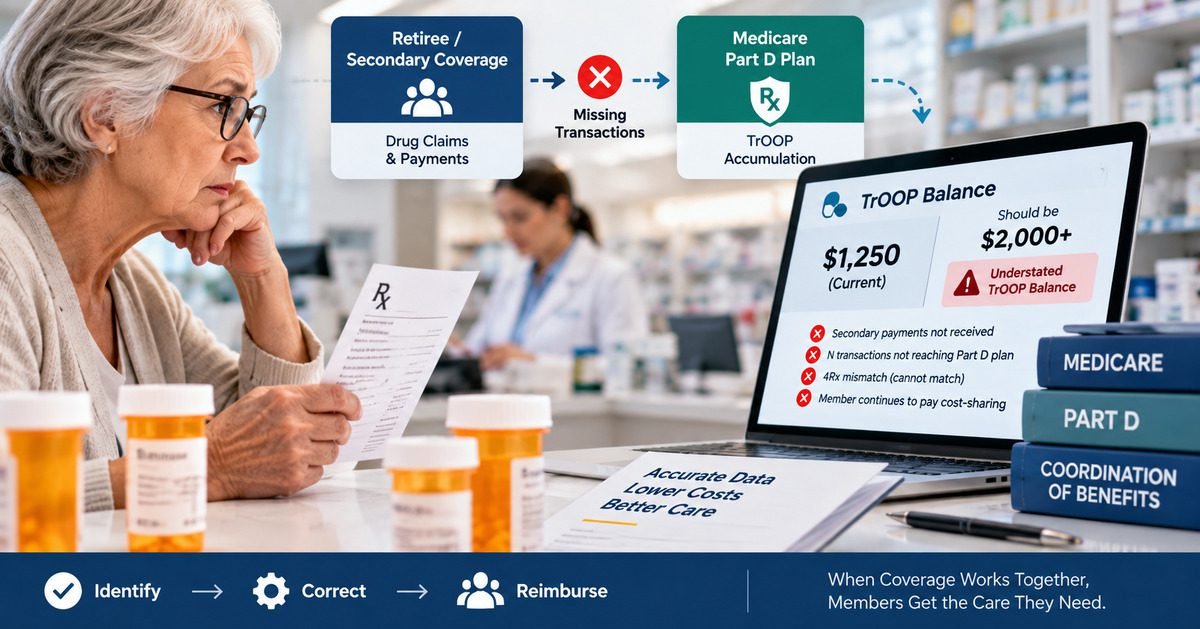
A member calls in January to ask why they are still paying copays after filling the same high-cost drug every month for years. Your representative checks the account. The year-to-date TrOOP balance shows $1,200. The member insists they have paid far more. They have. Other payer payments have not been applied. The TrOOP accumulator is understated. The member will reach the $2,000 out-of-pocket cap months later than they should. And your plan has been generating non-compliant TrOOP data since the plan year began. This case study walks through how Part D COB and TrOOP facilitation failures happen, why they compound, and what plan operations must do to prevent them.
Plan liability
TrOOP Tracking Is the Plan’s Responsibility, Not the Facilitator’s
Part D sponsors are responsible for tracking, accumulating, and reporting TrOOP. The CMS Part D Transaction Facilitator transmits data between payers, it is not involved in calculating TrOOP, only transmitting reported data. When TrOOP accumulators are wrong, the plan is accountable, not the contractor. A wrong accumulator is the plan’s compliance problem.
CMS: Medicare Prescription Drug Benefit Manual Chapter 14, COB
Only Part D
Covered Drugs Count Toward TrOOP
Only supplemental coverage of Part D covered drugs must follow COB rules. Only drugs on the plan’s formulary, obtained via transition supply, or approved via formulary exception count toward TrOOP accumulation. Drugs a member pays for out of pocket because they are not Part D covered do not count. Staff who misapply this rule generate incorrect accumulators and incorrect member communications.
McKesson: N Transactions and Part D TrOOP Facilitation
Anti-KS bar
Manufacturer Copay Cards Cannot Apply to Part D TrOOP
Copay accumulators and maximizers are commercial insurance mechanisms that operate on manufacturer copay cards. Those cards are not legally available to Medicare beneficiaries because the federal Anti-Kickback Statute bars manufacturer cost-sharing assistance for government-reimbursed drugs. Staff who are unfamiliar with this prohibition may incorrectly attempt to apply copay assistance to Part D claims.
Rx Almanac: Part D Redesign and Copay Accumulator Impact (2026)
A Part D plan member, enrolled in a Medicare Advantage Prescription Drug (MA-PD) plan, taking a high-cost specialty drug for a chronic condition, calls member services in March. She has been on the same drug for three years. She knows roughly what she pays each month. She knows she should have reached or be close to the $2,000 out-of-pocket cap by February based on what her pharmacy charges her.
The member services representative pulls her account. The TrOOP year-to-date balance shows $780, less than half of what the member says she has paid. The representative sees that her drug is on the formulary and that the plan has been processing claims correctly. The plan’s records look fine. The member’s records do not match.
The member has secondary coverage through her former employer’s retiree drug plan. That secondary payer has been paying a portion of her cost-sharing at the pharmacy. Those secondary payer payments are “other TrOOP”, they should be reported to the plan via N transactions from the Part D Transaction Facilitator and applied to her TrOOP accumulator alongside her own out-of-pocket payments. They have not been. The TrOOP data flow from the secondary payer through the facilitator to the plan has broken down. The plan has been accumulating only the member’s direct payments and missing the other payer amounts entirely.
Why this matters immediately
The member has been overpaying for months. Under a correct TrOOP accumulator, she would have reached the $2,000 cap in February and been paying $0 for covered drugs since then. Instead she has continued paying full cost-sharing through March. The plan has under-credited her accumulator, resulting in a member paying more than she legally owes. This is both a member harm and a CMS compliance violation in TrOOP reporting accuracy.
Jan 1
Plan Year Opens
The member’s plan year begins. Her secondary retiree drug plan coverage is active. The plan’s COB data from CMS shows the secondary coverage exists, the eligibility file has her Other Health Insurance (OHI) information. The TrOOP facilitation process should be active: her secondary payer’s pharmacy claims should be routed through the Transaction Facilitator as N transactions and applied to her TrOOP accumulator.
Jan-Feb
No N Transactions
The member fills her specialty drug in January and February. Her secondary retiree plan pays a portion of her cost-sharing. Those secondary payments should generate N transactions to the plan. No N transactions arrive. The plan’s TrOOP accumulator records only the member’s direct out-of-pocket payments, roughly $400 for each of two months. The secondary payer amounts of approximately $200 per month are not applied. The accumulator is now understated by $400.
Late Feb
Cap Missed
The member’s correct TrOOP total (including secondary payer amounts) would have reached $2,000 by the third fill in late February. Under a correct accumulator, she would have paid $0 in cost-sharing from that point forward. Because the secondary amounts are not in her accumulator, the plan’s system shows she has not reached the cap. She pays full cost-sharing on her February fill, an overpayment she is not aware of yet.
March
Member Calls
The member notices she is still paying and calls member services. The representative sees a TrOOP balance of $780 and does not immediately identify the problem. The representative confirms the drug is on the formulary, the claims were processed correctly, and the member’s plan premium is current. The representative cannot explain the gap. The call is escalated to a supervisor.
March
Root Cause Found
The compliance team reviews the member’s OHI data and N transaction records. No N transactions were received for this member’s secondary payer since January 1. The secondary payer’s data feed to the Transaction Facilitator contains an error in the 4Rx matching data, the BIN/PCN combination on the secondary payer’s records does not match what is on file with the eligibility system. No match, no N transaction, no TrOOP credit. The data mismatch has been present since the start of the plan year and has never been caught.
Root Cause 1: No monitoring of N transaction receipt for members with OHI
The plan had OHI data showing the member had secondary drug coverage. That data creates an expectation: N transactions should arrive from the secondary payer via the Transaction Facilitator whenever the secondary payer covers a Part D drug. The plan had no process to monitor whether expected N transactions were actually arriving for members with known OHI. The absence of N transactions for an active OHI member was invisible until the member called. A monitoring process would have caught this in January.
Root Cause 2: 4Rx data mismatch not caught during OHI onboarding
The Transaction Facilitator matches secondary payer claims to Part D plan records using 4Rx data: BIN, PCN, Cardholder ID, and Group. If the 4Rx on the secondary payer’s record does not match the 4Rx on the eligibility file, no match occurs and no N transaction is sent. The mismatch in this case was present since January 1 and was never caught because the plan had no reconciliation process to verify that 4Rx data on OHI records matches current eligibility file data. The secondary payer had submitted claims and received no match notification, the system silently failed.
Root Cause 3: Member services staff could not identify a TrOOP data gap
When the member called, the representative confirmed that plan-side claims were processed correctly and ended the diagnostic there. The representative did not know to check whether N transactions had been received for the member’s secondary payer, whether the member’s OHI was active in the system, or whether the TrOOP accumulator reflected both direct member payments and other-payer amounts. TrOOP facilitation was a back-office process the member services team had no visibility into and no training to diagnose.
Root Cause 4: No retroactive TrOOP correction process existed
Once the data mismatch was identified, the compliance team needed to retroactively apply the secondary payer amounts to the member’s TrOOP accumulator and reimburse the member for the cost-sharing she overpaid from late February through March. The plan had no documented process for retroactive TrOOP corrections. The correction had to be built from scratch under time pressure, with no playbook for how to handle the reimbursement, the accumulator update, or the required member notification.
Monitor N transaction receipt for all members with active OHI
Any member whose eligibility record shows active OHI that is primary or supplemental to Part D should be generating N transactions from the Transaction Facilitator whenever the secondary payer pays a Part D drug. Build a monthly report: members with OHI, months with no N transactions, and months where N transactions are expected based on claims history. Zero N transactions for an active OHI member is a red flag that requires investigation, not assumption that the member had no pharmacy activity.
Verify 4Rx data on OHI records at the start of every plan year
4Rx mismatches (incorrect BIN, PCN, Cardholder ID, or Group) silently block N transactions with no error notice to the plan. At the start of each plan year, verify that OHI records for secondary payers show 4Rx data that matches the eligibility file. Where discrepancies exist, work with the BCRC and the secondary payer to correct them before the first fills of the year, not after a member calls to report a problem.
Train member services to recognise TrOOP discrepancy calls
A member who calls to say their TrOOP balance does not match what they have paid is describing a potential COB failure. Train member services representatives to recognise this call type, pull OHI status for the member, check N transaction history, and escalate to COB or compliance operations when the three-question check (active OHI + no N transactions + TrOOP gap) is positive. A representative who can do this diagnosis in five minutes catches failures that otherwise take months to surface.
Document and test the retroactive TrOOP correction process before you need it
When TrOOP accumulators are wrong, the plan needs a documented, tested process for retroactive correction: how to obtain secondary payer claim data, how to recalculate the correct accumulator, how to apply the retroactive credit, how to calculate and issue reimbursement for overpaid cost-sharing, and how to notify the member in writing. Building this process under time pressure after a failure is far harder and slower than having a tested playbook ready in advance.
TrOOP accumulation is the plan’s legal obligation, the Transaction Facilitator transmits data, it does not calculate TrOOP
The CMS Part D Transaction Facilitator transmits N transaction data between payers. It does not calculate TrOOP. Part D sponsors are responsible for tracking, accumulating, and reporting TrOOP for every enrolled member. If the data flow from a secondary payer breaks, due to a 4Rx mismatch, a reporting failure, or a system error, the plan’s TrOOP accumulator is wrong and the plan is non-compliant. The facilitator’s silence is not the plan’s defence.
A 4Rx mismatch silently blocks N transactions with no error alert to the plan
When the BIN, PCN, Cardholder ID, or Group on the secondary payer’s OHI record does not match the eligibility file, the Transaction Facilitator cannot match the secondary claim to the Part D plan and no N transaction is sent. No error is generated for the plan. The plan receives nothing and has no indication anything is wrong unless it is actively monitoring for missing N transactions. Passive reliance on the system to alert the plan when something breaks is not a control, it is an absence of control.
A member calling to report a TrOOP discrepancy is describing a COB failure, not a billing complaint
When a member says their TrOOP balance does not match what they have paid, the standard member services workflow, confirm plan claims are correct, confirm formulary, confirm premium, will not find the problem. The problem is in the COB data layer: OHI data, N transaction history, and 4Rx matching. Training member services to recognise this call type and trigger the three-question COB check (active OHI, N transaction history, accumulator gap) turns a complaint call into an early COB failure detection mechanism. Without that training, the failure stays invisible until a CMS audit surfaces it.
What is TrOOP in Medicare Part D and who is responsible for tracking it?
TrOOP stands for True Out-of-Pocket. It is the accumulator that tracks how much a Medicare Part D member has paid toward the annual out-of-pocket cap, $2,000 in 2025. TrOOP includes the member’s own cost-sharing payments and amounts paid by certain other payers on the member’s behalf (other TrOOP), such as supplemental drug coverage from a retiree plan. Part D sponsors (the plan) are responsible for tracking, accumulating, and reporting TrOOP. The CMS Part D Transaction Facilitator transmits data between payers to support TrOOP accumulation but does not calculate TrOOP itself. Source: CMS: Prescription Drug Benefit Manual Chapter 14
What is an N transaction in Part D COB and what does it do?
An N transaction is a record transmitted by the CMS Part D Transaction Facilitator to a Part D plan when a secondary payer (such as a retiree supplemental drug plan) has paid for a Part D covered drug on behalf of a plan member. The N transaction carries the supplemental payer’s payment data and allows the Part D plan to apply the secondary payer’s contribution to the member’s TrOOP accumulator as “other TrOOP.” Without N transactions reaching the plan, the secondary payer’s amounts are not included in the member’s TrOOP, understating the accumulator and potentially delaying when the member reaches the cap. Source: McKesson: N Transactions and TrOOP Facilitation
What is 4Rx data and why does a 4Rx mismatch block N transactions?
4Rx refers to four identifiers used to match a pharmacy claim to a specific Part D plan: BIN (Bank Identification Number), PCN (Processor Control Number), Cardholder ID, and Group number. The Transaction Facilitator uses 4Rx data from secondary payer records to match secondary claims to the correct Part D plan and member. If any of the four identifiers on the secondary payer’s record does not match the identifiers on the CMS eligibility file for that member, the match fails and no N transaction is generated or delivered to the plan. The plan receives no notification of the mismatch. Source: McKesson: N Transactions and 4Rx Matching
What types of payments count toward Part D TrOOP?
TrOOP includes two types of qualifying payments for Part D covered drugs: the member’s own direct cost-sharing (deductible, copay, coinsurance), and other TrOOP, amounts paid by certain other payers on the member’s behalf. Other TrOOP sources include supplemental drug coverage such as retiree drug plans. Not all third-party payments qualify. Specifically, payments from sources with government subsidies (such as Medicaid) reduce plan liability rather than counting as other TrOOP. Manufacturer copay cards do not count toward Part D TrOOP because the Anti-Kickback Statute bars manufacturer cost-sharing assistance for government-reimbursed drugs. Only Part D covered drugs (formulary drugs, transition drugs, and formulary exception drugs) count. Source: McKesson: TrOOP COB Rules
What is the BCRC and how does it support Part D COB?
The Benefits Coordination and Recovery Center (BCRC) is the CMS contractor that consolidates Medicare benefit coordination activities, including collection, management, and reporting of other prescription drug coverage for Medicare beneficiaries. In the COB context, the BCRC maintains the OHI data about secondary payers that the Transaction Facilitator uses for TrOOP facilitation. When a secondary payer’s data on CMS records is incorrect (such as a 4Rx mismatch), the correction process involves working with both the secondary payer and the BCRC to update the information in CMS’s systems. Source: CMS: Coordination of Benefits Overview
Can a Part D plan use manufacturer copay assistance to reduce a member’s cost-sharing?
No. Manufacturer copay cards and copay assistance programmes are commercial insurance mechanisms that operate on drugs paid by commercial insurance plans. Federal Anti-Kickback Statute interpretation bars manufacturers from providing cost-sharing assistance for drugs reimbursed by government programmes including Medicare Part D. A Part D member cannot use a manufacturer copay card to reduce their Part D cost-sharing, and those amounts do not count toward TrOOP. Plan staff who attempt to apply copay assistance to Part D claims or who tell members to use copay cards for their Part D drugs are giving incorrect information that could generate compliance problems for the plan and the member. Source: Rx Almanac: Part D Redesign and Copay Accumulator Impact (2026)
What should a Part D plan do when it discovers a member’s TrOOP accumulator is understated?
When a plan discovers an understated TrOOP accumulator, it must take four steps promptly. First, reconstruct the correct accumulator using all qualifying payment data, direct member payments and any other TrOOP that should have been applied. Second, identify whether the error caused the member to pay cost-sharing after their correct cap date and calculate the overpayment amount. Third, issue a reimbursement to the member for any cost-sharing paid after the correct cap date and notify the member in writing. Fourth, investigate and fix the root cause, whether a 4Rx mismatch, a secondary payer reporting failure, or a system configuration error, and audit other members who may have the same secondary payer with the same issue. Document all steps in the compliance file for CMS audit purposes.
Tips
7 Medicare Part D Administration Tips
The operational companion, covering LIS cost-sharing, the $2,000 OOP cap, transition policy, prior auth, and EOB explanation. Tip 2 on the cap and Tip 1 on LIS directly connect to the TrOOP failure mode in this case study.
Worker Safety
Medicare Program Overview: What Plan Workers Need
The foundational programme overview covering Part D structure, LIS, and enrollment periods, the knowledge base plan staff need before they can identify the COB and TrOOP failure modes covered in this case study.
Guides
Medicare Advantage Quality and Utilization Management Guide
The QM and UM operational guide, the Star Ratings measures for medication adherence and MTM completion that are suppressed when COB failures block members from reaching the cap and accessing their covered drugs at $0 cost-sharing.
MEDICARE PART D SITUATIONAL LIBRARY
More Medicare Part D Case Studies and Situational Guidance
Explore VelSafe’s Medicare Part D situational library for case studies covering COB failures, TrOOP errors, prior authorisation breakdowns, and the compliance failures that surface in CMS programme audits.
Explore All Situational Articles