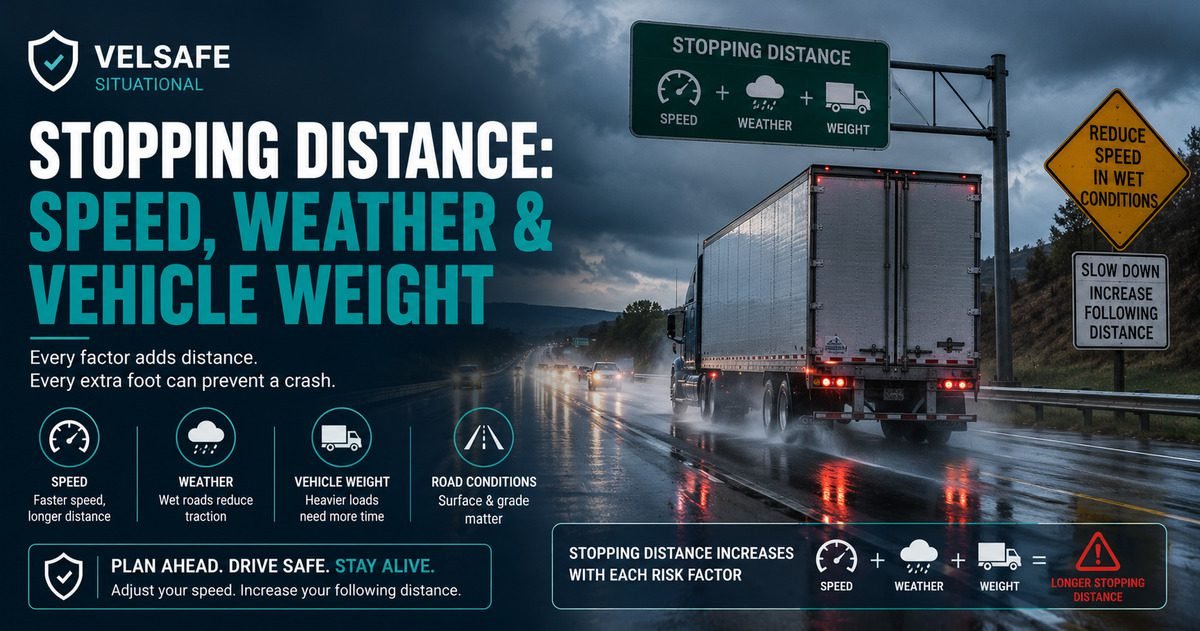
SITUATIONAL: Commercial Vehicle Braking Incident
The Driver Had 1.5 Seconds to React
Physics Gave Him 400 Feet He Did Not Have
A fully loaded commercial truck travelling at highway speed on a wet interstate approached slowing traffic. The driver had adequate training, functional brakes, and years of experience. None of it was enough because the following distance had been set for dry pavement, not the conditions on the road. This is what the physics of stopping distance looks like when the gap between calculated and actual stopping distance is 200 feet.
4x
Braking Distance Increase
Doubling vehicle speed quadruples braking distance. A truck doing 60 mph needs roughly four times the stopping distance of the same truck at 30 mph.
FMCSA LTCCS
10x
Ice vs Dry Road
On ice, stopping distance can be up to ten times longer than on dry pavement. Wet roads typically double stopping distance compared to dry conditions.
NHTSA Traffic Safety Facts
132 ft
Thinking Distance at 60 mph
At 60 mph, a vehicle travels approximately 132 feet during the average 1.5-second driver reaction time, before the brakes even begin to work.
FMCSA Driver Safety
A tractor-trailer combination weighing 76,000 pounds, within federal limits, is travelling southbound on a wet interstate highway at 63 mph in a 65-mph zone. The road surface temperature is 38°F following overnight rain. The trailer is carrying automotive parts, the load is secured, and all braking systems are functional and in compliance with FMCSA standards.
Approximately 1.4 miles ahead, an earlier incident has caused a partial lane closure. Traffic is slowing from 65 mph to a stop across three lanes. The truck driver is travelling in the centre lane, maintaining what he estimates to be an eight-second following gap behind the vehicle ahead, a gap he established on the dry conditions of the morning and has not recalculated for the wet surface.
The gap that looked like eight seconds was not
An eight-second following gap at 63 mph on dry pavement is approximately 738 feet. On a wet road surface at the same speed, that gap provides approximately six seconds of reaction and braking time, not eight. The driver’s calculation was accurate for conditions that no longer existed.
T-0:00
Driver is travelling at 63 mph on wet interstate. Following gap is approximately 738 feet (established in dry conditions earlier). Traffic ahead is flowing normally.
T-0:04
Brake lights of vehicles ahead become visible. Traffic is slowing rapidly due to the lane closure. The driver perceives the hazard and begins lifting off the accelerator.
T-0:05.5
Driver applies full braking. At 63 mph, the truck has already travelled approximately 138 feet during the 1.5-second reaction window. Braking begins at approximately 600 feet from the slowing vehicle ahead.
T-0:09
On wet pavement, a truck at 63 mph requires approximately 450-500 feet to stop under full braking. The available gap is insufficient. The driver attempts a lane change but traffic in adjacent lanes has also slowed.
T-0:12
Rear-end collision at approximately 28 mph residual speed. The truck has shed approximately 35 mph during the braking sequence but cannot stop within the available distance on wet pavement.
Following distance calculated for dry conditions was not adjusted for wet road
The driver established his following gap earlier in dry conditions and did not recalculate when the road surface changed. Wet pavement increases stopping distance by approximately 50-100% depending on tyre tread depth, road surface texture, and vehicle weight. What appeared as an eight-second gap was effectively a six-second gap under the actual conditions, insufficient for a vehicle of this weight at highway speed.
Speed was legal but not appropriate for conditions
63 mph in a 65-mph zone is legally compliant. It is not necessarily appropriate for wet road conditions with limited visibility of downstream traffic events. FMCSA regulations and state traffic codes require drivers to adjust speed for conditions, not merely for the posted limit. Travelling at the posted limit in wet conditions when a large, loaded commercial vehicle requires 500+ feet to stop creates a permanent deficit against unanticipated traffic events.
Braking distance scales with the square of speed, not linearly
Most drivers understand that higher speed means longer stopping distance. The non-intuitive part is that the relationship is not linear, braking distance increases with the square of velocity. A truck doing 60 mph does not need twice the stopping distance of one doing 30 mph. It needs approximately four times the distance. This mathematical reality means that small speed reductions produce disproportionately large safety gains in stopping distance.
Reaction time consumed available stopping margin
The driver’s 1.5-second reaction time, entirely average and not a performance failure, consumed 138 feet before braking began. In commercial vehicle safety, reaction time is not a variable that can be improved significantly through training. It is a fixed physical constraint that must be accounted for in following distance. Training that does not teach drivers to calculate and maintain following distances that include thinking distance, not just braking distance, creates a structural gap between what drivers believe is safe and what physics requires.
This incident does not represent a straightforward regulatory violation, brakes were functional, speed was legal, the load was within limits. The regulatory dimension is subtler and more consequential: the failure is in how following distance and speed for conditions are trained, monitored, and enforced.
FMCSA 49 CFR Part 392.14
49 CFR 392.14 requires commercial drivers to reduce speed when hazardous conditions exist, including wet roads. The regulation is explicit: compliance with posted speed limits does not satisfy this obligation if conditions require lower speed.
FMCSA 49 CFR Part 392.21
49 CFR Part 392 requires drivers to maintain sufficient following distance to stop safely in an emergency. FMCSA guidance establishes the one-second-per-ten-feet-of-vehicle-length rule as a minimum, not a target, and explicitly states that adverse conditions require additional distance.
Stopping Distance by Speed and Condition (Fully Loaded Tractor-Trailer)
Approximate figures including reaction distance. Actual values vary by vehicle condition, tyre tread, brake temperature, and road surface. Source: FMCSA Large Truck Crash Causation Study
Teach drivers to recalculate following distance dynamically, not once at trip start
Following distance is not a setting established at the start of a trip. It must be recalculated continuously as conditions change. When road conditions change from dry to wet, drivers must actively increase the following gap, not maintain the gap they set earlier. Training programmes that teach a rule of thumb without teaching the underlying physics produce drivers who know a number but not when to change it.
Reduce speed on wet roads regardless of the posted limit
Under 49 CFR 392.14, commercial drivers are required to reduce speed when hazardous conditions exist. A 10 mph reduction on a wet highway reduces stopping distance by approximately 25-30% for a loaded commercial vehicle, a margin that can be the difference between a close call and a collision.
Include thinking distance, not just braking distance, in following gap calculation
Total stopping distance equals thinking distance plus braking distance. A driver calculating only braking distance when setting a following gap is systematically underestimating the required space by 100-150 feet at highway speeds. Training must make this explicit: the gap begins being consumed the moment the hazard appears, not the moment the brake pedal is pressed.
Use telematics following-distance alerts as a continuous training tool
Modern fleet telematics systems can detect and alert on following distance violations in real time and provide data for post-trip review. Carriers that use following-distance data only for incident investigation, rather than as a continuous coaching trigger, are missing the primary prevention window. Alerts triggered during adverse weather should carry higher weight in driver coaching programmes than alerts in dry conditions.
Legal compliance is not the same as safety compliance
This driver was legally compliant at the moment of the incident, speed within limits, brakes functional, load within federal weight limits. The collision still occurred. Safety compliance requires evaluating actual conditions, not just regulatory minimums. Carriers whose safety programmes focus exclusively on regulatory compliance metrics can have drivers who are technically compliant and operationally unsafe simultaneously.
The physics of braking must be taught explicitly, intuition is wrong
Human intuition treats stopping distance as roughly proportional to speed. The actual relationship is quadratic. Experienced drivers with thousands of miles may have deeply ingrained intuitions about stopping distances that are systematically incorrect for the mathematical reality of braking physics. Training that does not correct this explicitly, with numbers and distances, not just general warnings about following distance, is not sufficient.
Conditions that change mid-trip require active driver response, not passive awareness
Drivers who receive general training on wet-weather driving know that wet roads are more dangerous. Knowing is not the same as taking a specific action, reducing speed to a concrete lower number and increasing the following gap to a concrete larger number, every time conditions change. Safety training that produces awareness without producing behaviour change does not reduce incident rates.
Driver: Before and During Every Trip
Check road condition and weather forecast before departure
Set following gap for current conditions, not estimated conditions
Recalculate following gap every time conditions change
Reduce speed on wet, icy, or low-visibility roads
Account for thinking distance, not just braking distance
Increase gap when carrying heavier loads
Carrier: Programme Requirements
Train drivers on the quadratic relationship between speed and stopping distance
Require explicit speed reduction procedures for adverse weather
Use telematics following-distance data in routine driver coaching
Set weather-condition speed policies in writing
Include stopping distance calculations in driver qualification training
Review following-distance data after every reportable incident
Fleet Safety Manager: Ongoing Monitoring
Review telematics data for following-distance violations segmented by weather condition
Identify drivers whose following gap does not increase during adverse weather events
Include weather-adjusted following distance in driver scorecard metrics
Conduct post-incident root cause analysis that distinguishes legal compliance from safety compliance
Update training content when real incidents reveal systematic gaps
Stopping distance doubles on wet roads, the following gap must double too
A following gap set in dry conditions is not safe in wet conditions. Drivers must actively recalculate and increase the gap when road surface conditions change. This is a required behaviour under 49 CFR 392.14, not just a best practice recommendation.
Braking distance scales with the square of speed, small reductions have large effects
Reducing speed from 65 to 55 mph on a wet highway reduces stopping distance by approximately 25%. That 100 feet of recovered margin, the equivalent of a ten-second speed reduction, can be the difference between a near miss and a fatality. Speed reduction is the single highest-leverage intervention available to a commercial driver in adverse conditions.
Legal compliance and safety compliance are not the same thing, and incidents prove it
This driver was within the speed limit, within weight limits, and operating functional equipment. The collision still occurred. Safety programmes that evaluate only regulatory compliance metrics will have drivers who are compliant and unsafe simultaneously. The standard of care in commercial vehicle operation is not what the law permits, it is what the physics of the vehicle requires for the conditions at the time.
Why does stopping distance increase so much at higher speeds?
Braking distance increases with the square of velocity because of the physics of kinetic energy. Kinetic energy equals half the mass multiplied by velocity squared. To stop a vehicle, the brakes must dissipate all of that kinetic energy through friction. Doubling the speed quadruples the kinetic energy and therefore approximately quadruples the braking distance. This is not a mechanical limitation that can be engineered away, it is a fundamental physical relationship.
What does 49 CFR 392.14 actually require of commercial drivers in wet weather?
49 CFR 392.14 requires that commercial drivers exercise extreme caution in hazardous conditions, including wet roads, and that they reduce speed as necessary for those conditions. If conditions become sufficiently dangerous, the driver must stop and not proceed until it is safe. The regulation explicitly states that compliance with posted speed limits is not sufficient if conditions require a lower speed.
How much following distance does a loaded tractor-trailer actually need at 65 mph on a wet road?
A fully loaded tractor-trailer at 65 mph on wet pavement may need 600-700 feet or more to stop, including reaction distance. FMCSA guidance uses the one-second-per-ten-feet-of-vehicle-length rule as a minimum baseline for dry conditions, which for a 70-foot truck-trailer combination is seven seconds. On wet roads, this should be increased to at least ten to twelve seconds. At 65 mph, twelve seconds of following distance equals approximately 1,144 feet, well over a quarter mile.
Does ABS help on wet roads and does it reduce stopping distance?
Anti-lock braking systems (ABS) prevent wheel lockup, which allows the driver to maintain steering control during hard braking on wet or slippery surfaces. ABS does not significantly reduce stopping distance on wet pavement, its primary benefit is directional control, not shorter stops. A vehicle with ABS may stop in approximately the same distance as a non-ABS vehicle on wet roads, but the ABS-equipped vehicle will maintain the ability to steer around an obstacle during the stop. ABS does not substitute for adequate following distance.
How does vehicle weight affect stopping distance for commercial trucks?
A fully loaded tractor-trailer can weigh 80,000 pounds under federal limits, approximately 20-30 times the weight of a passenger car. Heavier vehicles carry more kinetic energy at the same speed and require proportionally more work from the braking system to stop. However, braking regulations require commercial vehicles to meet specific stopping distance standards regardless of load, meaning the braking system must be capable of stopping the fully loaded vehicle. In practice, warmer brake temperatures from heavy use and tyre wear under load both degrade braking performance below the rated standard.
Can a carrier be held liable for a rear-end collision by a legally compliant driver?
Yes. Carrier liability in commercial vehicle accidents is not solely determined by regulatory compliance. Courts evaluate whether the carrier’s safety programme, training, supervision, and operational policies were adequate to prevent the foreseeable incident. A carrier whose driver training does not address condition-adjusted following distance, whose telematics data shows a pattern of close-following in wet weather, or whose speed policies do not require explicit reduction in adverse conditions may face significant liability even when the driver’s individual actions were within legal limits.
What is the three-second rule and is it adequate for commercial vehicles?
The three-second rule, maintaining at least three seconds of following time behind the vehicle ahead, is a passenger vehicle guideline from state driver education curricula. It is not adequate for commercial vehicles. FMCSA recommends a minimum of one second per ten feet of vehicle length in ideal conditions for commercial trucks, which translates to seven to eight seconds for a standard tractor-trailer. This should be doubled in wet conditions and tripled in snow or ice. Commercial drivers who apply the three-second rule are operating with a following gap that is less than half of what their vehicle requires.
Tips
8 Load Securement Tips for Heavy Equipment Haulers
Federal tie-down requirements, working load limits, en-route inspection obligations, and the most common load securement failures on flatbed and heavy haul operations.
Worker Safety
Fall Protection Awareness: Who Falls and Why
The data on who falls, where fatal falls happen, and what the evidence shows about prevention, the same systematic analysis of a preventable hazard applied to a different workplace context.
Situational
LOTOTO Incident: How a Skipped Tryout Kills
A step-by-step incident analysis of how a skipped energy verification during lockout/tagout procedures leads to injury, the same pattern of known procedure, perceived shortcut, and irreversible consequence.
COMMERCIAL VEHICLE SAFETY
Physics Does Not Negotiate With Following Distance Rules of Thumb
Find more commercial vehicle safety incident analyses, driver training resources, and fleet safety guides at VelSafe.
Explore More Situational Articles