

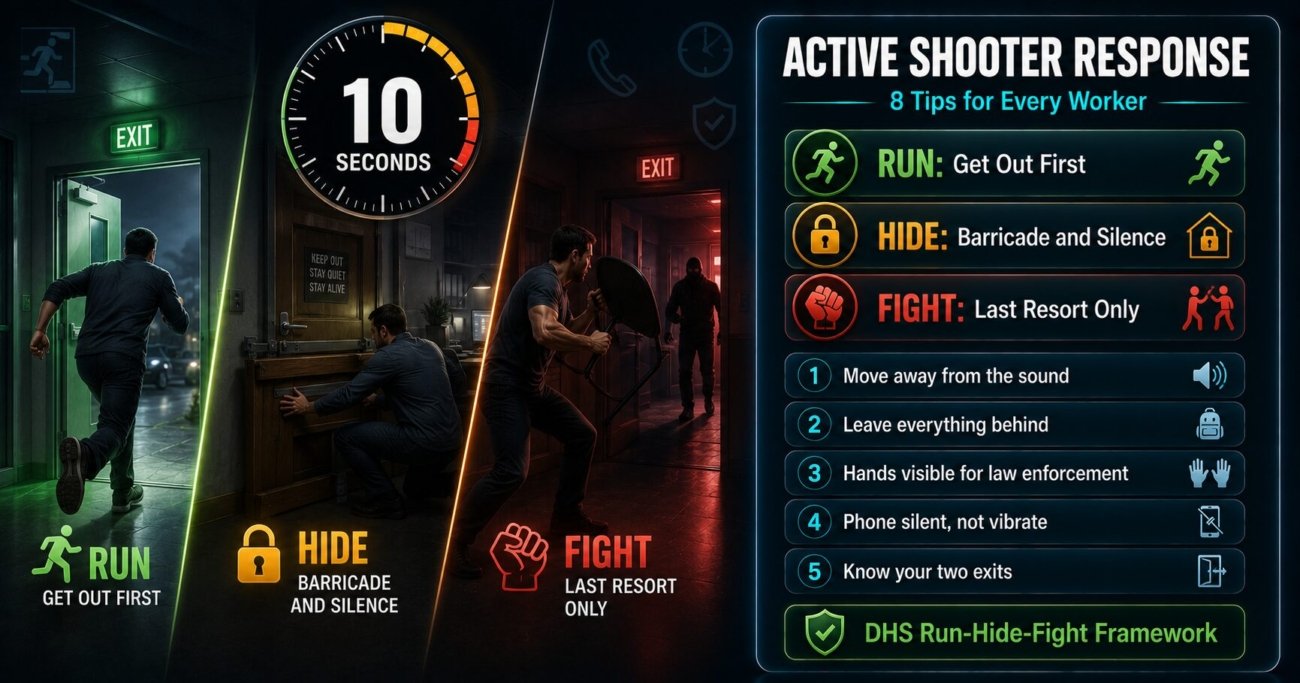
Most people have never thought about what they would do in the first ten seconds of an active shooter event. Most people do not want to think about it. But law enforcement, emergency management professionals, and workplace safety researchers consistently identify those first ten seconds as the window that most directly determines whether someone survives.
The decisions made in those seconds are not made rationally. They are made from whatever mental model you already have. If you have never thought about it, you will freeze while your brain tries to process what is happening. If you have thought about it, you will move.
These tips are designed to give you a mental model before you need one.
Tip 1: Understand the Run-Hide-Fight Framework Before You Need It
The Department of Homeland Security’s Run-Hide-Fight framework is the foundational guidance for active shooter response in the United States. It establishes a priority order, not three equal options.
Run is the first priority. If you can get out safely, get out. Leave belongings behind. Do not wait for others if they will not follow. Get away from the building, move away from the threat, and do not stop until you reach a safe location well away from the scene.
Hide is the second option when running is not possible. Find a room that can be locked or barricaded, turn off lights, silence your phone, move away from the door, and stay low. Do not hide in a location where you could be trapped without an exit if the threat enters your space.
Fight is the last resort. When you cannot run and cannot hide, when the threat enters your space, fighting back is preferable to doing nothing. Use whatever is available. Commit fully. Studies of active shooter incidents consistently show that aggressive counter-response reduces casualties when other options are exhausted.
Know your building layout before an event. Identify at least two exits from any room you occupy regularly. Know which interior doors lock from the inside and which require a key. This takes five minutes and removes decision-making from the first ten seconds.
Tip 2: In the First Ten Seconds, Move Away From the Sound
The human instinct when hearing a sudden loud noise is to freeze and orient toward the sound. In a gunshot situation, this instinct works against survival. The first and most important physical action in the first ten seconds is to move away from the sound, not toward it and not in place.
Movement creates distance. Distance reduces lethality. Most active shooter events involve a single shooter moving through a building. The further you are from the shooter’s current location and direction of movement, the better your odds of reaching a safe exit or a secure hiding location before they reach you.
Do not wait to confirm what you heard. Do not look for confirmation from others. If you hear what sounds like gunshots in a building you are in, move immediately and reassess as you go. The cost of responding to a false alarm is minimal. The cost of not responding is not.
Do: Trust your instinct that something is wrong and move immediately. The survival advantage belongs to people who act in the first seconds, not to those who wait for certainty.
Avoid: Looking around to see if others are reacting before you decide to move. Crowd behaviour in emergencies defaults toward inaction. Your decision to move must come from your own assessment, not from whether others are moving.
Tip 3: Leave Everything and Get Out If You Can
The single most common mistake identified in after-action reviews of workplace shooter events is that people took time to gather belongings before evacuating. A bag slows you down. A coat slows you down. Your phone is in your pocket. Everything else is replaceable.
Leave your desk, leave your laptop, leave your bag, and go. Once you are safely out of the building and away from the threat, you can call 911, contact family, and deal with everything else. None of that is possible if you spend thirty seconds at your desk.
When evacuating, keep your hands visible and empty so that law enforcement responding to the scene can identify you as a civilian, not a threat. Follow any instructions from police officers without argument or hesitation.
Conduct a 60-second mental exercise now: if you had to leave your current location immediately without any belongings, which way would you go? Which exit is closest? Which one is furthest from the main entrance? Running that scenario mentally once reduces the decision time to near zero if you ever need it.
Tip 4: If You Cannot Run, Barricade the Door and Stay Silent
If you are unable to evacuate, the goal is to make your location as difficult to access and as invisible as possible. A locked or barricaded door is a significant deterrent. Most active shooters do not have unlimited time and will move to locations with easier access rather than force entry through a barricaded door.
Barricade the door with whatever is available: furniture, file cabinets, chairs, desks. The goal is not to create an impenetrable barrier but to create one that takes time and effort to breach.
Turn off the lights and move away from the door. Crouch below window level if the door has a window. Silence your phone completely, not on vibrate. If others are with you, keep them quiet and away from the door.
Call 911 when it is safe to do so. Provide your location, the number of people with you, and any information about the shooter’s location if you have it. Leave the line open if you cannot speak. Put the phone down and let the dispatcher listen.
Most interior office doors do not lock from the inside with a standard key lock. Identify now which doors in your workspace can be secured. Consider whether door wedges or door barricade devices are appropriate for your facility. FEMA and DHS guidance for workplace preparedness specifically recommends pre-positioning barricade equipment in high-occupancy areas.
Tip 5: Silence Your Phone Completely, Not Just on Vibrate
A phone on vibrate in a quiet room is audible from several feet away. In a life-safety hiding situation, any sound that reveals your location is a risk. Silence your phone completely if you are hiding, and keep it face-down to prevent screen brightness from revealing your position under a door gap.
This applies to everyone in a hiding group, not just you. If others are with you, communicate this instruction immediately and quietly before the need to call 911 arises. The call to 911 should be made from a silenced phone held close to your ear at the minimum volume necessary for the dispatcher to hear you.
Practise putting your phone on silent without looking at the screen. On most phones this requires holding a physical button or navigating a settings menu. Practise it now so that in a high-stress situation your hands can do it automatically.
Tip 6: When Law Enforcement Arrives, Follow Instructions Without Hesitation
When law enforcement arrives at an active shooter scene, their immediate priority is to stop the threat. They will move through the building with weapons drawn and will treat any individual they encounter as a potential threat until confirmed otherwise.
If law enforcement encounters you during an active response: keep your hands visible and empty, do not make sudden movements, do not reach for your phone or any object, follow their instructions immediately and without argument, and do not stop to ask questions. You will have the opportunity to provide information once you have been guided to a safe area outside the building.
Do not grab or hold onto officers. Do not run toward officers from behind without warning. If you must move toward officers, announce yourself calmly and keep your hands raised and visible.
Do: Hands up, palms visible, fingers spread, when you encounter law enforcement during an active response. This is the universal signal that you are not a threat.
Avoid: Stopping to explain the situation to officers who are actively moving toward the threat. They need to keep moving. Give your information to officers who are directing evacuees, not to those advancing toward the shooter’s location.
Tip 7: If You Must Fight, Commit Completely
Fight is the last resort in the Run-Hide-Fight framework, used only when all other options are exhausted and you are in immediate danger. If the shooter enters your space and you have no other option, fighting back with full commitment gives you a better chance than attempting to negotiate, plead, or remain passive.
Act aggressively. Use any available object as an improvised weapon: a fire extinguisher, a chair, a laptop, a stapler. Aim for the shooter’s face, throat, and hands. If others are with you, coordinate a simultaneous attack from multiple directions. A shooter who is being actively resisted from multiple angles is significantly less effective than one dealing with a passive group.
The goal of fighting back is not to win a physical contest. It is to disrupt, disorient, and create an opportunity to disarm or escape. Commitment and aggression are the most effective tools available in this scenario.
Note one improvised defensive object in every room you occupy regularly. Not because you will need it, but because the habit of spatial awareness that comes from this exercise is the same habit that helps you identify exits, notice unusual behaviour, and make faster decisions in an emergency.
Tip 8: After the Event, You Will Not Feel Normal and That Is Normal
Active shooter events produce significant psychological responses in survivors, witnesses, and even people who were in the building but not directly threatened. Shaking, nausea, confusion, emotional numbness, hyper-vigilance, and intrusive memories in the days following the event are all normal responses to an abnormal situation.
After an event, do not dismiss these responses in yourself or in colleagues. Seek support from mental health professionals who specialise in trauma. Many employers have Employee Assistance Programmes (EAPs) that provide confidential access to counselling. First responders and crisis support teams deployed to the scene can also direct survivors to appropriate resources.
Physical safety and psychological recovery are both parts of surviving an active shooter event. The physical part ends when the threat is resolved. The psychological part takes longer and requires the same intentional attention.
Workplace active shooter preparedness includes post-event planning, not just pre-event training. Know your organisation’s EAP contact information. Know whether your workplace has a critical incident response plan that includes mental health resources. Communicate these resources to staff immediately following any threatening event, not just after a confirmed shooting incident.
Quick Reference: The First 10 Seconds
Active Shooter Preparedness Checklist
✓ I know at least two exits from every room I occupy regularly
✓ I know which interior doors in my workspace lock from the inside
✓ I know the Run-Hide-Fight priority order and what each option requires
✓ I know to move away from the sound immediately, not wait for confirmation
✓ I know to leave all belongings and keep hands visible and empty when evacuating
✓ I know how to silence my phone completely without looking at the screen
✓ I know to follow law enforcement instructions without hesitation when encountered
✓ I know my organisation’s EAP contact information for post-event support
✓ I have identified one improvised defensive object in each area I occupy regularly