

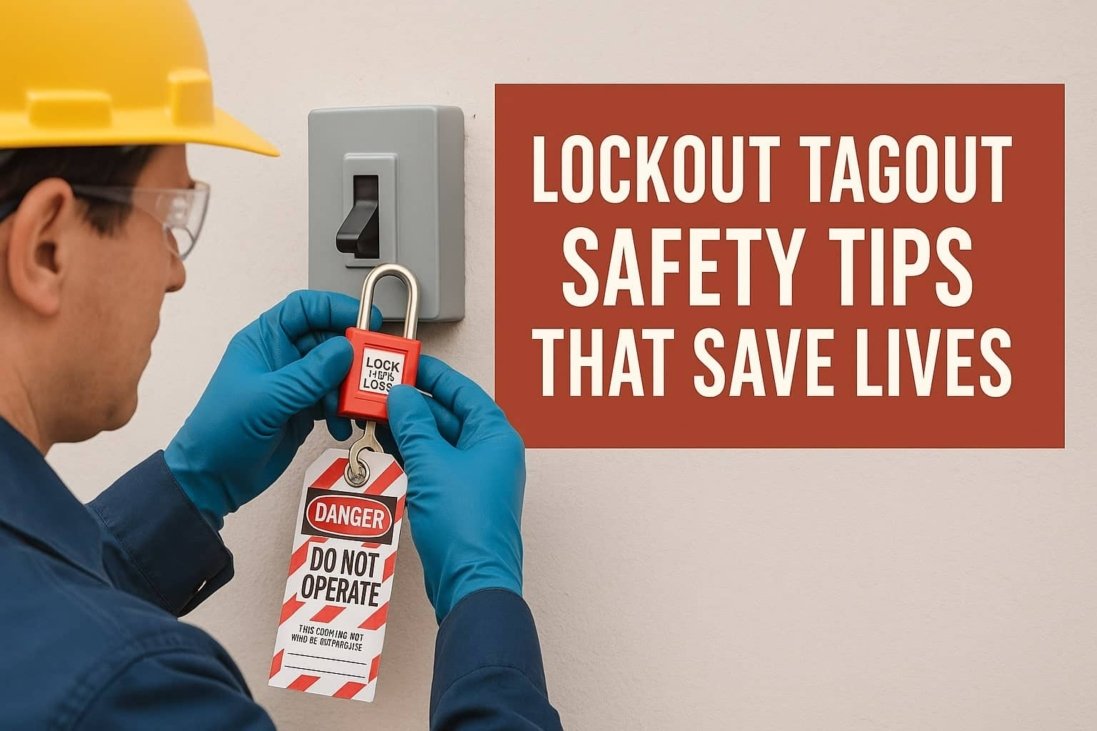
Lockout/Tagout violations have ranked in OSHA’s top-ten most-cited standards for more than a decade. The standard, 29 CFR 1910.147, exists because hazardous energy, including electrical, mechanical, hydraulic, pneumatic, chemical, and thermal forms, has killed and permanently injured workers during routine service and maintenance tasks that were considered low-risk.
These 10 tips translate OSHA’s Control of Hazardous Energy requirements into practical on-the-floor habits for authorized employees, affected employees, and supervisors across manufacturing, maintenance, and construction environments.
1. Identify Every Energy Source Before Beginning Isolation
A common LOTO failure is isolating the obvious energy source and missing the others. Machines in manufacturing environments routinely have multiple energy inputs: a main electrical disconnect, control circuit power, a pneumatic supply line, hydraulic pressure, and gravity-loaded components. All must be identified and isolated before work begins.
2. Follow the Written Procedure, Not Memory
OSHA requires machine-specific energy control procedures for equipment with more than one energy source, or where the magnitude, type, or location of energy is not immediately obvious. These procedures exist because memory is unreliable, especially on equipment workers service infrequently or under time pressure.
Steps to shut down the machine; location and type of all energy isolation devices; required locks, tags, and equipment; method to verify zero energy; re-energization sequence and who authorizes it.
Equipment is modified, energy sources are added, and isolation points change. A procedure that was accurate six months ago may no longer match the machine. Only a reviewed, current document is reliable.
In LOTO program audits, we find machine-specific procedures either missing entirely or not accessible at the point of use in the majority of facilities that have received OSHA citations for 1910.147. The written program exists in a binder in the safety office. Workers at the machine do not have it and have not reviewed it before starting work.
3. Apply Your Personal Lock, Every Time
The one-person, one-lock principle is the foundational safety guarantee of an LOTO program: only the person who applied the lock holds the key. This ensures that equipment cannot be re-energized while that person is in the hazard zone, regardless of what anyone else decides. Sharing locks, using a supervisor’s lock on behalf of a crew, or allowing a single lock for multiple workers eliminates that guarantee.
4. Verify Zero Energy Before Starting Work
Isolation does not equal zero energy. Isolating an energy source, turning off a disconnect, closing a valve, and locking it puts the isolation device in the de-energized position. It does not confirm that the energy has actually dissipated from the downstream equipment. Zero-energy verification is a separate, required step.
5. Control Stored and Residual Energy Before Entering the Hazard Zone
Stored and residual energy is the most underestimated hazard in LOTO programs. A machine can be electrically de-energized and still contain enough stored energy to cause a fatal injury: a compressed spring that releases when a guard is removed, a pressurized hydraulic cylinder, a charged capacitor bank, or a heavy component held in the raised position by a cylinder that loses pressure when the hydraulic supply is isolated.
In LOTO procedure reviews, stored energy is the most common gap between the written procedure and actual practice. Procedures frequently describe electrical isolation in detail and list pneumatic or hydraulic isolation as a single step without specifying bleed-down verification or blocking requirements. Workers follow the procedure as written and assume isolation is complete.
6. Never Remove Another Person's Lock or Tag
Removing another person’s lock without their knowledge and authorization is one of the most serious LOTO violations, and one of the most dangerous. It re-exposes that worker to hazardous energy without any warning. OSHA requires that lock removal be performed only by the authorized employee who applied it, with a formal employer-authorized process for the rare case where that employee is not available.
7. Use Group Lockout Correctly for Multi-Worker Jobs
When multiple workers service the same equipment, each authorized employee must be protected by their own lock or by a group lockout device that provides equivalent protection. The most common group lockout method uses a hasp: a single hasp locks the isolation point, and each worker applies their personal lock to the hasp. The equipment cannot be re-energized until every lock is removed.
Hasp applied to the isolation point. Each of three workers applies their personal lock to the hasp. All three locks must be removed before the equipment can be re-energized. Each worker controls their own protection.
One lead worker applies a single lock for the crew. If that worker leaves the area without telling others, anyone can remove the lock and re-energize, exposing remaining workers without warning.
8. Complete Restoration Steps in the Correct Order
Re-energization after LOTO is a structured process with a defined sequence. Injuries during this phase typically happen when a worker is still in the hazard zone, when tools or materials are left in the machine, or when the re-energization sequence bypasses steps because time pressure makes workers rush the handback.
In observed LOTO task performance evaluations, the notification step before re-energization is the most frequently skipped. Workers complete the physical restoration correctly and re-energize without confirming that all crew members are clear and that affected employees in the area have been warned. The physical steps were correct; the communication step was not.
9. Inspect the LOTO Program at Least Annually
OSHA requires that each energy control procedure be reviewed at least once every 12 months and that each authorized employee’s knowledge and performance of the procedure be certified. This is not a documentation exercise: the inspection must involve direct observation of an authorized employee performing the procedure on the actual equipment.
10. Train to the Task, Not Just to the Standard
OSHA requires training for authorized employees (those who perform LOTO), affected employees (those who operate equipment where LOTO is used), and other employees in the area. The training failure that leads to incidents is not usually a gap in general LOTO knowledge: it is a gap in task-specific application. A worker who understands LOTO principles but has not been trained on the specific machine’s procedure, its stored energy hazards, and its isolation sequence is not adequately trained for that job.
Recognition of hazardous energy types and magnitudes; methods and means of energy isolation; the machine-specific procedure for each piece of equipment they will service; how to verify zero energy.
New equipment added; procedure changed; annual inspection identifies deviations; worker observed performing LOTO incorrectly; worker assigned to a new machine not previously trained on.
Under 29 CFR 1910.147, how often must each energy control procedure be inspected, and what must the inspection involve?
Show answer
At least annually. The inspection must involve direct observation of an authorized employee performing the procedure on the actual equipment, and the results must be certified in writing with the machine, date, employees involved, and inspector’s name.
Common Mistakes
Pneumatic, hydraulic, mechanical, and stored energy remain present after electrical isolation. All forms must be identified and controlled per the machine-specific procedure.
Isolation and verification are separate steps. Isolation puts a control device in the de-energized position; verification confirms the energy has actually dissipated. The verification step is most frequently omitted in fatal LOTO incidents.
Each authorized employee must control their own protection. A group lockout hasp with individual personal locks is required, not a single lock held by a lead worker.
A procedure filed in the safety office does not help a worker at the machine. Procedures must be available at or near the equipment they cover.
A tag is a warning device, not a physical restraint. Where lockout is feasible, it is required. Tagout alone is only permitted when the energy isolation device is not capable of being locked.
Affected employees in the area must be told the equipment will be re-energized before the process begins. This step is consistently skipped under time pressure and is directly linked to near-miss incidents during handback.
Additional Recommendations
OSHA’s 29 CFR 1910.147 standard and its accompanying appendices provide the full regulatory requirements and non-mandatory guidance for LOTO program design. OSHA’s Small Business Handbook and the LOTO eTool (available at osha.gov) are useful references for developing machine-specific procedures and inspection checklists.
Facilities with complex or high-voltage electrical systems should also refer to NFPA 70E for arc flash risk assessment and electrical safe work practice requirements, which complement rather than substitute for 29 CFR 1910.147.