

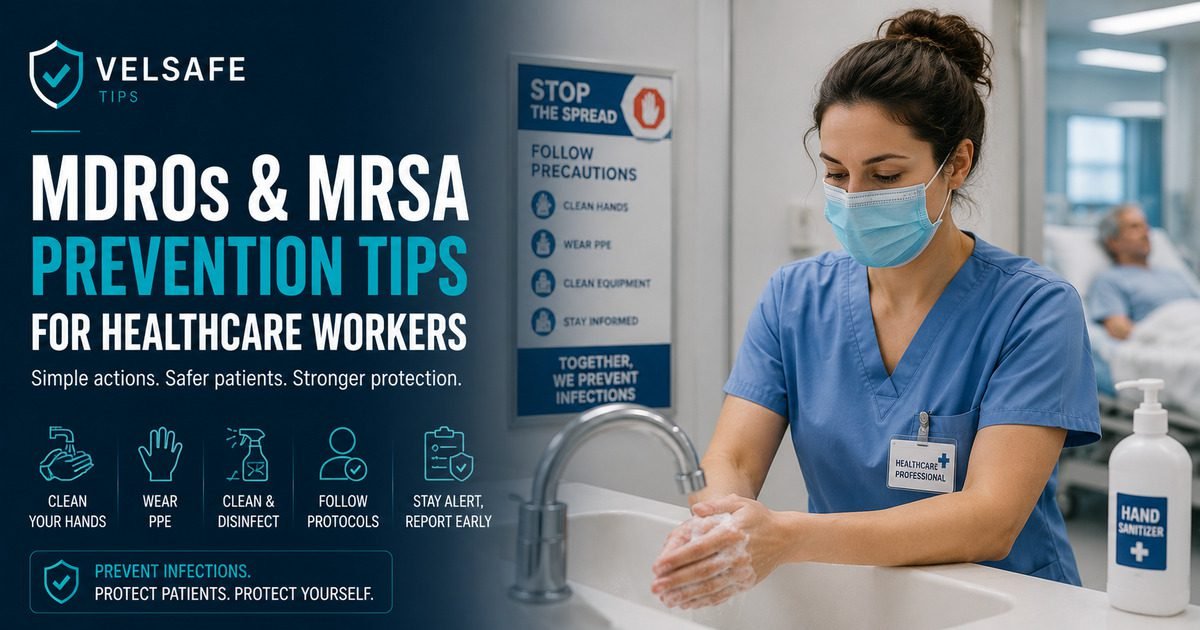
TIPS: MDROs, MRSA Prevention at Work
7 MRSA Prevention Tips for Healthcare Workers
and Safety Supervisors
and Safety Supervisors
MRSA prevention in the workplace requires consistent application of contact precautions, hand hygiene, and environmental controls, not occasional effort. CDC estimates MRSA causes more than 70,000 severe infections and 9,000 deaths per year in the United States, and progress in reducing healthcare facility rates has slowed. These seven MRSA prevention tips cover the actions that most directly interrupt transmission in healthcare, first-aid, and high-contact workplace settings.
70,000+
Severe MRSA Infections Per Year
CDC estimates MRSA causes more than 70,000 severe infections and approximately 9,000 deaths annually in the United States. CDC classifies MRSA as a “serious threat”, the second most severe tier in its antimicrobial resistance threat hierarchy.
CDC MRSA Infection Control Guidance
16%
Drop in HA-MRSA Bacteremia (2022)
US acute care hospitals recorded a 16% decrease in hospital-onset MRSA bacteremia in 2022 per CDC National Healthcare Safety Network data, proof that contact precautions and hand hygiene work when applied consistently.
CDC NHSN 2022 HAI Data
Contact
Primary Transmission Route
MRSA spreads primarily through direct contact with an infected wound or through contaminated hands, not through the air. This makes hand hygiene and PPE the primary prevention tools, not ventilation systems or airborne precautions.
CDC MRSA Clinical Overview
Quick Summary
MRSA prevention in the workplace starts with understanding how the organism spreads: by contact with infected wounds and by contaminated hands. Every tip in this list targets one of those two pathways. Facilities that achieve sustained reduction in MRSA transmission rates use multiple interventions simultaneously, not one or two in isolation.
1
Perform hand hygiene before and after every patient or wound contact
2
Apply Contact Precautions for known or suspected MRSA cases
3
Use dedicated or single-use patient-care equipment in MRSA cases
4
Clean and disinfect frequently touched surfaces and equipment daily
5
Cover all wounds, yours and your patients’, before contact activities
6
Do not share personal items that contact skin or wounds
7
Report any suspicious skin lesion or wound that does not heal to a supervisor and seek evaluation
7 MRSA Prevention Tips for Healthcare and High-Contact Workplaces
1
Perform hand hygiene before and after every patient or wound contact
Why It Matters
Contaminated hands are the primary route of MRSA transmission in healthcare settings. A healthcare worker who does not perform hand hygiene after contact with a colonised patient carries the organism on their hands to the next patient, who may be immunocompromised and unable to resist infection. Hand hygiene is the single intervention with the most evidence for reducing MRSA transmission rates.
What To Do
Use alcohol-based hand rub (ABHR) before and after touching a patient, before and after a procedure, after touching the patient’s environment, and after removing gloves. Use soap and water when hands are visibly soiled or after contact with a patient with a suspected spore-forming organism. Scrub for at least 20 seconds when using soap and water. ABHR is acceptable for MRSA specifically, it is not an airborne or spore-forming organism. Source: CDC MRSA Infection Control Guidance
Common Mistake
Performing hand hygiene before patient contact but not after. The “after” is the step that protects subsequent patients. Workers who clean their hands before gloving but do not clean hands after removing gloves, because “the gloves protected their hands”, are transferring contamination from the glove surface to their hands at the moment of removal.
Pro Tip
Place ABHR dispensers at the point of care, at the bedside, at the door of every patient room, and at every first-aid station. Compliance increases significantly when the product is within arm’s reach rather than requiring a worker to walk to a sink. Audit hand hygiene compliance quarterly by direct observation, not self-report.
2
Apply Contact Precautions for known or suspected MRSA cases
Why It Matters
CDC recommends Contact Precautions for all patients known to be colonised or infected with MRSA in inpatient acute care settings. Contact Precautions, gowns and gloves for all contact with the patient and the patient’s immediate environment, reduce transmission by creating a barrier between the organism and the healthcare worker’s clothing and hands. They have demonstrated efficacy in reducing MRSA bacteremia alongside hand hygiene. Source: CDC MRSA Infection Control Guidance
What To Do
Don a gown and gloves before entering the room of a patient on Contact Precautions. Remove and dispose of the gown and gloves before leaving the room. Perform hand hygiene immediately after glove removal, before touching any surface outside the patient’s room. Where possible, place MRSA patients in a single-patient room. If single rooms are unavailable, cohort MRSA patients together rather than mixing them with non-MRSA patients.
Common Mistake
Wearing a gown and gloves into the room but removing them inside and then touching the door handle or curtain on the way out. The point of removing PPE inside the room is to leave the contamination within the room. Touching environmental surfaces after removing the gown, including the call button, bed rail, or room phone, transfers the organism to surfaces that non-precaution patients and staff will subsequently touch.
Pro Tip
Brief patients and visitors entering a MRSA Contact Precautions room on the donning and doffing sequence. Visitors are a commonly overlooked transmission source, they visit multiple patients during a single hospital visit, and contaminated clothing or hands from a MRSA room can transfer the organism to other patients. The NIOSH publication MRSA and the Workplace covers community and workplace MRSA settings where formal Contact Precautions training for workers applies. Source: NIOSH Publication 2013-112
3
Use dedicated or single-use patient-care equipment in MRSA cases
Why It Matters
MRSA can survive on dry surfaces including stethoscopes, blood pressure cuffs, keyboards, and bed rails for hours to days. Equipment moved from a MRSA patient’s environment to another patient without adequate disinfection can transfer the organism to a patient who has had no direct contact with the MRSA case. Dedicated equipment eliminates this route entirely.
What To Do
Assign dedicated stethoscopes, blood pressure cuffs, and thermometers to each MRSA patient’s room for the duration of their isolation. If dedicated equipment is not available, clean and disinfect shared equipment with an EPA-registered hospital-grade disinfectant effective against MRSA between uses. Label dedicated equipment clearly and do not remove it from the room without disinfecting it first. Source: CDC MDRO Prevention and Control
Common Mistake
Leaving the dedicated stethoscope in the room but then carrying a personal stethoscope in and using it instead, then leaving with the personal stethoscope contaminated. If personal equipment enters a Contact Precautions room and contacts the patient or their environment, it must be disinfected before use with any other patient.
Pro Tip
Keep a small supply of disposable or disinfectable stethoscopes designated for Contact Precaution rooms. The cost of a disposable stethoscope is substantially lower than the cost of a healthcare-associated MRSA infection. For first-aid stations in non-healthcare workplaces, single-use gloves and disposable wound dressings should be standard for any wound contact.
4
Clean and disinfect frequently touched surfaces and equipment daily
Why It Matters
Enhanced environmental cleaning has been documented as a component of successful MRSA control programmes in both US and international healthcare settings. MRSA on high-touch surfaces, bed rails, call buttons, door handles, and sink fixtures, can persist long enough to contaminate the hands of staff, patients, and visitors who touch those surfaces. Cleaning alone (removing dirt) does not kill MRSA; disinfection with an appropriate product is required.
What To Do
Use an EPA-registered hospital-grade disinfectant with a label claim against MRSA (Staphylococcus aureus). Follow the product’s contact time, the surface must remain wet for the specified duration for the disinfectant to be effective. High-touch surfaces in MRSA patient rooms require daily disinfection at minimum, and terminal cleaning is required when the patient is discharged or transferred. Source: CDC MDRO Prevention and Control
Common Mistake
Wiping a surface and moving on immediately, not allowing the disinfectant sufficient contact time. Most EPA-registered disinfectants require the surface to remain visibly wet for 1 to 10 minutes to achieve the efficacy described on the label. Wiping a surface and immediately drying it eliminates the contact time and may not kill MRSA even though the surface looks clean.
Pro Tip
Use UV-C or fluorescent gel marker auditing tools periodically to verify that environmental cleaning is actually reaching all high-touch surfaces, not just the visible ones. Audit results should be shared with environmental services teams as part of a continuous improvement cycle, not only as performance penalties.
5
Cover all wounds before any patient contact or shared workspace activity
Why It Matters
Open wounds, including cuts, abrasions, insect bites, and skin breakdown, are the primary portal of entry for MRSA. An uncovered wound on a healthcare worker’s hand or arm can allow MRSA from the patient’s environment to enter the worker’s bloodstream. Equally, an infected wound on a healthcare worker who is an asymptomatic carrier can transfer the organism to a patient during direct care activities.
What To Do
Cover all cuts, abrasions, or open skin lesions on hands and forearms with a waterproof, secure dressing before any direct patient contact. Change the dressing if it becomes wet, soiled, or loses adhesion. Workers with draining wounds, particularly those that are slow to heal or unusually red, should report the wound to occupational health for evaluation before returning to direct patient care. This applies to community workplaces with shared equipment or close-contact work as well.
Common Mistake
Treating a slow-healing wound as cosmetic rather than as an infection risk. MRSA skin and soft tissue infections are often initially dismissed as spider bites, ingrown hairs, or minor boils. CDC notes that clinicians should consider MRSA in the diagnosis of any skin or soft tissue infection with purulent drainage, especially one that is not improving with standard antibiotics. Source: CDC MRSA Clinical Overview
Pro Tip
Keep waterproof bandages and nitrile gloves at every first-aid station and workstation where workers handle materials that contact skin. In settings outside acute care, gyms, warehouses, athletic facilities, schools, any shared surface or equipment that contacts broken skin is a potential MRSA vector. A posted protocol for wound covering before shared activities takes less than one minute to follow.
6
Do not share personal items that contact skin, wounds, or body fluids
Why It Matters
Community-associated MRSA (CA-MRSA) transmission frequently occurs through shared personal items, razors, towels, athletic equipment, and clothing that contacts skin. In workplace settings including athletics, close-contact work environments, and long-term care, these items can transfer the organism between individuals who have no direct wound-to-wound contact. CA-MRSA is a recognised occupational risk for workers in correctional facilities, athletic departments, and military environments.
What To Do
Establish and communicate a clear no-sharing policy for razors, towels, uniforms, sports equipment, and wound care supplies in shared facilities. Provide each worker with individual supplies where practical. Where shared equipment cannot be avoided, such as athletic pads, establish a documented cleaning and disinfection protocol between uses with an EPA-registered product. Source: NIOSH Publication 2013-112: MRSA and the Workplace
Common Mistake
Posting a no-sharing policy but providing no individual alternatives, which leads to sharing regardless of the policy. Policies work when they are backed by provision: if towels are not shared, clean individual towels must be available. If razors are not shared, individual razors must be stocked. Enforcement without provision is not an effective MRSA prevention programme.
Pro Tip
In athletic or residential workplace settings, label personal items with each individual’s name and store them separately. Brief incoming workers and athletes on the rationale, not just the rule. Workers who understand that MRSA can cause serious, hospitalisation-level infections are more compliant with prevention policies than those who are only told “do not share towels.”
7
Report suspicious skin lesions or slow-healing wounds promptly for evaluation
Why It Matters
Healthcare workers who are MRSA carriers and have active draining lesions can transmit the organism to patients during direct care. CDC guidance is clear: healthcare personnel implicated in MRSA transmission are candidates for decolonisation and should be culture-negative before returning to direct patient care. Early reporting enables early evaluation, early treatment if needed, and interrupts an otherwise silent transmission chain.
What To Do
Report any boil, abscess, skin lesion, or wound that is unusually red, warm, draining pus, or failing to improve to your supervisor or occupational health before your next direct patient contact shift. Do not self-treat and return, especially with over-the-counter products not indicated for MRSA. The evaluation by a clinician, including culture where appropriate, is the standard. Asymptomatic colonisation without active lesions or epidemiological link to transmission does not require removal from direct patient care. Source: CDC MDRO Prevention and Control
Common Mistake
Assuming a draining skin lesion is a minor nuisance and continuing direct patient care without reporting it. MRSA skin and soft tissue infections that are not identified and treated can progress to serious invasive disease, septicaemia, endocarditis, and osteomyelitis. Early evaluation protects both the worker and the patients in their care.
Pro Tip
Build a non-punitive reporting culture. Workers who fear disciplinary action or loss of pay for reporting a potential infection are less likely to report early. The earlier a MRSA skin infection is identified and managed, the lower the risk to patients and the shorter the worker’s recovery time. Supervisors who respond to early reports with support rather than discipline see higher reporting rates and fewer transmission events.
Pre-Contact Checklist: Before Every Direct Care or Wound Contact Activity
Hands clean with ABHR or soap and water immediately before contact
For MRSA Contact Precautions patients: gown and gloves donned before entering room
Personal wounds or open skin lesions covered with a waterproof dressing
Equipment to be used is dedicated to this patient or has been disinfected since last use
No personal items (phone, badge, lanyard) worn in Contact Precaution room without plan for disinfection on exit
No active draining wounds or unusual skin lesions on self, if present, reported to supervisor before this contact
High-touch surfaces in the patient area were disinfected during today’s scheduled cleaning
Key Takeaways
MRSA spreads by contact, and hand hygiene remains the primary control
MRSA is not airborne. It travels from patient to patient via contaminated hands and equipment. Hand hygiene before and after every patient contact, applied consistently, is the single intervention with the most evidence for reducing MRSA transmission in healthcare settings.
Multiple interventions together achieve what single interventions do not
The 16% reduction in hospital-onset MRSA bacteremia documented in 2022 came from combined interventions: hand hygiene, Contact Precautions, active surveillance, environmental cleaning, and communication systems between facilities. No single tip on this list is sufficient alone. All seven must operate simultaneously.
Progress in reducing MRSA has slowed, and that means existing controls must be applied more consistently, not replaced
CDC noted explicitly that progress in reducing MRSA infections in healthcare facilities has slowed and that more action is required. The controls that work, hand hygiene, Contact Precautions, dedicated equipment, and environmental cleaning, are well established. The gap is not in knowledge of what to do. It is in consistent application of what is already known. For supervisors, the priority is audit and reinforcement of existing protocols, not the introduction of new ones.
Frequently Asked Questions
What is MRSA and why is it a workplace concern?
Methicillin-resistant Staphylococcus aureus (MRSA) is a type of staph bacteria that has developed resistance to several commonly used antibiotics, including methicillin, oxacillin, and amoxicillin. It is a workplace concern in healthcare settings because it can spread through direct patient contact and contaminated surfaces, causing serious infections including bacteremia, sepsis, and pneumonia. CDC classifies MRSA as a serious antimicrobial resistance threat. It is also an occupational risk in non-healthcare workplaces including correctional facilities, athletic settings, and military environments.
How does MRSA spread in the workplace?
MRSA spreads primarily through direct contact with an infected wound and through contaminated hands. It can also survive on dry surfaces including bed rails, door handles, stethoscopes, and equipment for hours to days, allowing indirect transmission through contact with contaminated surfaces. It is not an airborne organism, which means standard airborne precautions are not required, but hand hygiene and surface disinfection are. Source: CDC MRSA Clinical Overview
What is the difference between healthcare-associated MRSA and community-associated MRSA?
Healthcare-associated MRSA (HA-MRSA) is acquired in healthcare facilities, hospitals, nursing homes, and dialysis centres, typically affecting patients with underlying conditions, surgical wounds, or medical devices. Community-associated MRSA (CA-MRSA) occurs in otherwise healthy people with no recent healthcare exposure, often through contact with contaminated surfaces or infected individuals in community settings including workplaces, gyms, athletic teams, and correctional facilities. CA-MRSA most commonly causes skin and soft tissue infections, while HA-MRSA is more likely to cause bloodstream infections and pneumonia.
What are Contact Precautions and when are they required for MRSA?
Contact Precautions are infection control measures that require healthcare personnel to wear a gown and gloves before entering the room of a patient who is colonised or infected with a contact-transmitted organism. CDC recommends Contact Precautions for all patients with MRSA in inpatient acute care settings. Contact Precautions are maintained until the patient is no longer colonised or infected, as confirmed by cultures. They apply to all personnel entering the room, not only those performing direct care procedures, because contact with the patient’s environment can transfer MRSA even without direct patient touch.
Can a healthcare worker carry MRSA without knowing it?
Yes. MRSA colonisation, carrying the organism without active infection, is common and asymptomatic. MRSA most frequently colonises the nose, groin, and skin, and a colonised individual may have no symptoms while being capable of transmitting the organism to others. CDC guidance states that asymptomatic healthcare workers who have not been epidemiologically linked to patient MRSA transmission do not need to be removed from direct patient care or decolonised. However, workers with active draining lesions who have been implicated in transmission are candidates for decolonisation and should be culture-negative before returning to direct patient care. Source: CDC MDRO Prevention and Control
What does OSHA require for MRSA prevention in healthcare workplaces?
OSHA does not have a specific MRSA standard but applies the Bloodborne Pathogen Standard (29 CFR 1910.1030) to blood and body fluid contact, and the General Duty Clause to the broader obligation to protect workers from recognised hazards. OSHA’s hospital eTool specifically addresses MRSA and refers to CDC Contact Precaution guidance as the recognised control for healthcare settings. Employers in healthcare are expected to implement CDC infection control guidance, including hand hygiene protocols, Contact Precautions, and environmental cleaning, as the feasible controls for the recognised hazard. Source: OSHA Hospital eTool: MRSA
What types of workplaces outside healthcare are at risk of MRSA transmission?
NIOSH publication 2013-112 identifies several non-healthcare workplace settings with documented CA-MRSA risk: athletic teams and gyms (through shared equipment and skin-to-skin contact), correctional facilities (through close quarters and inadequate wound care), military barracks and training environments, childcare settings, and schools. The common factors are close contact, potential for wound-to-wound transmission, and shared surfaces or personal items that are not consistently cleaned between uses. Prevention in these settings applies the same core principles: hand hygiene, wound covering, no sharing of personal items, and regular cleaning of shared surfaces. Source: NIOSH Publication 2013-112: MRSA and the Workplace
Sources
Government and Regulatory Sources
- CDC: Infection Control Guidance, Preventing MRSA in Healthcare Facilities: source for the 70,000+ severe infections and 9,000 deaths per year estimate, the 16% decrease in hospital-onset MRSA bacteremia in 2022, and the Contact Precautions recommendation for MRSA inpatients in acute care.
- CDC: Clinical Overview of MRSA in Healthcare Settings: source for MRSA as a “serious threat,” contact transmission route, and guidance for clinicians on considering MRSA in purulent skin and soft tissue infections.
- CDC: MDRO Prevention and Control: source for multi-intervention MRSA control evidence, healthcare worker decolonisation guidance, and combined interventions including active surveillance, environmental cleaning, and communication protocols.
- NIOSH Publication 2013-112: MRSA and the Workplace: NIOSH guidance covering workplace MRSA exposure and prevention in non-healthcare settings including athletics, corrections, and military environments.
- OSHA Hospital eTool: MRSA in the Emergency Department: OSHA’s application of the General Duty Clause and CDC guidance to MRSA prevention obligations for healthcare employers.
Related VelSafe Articles
Guides
21 CFR Part 803: Medical Device Reporting Requirements
A complete guide to FDA MDR reporting obligations for manufacturers, importers, and device user facilities, including healthcare facilities’ mandatory reporting requirements when MRSA or other MDRO adverse events involve medical devices.
Tips
VelSafe Tips: Health, Safety, and Compliance Guidance
Actionable tips for healthcare workers, supervisors, and safety coordinators across first aid, infection control, and workplace health and wellness topics.
Worker Safety
VelSafe Worker Safety Library
Practical worker safety guides covering hazard identification, PPE requirements, and OSHA worker rights, including resources for healthcare, warehouse, and general industry settings.
VELSAFE HEALTH AND SAFETY LIBRARY
More Infection Control and Workplace Health Guidance
Explore VelSafe’s full tips library for actionable guidance on infection control, first aid, health and safety management, and worker protection.
Explore All Tips