

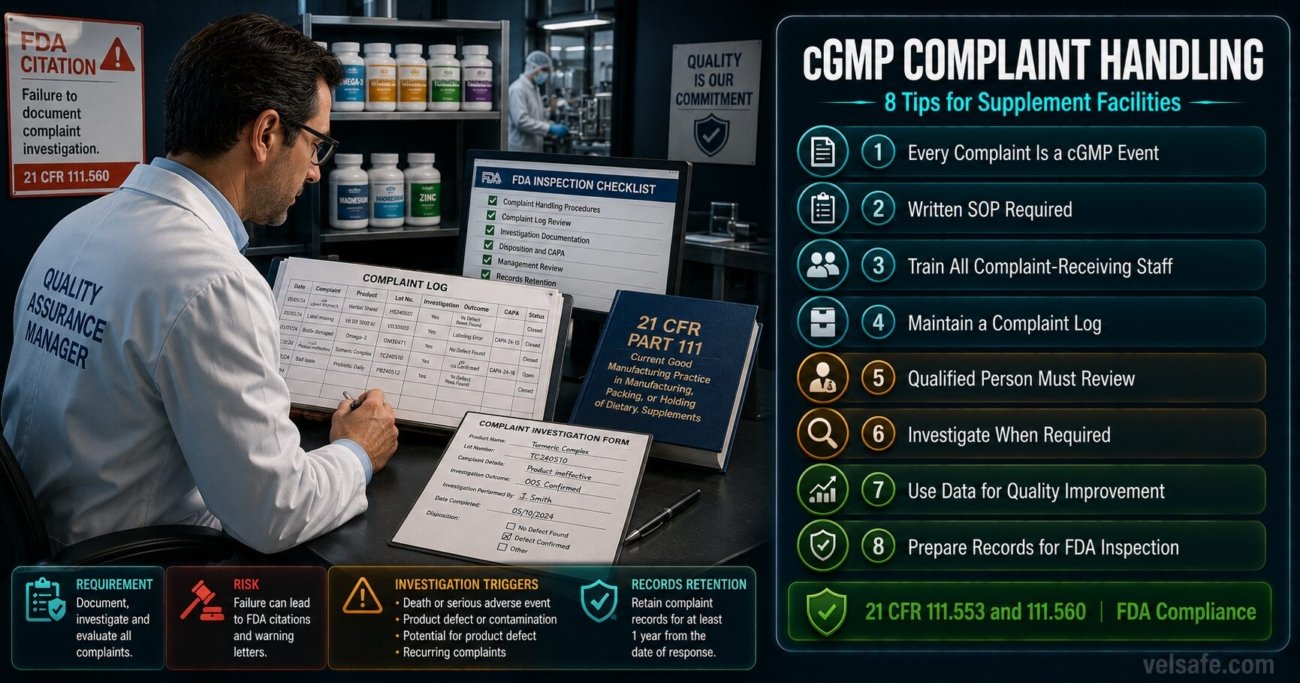
Dietary supplement facilities operating under 21 CFR Part 111 are routinely inspected by the FDA. When inspectors review complaint handling records, the same violation appears across facilities of every size: complaints were received, customers were refunded, but nothing was documented, nothing was investigated, and nothing was connected to the cGMP system that governs product quality.
Under 21 CFR 111.553 and 111.560, complaint handling is not a customer service function. It is a mandatory quality system requirement. These tips explain how to build a compliant complaint handling system from the ground up, or fix the one you already have.
Tip 1: Understand That Every Product Complaint Is a cGMP Event
Under 21 CFR 111.553, every complaint related to a possible failure of a dietary supplement to meet any of its specifications, or any complaint related to possible contamination, mislabeling, or other adulteration must be reviewed. This review is mandatory, not discretionary.
Complaints that trigger mandatory review and investigation include: reports of adverse health effects (nausea, rash, dizziness, allergic reaction), unusual odour or taste, structural defects such as broken capsules or clumping, incorrect labelling, foreign matter in the product, and expired product identified on retail shelves. Complaints about taste preference or product effectiveness that do not suggest a cGMP failure may not require full investigation but must still be recorded and reviewed to make that determination.
If you receive a complaint by phone, email, or in person, do not resolve it and move on. The resolution of the customer’s issue and the cGMP documentation of the complaint are two separate tasks. The customer can be satisfied today. The complaint record needs to follow the process your facility’s SOP requires.
Tip 2: Create a Written Complaint Handling SOP Before Your Next FDA Inspection
21 CFR 111.553 requires that you establish written procedures for handling product complaints. A verbal understanding shared among staff is not a written procedure and will not satisfy an FDA inspector who asks to see your complaint handling SOP.
A compliant SOP for complaint handling must cover: how complaints are received (phone, email, web form, retailer report), who is responsible for initial review, the criteria that trigger a formal investigation, who conducts the investigation and what it must include, how results are documented, the timeline for each step, and what corrective actions are required when a deficiency is found. The SOP does not need to be lengthy. A clear, one-to-two page procedure that describes what your team actually does is more defensible than a 20-page document that does not match practice.
Do: Write your SOP in plain, operational language that describes the actual process. FDA inspectors evaluate whether your documented procedure reflects what workers actually do. A gap between the SOP and actual practice is itself a cGMP violation.
Avoid: Copying a generic SOP template without customising it to your facility. Template language that references roles, systems, or timelines that do not exist in your operation creates more risk than no SOP at all.
Tip 3: Train Every Person Who Might Receive a Complaint
Complaints reach facilities through many channels: customer service teams, sales representatives, warehouse staff, and sometimes directly through online reviews or retailer feedback. Any person in your organisation who might first receive a product complaint must know what to do with it.
Training for complaint-receiving personnel must cover: what qualifies as a formal product complaint under your cGMP programme, who to immediately notify when a complaint is received, what information to collect from the complainant (product name, lot number, description of the issue, contact information), and why documentation matters. The training does not need to be complex. A one-page reference card with the complaint hotline number, the minimum information to collect, and the name of the quality contact person is often sufficient for frontline staff.
Train new employees on complaint handling procedures before they take their first customer call. A new customer service representative who fields an adverse event complaint, apologises, provides a refund, and closes the call without creating a complaint record has created a cGMP violation on their first day. Prevention is significantly easier than remediation.
Tip 4: Maintain a Complaint Log That Satisfies 21 CFR 111.560
21 CFR 111.560 requires that you document the review of each complaint, the findings of any investigation, and the corrective actions taken. This documentation must be retained for one year beyond the shelf life of the product involved, or two years from the date of distribution if the shelf life is not known, but in no case less than three years after the date of distribution.
Your complaint log, whether paper-based or electronic, must include at minimum: the date the complaint was received, the identity of the complainant if available, the product name and lot or batch number, a description of the complaint, the date and outcome of the initial review, whether a formal investigation was initiated and why or why not, the findings of any investigation conducted, and the signature or initials of the qualified person who reviewed the complaint. Missing any of these elements is a citable violation.
If your facility does not currently maintain a complaint log, start one today using a simple spreadsheet with the required fields listed above. Retroactively enter any complaints received in the past 90 days that you can reconstruct from email threads, call notes, or refund records. Incomplete historical records are better than no records, and demonstrating a current compliant system reduces the weight FDA gives to past gaps.
Tip 5: Assign a Qualified Person to Review Every Complaint
Under 21 CFR 111.553, a qualified individual must review each complaint to determine whether an investigation is necessary. This is not a task that can be assigned to an administrative assistant or left to whoever happens to be available. The qualified person must have sufficient training, education, and experience to evaluate whether a complaint reflects a cGMP failure.
In a small facility, the qualified person may be the owner, the quality manager, or a contracted quality consultant. In a larger facility, it is typically a member of the Quality Assurance team. The key requirement is that the reviewer must be able to assess the complaint against the product’s specifications and cGMP requirements and make a documented determination about whether an investigation is required.
If your facility does not have a designated qualified person for complaint review, identify who fills this role now. The designation must be documented, and the person must have or receive the training necessary to perform the function. An uninvestigated complaint is bad. An uninvestigated complaint reviewed by an unqualified person is the same outcome with the additional problem of a documented procedural failure.
Tip 6: Conduct Investigations When the Evidence Warrants
21 CFR 111.560(b) requires that you investigate any complaint that alleges a failure of a dietary supplement to meet any of its specifications, or any complaint related to contamination, mislabeling, or adulteration. When an investigation is required, it must be documented and must address the complaint fully.
A compliant investigation should include: review of the batch or lot records for the product involved, examination of any remaining retention samples from the lot, review of incoming ingredient test results for the relevant production run, review of equipment cleaning and maintenance records for the production period, and if necessary, laboratory analysis of retention samples. When an investigation finds no cause, the documentation should state that: the investigation was conducted, the records reviewed, and no assignable cause was identified. Closing an investigation without documentation is the same as not investigating.
Do: Document the investigation as you conduct it, not after the fact. Contemporaneous records are more credible to FDA investigators than summaries written after an inspection is announced.
Avoid: Closing a complaint without investigation when the complaint describes a potential health risk, even if you believe the complaint is inaccurate or exaggerated. The investigation is what determines whether the complaint reflects a real product problem. That determination cannot be made without conducting the investigation.
Tip 7: Use Complaint Data to Drive Continuous Quality Improvement
Beyond the regulatory requirement, complaint data is one of the most valuable sources of product quality feedback available to a supplement facility. Patterns in complaint data can reveal problems that internal testing missed: a batch of capsules that are failing too early in their shelf life, an ingredient supplier whose quality has declined, a packaging seal that is failing under certain storage conditions, or a formulation that is causing unexpected reactions in a subset of users.
A periodic review of complaint trends, monthly for active facilities or quarterly for lower-volume operations, should be a standard quality management activity. This review should look for patterns by product, lot, ingredient, and complaint type. Findings from trend reviews should be documented and should feed into corrective and preventive action (CAPA) processes where patterns suggest systemic issues.
At the end of each week, spend 10 minutes reviewing the complaint log entries from the past seven days. Are there any products generating more than one complaint? Are any complaint types repeating? Even a brief weekly scan can catch emerging patterns before they become recall situations. Ten minutes a week is significantly less expensive than an FDA-initiated recall.
Tip 8: Prepare Your Complaint Records Before Every FDA Inspection
When FDA investigators arrive for a cGMP inspection of a dietary supplement facility, complaint handling records are among the first documents they request. Inspectors will ask to see your written SOP, your complaint log for the inspection period, examples of investigations conducted, and evidence that a qualified person reviewed each complaint.
Preparing for this review should not wait until an inspection is announced. Complaint records should be complete, current, and organised for retrieval at all times. Inspectors who find missing records, blank fields in the complaint log, or investigations that were started but never completed will cite these as 21 CFR Part 111 violations. Those citations appear on FDA’s publicly available inspection database and can affect customer and retailer confidence in your facility.
Conduct an internal audit of your complaint records at least twice a year. Verify that every complaint received has a corresponding log entry, that all required fields are completed, that investigations required by the complaint type were conducted and documented, and that qualified person review is documented on each entry. Gaps found during an internal audit can be corrected before an inspection. Gaps found during an inspection cannot.
cGMP Complaint Handling Requirements at a Glance
cGMP Complaint Handling Checklist
✓ A written SOP for complaint handling exists and has been reviewed in the past 12 months
✓ The SOP describes the actual process used, not an idealised process that does not match practice
✓ All staff who may receive complaints have been trained on the SOP and know who to notify
✓ A complaint log is maintained with all required fields for every complaint received
✓ A designated qualified person reviews every complaint and their review is documented
✓ Complaints that require investigation under 21 CFR 111.560(b) are investigated and documented
✓ Investigations include batch record review, retention sample review, and supplier data where relevant
✓ Complaint records are retained for the required period (minimum three years from distribution)
✓ Complaint data is reviewed periodically for trends that may indicate systemic product quality issues
✓ An internal audit of complaint records has been conducted within the past six months
Sources
- 21 CFR Part 111 Subpart N: Complaints (Sections 111.553 and 111.560)
- FDA: Dietary Supplement Products and Ingredients
- FDA: Guidance Documents for Dietary Supplements
- 21 CFR Part 111: Current Good Manufacturing Practice in Manufacturing, Packaging, Labeling, or Holding Operations for Dietary Supplements