

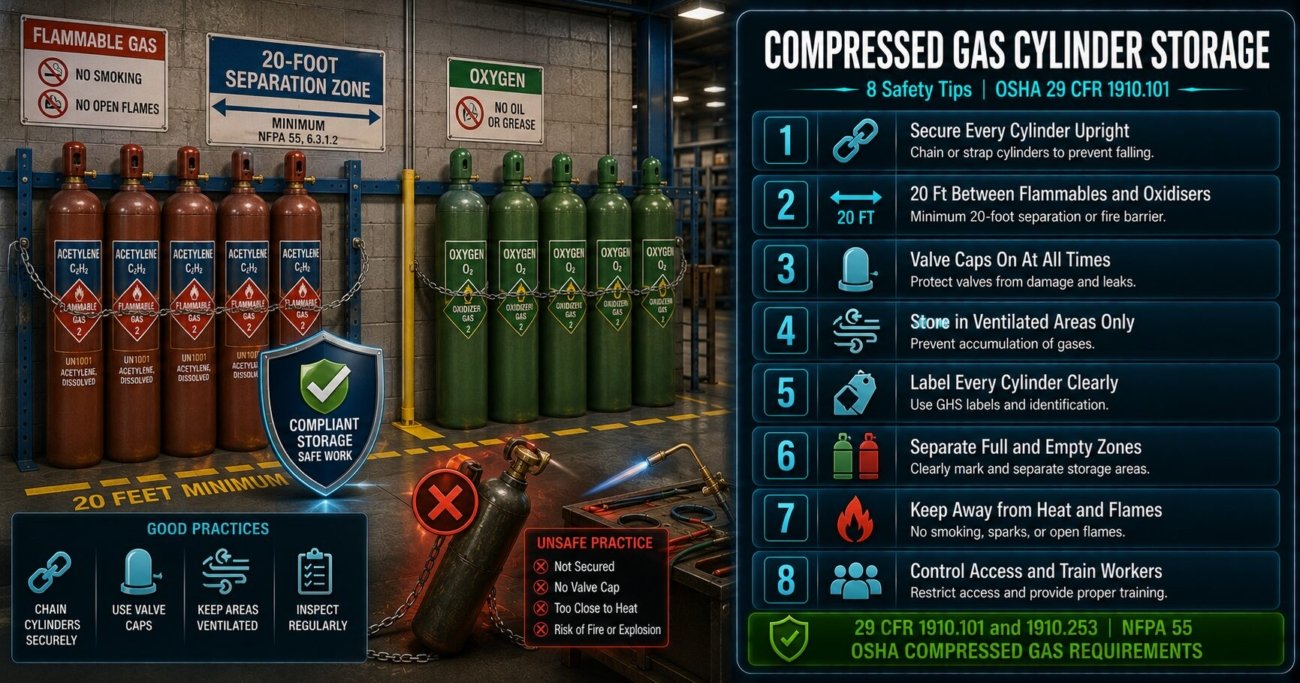
A compressed gas cylinder is a pressure vessel. The gas inside is stored at pressures that can exceed 2,000 psi. When a cylinder valve is sheared off in a fall, the escaping gas can propel the cylinder through concrete block walls. OSHA’s investigation records contain exactly this type of incident, in welding shops, laboratories, and construction sites where cylinders were stored upright but not secured.
The hazards of compressed gas cylinders are not limited to physical projectile risk. Depending on the gas type, a leaking cylinder in an enclosed space can displace oxygen and cause asphyxiation before workers realise the air is depleted. A leak from a flammable gas cylinder in an area with an ignition source can ignite without warning. An oxidiser leak in proximity to combustible materials can cause a fire that accelerates beyond normal suppression.
These eight tips cover the storage requirements that OSHA’s compressed gas standards and NFPA codes consistently identify as the most frequently violated and the most consequential when something goes wrong.
Tip 1: Secure Every Cylinder to a Fixed Structure Before Anything Else
Under 29 CFR 1910.101(b), cylinders must be stored in a safe, dry, well-ventilated place and must be secured in an upright position to prevent falling. This requirement applies to all cylinders, full or empty, capped or connected. A cylinder that is leaning against a wall, resting on its cap, or stored horizontally is non-compliant regardless of other storage conditions.
The securing method must be capable of preventing a cylinder from falling if it is bumped by a forklift, struck by a dolly, or knocked by a passing worker. Single chains at mid-height are the minimum. Two-point restraint systems (chains or straps at upper and lower thirds of the cylinder) provide more reliable protection and are required by some facility insurance standards.
When you arrive in a storage area and find a cylinder that is not secured to a fixed structure, do not leave it that way. Lay it on its side if no restraint is available and secure it against rolling until a proper chain or strap can be installed. An unsecured upright cylinder is more dangerous than a horizontal cylinder with its valve protected.
Tip 2: Separate Flammable and Oxidising Gases by 20 Feet or a Fire Wall
Oxygen and other oxidising gases dramatically accelerate the combustion of materials that would otherwise burn slowly or not at all. Acetylene, hydrogen, and propane in proximity to oxygen create the conditions for explosive combustion if a leak occurs from either cylinder. OSHA 29 CFR 1910.253(b)(2) and NFPA 55 both require that flammable gas cylinders and oxidising gas cylinders be stored at least 20 feet apart, or separated by a non-combustible partition at least 5 feet high with a fire resistance rating of at least 30 minutes.
This segregation requirement is absolute. A storage area where acetylene and oxygen cylinders are chained to the same rack, regardless of how neatly they are arranged, is a cited OSHA violation and a potential combustion event if either cylinder develops a leak.
Do: Measure the actual distance between your flammable and oxidiser cylinder storage areas. Paint a dividing line on the floor if needed. Post signage identifying each zone.
Avoid: Using a single storage cage for both flammable and oxidiser cylinders on the assumption that the cage walls provide sufficient separation. Cage walls do not satisfy the 20-foot or fire-rated partition requirement under NFPA 55.
Tip 3: Keep Valve Caps On Every Stored Cylinder at All Times
The valve is the most mechanically vulnerable part of a compressed gas cylinder. It protrudes from the top of the cylinder and is the first point of contact if the cylinder falls. A sheared valve on a cylinder pressurised at 2,000 psi releases its stored energy immediately. The resulting projectile force has been measured at sufficient velocity to penetrate reinforced concrete.
Under 29 CFR 1910.101(b), valve protection caps must be kept on cylinders when they are not in service. This means: cap on during storage, cap on during transport, cap on when connected to a regulator that has been disconnected, and cap on empty cylinders returned for refill. The cap is not optional protection for a cylinder that looks intact. It is mandatory protection against the consequence of the cylinder falling.
Workers who remove valve caps when a cylinder is temporarily taken out of service but not yet returned to storage often leave the cap off because they intend to reconnect the cylinder shortly. This practice is responsible for a significant share of valve shear incidents. The cap must go back on the cylinder whenever it is not actively connected to service equipment. ‘Briefly’ disconnected is still disconnected.
Tip 4: Store in Ventilated Areas and Never in Confined Spaces
Even gases that are classified as non-toxic can displace oxygen in an enclosed space. Argon, nitrogen, and carbon dioxide are all asphyxiants in sufficient concentration despite being physiologically inert. A cylinder leak in a sealed room can reduce oxygen concentration from the normal 20.9% to below the 19.5% OSHA action level before workers notice symptoms. At 16%, cognitive impairment begins. Below 10%, loss of consciousness is rapid.
OSHA 29 CFR 1910.101(b) requires that cylinders be stored in well-ventilated, dry locations. This means outdoor storage or indoor storage with confirmed cross-ventilation, not storage in basements, enclosed vaults, or rooms served only by HVAC return air systems without exhaust. Storage areas for toxic or flammable gases should be equipped with gas detection systems set to alarm at appropriate concentration thresholds.
If your facility stores gas cylinders in a room that does not have dedicated exhaust ventilation, assess whether the ventilation is adequate for the volume of the room, the number and type of cylinders stored, and the leak volume that could result from a valve failure. This assessment should be documented. An undocumented ventilation assessment that fails at inspection time provides no compliance protection.
Tip 5: Clearly Label Every Cylinder and Never Rely on Colour Alone
Cylinder colours are not standardised in the United States. Different suppliers use different colour coding systems, and the same colour can represent different gases from different manufacturers. Relying on cylinder colour to identify contents is a documented cause of wrong-gas incidents in welding, laboratory, and medical environments.
Under 29 CFR 1910.1200 (Hazard Communication) and the GHS labelling requirements, cylinders must be labelled with the product name and hazard information sufficient for workers to understand what they are handling. A cylinder with a damaged, missing, or illegible label must be removed from service and returned to the supplier for relabelling or disposal. It must not be used, even if workers believe they know the contents from prior use or cylinder colour.
At the start of every shift in a cylinder storage area, check that every cylinder has a legible label identifying the gas and the hazard class. Cylinders with damaged or missing labels should be tagged as DO NOT USE and reported to the supervisor. This check takes under two minutes for a standard storage area and is the simplest intervention point for preventing wrong-gas incidents.
Tip 6: Separate Full and Empty Cylinders in Designated Zones
Empty cylinders are not empty. They contain residual gas at reduced pressure. An empty acetylene cylinder still contains residual acetylene. An empty oxygen cylinder can still feed a fire if the valve is opened near a fuel source. The only safe assumption for a cylinder whose status is not positively known is that it is full.
Separating full and empty cylinders in clearly marked zones serves two purposes. It prevents a worker from connecting an empty cylinder under the assumption it is full and losing production time or creating a safety issue from the resulting pressure loss. And it prevents an empty cylinder from being treated as safe for casual handling when it still contains residual hazard.
Paint the floor of your cylinder storage area in two clearly differentiated zones: one for full cylinders, one for empties. Post signs at each zone. Apply FULL and EMPTY tags to cylinders when their status changes. This system costs less than two hours of labour to implement and eliminates the most common cylinder status confusion error in mixed storage areas.
Tip 7: Protect Cylinders from Heat Sources and Direct Sunlight
Compressed gas cylinders must not be exposed to temperatures above 125 degrees Fahrenheit (52 degrees Celsius). At elevated temperatures, the pressure inside a cylinder increases. At sufficient pressure, the cylinder’s pressure relief device may vent. In a flammable gas cylinder, venting near an ignition source creates an immediate fire or explosion hazard.
OSHA 29 CFR 1910.253(b)(4) requires that cylinders be stored away from radiators, furnaces, and other heat-generating equipment. Storage outdoors in direct sunlight in regions where ambient temperatures routinely approach or exceed 100 degrees Fahrenheit can also create dangerous cylinder temperatures during summer months. Outdoor cylinder storage in hot climates should provide shade cover and should not place cylinders on heat-absorbing surfaces such as asphalt paving.
Do: Store cylinders in shaded areas, away from process equipment, heating systems, and south-facing exterior walls that absorb heat during the day.
Avoid: Storing cylinders near welding operations, in direct sun in climates with summer temperatures above 95 degrees Fahrenheit, or adjacent to steam or hot water piping.
Tip 8: Control Access and Train Every Person Who Enters the Storage Area
Cylinder storage areas should be accessible only to workers who have been trained on the specific hazards of the gases stored, the correct handling procedures, and the emergency response actions required if a leak or fire occurs. Under 29 CFR 1910.1200 and OSHA’s HAZMAT training requirements, workers who may encounter compressed gas cylinders in their work area must receive training on the physical and health hazards of the specific gases present, the PPE required for handling, and the emergency procedures applicable to each gas type.
Access control also reduces the risk of tampering, theft, and accidental valve opening by untrained personnel. Outdoor cylinder storage areas should be enclosed in lockable cages. Indoor storage areas should be secured and clearly posted with warning signage identifying the gases stored, the required PPE for entry, and the emergency contact information for the facility.
If your facility has any person whose job includes entering the cylinder storage area, moving cylinders, connecting or disconnecting regulators, or responding to a cylinder alarm, that person must have documented HAZMAT training for the gases present. A visitor, contractor, or temporary worker who enters the storage area without training has not received the training required under 29 CFR 1910.1200 and creates compliance exposure for the employer even if they do not touch anything.
Compressed Gas Cylinder Storage Compliance Checklist
Sources
- 29 CFR 1910.101: Compressed Gases (General Industry)
- 29 CFR 1910.253: Oxygen-Fuel Gas Welding and Cutting (segregation requirements)
- 29 CFR 1910.1200: Hazard Communication Standard (cylinder labelling)
- NFPA 55: Compressed Gases and Cryogenic Fluids Code
- NIOSH: Preventing Injuries and Deaths from Compressed Gas Cylinders