

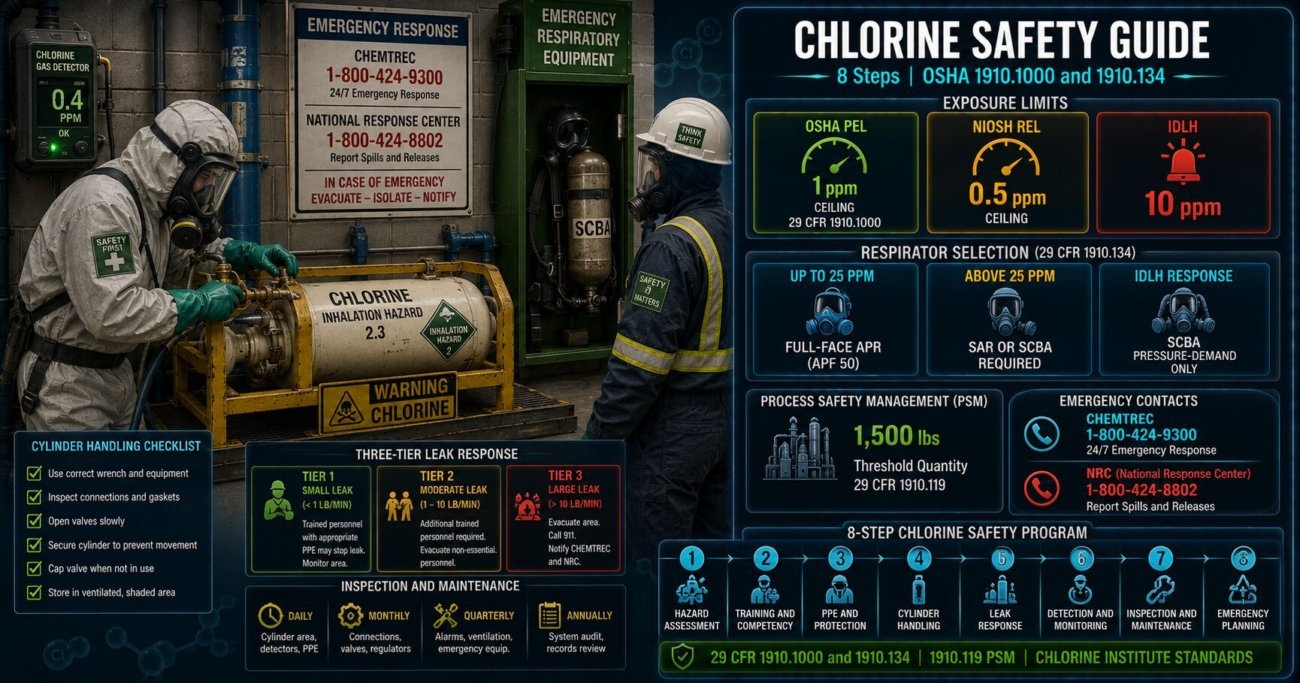
Chlorine is classified by OSHA as an immediately dangerous to life and health (IDLH) substance at concentrations at or above 10 parts per million. At 1 ppm, most people can detect its characteristic sharp odour. At 3 ppm, OSHA’s ceiling limit, mucous membrane irritation begins. At 25 ppm, severe pulmonary oedema can develop within hours. At concentrations above 430 ppm, a 30-minute exposure is lethal to approximately half of exposed adults.
Chlorine is heavier than air (density approximately 2.5 times that of air at standard conditions), which means leaked gas does not disperse upward and dilute – it pools in low areas, trenches, basements, and enclosed spaces where workers may not initially detect it. This physical property makes chlorine particularly dangerous in below-grade work environments and enclosed facilities.
This guide covers the complete safe handling framework for chlorine in industrial settings under OSHA’s standards at 29 CFR 1910.1000 (air contaminants), 29 CFR 1910.134 (respiratory protection), and the Process Safety Management standard at 29 CFR 1910.119 (which applies to chlorine processes at or above 1,500 pounds).
This guide covers eight steps for safe chlorine handling in industrial workplaces: understanding exposure limits and health effects, selecting and using PPE including respirators, engineering controls and ventilation requirements, safe storage under OSHA and Chlorine Institute standards, cylinder handling and transfer procedures, leak detection and emergency response, training requirements, and inspection and maintenance obligations. Each step includes the applicable OSHA regulation and specific requirements rather than general recommendations.
Step 1: Know the Exposure Limits and Health Effects Before You Begin
Three regulatory exposure limits govern chlorine in US workplaces:
- OSHA PEL (Permissible Exposure Limit): 1 ppm as a ceiling concentration, meaning this limit must never be exceeded at any time, not averaged over a shift. This is established under 29 CFR 1910.1000 Table Z-1.
- NIOSH REL (Recommended Exposure Limit): 0.5 ppm as a ceiling (15-minute short-term exposure limit).
- ACGIH TLV-C (Threshold Limit Value – Ceiling): 0.5 ppm, consistent with NIOSH guidance.
The OSHA ceiling limit of 1 ppm is the legally enforceable standard. The NIOSH ceiling of 0.5 ppm is a health-based recommendation that many industrial hygienists use as the operational target because it provides a wider safety margin before the OSHA limit is reached.
Health effects by concentration:
- 0.5 to 1 ppm: Detectable odour for most people; mild throat irritation
- 1 to 3 ppm: Mucous membrane irritation, coughing; approaches OSHA ceiling
- 5 to 15 ppm: Severe respiratory irritation, chest tightness, pulmonary damage with prolonged exposure
- 25 to 50 ppm: Dangerous – pulmonary oedema risk, severe chest pain
- 430 ppm and above: IDLH concentration – immediately dangerous to life at 30-minute exposure
At low concentrations, chlorine’s odour is a reliable indicator of presence. However, prolonged exposure causes olfactory fatigue – the ability to smell chlorine diminishes even as the concentration remains hazardous. A worker who has been in a chlorine environment for 30 to 60 minutes and no longer smells chlorine has not necessarily moved to a safe area. The concentration may be unchanged. Engineering controls and air monitoring must serve as the primary warning system, not the worker’s sense of smell.
Step 2: Select and Use the Correct Respiratory Protection
Respiratory protection for chlorine is governed by 29 CFR 1910.134 and must be selected based on the concentration of chlorine the worker may be exposed to and the assigned protection factor (APF) of the respirator type.
Respirator requirements by exposure scenario:
- Routine work in areas with potential for chlorine above 0.5 ppm: Full-face air-purifying respirator with NIOSH-approved Cl2 cartridge (APF 50). This provides protection up to 25 ppm (50 x 0.5 ppm NIOSH ceiling).
- Work in areas with potential for concentrations above 25 ppm: Supplied-air respirator (SAR) in pressure-demand mode or self-contained breathing apparatus (SCBA) (APF 10,000). Full-face APRs are not adequate above 25 ppm.
- Emergency response or rescue in IDLH concentrations (10 ppm and above): Pressure-demand SCBA only.
Air-purifying respirators with chlorine cartridges have a service life that depends on concentration and humidity. Cartridges must be replaced on a schedule determined by the employer’s cartridge change-out programme, which must be based on cartridge service life calculations, not on smell breakthrough (because olfactory fatigue means smell breakthrough is not a reliable indicator).
Fit testing under 29 CFR 1910.134(f) is required for all tight-fitting respirators before first use and annually thereafter. A worker who has not been fit tested for their assigned respirator is not in compliance regardless of whether they are wearing the correct cartridge type. Medical evaluation under 1910.134(e) is also required before a worker is assigned to wear a respirator. Both requirements must be documented.
Step 3: Implement Engineering Controls as the Primary Hazard Control
Under OSHA’s hierarchy of controls and the General Duty Clause, engineering controls must be implemented to the extent feasible before relying on PPE or administrative controls to manage chlorine exposure. For chlorine handling in fixed facilities, the primary engineering controls are:
- Local exhaust ventilation (LEV): Capture ventilation at the point of chlorine use (valve connections, transfer points, and sampling ports) that exhausts chlorine-contaminated air directly to a scrubber or safe outdoor discharge location. LEV flow rates must be sufficient to capture chlorine at all anticipated leak or release scenarios, not just normal operations.
- Continuous air monitoring: Fixed chlorine gas detectors with visual and audible alarms set to alarm at 0.5 ppm (NIOSH ceiling) must be installed in all areas where chlorine is handled. Detectors must be calibrated on the manufacturer’s schedule and the calibration records retained.
- Chlorine scrubbers: Emergency scrubbers or absorption systems on chlorine storage and use areas that can capture a release from the maximum credible failure (typically a full cylinder rupture or a valve failure) without allowing hazardous concentrations to reach occupied areas.
- Interlocks and shutoffs: Automatic or remotely operated shutoff valves on chlorine supply lines that can be closed from a safe location outside the hazard zone.
Air monitoring systems must be tested and calibrated on a documented schedule. An alarm system that has not been calibrated in six months may not respond accurately to chlorine concentrations at or below 0.5 ppm. Calibration records, including the calibration gas concentration and date, must be retained and available for OSHA inspection. A detector that is out of calibration is not an engineering control – it is false assurance.
Step 4: Follow Chlorine Institute and OSHA Standards for Storage
Chlorine storage in the United States is governed by OSHA’s General Industry standards, the Process Safety Management (PSM) standard at 29 CFR 1910.119 (for facilities with 1,500 pounds or more of chlorine), and the Chlorine Institute’s Pamphlet 74 (chlorine cylinder facilities) and Pamphlet 78 (chlorine tank car and tank truck facilities).
Key storage requirements:
- Chlorine cylinders must be stored upright and secured with chains or straps to prevent tipping. The valve protection cap must be in place whenever the cylinder is not in active use.
- Storage areas must be constructed of materials resistant to chlorine corrosion and must have ventilation sufficient to prevent accumulation of leaked gas.
- Chlorine must not be stored with flammable materials, ammonia, or other reactive chemicals. Chlorine and ammonia react to form chloramine gases, which are acutely toxic.
- Storage temperature must not exceed 120 degrees Fahrenheit. Elevated temperatures increase cylinder pressure and the risk of pressure relief device activation.
- Storage areas must be equipped with fixed chlorine detection and alarm systems and must have restricted access limited to trained personnel.
- Facilities subject to PSM under 29 CFR 1910.119 must maintain a Process Hazard Analysis, written operating procedures, a Management of Change programme, and an Emergency Response Plan for chlorine storage and use.
Chlorine must never be stored adjacent to ammonia, flammable gases, hydrogen, or organic materials. These combinations can produce explosive or acutely toxic secondary reactions if a release from either material occurs. Review the storage area layout against the incompatibility table in chlorine’s Safety Data Sheet (Section 7) whenever new chemicals are introduced to a facility that also uses chlorine. A new ammonia-based refrigerant system installed in a building that also houses chlorine storage requires a segregation assessment before commissioning.
Step 5: Apply Safe Cylinder Handling and Transfer Procedures
Chlorine cylinder handling is a high-risk task that must be performed by trained workers following written procedures. The Chlorine Institute’s Pamphlet 74 provides the industry standard procedures for cylinder handling, and these procedures are referenced in OSHA’s General Industry standards.
Required practices for cylinder handling and transfer:
- Full PPE including chemical splash goggles, chemical-resistant gloves, and at minimum a half-face APR with chlorine cartridges must be worn before any cylinder connection or disconnection
- Cylinders must be moved only with appropriate equipment (cylinder hand trucks with chain restraints) – never rolled, dragged, or carried by the valve
- All connections must use chlorine-compatible fittings and gaskets specified by the Chlorine Institute. Non-compatible materials including brass, galvanised iron, and many polymers react with liquid or gaseous chlorine
- Valves must be opened slowly, no more than one full turn, and the system must be checked for leaks at all connection points before proceeding
- A minimum of two trained workers must be present during cylinder connection, disconnection, and transfer operations – one to perform the task and one to observe and assist in an emergency
- Leak check solution (soapy water or commercial HVAC leak detector) must be used at all connection points after valve opening
A worker who connects or disconnects a chlorine cylinder alone has no assistance if a valve failure or fitting failure occurs during the operation. The two-person requirement for chlorine cylinder work is not a staffing preference – it is a critical control for a task where the consequences of an uncontrolled release while a worker is in direct contact with a cylinder fitting include rapid, incapacitating chlorine exposure before the worker can evacuate. Never perform chlorine cylinder operations alone.
Step 6: Establish and Practise the Leak Response Procedure
A chlorine leak response procedure must be written, posted in the work area, and practised through drills before a leak occurs. Under 29 CFR 1910.119 (for PSM-covered facilities) and OSHA’s Emergency Response standard at 29 CFR 1910.120, workers who may be called upon to respond to a chlorine release must be trained to the appropriate level for their response role.
Tiered response levels for chlorine leaks:
- Level 1 (small leak detected by alarm): Non-emergency personnel evacuate upwind to designated assembly point. Trained chlorine operators in full SCBA assess and attempt to isolate using remote shutoffs if available. Contact emergency coordinator.
- Level 2 (significant release, visible chlorine cloud or alarm at elevated threshold): Full facility evacuation downwind. Notify local emergency services (LEPC, fire department with HAZMAT capability). Contact CHEMTREC (1-800-424-9300). Shelter-in-place protocol activated for personnel who cannot evacuate.
- Level 3 (major release, IDLH concentrations): Full evacuation of facility and immediate vicinity. Only trained HAZMAT responders in pressure-demand SCBA may enter. Notify NRC (1-800-424-8802) if reportable quantity threshold is reached.
The reportable quantity for chlorine under CERCLA is 10 pounds. A release of 10 pounds or more of chlorine requires immediate notification to the NRC and to the State Emergency Response Commission.
Conduct an unannounced chlorine leak drill at least annually. Measure the time from alarm activation to full personnel evacuation and compare it against the facility’s emergency response plan target. Evacuation drills that have not been conducted within the past 12 months tell you only that your written procedure exists, not that workers can execute it effectively under the time pressure of an actual alarm. Document the drill, identify gaps, and correct them before the next scheduled review.
Step 7: Complete and Document Chlorine Safety Training
Workers who handle, store, or may be exposed to chlorine must receive specific training that goes beyond generic hazard communication training. The regulatory training requirements include:
- Hazard Communication (29 CFR 1910.1200): Workers must be trained to read and understand chlorine’s SDS, understand the GHS label elements on chlorine containers, and know the specific health hazards and physical hazards of chlorine before initial assignment.
- Respiratory Protection (29 CFR 1910.134): Workers assigned respirators must receive training on the limitations of their respirator, proper donning and doffing, seal check procedures, cartridge change-out schedules, and how to use the respirator in an emergency.
- Emergency Response (29 CFR 1910.120): Workers designated as part of the emergency response team must receive First Responder Operations-level training at minimum. Workers who only evacuate and call for help require awareness-level training.
- PSM (29 CFR 1910.119): For facilities covered by PSM, operators must receive initial and refresher training on operating procedures, process hazards, and emergency shutdown procedures specific to the chlorine process.
Training records must document the employee name, training date, content covered, and the trainer or training provider. Generic training completion records that do not specify chlorine-specific content do not satisfy the regulatory documentation requirement for hazardous chemical training. OSHA inspectors in chlorine-related enforcement actions consistently request training records as one of the first document requests. Records that cannot be produced are treated as if the training did not occur.
Step 8: Inspect Equipment on a Documented Schedule
Equipment used in chlorine service degrades through corrosion, stress corrosion cracking, and chemical attack at a rate that depends on concentration, temperature, and moisture. OSHA’s General Industry standards and the Chlorine Institute’s pamphlets specify inspection intervals and criteria for chlorine equipment.
Required inspection activities:
- Daily: Visual inspection of all cylinder connections, valve condition, and pressure readings. Check fixed detector readings and confirm alarms are functional. Document findings.
- Weekly: Inspect hoses, flexible connections, and valve seat condition for signs of attack. Check ventilation system function. Inspect PPE for damage or degradation.
- Monthly: Calibrate fixed gas detectors with certified calibration gas. Inspect emergency shutoff valve function. Review emergency response equipment (SCBA, emergency kits) for completeness and condition.
- Annually: Comprehensive inspection of all chlorine-service piping, valves, and fittings by a qualified inspector. Pressure test where appropriate. Verify PSM compliance elements (for covered facilities) including process hazard analysis currency and operating procedure review.
All inspections must be documented with the date, inspector name, findings, and any corrective actions taken. Equipment with identified deficiencies must be tagged out of service until repaired or replaced.
Daily inspection records that show no findings for months or years are either accurate (the equipment is in excellent condition) or inaccurate (the inspection is not being performed thoroughly). OSHA inspectors reviewing a chlorine incident will compare daily inspection records against the maintenance history and the condition of the equipment at the time of the incident. Daily records showing no findings followed by a major equipment failure are a signal that the inspection programme was not effective. Document actual findings, including minor observations, to demonstrate that the inspection is substantive rather than pro forma.
Knowledge Check
Test your understanding of chlorine safe handling requirements.
No. Two issues apply here. First, 0.8 ppm is below the OSHA ceiling of 1 ppm but above the NIOSH ceiling of 0.5 ppm. Exposures above 0.5 ppm should trigger respiratory protection use based on health-protective guidance. Second, the worker’s inability to smell chlorine after two hours of exposure is a classic indicator of olfactory fatigue, not an indication that concentrations have decreased. The worker should not rely on odour absence as a safety indicator. If the air monitoring shows 0.8 ppm, the worker should don appropriate respiratory protection and the supervisor should investigate whether engineering controls are functioning as designed.
No. The PSM threshold quantity for chlorine under 29 CFR 1910.119 is 1,500 pounds. A facility storing 2,000 pounds of chlorine at any one time meets the threshold quantity and is subject to PSM requirements regardless of whether the primary use of the chlorine is considered a covered process. The PSM standard applies based on the quantity of the highly hazardous chemical present at the facility, not only to processes that are explicitly industrial or manufacturing in nature. The facility must implement the 14 PSM elements including Process Hazard Analysis, written operating procedures, training, mechanical integrity, emergency planning, and compliance audits.
Close the valve immediately, move upwind, and alert the second operator. A chlorine odour immediately after valve opening indicates a leak at the connection point, likely from an improperly seated gasket, a cross-threaded fitting, or a damaged valve seat. The valve must be closed before the worker attempts to identify the source of the leak. The worker must not attempt to tighten connections or inspect fittings while the valve is open and chlorine is leaking. After closing the valve and moving to a safe upwind location, the second operator must be notified, the area must be ventilated, and the connection must be inspected and corrected before the valve is reopened. If the worker was not wearing a respirator, they must be evaluated for chlorine exposure symptoms before returning to work.
Chlorine Safe Handling Compliance Checklist
✓ Air monitoring in the work area is calibrated and showing readings within acceptable limits
✓ Full PPE is available, inspected, and correctly fitted including respirator with correct cartridge type
✓ A second trained worker is present for cylinder connection or disconnection tasks
✓ Engineering controls (LEV, scrubbers, remote shutoffs) are confirmed functional before work begins
✓ I know the location of the nearest emergency eyewash and safety shower
✓ I know the Level 1, 2, and 3 leak response procedures and my role in each
✓ I know the NRC number (1-800-424-8802) and CHEMTREC number (1-800-424-9300)
✓ My chlorine-specific training is current (initial and refresher as required)
✓ My respirator fit test and medical evaluation are current under 29 CFR 1910.134
✓ Daily equipment inspection is completed and documented before starting work
Sources
- 29 CFR 1910.1000 Table Z-1: Air Contaminants (Chlorine PEL: 1 ppm ceiling)
- 29 CFR 1910.134: Respiratory Protection Standard
- 29 CFR 1910.119: Process Safety Management of Highly Hazardous Chemicals (chlorine TQ: 1,500 lbs)
- NIOSH: IDLH Documentation for Chlorine (10 ppm IDLH, 0.5 ppm REL ceiling)
- Chlorine Institute: Pamphlets 74 and 78 – Cylinder and Bulk Chlorine Handling Standards