

Chemical facilities are among the most consequential safety environments in the United States. They produce materials for agriculture, medicine, fuel, plastics, and dozens of other essential industries. They also carry hazards that can affect not just workers but entire surrounding communities when things go wrong. And in 2024 and 2025, things went wrong more frequently.
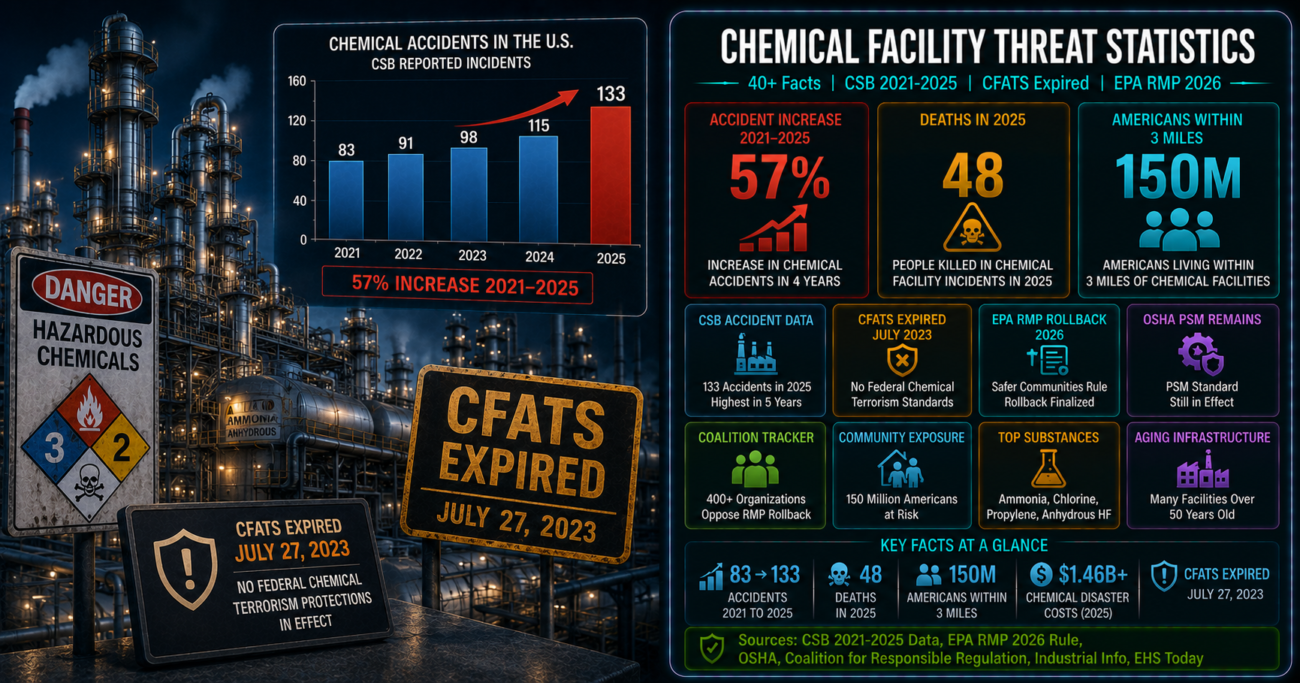
Serious chemical accidents rose 57% between 2021 and 2025. Deaths nearly doubled from 2024 to 2025. More than 650 accidents occurred between April 2020 and May 2026, producing 103 fatalities, 355 injury-causing incidents, and 314 events with substantial property damage. These numbers come against a backdrop of significant regulatory change: CFATS – the federal program that had regulated security at 3,200 high-risk chemical facilities since 2007 – expired on July 28, 2023, and Congress has not reauthorized it. EPA’s 2024 Safer Communities rule, which tightened accident prevention at 11,500 facilities, was proposed for rollback in February 2026. This article compiles 40+ statistics on chemical facility incidents, threat categories, the regulatory gap, and what the current landscape means for facility safety programs.
Editor's Choice: Key Chemical Facility Statistics for 2024-26
1. Chemical Accident Trends 2021-2025: A 57% Rise in Serious Incidents
- An analysis by Public Employees for Environmental Responsibility (PEER) using Chemical Safety and Hazard Investigation Board (CSB) data found that serious industrial chemical accidents rose 57% between 2021 and 2025, from 83 to 131 reportable events involving releases of dangerous substances. Accidents involving injuries or fatalities rose from 60 to 89 over the same period. (PEER / CSB, June 2026; Inside Climate News, June 2026)
- Federal CSB data captures 133 reportable events in 2025 in its quarterly-revised database, slightly higher than PEER’s figure of 131. The discrepancy reflects timing of reporting and retroactive corrections. Both figures represent a near-doubling from 2021 levels. (PCI Magazine, July 2026, citing CSB data)
- Chemical accidents killed 48 people in 2025 – nearly double the number killed in 2024, according to a Wall Street Journal analysis of CSB data. The 2025 toll included 16 people killed in a single explosion at a manufacturing facility in McEwen, Tennessee. (WSJ / CSB; Coming Clean Inc., 2026)
- Between April 2020 and May 2026, the CSB database shows more than 650 chemical accidents, with 103 resulting in fatalities, 355 causing injuries, and 314 causing substantial property damage. Close to 150 million people live within 3 miles of these facilities. (Inside Climate News, June 2026; CSB database)
- The Coalition to Prevent Chemical Disasters, which tracks news reports rather than just formal CSB reportable events, counted approximately 215 dangerous chemical incidents in 2025 – fires, explosions, and toxic releases – roughly twice the CSB figure. The difference reflects the CSB’s narrow reporting threshold, which excludes incidents that result only in shelter-in-place or evacuation orders without a chemical release. (Scientific American, May 2026; Coalition data)
- A cross-sectional academic study published in the Annals of Emergency Medicine (September 2025) analyzing data from EPA, CSB, HAZMAT Incident Database, and the Coalition found that 102,177 hazardous chemical incidents occurred in the U.S. from 2021 to 2024, resulting in damages exceeding $1 billion. Approximately 1,033 (1%) were HAZMAT releases that threatened public health, frequently occurring around transportation corridors and storage facilities. (Annals of Emergency Medicine, September 2025)
2. CFATS Expired: The Chemical Security Gap Since July 2023
- On July 28, 2023, Congress allowed the statutory authority for the Chemical Facility Anti-Terrorism Standards (CFATS) program to expire. CISA can no longer require facilities to report their chemicals of interest, perform inspections, require Site Security Plans, or provide compliance assistance. The program has not been reauthorized as of July 2026. (CISA.gov/cfats, 2023)
- When CFATS was active, it regulated 3,200 high-risk chemical facilities through a tiered risk system and covered communities where 89 million Americans lived or worked within 2 miles of those sites. With CFATS expired, CISA explicitly states that “our tools to lessen the risk of such an attack are now limited.” (CISA; SOCMA, 2023)
- CFATS had covered 322 chemicals of interest (COI) categorized by three threat types: release (toxic, flammable, explosive), theft/diversion, and sabotage. The tiered structure placed the most dangerous and attractive-to-terrorists facilities in Tier 1 and 2 with the most stringent security requirements. (CISA CFATS appendix)
- More than 90% of CFATS site visits resulted in confirmed outreach with local law enforcement and fire departments – creating a safety information-sharing network that connected first responders to site-specific chemical hazard data. CISA can no longer conduct these visits or confirm that these relationships exist. (CISA statement on CFATS lapse)
- CISA has encouraged facilities to maintain voluntary security measures through the ChemLock program, which provides guidance and resources but carries no enforcement authority and imposes no reporting obligations. Industry associations including SOCMA have advocated for CFATS reauthorization through the National Defense Authorization Act process but as of mid-2026 no legislation has passed. (SOCMA; CISA ChemLock, 2024)
3. EPA's RMP Rollback Proposal: The 2024 Safer Communities Rule Under Revision in 2026
- The 2024 Safer Communities by Chemical Accident Prevention rule covered approximately 11,500 RMP-regulated facilities nationwide, including chemical manufacturers and distributors, oil refineries, agricultural supply distributors, water and wastewater treatment facilities, and food and beverage manufacturers. (EPA Fact Sheet, March 2026)
- EPA’s February 2026 proposed rollback would rescind: safer technology and alternatives analysis requirements, mandatory third-party audits following accidents, requirements to provide chemical hazard information to communities upon request, employee participation provisions, and climate-related emergency planning mandates. (Holland and Knight, March 2026; Haynes Boone, March 2026)
- EPA estimates the proposed rollback would generate $234.7 to $241.9 million in annualized cost savings, with more than half from eliminating the safer technology review requirement alone. The agency frames this as reducing duplicative requirements relative to OSHA’s Process Safety Management standard. (EPA Fact Sheet; Alliance Chemical, May 2026)
- Critics including members of Congress note that between 2016 and 2020, nearly 100 reportable chemical accidents occurred annually at RMP facilities, resulting in worker fatalities, thousands of injuries, and billions of dollars in property damage – the evidence base that justified the 2024 rule in the first place. (Krishnamoorthi letter to EPA, February 2026)
- EPA itself cited data in the proposed rollback document showing that RMP-reportable accidents declined from 147 in 2014 to 81 in 2023 – a 45% reduction – as evidence that the pre-SCCAP RMP framework was working sufficiently. Critics counter that the 2025 acceleration in incidents argues against relaxing requirements at this juncture. (Holland and Knight, March 2026; PEER analysis, June 2026)
4. Chemical Facility Threat Categories: What the Data Shows
- The most consequential 2025 chemical incident by death toll was the explosion at a manufacturing facility in McEwen, Tennessee, which killed 16 people. It was among several high-profile incidents that drove the 2025 death toll to nearly double 2024 levels. The incident prompted renewed calls for stronger accident prevention requirements. (Scientific American, May 2026)
- The GKN Aerospace Transparency Systems plant explosion in Garden Grove, California on May 22, 2026 – when temperatures spiked inside a tank containing approximately 7,000 gallons of methyl methacrylate – illustrated the compounding risk of inadequate physical containment. GKN had agreed to pay more than $900,000 in 2025 for violations uncovered by the South Coast Air Quality Management District, and OSHA had cited the site in 2018. (Scientific American, May 2026)
- The West Fertilizer explosion (West, Texas, 2013) remains the canonical example of how converging security failures and safety failures produce catastrophe: 15 deaths, 260+ injuries, inadequate fencing, and prior reports of ammonium nitrate theft from the site. The CSB findings from that investigation remain the most-cited evidence for why chemical facility security and safety programs must be integrated. (CSB West Fertilizer investigation)
- CISA’s voluntary ChemLock program – the only remaining federal resource for chemical facility security after CFATS expired – provides assessments, training, and planning tools but cannot require facilities to take any action. As of mid-2026, ChemLock participation remains voluntary and unverified. (CISA ChemLock; SOCMA)
- The Annals of Emergency Medicine study found hazardous chemical incidents frequently occurred around transportation corridors and storage facilities – not just fixed chemical manufacturing sites – confirming that the chemical security risk landscape extends well beyond the 3,200 facilities that CFATS had historically targeted. (Annals of Emergency Medicine, September 2025)
5. OSHA Process Safety Management: The Remaining Mandatory Framework
- OSHA’s Process Safety Management standard at 29 CFR 1910.119 remains the most comprehensive mandatory federal safety framework for chemical facilities handling highly hazardous chemicals. EPA’s proposed RMP rollback explicitly cites PSM as the surviving framework, framing the SCCAP rule requirements as “duplicative” of PSM rather than additive to it. (EPA Fact Sheet; Holland and Knight, March 2026)
- PSM’s fourteen elements – including Process Hazard Analysis, Management of Change, and Incident Investigation – create the core of what OSHA inspectors evaluate during chemical facility PSM audits. Mechanical integrity failures and inadequate Management of Change procedures are consistently among the most-cited PSM violations in enforcement actions. (OSHA PSM enforcement data)
- The PSM-RMP coverage gap is significant. EPA estimates approximately 11,500 facilities are subject to RMP, while PSM covers a different (overlapping but not identical) population of facilities handling different chemicals at different thresholds. The 2024 SCCAP rule specifically added requirements for facilities that have historically had high accident rates but are not covered by PSM – a population that would be left with reduced requirements if the rollback is finalized. (EPA; Haynes Boone, March 2026)
- Facilities that have begun compliance with the 2024 SCCAP rule – particularly the safer technology analysis and third-party audit requirements – are in a planning uncertainty period. Haynes Boone recommends that RMP-regulated facilities evaluate the impact of the proposed revisions on ongoing SCCAP compliance efforts and reassess whether to submit comments to the EPA docket before the rule is finalized. (Haynes Boone, March 2026)
6. Community Exposure and Environmental Justice Dimensions
- Between January 2021 and October 2023 alone, the Coalition to Prevent Chemical Disasters tracked at least 825 chemical incidents resulting in nearly 200 community evacuations in the United States. Many incidents stemmed from the fossil fuel lifecycle. These figures substantially undercount the total incident burden because they capture only publicly reported events. (Coalition data; Coming Clean Inc.)
- The Philadelphia Energy Solutions refinery fire (June 2019) – among the most significant recent incidents – caused an estimated $750 million in property damage after a severely corroded pipe elbow released more than 5,000 pounds of hydrofluoric acid and launched a 38,000-pound equipment fragment across the Schuylkill River. The CSB investigation found that HF risk had been flagged for years without remediation. (Inside Climate News, June 2026)
- The South Philadelphia neighborhood near the 2019 refinery explosion was described as “mostly Black and brown” – typical of the geographic pattern that characterizes environmental justice concerns around chemical facilities. The 2024 SCCAP rule specifically added requirements for facilities in industry sectors with high accident rates near vulnerable communities. The proposed rollback would rescind requirements targeting exactly this population. (Inside Climate News; Haynes Boone, 2026)
- RMP facilities are required to submit risk management plans that include worst-case and alternative release scenarios estimating the distance to an endpoint that could cause serious injury or death. The 2024 SCCAP rule tightened requirements for providing this information to nearby communities. The proposed rollback would restrict community access to this information through a modified public data tool. (Holland and Knight, March 2026)
7. What Chemical Facilities Should Be Doing in the Current Regulatory Landscape
- With CFATS expired, chemical facilities should engage with CISA’s voluntary ChemLock program to maintain the security planning, assessment, and first-responder coordination activities that CFATS previously required. ChemLock offers vulnerability assessments, consequence analysis, security planning guides, and training – all without regulatory obligation, but all essential to maintaining the site security posture that CFATS mandated. (CISA ChemLock)
- OSHA’s PSM standard (29 CFR 1910.119) remains the most comprehensive mandatory chemical process safety framework and is not affected by the RMP rollback proposal. Facilities should ensure PSM compliance is current, including Process Hazard Analysis revalidation schedules, mechanical integrity programs, and Management of Change documentation – since OSHA can and does inspect PSM compliance independently of EPA enforcement. (OSHA PSM enforcement)
- RMP-regulated facilities should carefully monitor finalization of the EPA “Common Sense” rollback proposal. Haynes Boone specifically advises facilities to evaluate the impact of proposed revisions on ongoing SCCAP compliance investments and consider whether to document incurred compliance costs in comments to the EPA docket. Facilities that have already completed STAA analyses or third-party audits may have a comment period opportunity to shape what the final rule requires. (Haynes Boone, March 2026)
- The rising cyber threat to industrial control systems has not diminished with the CFATS expiration. CISA continues to publish advisories and respond to industrial control system (ICS) and operational technology (OT) intrusions. Chemical facilities should maintain ICS security programs under CISA’s voluntary chemical sector guidance, including segmentation of control networks, remote access controls, and incident response planning for cyber-triggered process upsets. (CISA ICS-CERT; chemical sector guidance)
Key Takeaways for Chemical Facility Safety and Security Professionals
Sources
Government and Regulatory Sources
- CISA – CFATS Program Page: July 28, 2023 expiration, 3,200 facilities, 89M within 2 miles, ChemLock voluntary successor, CISA cannot ensure facilities are mitigating terrorist exploitation
- EPA Fact Sheet – Common Sense Approach to Chemical Accident Prevention Proposed Rule (March 2026): 11,500 RMP facilities, $234.7-241.9M annualized savings, proposed rescissions
- EPA – 2024 Safer Communities by Chemical Accident Prevention (SCCAP) Rule Timeline: March 11, 2024 final rule, March 12, 2025 reconsideration, February 13, 2026 proposed Common Sense rule
Research and Industry Sources
- Inside Climate News (June 2026) – Chemical accidents rise 57% 2021-2025: 83 to 131, PEER/CSB analysis, 650+ accidents April 2020-May 2026, 103 fatalities, $750M Philadelphia Energy refinery damage
- PEER (June 2026) – Industrial Chemical Accidents Rise Amid Safety Rollbacks: 83 to 131 accidents 2021-2025, injuries/fatalities 60 to 89, CSB undercount analysis
- PCI Magazine (July 2026) – 133 reportable events in 2025 per CSB database (quarterly revised), RMP proposed rule affects approximately 11,500 facilities
- Scientific American (May 2026) – Back-to-Back Chemical Accidents: 215 incidents 2025 (Coalition tracker), GKN Aerospace May 2026 explosion, 12,000 RMP facilities per EPA
- Annals of Emergency Medicine (September 2025) – 102,177 hazardous chemical incidents 2021-2024, over $1 billion in damages, 1,033 public health threats, transportation corridor concentration
- Haynes Boone (March 2026) – EPA RMP Rollback: SCCAP provisions proposed for rescission, facilities should evaluate impact and consider comment submission
- Holland and Knight (March 2026) – EPA Common Sense Rule: RMP-reportable accidents declined 147 (2014) to 81 (2023), definition gaps, PSM alignment framing
- Coming Clean Inc. – Chemical Disaster Prevention Program: 825 incidents Jan 2021-Oct 2023, approximately 200 evacuations, 48 deaths in 2025 (WSJ/CSB data)