GUIDES: Construction Safety Orientation
Safety Orientation for New Construction Workers:
A Complete Supervisor Guide
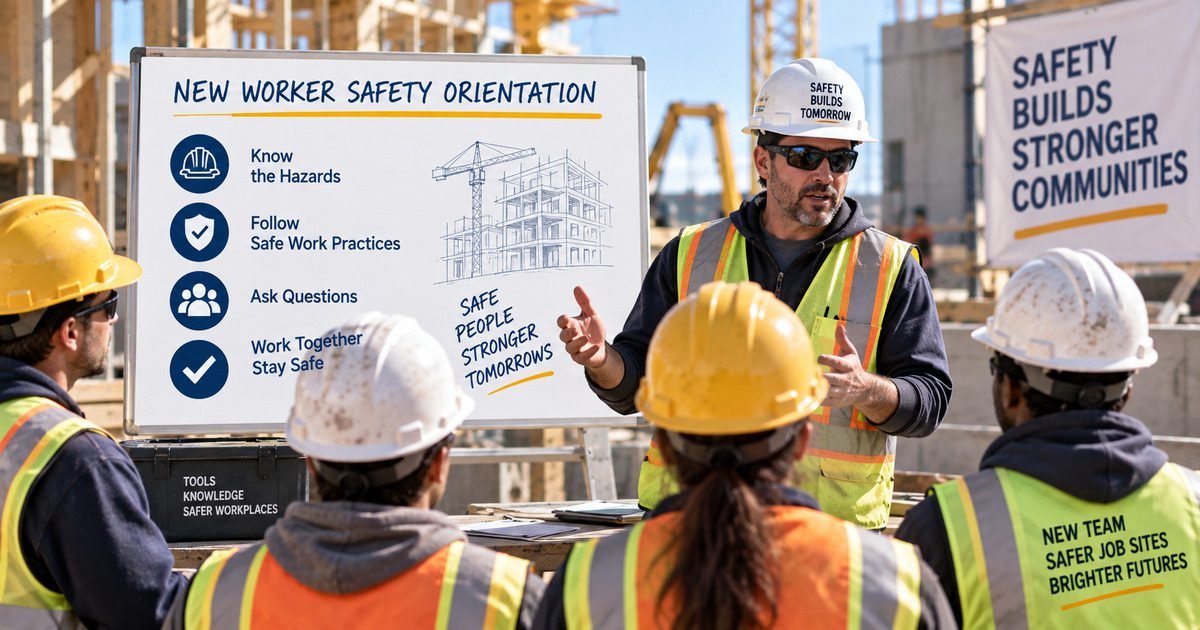
New construction workers are injured at a rate nearly three times higher than experienced workers during their first year on the job. OSHA’s 29 CFR 1926.21(b)(2) requires employers to instruct every employee in the recognition and avoidance of unsafe conditions before they begin work. A safety orientation is not optional and is not a formality, it is the first mandatory safety control for every new hire, returning worker, and subcontractor joining a site. This guide covers what OSHA requires, how to structure a compliant orientation, what documentation you must retain, and the orientation failures that most commonly trigger citations and early-career injuries.
40%
of Construction Fatalities Involve Workers in Their First Year
CPWR research consistently shows that workers during their first year on a construction site account for a disproportionate share of serious injuries and fatalities. The hazard exposure is greatest before site-specific training takes effect. A structured safety orientation is the primary control that closes this window of elevated risk.
CPWR: The Construction Chart Book (2024 Edition)
$16,131
OSHA Maximum Penalty Per Serious Violation
OSHA can cite employers up to $16,131 per serious violation for failure to provide required safety training under 29 CFR 1926.21. Willful or repeated violations carry penalties up to $161,323 per violation. An undocumented or incomplete orientation leaves the employer with no evidence of compliance when a citation is issued or when an injury leads to litigation.
OSHA: Penalty Amounts (2024)
4
Fatal Four Hazards That Must Be Addressed in Every Orientation
Falls, struck-by incidents, electrocution, and caught-in/between hazards, OSHA’s Fatal Four, account for more than 60% of construction worker deaths each year. OSHA’s 1926 Subpart standards governing each of these hazard types carry specific training requirements that must be covered before workers encounter those conditions on site.
OSHA: Fatal Four Construction Hazards
29 CFR 1926.21(b)(2) is the foundational training requirement for construction: employers must instruct each employee in the recognition and avoidance of unsafe conditions and the regulations applicable to their work environment to control or eliminate any hazards or other exposure to illness or injury. This instruction must happen before the employee begins work. A safety orientation is the mechanism for delivering that instruction at the point of hire or site entry.
Beyond the general training obligation, specific 29 CFR 1926 subpart standards impose additional training requirements that must be addressed before workers encounter those hazards. Fall protection training under 1926.503 must happen before workers are exposed to fall hazards. Scaffold training under 1926.454 must happen before workers use or work near scaffolding. Electrical safety training under 1926.416 applies before workers work near electrical hazards. A single orientation session must cover all training obligations applicable to the work the employee will perform.
Who requires a safety orientation
New hires on their first day. Returning workers who have been absent for 90 days or more. Subcontractors and their workers entering a new general contractor’s site. Workers reassigned to a new project with different hazards. Anyone whose job scope changes materially during the project. A worker who received an orientation two years ago on a different site has not received the site-specific training required by 29 CFR 1926.21(b)(2) for the current site.
What an orientation must accomplish
The worker must be able to recognise the hazards present at their specific site, know the controls in place for each hazard, understand emergency procedures and who to contact, know how to report unsafe conditions and injuries, understand the PPE requirements and how to use the equipment correctly, and know the site-specific rules. A general industry safety overview does not satisfy 1926.21(b)(2), the instruction must be specific to the work environment and the hazards the worker will actually encounter.
Site-specific hazard inventory
The orientation content cannot be finalised until the site’s specific hazards are documented. What fall exposures exist? What electrical hazards are present? What equipment is operating? What chemicals are on site? The Job Hazard Analysis (JHA) or site safety plan is the source document for orientation content, not a generic construction safety template.
Written documentation forms
Prepare the training acknowledgement form before the session. It must capture: worker name, date, topics covered, trainer name, and the worker’s signature confirming they received and understood the training. Pre-printed forms ensure nothing is missed. Handwritten notes on a clipboard are not sufficient, they will not survive an OSHA inspection or a legal proceeding.
PPE and site materials
Have all required PPE ready for issuance at the orientation, not “available later.” Under 29 CFR 1926.28, the employer must require employees to use appropriate PPE before they begin work. Issuing PPE after orientation, on the worker’s first active day, means they may be exposed to hazards without the required controls already in place.
Language and literacy assessment
OSHA has consistently held that training must be conducted in a language and vocabulary the worker understands. If a worker does not read or speak English, the orientation must be delivered in their primary language or through a qualified interpreter. Handing a Spanish-speaking worker an English-language handout and having them sign an acknowledgement does not satisfy the training requirement.
Problem: Orientation completed in under 30 minutes to get workers on tools faster
Root cause: Production pressure is treated as competing with safety requirements rather than both being non-negotiable. Fix: Build the orientation block into the project schedule as a fixed cost, one to two hours minimum per new worker, not reducible. Assign a dedicated safety trainer rather than relying on a foreperson who has competing priorities. A 20-minute orientation does not satisfy 29 CFR 1926.21(b)(2) and will not survive an OSHA inspection or post-incident scrutiny. The injury risk it creates is far more expensive than the time it would have taken.
Problem: The same orientation template is used for every worker on every project
Root cause: The orientation is treated as a document to be completed rather than a training event to be delivered. Fix: The orientation template should have a fixed section (company policy, worker rights, emergency reporting) and a variable section that is populated from the site’s current JHA. Every site has different fall exposures, different equipment, different chemical hazards. A worker who received an orientation for a concrete pour project and is now assigned to steel erection has not received the training required for the new work. The orientation must be updated each time the hazard profile changes materially.
Problem: Documentation exists but workers did not actually understand the training
Root cause: Training was delivered in English to workers whose primary language is not English, or the knowledge check was skipped to save time. A signed form does not prove comprehension, it proves presence. Fix: Deliver all orientation content in the worker’s primary language. Conduct the knowledge check as a two-way conversation, not a written test. Ask the worker to demonstrate what they would do in an emergency. Ask them to show you where the first aid kit is. Comprehension testing takes less than five minutes and provides far better evidence of effective training than a signature on a form.
Problem: Subcontractors’ workers receive a reduced orientation or skip it entirely
Root cause: The assumption that the subcontractor’s employer is responsible for training, so the general contractor does not need to provide a site-specific orientation. Fix: Under OSHA’s multi-employer worksite doctrine, the general contractor has a controlling employer duty to ensure that all workers on the site, including subcontractors’ workers, receive the site-specific hazard information required by 29 CFR 1926.21(b)(2). The subcontractor may be responsible for trade-specific training; the GC is responsible for site-specific hazard orientation for every person who enters the site. This includes one-day workers, delivery personnel in hazard zones, and specialty subcontractors doing a single visit. Source: OSHA: Multi-Employer Worksite Policy
A safety orientation is a legal obligation under 29 CFR 1926.21, not a best practice
OSHA’s 29 CFR 1926.21(b)(2) requires that every construction employee receive instruction in the recognition and avoidance of unsafe conditions before they begin work. This is not a recommendation. An employer who puts a new worker on a construction site without completing a site-specific safety orientation has already violated this standard. The penalty exposure starts at $16,131 per serious violation. If the worker is injured before the orientation happens, the violation becomes evidence in the workers’ compensation and civil proceedings that follow.
Documentation proves the orientation happened, the knowledge check proves it worked
A signed training acknowledgement form proves presence, not comprehension. OSHA’s training standard for construction requires effective training, training that the worker understands. During an OSHA inspection following a worker injury, the inspector will ask not only whether training was documented, but whether the training was effective. A brief verbal knowledge check at the end of the orientation creates evidence that the worker understood the hazards, controls, and emergency procedures, and it takes less than five minutes to conduct.
Site-specific hazard information cannot be replaced by a generic construction safety overview
The most common orientation failure is delivering a generic construction safety lecture while the worker has no information about the specific hazards at the site they are about to enter. A worker who understands fall protection in the abstract but does not know that the floor opening on Level 3 is currently uncovered, that the crane swing radius extends over the entrance path, or that a confined space permit is required for the manhole access, that worker is not equipped to work safely on this site regardless of how comprehensive the generic training was. The site-specific hazard walkthrough is the element that makes orientation a safety control rather than a compliance exercise.
What OSHA standard requires construction safety orientation?
The primary standard is 29 CFR 1926.21(b)(2), which requires employers to instruct each employee in the recognition and avoidance of unsafe conditions and the regulations applicable to their work environment to control or eliminate any hazards or exposure to illness or injury. Beyond this general obligation, specific subpart standards impose additional training requirements: fall protection training under 1926.503 (before fall hazard exposure), scaffold training under 1926.454, and hazard communication training under 1926.59. Each of these must be completed before the worker encounters the relevant hazard. Source: 29 CFR 1926.21(b)(2)
Does OSHA specify how long a safety orientation must be?
No. OSHA does not specify a minimum duration for safety orientation. What OSHA requires is that the training be effective, that the employee actually understands the hazards and controls relevant to their work. Duration is a function of the complexity of the site and the hazards present. A simple renovation with limited hazards may require less time than a multi-trade heavy construction project with fall exposures, confined spaces, and hazardous materials. The standard is comprehension, not clock hours. An OSHA inspector evaluating a training programme will ask whether the worker could demonstrate understanding of the hazards, not whether the session lasted a minimum number of minutes.
Are subcontractors’ workers required to receive a site safety orientation from the general contractor?
Yes. Under OSHA’s multi-employer worksite policy, the general contractor has a controlling employer responsibility to ensure that hazardous conditions on the site are identified and corrected, including ensuring that all workers on site, regardless of their employer, receive site-specific hazard information. The subcontractor may be responsible for trade-specific training. The general contractor is responsible for site-specific hazard orientation for every person who enters the site. This includes subcontractors, sub-subcontractors, one-day specialty workers, and delivery personnel who enter areas with active hazards. Assuming the subcontractor handled orientation without verifying it does not transfer the GC’s liability. Source: OSHA: Multi-Employer Worksite Policy
How long must safety orientation training records be kept?
OSHA does not specify a universal retention period for general safety training records under 29 CFR 1926. However, specific standards impose retention requirements: OSHA’s hazard communication standard (29 CFR 1926.59) incorporates the requirement to maintain safety data sheets, and recordkeeping requirements under 29 CFR 1904 specify that OSHA injury and illness records must be retained for five years. As a practical matter, safety orientation records should be retained for the duration of employment and a minimum of three to five years after separation, as they may be relevant in workers’ compensation proceedings and civil litigation that arise years after the training event. Source: OSHA: Recordkeeping Requirements
What must fall protection training cover and when must it happen?
Under 29 CFR 1926.503, employers must provide fall protection training for each employee who might be exposed to fall hazards. The training must be conducted by a competent person and must cover: the nature of fall hazards in the work area; the correct procedures for erecting, maintaining, disassembling, and inspecting fall protection systems; the use and operation of guardrail systems, personal fall arrest systems, safety net systems, warning line systems, safety monitoring systems, controlled access zones, and covers; the role of each employee in the safety monitoring system; the limitations on the use of mechanical equipment during roofing work on low-sloped roofs; and the correct procedures for equipment and materials handling, erection of overhead protection, and fall protection plan procedures. This training must be completed before the worker is exposed to a fall hazard. Source: 29 CFR 1926.503
What are OSHA’s penalties for failure to provide required construction safety training?
OSHA’s current penalty structure (as of 2024) sets a maximum of $16,131 per serious violation. A serious violation exists when there is a substantial probability that death or serious physical harm could result from a condition that exists, and the employer knew or should have known of the hazard. Failure to provide required safety training under 29 CFR 1926.21, 1926.503, or other specific training standards can be cited as a serious violation. Willful violations, where the employer intentionally disregarded the requirement, carry penalties up to $161,323 per violation. Repeated violations of the same standard within a five-year period also carry penalties up to $161,323. Source: OSHA: Penalty Amounts
Does a returning worker who was previously on this site need a new orientation?
It depends on how much has changed and how long the worker has been away. A worker returning after two weeks’ vacation to the same site with the same scope of work does not require a full orientation, a brief toolbox talk on any changes since they left is sufficient. A worker returning after a 90-day or longer absence, or returning to a site where the phase of work has changed significantly, should receive a refresher orientation covering the current hazards. A worker who was on a different site and is now joining this one for the first time requires a full site-specific orientation regardless of their experience level. Experience in construction does not transfer site-specific hazard knowledge, every site has different conditions, different equipment, different emergency procedures, and different access routes.
Guides
VelSafe Construction Safety Guides Library
Browse the full VelSafe Guides library for construction safety programme references covering fall protection, scaffolding, PPE programmes, JHA development, and OSHA compliance management.
Tips
VelSafe Construction Safety Tips
Practical, action-oriented safety tips for construction supervisors and workers, covering daily inspections, toolbox talk delivery, PPE compliance, and hazard reporting culture.
Law
OSHA Construction Compliance: Law and Penalty Guides
The VelSafe Law library covers the OSHA standards behind the training requirements in this guide, including 1926.21, 1926.503, and the penalty structure for training violations, with plain-language analysis for compliance teams.
CONSTRUCTION SAFETY GUIDES LIBRARY
More Construction Safety Programme Guides
Explore VelSafe’s construction safety guides library for complete programme references covering fall protection, scaffolding, PPE, hazard communication, and OSHA compliance for construction supervisors and EHS teams.
Explore All Guides