

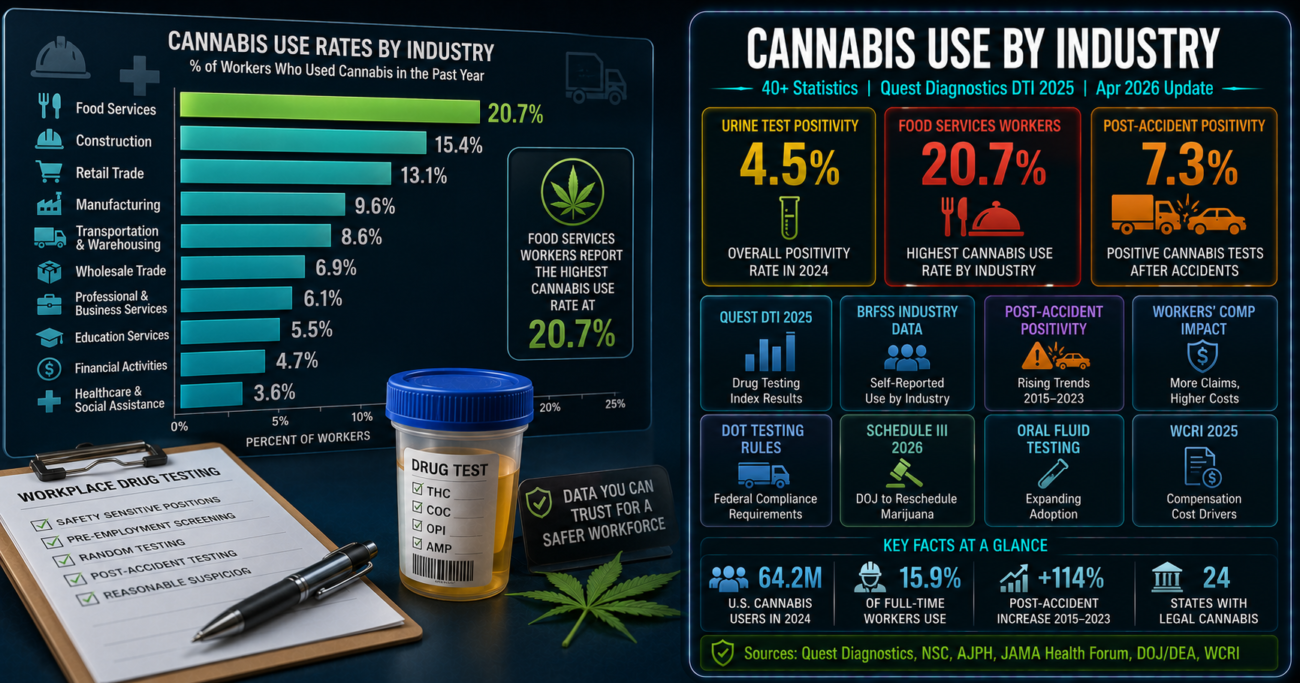
Cannabis is now legal for recreational use in 24 states, and 15% of Americans identify as active marijuana users – the highest proportion since Gallup began asking the question. In the workforce, the numbers are equally striking. Over 64 million Americans used cannabis in 2024, the highest ever recorded. Yet the federal classification, the DOT testing rules, and the safety evidence have not changed in a way that makes workplace cannabis use less consequential for employers or safety managers.
Marijuana positivity rates in drug tests have climbed steadily since 2015. Post-accident positivity hit a record high in 2023 and remained near that level in 2024. Recreational marijuana laws in states have been associated with a 10% increase in workplace injuries among workers aged 20 to 34. And on April 23, 2026, the DOJ partially moved state-licensed medical marijuana to Schedule III – without changing federal workplace testing obligations. Below we have compiled 40+ statistics on cannabis use by industry, drug testing data, safety impact, and the current legal landscape through 2025-26.
Editor's Choice: Key Cannabis Workforce Statistics for 2025-26
1. National Snapshot: Cannabis Use Among U.S. Workers in 2024-25
- A 2024 study in the American Journal of Public Health analyzing BRFSS data from 15 states found 10.7% of adult workers reported past 30-day cannabis use – with rates varying widely by industry, occupation, age, and education. (AJPH, November 2024)
- A more recent 2024 American Journal of Preventive Medicine study focusing on full-time workers found a higher rate: 15.9% of full-time employed adults used cannabis in the past month, and 6.5% met diagnostic criteria for cannabis use disorder. (AJPM, 2024; NSC)
- Gallup’s 2023-2024 combined data shows 15% of Americans identify as active marijuana users, up slightly from 14% in 2021-2022 and dramatically higher than the 4% who reported trying marijuana when Gallup first asked the question in 1969. (Gallup / Flowhub, 2026)
- 64.2 million Americans used cannabis in 2024 – the highest number ever recorded – driven by legalization in 24 states for adult recreational use and continued growth in both medical and social use patterns. (Upmetrics, April 2026)
- A 2025 cross-sectional analysis found approximately 8% of all workers said they used cannabis shortly before or at work, and 21% of past-year cannabis consumers reported the same. Among daily consumers, the proportion reporting on-the-job use was substantially higher. (NSC, citing 2025 study)
2. Cannabis Use by Industry: Which Sectors Show the Highest and Lowest Rates
- Accommodation and food services had the highest cannabis use rate at 20.7% – more than one in five workers reporting past 30-day use. The occupation group with the highest rate was food preparation and service at 21.9%. (AJPH, November 2024)
- Arts, entertainment, and recreation workers showed the second-highest rates, followed by construction and extraction workers – a sector with significant safety implications given the physical hazards involved and the prevalence of use among workers. (AJPH, 2024)
- Construction is a particularly high-risk combination: elevated cannabis use prevalence paired with heavy equipment operation, fall hazards, and confined space work. Marijuana positivity in construction workers has been among the highest of any safety-sensitive industry in drug testing data. (AJPH; Quest Diagnostics)
- Healthcare and social assistance workers showed among the lowest rates, alongside finance and insurance and education services – sectors typically characterized by stricter professional licensing requirements, mandatory background checks, and organizational drug-free workplace policies. (AJPH, 2024)
- Transportation and warehousing sits below the national average, reflecting the DOT federal testing mandate for safety-sensitive transportation workers – commercial drivers, pilots, and rail operators – which creates a strong deterrent regardless of state legalization. (AJPH; DOT drug testing rules)
3. Workplace Drug Testing: Marijuana Positivity Data Through 2024-25
- The 2025 Quest Diagnostics Drug Testing Index analyzed more than 8 million drug test results from 2024. Marijuana positivity for the general workforce from urine tests was 4.5% – far outpacing amphetamines at 1.7%, the second most common positive result. (Quest Diagnostics 2025 DTI)
- Oral fluid testing showed marijuana positivity of 10.4% in 2024 – more than double the urine rate, reflecting that oral fluid captures more recent use patterns and is more resistant to specimen tampering or substitution. (Quest Diagnostics 2025 DTI)
- Hair testing showed 9.8% marijuana positivity in 2024, with cocaine second at 2.8% – reflecting the longer detection window of hair testing, which captures use patterns over the preceding 90 days rather than recent days. (Quest Diagnostics 2025 DTI)
- For federally mandated (DOT-regulated) tests, marijuana was the most detected drug at 0.87% in 2024, with amphetamines second at 0.80%. The lower rate for federally mandated workers reflects the strong deterrent effect of regular DOT testing on commercial drivers, pilots, and safety-sensitive transport workers. (Quest Diagnostics 2025 DTI)
- General workforce urine marijuana positivity has increased from 3.6% in 2020 to 4.5% in 2024 – a consistent upward trend that correlates directly with state-level recreational marijuana legalization. (Quest Diagnostics 2025 DTI)
- The 2026 Quest Diagnostics DTI (analyzing 2025 test data) reported the combined workforce urine drug positivity held at 4.3%, a decrease of 2.3% compared to 4.4% in 2024, with marijuana continuing as the primary driver. In the general workforce specifically, marijuana positivity reached 4.4% and oral fluid positivity reached 11.1%. (Quest Diagnostics 2026 DTI / PR Newswire, July 2026)
4. Workplace Safety Impact: Post-Accident Positivity and Injury Statistics
- Post-accident marijuana positivity was 7.3% in 2024 – just below the record 7.5% set in 2023, which was itself the culmination of a nine-year upward trend. Between 2015 and 2023, post-accident marijuana positivity increased 114.3% in the general U.S. workforce. (Quest Diagnostics 2025 DTI)
- A February 2024 study in JAMA Health Forum found recreational marijuana laws allowing retail sales were associated with a 10% increase in workplace injuries among individuals aged 20 to 34 years – the demographic with the highest cannabis use rates. (JAMA Health Forum, February 2024; Quest Diagnostics, May 2024)
- The Workers’ Compensation Research Institute’s 2025 report found that enactment of a recreational marijuana law leads to a 7.7% increase in workers’ compensation claim frequency at the 1.7-year mark, rising to a 15% increase by the fifth year. (WCRI, 2025; Quest Diagnostics insight)
- In a 2024 study of fatally injured drivers in the United States, more than one-third tested positive for cannabis. Drivers in states with recreational cannabis laws had significantly higher odds of cannabis positivity than drivers in states without such laws. (NSC, citing 2024 study)
- Cannabis affects cognitive skills critical to workplace safety: attention, reaction time, short-term memory, coordination, and judgment. The duration of impairment varies by potency, consumption method, and individual tolerance – making policy enforcement more complex than alcohol impairment assessment. (NSC; DISA)
- The 2024 AJPM study found that more frequent cannabis use and greater cannabis use disorder severity were associated with higher rates of illness, injury-related absences, and skipped work – documenting a productivity and safety cost beyond the injury statistics alone. (AJPM, 2024; NSC)
5. The Legal Landscape in 2025-26: Legalization, Rescheduling, and Employer Obligations
- On April 23, 2026, the DOJ issued a final order immediately moving FDA-approved marijuana products and marijuana subject to a state medical marijuana license from Schedule I to Schedule III of the Controlled Substances Act – effective April 28, 2026. (DOJ press release; Seyfarth Shaw, June 2026)
- The April 2026 rescheduling order is limited in scope: it covers only FDA-approved products and state-licensed medical marijuana. All other marijuana – recreational cannabis, most bulk marijuana, and products outside these regulatory channels – remains Schedule I under federal law. (Gibson Dunn, April 2026)
- The partial rescheduling does not override state marijuana or employment laws, DOT testing requirements, or federal workplace drug testing rules. DOT-regulated employers must maintain current policies, testing panels, and enforcement procedures. (DISA, December 2025; DATCS, May 2026)
- A DEA administrative hearing on broader rescheduling of all marijuana to Schedule III is scheduled to begin June 29, 2026 – a proceeding that could significantly reshape federal marijuana policy, employer obligations, and workplace testing authority. (DEA.gov; Moritz College of Law, 2026)
- Adult-use recreational cannabis is now legal in 24 states. Employers in those states must navigate overlapping requirements including state medical marijuana statutes, disability discrimination laws, off-duty conduct protections, and state-specific limitations on employment drug testing. (Seyfarth Shaw, June 2026)
- Support for legalizing cannabis reached 87% in survey data, and cannabis tax revenue reached $25 billion nationally – nearly double that of alcohol. The commercial and political momentum for full legalization continues even as the federal regulatory picture remains unsettled. (Flowhub, 2026)
6. High-Risk Industry Focus: Construction, Transportation, and Food Services
- Construction’s combination of high cannabis use prevalence and hazardous physical working conditions – heavy equipment, elevated work surfaces, excavation hazards – creates a compounded safety risk that industry safety programs must specifically address. (AJPH, 2024; industry safety data)
- In transportation, marijuana is the most detected drug in federally mandated tests even at the lower 0.87% rate – with amphetamines second at 0.80%. The existence of DOT testing creates a meaningful deterrent, but the drug remains present in the safety-sensitive transport workforce. (Quest Diagnostics 2025 DTI)
- Food preparation and service workers showed the highest rate of any occupation group at 21.9% past 30-day use. Workplace injuries in this sector – burns, cuts, slips – may be influenced by impairment from cannabis or other substances, though the causal relationship is difficult to isolate. (AJPH, 2024)
- Healthcare and social assistance showed among the lowest cannabis use rates, reflecting professional licensing consequences, mandatory background check environments, and the nature of patient care responsibilities. Substance use policies in healthcare are among the most rigorously enforced in any sector. (AJPH, 2024)
7. What the Data Means for Employers: Policy, Testing, and Compliance in 2025-26
- Quest Diagnostics recommends employers think twice before dropping marijuana from their drug test panel – when employees and job applicants fail a drug test, it is usually because they used marijuana. The trend has been increasing annually since 2015. (Quest Diagnostics 2025 DTI insight)
- Oral fluid testing detects more recent marijuana use – typically within hours to days – compared to urine testing, which detects metabolites that persist for weeks in frequent users. For safety-sensitive employers concerned about on-the-job impairment, oral fluid provides a more relevant detection window. (Quest Diagnostics; PMC study, 2025)
- The April 2026 DOJ rescheduling order does not change employer obligations for non-medical or recreational cannabis. Federal contractors, DOT-regulated employers, and organizations in safety-sensitive industries retain full authority to prohibit cannabis use and enforce drug-free workplace policies. (Seyfarth Shaw, June 2026; DISA)
- State law complexity is increasing. Employers in states with recreational marijuana laws must now navigate medical marijuana accommodation requirements, off-duty conduct protections, and disability discrimination considerations – particularly when employees present medical marijuana documentation in response to a positive test. (Seyfarth Shaw, June 2026)
- The National Safety Council recommends employers not wait for legal clarity to build cannabis safety programs. The safety evidence – post-accident positivity, injury rate increases, impairment duration – supports proactive policy regardless of state legal status. (NSC Cannabis and Safety resource)
Key Takeaways for Safety Managers and HR Professionals
Sources
Government and Regulatory Sources
- DEA – Marijuana Rescheduling Regulatory Actions: April 28, 2026 Notice of Hearing, NPRM for Schedule I to Schedule III transfer
- DOJ (April 2026) – FDA-approved and state-licensed medical marijuana placed in Schedule III; expedited hearing set for June 29, 2026
- American Journal of Public Health (November 2024) – Cannabis use prevalence by industry among U.S. workers: 10.7% overall, 20.7% food services (BRFSS, 15 states, 2016-2020)
Industry and Research Sources
- Quest Diagnostics 2025 Drug Testing Index (8M+ tests, 2024 data): 4.5% urine, 10.4% oral fluid, 9.8% hair, 7.3% post-accident positivity
- Quest Diagnostics 2026 DTI (July 2026): 4.3% combined urine positivity, 4.4% general workforce, 11.1% oral fluid, 15.1% hair
- National Safety Council – Cannabis and Safety (2025-26): 15.9% full-time worker use (AJPM), 8% on-the-job use, 21% among past-year users, fatally injured driver data
- Seyfarth Shaw (June 2026) – April 2026 rescheduling analysis: employer obligations, DOT rules unchanged, state law complexity
- Moritz College of Law / Drug Enforcement and Policy Center – Federal marijuana rescheduling timeline: December 2025 EO, April 2026 order, June 2026 hearing
- Quest Diagnostics (May 2024) – 114.3% increase in post-accident positivity 2015-2023; JAMA Health Forum 10% injury increase with legalization
- Flowhub (2026) – Cannabis industry statistics: 15% active users (Gallup), 24 legal states, $25B tax revenue, 87% support for legalization
- Upmetrics (April 2026) – 64.2 million Americans used cannabis in 2024 (highest ever); market and employment trends
- DISA (December 2025) – DOT-regulated employer guidance on Schedule III EO: rules unchanged, policy preparation steps
- DATCS (May 2026) – Marijuana rescheduling and DOT drug testing: what federally regulated employers and drivers must know in 2026