
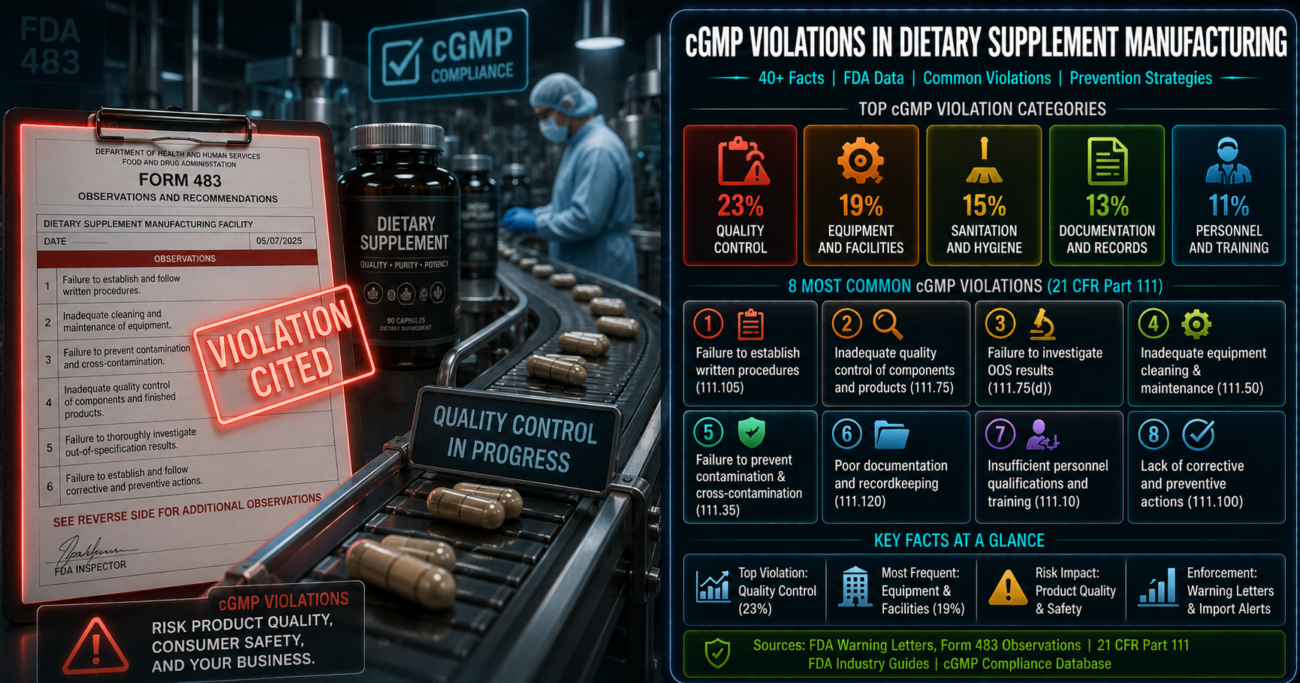
The dietary supplement industry operates on a fundamental compliance paradox: the FDA inspects roughly 5% of registered facilities each year, yet when an inspection does occur, approximately half of all facilities receive a Form 483 citing cGMP violations. And the observations have not changed substantially year over year. The same deficiencies that dominated 483 reports a decade ago – failure to establish product specifications, inadequate component identity testing, weak documentation – continue to account for the majority of citations in 2023 and 2024.
The industry is also growing. The U.S. dietary supplement market reached $70 billion in 2025, with more than 70% of American adults taking at least one supplement. FDA inspections grew from approximately 500 in FY2023 to 600 in FY2024, including a more than doubling of foreign facility inspections. Observations specific to dietary supplements jumped 46% year over year. Below we have compiled 40+ statistics from FDA Form 483 data, FOIA-obtained inspection records, and regulatory sources covering the most common violations, enforcement trends, and 2025-26 regulatory changes that manufacturers need to understand.
Editor's Choice: Key cGMP Violation Statistics for Dietary Supplements
1. FDA Inspection Activity and Industry Scale: The Numbers Behind cGMP Enforcement
- FDA conducted 600 dietary supplement facility inspections in FY2024, growing from approximately 500 in FY2023. Foreign inspections more than doubled, rising from 40 to 90 – a signal of increased scrutiny of international supply chains. (SupplySide Supplement Journal FOIA data, January 2025)
- Despite growing inspection activity, 600 inspections represent approximately 5% of the 13,000-15,000 registered dietary supplement facilities – FDA inspects around 500-600 facilities per year against a much larger base. (FDA ODSP Director Cara Welch, Ph.D., cited in SupplySide, 2025)
- Dietary supplement-specific 483 observations jumped 46% from 1,083 in 2023 to 1,578 in 2024, even as overall food industry 483 observations declined – meaning supplement enforcement intensified within a broader context of reduced food sector citations. (cGMP Consulting, March 2025)
- Nearly half of all dietary supplement facilities inspected in FY2023 received a Form 483 observation – confirming that when FDA does arrive, the odds of finding a violation are high, even after cGMP regulations have been in force since 2007. (Policy Canary, March 2026; Natural Products Insider FOIA)
- The U.S. dietary supplement market reached $70 billion in 2025, with more than 70% of American adults taking at least one supplement and the market projected to reach $128 billion by 2033 – the commercial scale against which these enforcement numbers must be understood. (MarketSpark Solutions, 2026)
- The vitamin and supplement manufacturing sector was valued at $34.1 billion in 2025 (manufacturing revenue, distinct from retail market), growing at 2.0% annually. (IBISWorld, April 2025)
2. The Top cGMP Violations: What FDA 483 Data Shows for 2023-2024
- Failure to establish finished product specifications (21 CFR 111.70(b)(1)) was the top FDA observation in both FY2023 and FY2024 – cited in approximately 33% of all facilities that received a Form 483. Manufacturers must specify identity, purity, strength, composition, and contaminant limits in writing. (Natural Products Insider FOIA, FY2023; Policy Canary, 2026)
- Failure to establish component specifications (21 CFR 111.70(b)(2)) was the second most common citation at approximately 20% of 483-receiving facilities – requiring manufacturers to ensure specs for purity, strength, and composition of dietary ingredients are met. (Natural Products Insider FOIA, FY2023)
- Failure to establish an identity specification for each component appeared in approximately 18% of 483-receiving facilities in FY2023 – the third most common violation, requiring at least one appropriate test to verify ingredient identity before use. (Natural Products Insider FOIA, FY2023)
- The most frequently cited subpart since 2009 has been 21 CFR 111 Subpart E – Requirement to Establish a Production and Process Control System – spanning five sub-categories of process control failures that inspectors consistently find. (Eurofins USA enforcement trends analysis)
- Supplier qualification failure is a persistent top-five observation – requiring manufacturers to establish reliability of supplier certificates of analysis through independent confirmation, not merely on-file acceptance. Relying on a supplier’s CoA alone without independent verification does not satisfy 21 CFR 111.75(a)(2)(ii)(A). (Nutritional Outlook; Certified Laboratories, 2025)
- The top two observations in both 2023 and 2024 are specification failures, not sanitation or contamination – confirming that the most pervasive compliance gap is documentation and quality planning at the design stage, not execution on the production floor. (cGMP Consulting, March 2025)
3. Product and Component Specifications: Why 33% of Facilities Fail the Same Test
- The specification requirement is described by FDA as fundamental to building a quality product – yet it has been the top citation every year it has appeared prominently in inspection data, suggesting systemic non-compliance rather than isolated lapses. (Natural Products Insider, March 2025)
- Without specifications, batch release decisions lack objective criteria – meaning a manufacturer cannot demonstrate, even to themselves, that a product meets its label claims before shipping it to consumers. (cGMP Consulting, March 2026)
- Contract manufacturers face particular scrutiny in the specification area because their failures cascade across every brand they produce for – a single missing specification at a contract facility creates compliance exposure for multiple brand owners simultaneously. (Policy Canary, March 2026)
- The identity testing requirement is specific: manufacturers must conduct at least one appropriate test or examination to verify the identity of each component before use. Relying on a supplier’s certificate of analysis alone – without independent verification – does not satisfy 21 CFR 111.75(a)(2)(ii)(A). (Policy Canary, 2026; Nutritional Outlook)
- The recurring observation pattern reflects what inspectors describe as the regulatory equivalent of building a house without blueprints – companies conducting manufacturing activities without the foundational written controls that FDA’s regulations require to be in place before production begins. (Policy Canary, 2026)
4. Documentation and Record-Keeping Violations: Batch Records, SOPs, and Audit Trails
- Missing or incomplete batch records remain a top recurring observation – FDA requires every step of manufacturing to be documented with signatures, test results, and step completion records. Missing entries, even for steps that were performed correctly, constitute a cGMP violation. (Certified Laboratories, 2025; Policy Canary, 2026)
- SOPs must be specific enough that a trained employee can follow them consistently. Inspectors find companies whose procedures are too vague to be actionable, inconsistent with actual practice, or simply absent for key manufacturing steps. (Policy Canary, 2026)
- Master Manufacturing Records are a long-standing compliance gap. FDA reviews have found repeated failures to maintain MMRs – and within those records, failures to establish specifications for identity, purity, strength, composition, and contaminant limits. (dicentra cGMP training resource)
- Non-contemporaneous record entries – filling in batch records after the fact rather than in real time – are a recurring documentation violation that inspectors specifically look for. In FDA’s view, if a process was not documented as it happened, it cannot be confirmed to have been performed correctly. (FDA; Certified Laboratories)
- Supplier qualification records are a documented weak area: many companies lack adequate supplier testing records or supplier audit reports. A review of warning letter trends revealed minimal compliance for keeping adequate MMRs with supplier qualification documentation. (dicentra; Nutritional Outlook)
5. Sanitation, Contamination Control, and Quality Unit Violations
- Poor sanitation is one of the most commonly observed physical facility violations – FDA reports machinery with visible residue or corrosion, floors with buildup, cobwebs in corners, and peeling surfaces in manufacturing areas. (FDA 483 observation data)
- The Quality Unit observation is a persistent finding that surprises many manufacturers: FDA requires the Quality Unit to have the highest degree of authority within the company. When top management overrides QU decisions on batch release or specification changes, this constitutes a cGMP violation. (Nutritional Outlook; Policy Canary)
- Cross-contamination between product lines – particularly when allergen-containing materials are not physically separated from other production – creates both cGMP violations and potential public health risks. FDA inspectors specifically review handling procedures for allergens as a standard inspection element. (FDA compliance program CP 7321.008, revised August 2025)
- Improper handling of returned or damaged goods without retesting before reintroduction into production is a cited violation – returned goods may carry unknown contamination and must not re-enter production streams without documented evaluation. (FDA 483 observation data)
- FDA’s compliance program for dietary supplements (CP 7321.008, revised August 2025) specifically directs inspectors to evaluate the potential for contamination, allergen cross-contact, and pests, as well as the adequacy of employee hygiene. (FDA CP 7321.008, August 2025)
6. 2025-26 Regulatory Changes Affecting Dietary Supplement cGMP Compliance
- FDA established the Human Foods Program (HFP) in early 2025, consolidating previously scattered regulatory functions under unified leadership – fundamentally altering how supplement manufacturers interact with the agency on inspections, NDI notifications, and enforcement. (Health Genesis, 2025)
- FDA experienced significant staffing reductions in 2025, including approximately 3,500 staff cuts (18% of workforce) and around 170 workers from the Office of Inspections and Investigations. This may affect inspection scheduling and follow-up enforcement capacity. (Health Genesis, 2025; SupplySide, May 2025)
- On January 15, 2025, FDA ordered that Red No. 3 (erythrosine) may no longer be used in dietary supplement products. Manufacturers using this colorant have until January 15, 2027 to reformulate – a compliance deadline that requires immediate action for affected product lines. (FDA; Health Genesis, 2025)
- On February 21, 2025, FDA updated its Dietary Supplement Ingredient Directory, expanding information on select ingredients and substances – manufacturers should verify that their ingredient classifications and documentation reflect the current directory. (FDA, February 2025)
- FDA’s compliance program CP 7321.008 was revised and reissued in August 2025, updating the framework for dietary supplement inspections including domestic and foreign inspections, sampling protocols, and import examination procedures under 21 CFR Part 111. (FDA CP 7321.008, August 2025)
- Third-party certification has emerged as both a quality signal and a competitive differentiator. Programs from NSF International and USP (Verified Mark) involve facility-level GMP audits that go beyond FDA’s minimum requirements – and major retailers increasingly require GMP certification from supplement suppliers. (Policy Canary, 2026; cGMP Consulting)
7. Consequences of cGMP Violations: Warning Letters, Recalls, and Enforcement Actions
- A Form 483 does not constitute a final agency determination of violation, but failure to respond adequately within 15 days can lead FDA to exercise other enforcement authorities including injunctions, mandatory recalls, and seizures. (Council for Responsible Nutrition)
- Warning letters are publicly posted on FDA’s website, creating immediate reputational consequences. The presence of a warning letter can affect retailer relationships, investor confidence, and consumer trust – especially in a market where brand credibility is a primary differentiator. (FDA; CRN)
- Western Innovations, Inc. received a warning letter on November 13, 2024 from FDA’s Human Foods Program for adulterated dietary supplement violations including cGMP failures – one of several active enforcement actions in the 2024-2025 period. (Cohen Healthcare Law, May 2025)
- On December 15, 2025, FDA sent a letter to industry reminding manufacturers of their legal responsibilities for food recalls and calling for increased adoption of recall best practices – specifically targeting foods for vulnerable populations including infants and young children. (FDA, December 2025)
- The risk of enforcement is not distributed equally: the 5% annual inspection rate means manufacturers may go years without an inspection – but when FDA does inspect, the odds of finding a Form 483-worthy violation approach 50%, and prior inspections with violations increase the probability of follow-up enforcement. (Policy Canary, 2026)
Key Takeaways for Dietary Supplement Quality and Compliance Teams
Sources
Government and Regulatory Sources
- FDA – 21 CFR Part 111: Current Good Manufacturing Practice in Manufacturing, Packaging, Labeling, or Holding Operations for Dietary Supplements
- FDA – Compliance Program CP 7321.008: Dietary Supplements – Foreign and Domestic Inspections, Sampling, and Imports (revised August 2025)
- FDA – What’s New in Dietary Supplements: regulatory updates including Ingredient Directory update (February 2025) and NDI guidance (2024)
- FDA – Recalls of Foods and Dietary Supplements: December 2025 letter to industry on recall responsibilities
Industry and Research Sources
- Natural Products Insider / SupplySide (March 2025) – Top FDA cGMP citation FY2023 via FOIA: 33% product specifications, 20% component specs, 18% identity specs
- SupplySide Supplement Journal (January 2025) – FY2024 FDA inspection data via FOIA: 600 inspections, 510 domestic + 90 foreign
- cGMP Consulting (March 2025) – Top FDA observations 2023 and 2024: 1,083 to 1,578 observations, 46% increase, specification failures #1 both years
- Policy Canary (March 2026) – Dietary Supplement GMP Requirements: 483 citation rates, specification violations, ~50% inspection-to-483 rate, enforcement consequences
- SupplySide (May 2025) – FDA in 2025: staffing reductions, HFP establishment, inspection changes under new administration
- Health Genesis (2025) – Supplement Industry Regulations 2025: HFP creation, 3,500 FDA staff cuts, Red No. 3 deadline, inspection rate context
- cGMP Consulting (March 2026) – FDA Observations Dietary Supplements: Part 111 trends, practical compliance strategies
- Eurofins USA – Dietary Supplement Enforcement Trends: most frequent 483 citations since 2009, Subpart E as leading category
- Certified Laboratories (September 2025) – Top five 21 CFR 111 compliance issues: specifications, identity testing, supplier qualification
- MarketSpark Solutions (2026) – U.S. Dietary Supplements Market: $70B in 2025, projected $128B by 2033, 70%+ adult adoption rate