GUIDES: Workplace Discrimination Prevention
How to Create a Discrimination-Free Workplace: A Practical Guide for U.S. Employers and Employees
Workplace discrimination in the United States is regulated by a network of federal statutes enforced primarily by the Equal Employment Opportunity Commission. Compliance requires more than a posted policy: it requires a system of prevention, complaint handling, investigation, and remediation that operates consistently in day-to-day employment decisions. This guide covers the legal framework, the practical steps employers must take to build a compliant workplace, and what employees need to know about their rights.
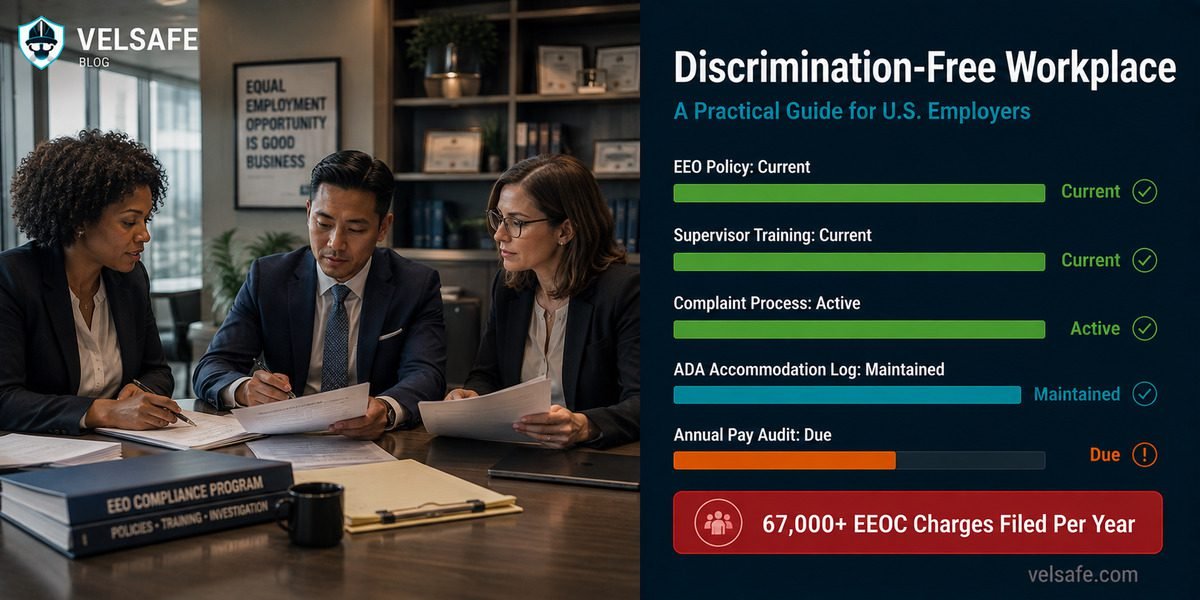
67K+
EEOC Charges Filed Per Year
The EEOC receives over 67,000 discrimination charges annually. Retaliation, disability, and race are the three most frequently cited bases. The EEOC resolved over $440 million in monetary relief for charging parties in fiscal year 2023.
EEOC, Charge Statistics FY2023
#1
Retaliation: Most Cited EEOC Basis
Retaliation has been the most frequently cited basis in EEOC charges for over a decade, appearing in more than 55% of all charges filed. An employer who takes adverse action against an employee for filing a complaint or participating in an EEOC investigation commits an independent violation.
EEOC, Retaliation-Based Charges, 2024
180
Days to File an EEOC Charge
Employees have 180 calendar days to file a charge with the EEOC from the date of the discriminatory act (300 days in states with a Fair Employment Practices Agency). Missing this deadline extinguishes the right to file a federal lawsuit under most EEO statutes.
EEOC, Filing a Charge of Discrimination
Federal employment discrimination law in the United States is built on a series of statutes that together prohibit discrimination in virtually every aspect of the employment relationship. Title VII of the Civil Rights Act of 1964 prohibits discrimination based on race, color, religion, sex, and national origin. The Age Discrimination in Employment Act (ADEA) covers workers 40 and older. The Americans with Disabilities Act (ADA) and the Rehabilitation Act protect qualified individuals with disabilities. The Equal Pay Act addresses sex-based pay disparities. The Pregnancy Discrimination Act, the Pregnant Workers Fairness Act, and the Genetic Information Nondiscrimination Act (GINA) extend protections to specific additional categories. The EEOC enforces all of these statutes for employers with 15 or more employees, with the ADEA threshold at 20 employees.
Beyond federal law, nearly every state has its own equal employment opportunity statute that applies to smaller employers and often provides broader protections. Local ordinances in major cities add additional protected categories. Employers operating in multiple jurisdictions must meet the highest applicable standard in each location. This guide focuses on the federal framework, which establishes the baseline for all U.S. employers above the statutory thresholds.
Why Discrimination Compliance Requires More Than a Written Policy
Courts assess systems, not documents. In most employment discrimination cases, the employer’s written equal employment opportunity policy is not dispositive. Courts ask whether the employer had an effective mechanism to prevent and correct discrimination, whether the employee unreasonably failed to use it, and whether the employer responded adequately when discrimination was reported. An employer with a policy but without training, a functional complaint process, and consistent enforcement of the policy will not be protected by the policy’s existence alone.
Supervisors create liability. Under Title VII and most EEO statutes, an employer is automatically liable for harassment and discrimination committed by supervisors that results in a tangible employment action (termination, demotion, failure to promote). For harassment that does not result in a tangible employment action, the employer may assert an affirmative defence, but only if it took reasonable steps to prevent and correct harassment and the employee unreasonably failed to use the employer’s complaint procedure. Supervisors who discriminate or harass are not acting outside the scope of the employer’s responsibility : they are acting as the employer for liability purposes.
Retaliation is an independent violation. An employer who does not discriminate on the basis of a protected characteristic but who fires, demotes, or otherwise punishes an employee for complaining about discrimination commits a separate and independent EEO violation. Retaliation does not require that the underlying discrimination complaint be valid. An employee who files a good-faith complaint that turns out to be unfounded is still protected from retaliation.
EEOC, Uniform Guidelines on Employee Selection Procedures
EEOC Charge Frequency by Basis (FY2023)
Retaliation (all statutes)55.8% of all charges
The single most cited basis across all EEOC charges. Any adverse action following a protected complaint activity can constitute retaliation, regardless of whether the underlying complaint had merit.
Disability (ADA)37.2% of all charges
Disability discrimination is the second most cited basis, covering discriminatory treatment, failure to provide reasonable accommodation, and qualification standards that screen out individuals with disabilities without business necessity.
Race (Title VII)34.8% of all charges
Race discrimination charges cover discriminatory treatment in hiring, promotion, compensation, and discipline, as well as racial harassment and hostile work environment claims.
Sex (Title VII, including pregnancy and sexual harassment)28.6% of all charges
Sex discrimination includes disparate treatment, pregnancy discrimination, sexual harassment, and following Bostock v. Clayton County (2020), discrimination based on sexual orientation and gender identity.
Age (ADEA, 40+)21.3% of all charges
Age discrimination claims arise most frequently in connection with reductions in force, performance management, and mandatory retirement policies. Workers 40 and older are a protected class under the ADEA.
EEOC, Charge Statistics FY2023
Protected Characteristic
Governing Statute
Coverage Threshold
Race, Color, Religion, Sex, National Origin
Title VII of the Civil Rights Act (1964)
15 or more employees
Age (40 and older)
Age Discrimination in Employment Act (ADEA, 1967)
20 or more employees
Disability
Americans with Disabilities Act (ADA, 1990)
15 or more employees
Pregnancy, Childbirth, Related Conditions
Pregnancy Discrimination Act (PDA, 1978); Pregnant Workers Fairness Act (PWFA, 2023)
15 or more employees (PWFA: 15+)
Genetic Information
Genetic Information Nondiscrimination Act (GINA, 2008)
15 or more employees
Sex (including sexual orientation and gender identity)
Title VII (as interpreted by Bostock v. Clayton County, 2020)
15 or more employees
EEOC, Federal Laws Prohibiting Job Discrimination
Signs That Discrimination May Be Occurring in Your Workplace
Patterns in promotion and compensation decisions. Qualified employees in a protected class being consistently passed over for promotion or paid less than similarly qualified employees outside that class, without documented performance justification, is a pattern associated with systemic discrimination.
Disproportionate discipline of employees in a protected class. If employees in a protected class are disciplined more frequently or more severely for similar conduct than employees outside the protected class, this disparity indicates potential discriminatory application of workplace rules.
Harassment based on a protected characteristic. Repeated offensive comments, jokes, images, or conduct directed at an employee because of their race, sex, religion, disability, national origin, age, or other protected characteristic, severe or pervasive enough to create a hostile work environment, constitutes harassment under Title VII and related statutes.
Adverse action following a protected activity. Termination, demotion, schedule change, or exclusion from projects that occurs within a short time of an employee filing a complaint, participating in an investigation, or requesting accommodation is a pattern associated with retaliation.
Accommodation requests that go unanswered or are denied without analysis. An employer who ignores a disability accommodation request or denies it without engaging in the interactive process required by the ADA may be violating both the accommodation obligation and the non-discrimination requirement.
EEOC, Harassment in the Workplace
Problem: Employees are not reporting concerns through the formal complaint process
Root cause: Employees distrust the complaint process, fear retaliation, or believe complaints will not be taken seriously based on prior experience.
Fix: Audit prior complaints and their outcomes to identify patterns of dismissal without investigation or without corrective action. Add alternative reporting channels such as an anonymous hotline or an ombudsman. Communicate outcomes to complainants (in general terms) so they know complaints are acted upon. Discipline supervisors who discourage reporting visibly enough that other employees become aware.
Problem: The same supervisor has received multiple complaints
Root cause: Prior complaints were resolved without adequate corrective action, or corrective action was taken but was insufficient to change the supervisor’s behaviour.
Fix: Review all prior complaints against the supervisor and their documented outcomes. If the prior corrective actions were inadequate, implement more significant intervention: performance improvement plan, mandatory coaching, removal of supervisory authority, or termination depending on the severity and pattern. A supervisor with a documented pattern of discrimination or harassment who is retained without meaningful intervention creates significantly elevated employer liability.
Problem: The EEOC has sent a notice of charge
Root cause: An employee or former employee has filed a charge of discrimination with the EEOC alleging a violation of an EEO statute.
Fix: Engage employment law counsel immediately. Preserve all documents and communications related to the employee and the employment decisions at issue. Do not take any action against employees who may have information relevant to the charge. Prepare the Position Statement with the assistance of counsel. Consider mediation through the EEOC’s mediation programme, which resolves a significant percentage of charges before investigation. Do not attempt to manage the EEOC response without legal guidance.
A Policy Without a System Is Not a Defence
Courts evaluating an employer’s affirmative defence to harassment claims assess whether the employer had a functioning prevention and complaint system, not just a written document. A policy that employees are unaware of, a complaint process that produces no corrective action, and training that covers only legal definitions without practical application do not establish the employer’s affirmative defence.
Retaliation Is the Most Common EEO Violation
Retaliation appears in over 55% of all EEOC charges and is the most frequently litigated EEO claim. Any adverse action following protected activity, including internal complaints, EEOC charges, or participation in an investigation, may constitute retaliation regardless of whether the underlying complaint was meritorious. Train managers on this explicitly and monitor for adverse actions following complaint events.
Supervisors Are the Employer for Liability Purposes
When a supervisor discriminates or harasses a subordinate and a tangible employment action results, the employer is automatically liable. The employer’s affirmative defence is available for supervisor harassment without a tangible action only if the employer can show it had a reasonable prevention and correction programme and the employee unreasonably failed to use it. Supervisor training and the integrity of the complaint process are therefore the primary liability management tools available to employers.
The ADA Interactive Process Cannot Be Skipped
Failure to engage in the good-faith interactive process when an employee requests a disability accommodation is itself an ADA violation, independent of whether the requested accommodation was reasonable. Document every step of the process: the request, the medical documentation requested and received, the discussions with the employee, the accommodations considered, and the decision with its basis.
Documentation Is the Employer’s Primary Defence
In a discrimination case, the employer who can produce contemporaneous documentation of the legitimate, non-discriminatory reasons for an employment decision is in a materially stronger position than one who relies on after-the-fact explanation. Document hiring decisions, promotions, performance reviews, discipline, and terminations with objective criteria applied consistently at the time the decision is made.
Federal Law Is the Floor, Not the Ceiling
Federal EEO statutes set minimum standards. Most states provide broader protections, cover smaller employers, or include additional protected categories such as sexual orientation (pre-Bostock in federal law), gender expression, marital status, or source of income. Employers in multiple jurisdictions must verify compliance with the highest applicable standard at each location and should update their programmes when state or local law changes.
What is the difference between disparate treatment and disparate impact discrimination?
Disparate treatment discrimination occurs when an employer treats an employee differently because of a protected characteristic. Intent to discriminate is an element of a disparate treatment claim. Disparate impact discrimination occurs when a facially neutral employment practice (a test, a degree requirement, a physical fitness standard) has a statistically significant adverse effect on a protected group and cannot be justified by business necessity. Intent is not required for a disparate impact claim. Both types of discrimination are prohibited under Title VII and related statutes. Selection procedures with adverse impact should be validated for job-relatedness before being used.
How long does an employee have to file an EEOC charge?
An employee has 180 calendar days from the date of the discriminatory act to file a charge with the EEOC. In states that have their own fair employment practices agency (which is most states), the filing deadline is extended to 300 calendar days. Missing the filing deadline typically bars the employee from filing a federal lawsuit, though some state law claims may have different limitations periods. Employees should be advised to contact the EEOC or an attorney promptly after experiencing or witnessing discrimination, as the deadline begins running from the date of the act, not from when the employee learns of the legal claim.
Can an employee be fired for making a false complaint of discrimination?
An employer may discipline or terminate an employee for making a knowingly false complaint of discrimination, but must do so with extreme caution. An employee is protected from retaliation for making a good-faith complaint, even if the complaint is ultimately found to be unsubstantiated. The distinction is between a complaint made in good faith that turns out to be incorrect (protected) and a complaint the employee knew was false when made (not protected). Because this distinction is difficult to prove and the risk of a retaliation claim is high, most employment lawyers advise employers to consult counsel before taking adverse action against any employee for complaint-related conduct.
What is a reasonable accommodation under the ADA?
A reasonable accommodation is any modification to the work environment or the way a job is performed that enables a qualified individual with a disability to enjoy equal employment opportunity. Examples include modified work schedules, remote work, reassignment to a vacant position, additional unpaid leave, modified equipment, accessible parking, and adjustment of non-essential job functions. An accommodation is reasonable unless it imposes an undue hardship on the employer, defined as an action requiring significant difficulty or expense given the employer’s size, resources, and the nature of the business. The ADA requires employers to provide a reasonable accommodation, not necessarily the accommodation the employee prefers.
Does the EEOC cover harassment by non-employees such as customers or clients?
Yes. An employer may be liable for harassment by non-employees (customers, vendors, contractors, clients) if the employer knew or should have known about the harassment and failed to take prompt and appropriate corrective action. The employer’s liability for third-party harassment depends on whether the employer had control over the harassing party or the work environment in which the harassment occurred. Employers in industries where employees frequently interact with members of the public (retail, hospitality, healthcare) should have policies and procedures for reporting and responding to customer or client harassment of employees.
What does the Pregnant Workers Fairness Act (PWFA) require that the Pregnancy Discrimination Act did not?
The Pregnancy Discrimination Act (PDA) prohibited discrimination against pregnant employees by requiring that they be treated the same as non-pregnant employees who are similar in their ability or inability to work. The Pregnant Workers Fairness Act (PWFA), effective June 27, 2023, goes further by requiring employers to provide reasonable accommodations for known limitations related to pregnancy, childbirth, or related medical conditions, similar to the ADA’s accommodation obligation for disabilities. The PWFA does not require the condition to meet the ADA’s definition of disability. It also requires that employers not require an employee to take leave if another effective accommodation is available. Employers must engage in the interactive process for PWFA requests and cannot deny accommodations based solely on the temporary nature of the limitation.
What questions are employers prohibited from asking during a job interview?
Employers should not ask questions in job interviews that require applicants to reveal protected characteristics, because the question itself may be used as evidence that the protected characteristic played a role in the selection decision. Questions to avoid include: age or date of birth; medical history, current health conditions, or disabilities; pregnancy or plans to have children; religion or religious practices; national origin or citizenship status; marital status or family situation; arrest records without conviction (prohibited in many states); and genetic information. Questions must be limited to the applicant’s qualifications for the job: their skills, experience, education, availability, and ability to perform the essential functions of the position with or without reasonable accommodation.
VelSafe Workplace Compliance Guides
Discrimination Prevention Is a System, Not a Policy.
An EEO policy that no one reads, a complaint process that produces no corrective action, and training that happens once at hire are not an effective discrimination prevention programme. VelSafe covers employment law compliance, workplace safety, and HR risk management for employers and HR professionals navigating U.S. federal and state requirements.
Browse Employer Compliance Guides