

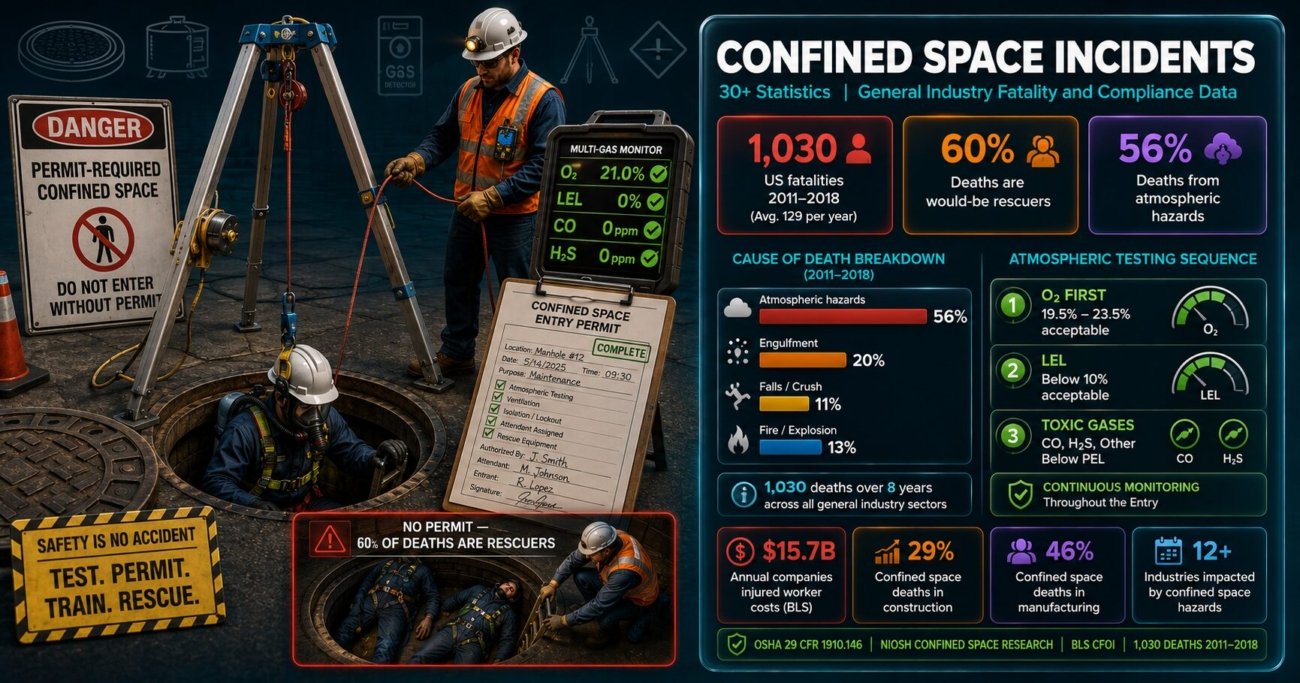
30+ Statistics on Fatalities, Causes, and Compliance
Confined spaces are found in nearly every general industry sector – tanks, silos, tunnels, pipelines, vaults, sewers, and manholes. They are often incidental to the main work of a facility, entered periodically for maintenance, inspection, or cleaning. Between 2011 and 2018, US workers recorded 1,030 fatalities in confined space incidents – an average of 129 deaths per year, or two to three fatalities every week. These deaths occurred not primarily during emergency operations but during routine maintenance and repair tasks.
The confined space fatality data contains a finding that safety professionals consistently identify as the most important single statistic in confined space safety: approximately 60% of confined space deaths are rescuers, not original entrants. This means that inadequate rescue planning does not only fail the person who enters a dangerous space – it converts coworkers and supervisors into additional victims. The majority of confined space incidents that produce multiple fatalities begin with a single person in distress and escalate through untrained rescue attempts.
Below we have compiled 30+ statistics and data points on confined space incidents in general industry, covering fatality data, cause-of-death breakdown, industry distribution, the rescuer death pattern, OSHA compliance data, and what distinguishes facilities with lower incident rates.
1. Fatality Data: Scale and Trend (2011-2018)
- Between 2011 and 2018, the US recorded 1,030 worker fatalities in confined space incidents – an average of 129 deaths per year, with annual figures ranging from 100 (2011) to 166 (2012). The absence of a consistent downward trend over this period indicates that confined space safety has not improved at the rate seen in other occupational hazard categories. (NIOSH / BLS CFOI)
- Confined space fatalities account for approximately 2% of all workplace fatalities nationally. This proportion is disproportionately high given that only a small fraction of the total workforce regularly enters permit-required confined spaces. (BLS; NIOSH)
- The rate of 2-3 confined space fatalities per week has remained relatively consistent over the study period, suggesting that the primary issue is not the absence of regulatory requirements – OSHA’s confined space standard has been in place since 1993 – but non-compliance and inadequate implementation at the facility level. (OSHA 29 CFR 1910.146; NIOSH)
- Confined space incidents are characterised by rapid escalation. Unlike many industrial hazards where injury is the most likely outcome, a significant proportion of confined space incidents result in death, reflecting the acute lethality of atmospheric hazards and engulfment. (NIOSH Research)
2. Cause of Death Breakdown: What Kills Workers in Confined Spaces
- Atmospheric hazards – oxygen deficiency, toxic gas accumulation, or both – are the leading cause of confined space deaths at 56% of fatalities. These hazards are invisible to the unaided senses: oxygen-deficient air looks and smells identical to normal air, and hydrogen sulfide gas desensitises the sense of smell at concentrations well below lethal levels. (NIOSH; OSHA)
- The most frequently cited toxic gases in confined space fatalities are hydrogen sulfide (H2S) in sewers and wastewater systems, carbon monoxide (CO) from incomplete combustion in enclosed spaces, and methane from organic decomposition. All three can be present at lethal concentrations in visually normal air. (NIOSH Pocket Guide to Chemical Hazards)
- Oxygen-deficient atmospheres – defined by OSHA as below 19.5% oxygen by volume – can result from rusting, fermentation, combustion, or displacement by other gases. Normal atmospheric oxygen is approximately 20.9%. An atmosphere at 16% oxygen causes impaired judgment and coordination; at 6%, death occurs within minutes. (OSHA 29 CFR 1910.146; NIOSH)
- Engulfment deaths at 20% of fatalities occur predominantly in grain bins, hoppers, and storage tanks in agriculture and food processing. Grain engulfment typically occurs when a worker walks on a grain surface over a void, or when grain flow creates a suction effect. Rescuing a fully engulfed victim requires specialised grain rescue tubes and trained rescue teams. (NIOSH Grain Engulfment Data; Purdue University Agricultural Safety)
- Fire and explosion hazards in confined spaces are elevated relative to open environments because the enclosed space concentrates flammable vapours. The lower explosive limit (LEL) for common flammable gases is reached more quickly in confined spaces than in ventilated environments, and ignition sources including non-intrinsically safe tools are a documented cause. (OSHA; NFPA 69)
3. The Rescuer Death Pattern: Why 60% of Victims Are Would-Be Helpers
- Approximately 60% of confined space fatalities are would-be rescuers, not original entrants. This is the single most important data point in confined space safety because it means the fatality count from any given incident is determined by how many people attempt an unplanned rescue, not solely by the hazard that affected the first person. (NIOSH)
- OSHA’s permit-required confined space standard at 29 CFR 1910.146(k) requires that employers develop and implement procedures for summoning rescue services, rescuing entrants from permit spaces, providing necessary emergency services, and preventing unauthorised personnel from attempting rescue. Non-entry rescue using retrieval systems must be used wherever feasible. (29 CFR 1910.146(k))
- Retrieval systems – a harness and lifeline attached to the entrant and managed by an attendant outside the space – allow non-entry retrieval when the entrant becomes incapacitated. OSHA requires retrieval systems for permit-required confined space entry whenever the retrieval system would not increase the overall risk of entry. In atmospheric hazard scenarios, this means retrieval systems are almost always required. (29 CFR 1910.146(k)(1))
- The attendant role is the most critical position in confined space entry operations. The attendant must maintain continuous communication with all authorised entrants, track the number and identity of persons in the space, and initiate the rescue or emergency response procedure when required – without entering the space themselves. (29 CFR 1910.146(i))
- An attendant who abandons their position – even briefly – creates the conditions for the rescuer death pattern. OSHA prohibits attendants from performing any duties that would interfere with their primary responsibilities. No other task takes priority over attendant duties during confined space entry operations. (29 CFR 1910.146(i)(10))
4. Industry Distribution: Where Confined Space Deaths Occur
- Confined space fatalities are distributed across all major industry sectors. Manufacturing, utilities, agriculture, and construction collectively account for the majority of confined space deaths. Mining and chemical manufacturing also contribute significantly. The distribution reflects the prevalence of tanks, vessels, and underground spaces in industrial operations. (NIOSH; BLS CFOI)
- Wastewater treatment and collection systems are among the highest-risk confined space environments. Manholes and wet wells can accumulate lethal concentrations of hydrogen sulfide from sewage decomposition within minutes of opening. H2S at 100 ppm causes rapid incapacitation; at 500-1000 ppm, death can occur within minutes. (NIOSH IDLH: H2S at 50 ppm)
- Grain bin engulfment deaths occur primarily in corn and soybean storage during harvest seasons. Purdue University’s Agricultural Safety and Health Program documents multiple grain engulfment fatalities annually, with most victims attempting to break up bridged or crusted grain while standing on the grain surface. (Purdue University Grain Engulfment Database)
- Construction excavations deeper than 5 feet are classified as confined spaces when they have limited means of egress and present atmospheric or engulfment hazards. Excavation collapse – separate from confined space atmospheric hazards – is also a leading cause of construction fatality. (29 CFR 1926.651; OSHA)
5. OSHA Permit-Required Confined Space Standard: Key Requirements
- OSHA’s permit-required confined space standard was promulgated in 1993 under 29 CFR 1910.146. The standard applies when a space meets all three OSHA confined space criteria – large enough to bodily enter, limited entry/exit, and not designed for continuous occupancy – and contains or has the potential to contain a serious safety or health hazard. (29 CFR 1910.146(b))
- The acceptable entry conditions for atmospheric hazards are: oxygen content between 19.5% and 23.5%, flammable gas concentration below 10% of LEL, and airborne combustible dust below 10% of LEL. Any atmospheric reading outside these bounds prohibits entry until the atmosphere is corrected. (29 CFR 1910.146(c)(5)(ii))
- Atmospheric testing must follow a specific sequence – oxygen first, then flammable gases, then toxic contaminants – because toxic gas detectors may not function accurately in oxygen-deficient atmospheres, and a flammable gas reading in oxygen-deficient air is not meaningful without first establishing oxygen content. (OSHA 1910.146; NIOSH)
- A construction-specific confined spaces standard, 29 CFR 1926 Subpart AA, was promulgated in 2015 to address the specific hazards of construction confined spaces. The construction standard has different permit and monitoring requirements from the general industry standard, and employers must determine which standard applies based on their work type. (29 CFR 1926.1200-1213)
- OSHA’s confined space standard is among the most frequently cited standards in General Industry inspections, appearing consistently in OSHA’s annual top-cited list. The most common specific violations are failure to have a written programme, failure to complete an entry permit, and inadequate attendant training. (OSHA Annual Citation Data)
6. Atmospheric Monitoring: The Critical Pre-Entry Requirement
- Multi-gas monitors capable of simultaneously measuring O2, LEL, CO, and H2S are the standard pre-entry testing instrument for most general industry confined spaces. Single-gas monitors may be appropriate for known single-hazard spaces but do not provide adequate protection in spaces with multiple potential atmospheric hazards. (NIOSH; OSHA)
- Continuous monitoring during entry is required when atmospheric conditions can change. Many fatalities have occurred after initial testing showed acceptable conditions – conditions that deteriorated after the entrant began work, disturbed sediment, used tools, or as outside temperature changed affecting gas migration. Initial testing is not a substitute for continuous monitoring. (OSHA 29 CFR 1910.146; NIOSH)
- Hydrogen sulfide desensitises the sense of smell at concentrations between 100-150 ppm – well above the OSHA PEL of 1 ppm but below the IDLH of 50 ppm. Workers who have been in a space with rising H2S may lose the ability to detect the odour before concentrations reach lethal levels, which is why sensor-based monitoring cannot be replaced by sensory assessment. (NIOSH; OSHA)
7. Demographics and Victim Profile
- 88% of confined space fatality victims are male, reflecting the gender composition of the industries and occupations most frequently associated with confined space work – construction, utilities, manufacturing, and agriculture. (NIOSH Demographic Data)
- The most common victim age group is 25-44 years, which represents workers in the active phase of industrial careers with significant exposure but variable training and experience with the specific hazards of the space they are entering. (NIOSH)
- A significant proportion of confined space fatalities involve routine maintenance or inspection tasks, not emergency or non-standard operations. Workers entering a manhole to inspect a valve, a tank to clean sediment, or a silo to break up bridged grain are performing familiar tasks – which is precisely the context in which complacency with permit requirements is most common. (NIOSH; OSHA Investigation Reports)
- Many confined space incidents involve workers who have entered the same or similar spaces before without incident. Previous uneventful entries create a false sense of safety and reduce compliance with pre-entry atmospheric testing and permit requirements. OSHA incident investigations consistently document this pattern as a contributing factor. (OSHA; NIOSH)
- Contractor and temporary workers are overrepresented in confined space fatalities relative to their share of the workforce, because they may be less familiar with site-specific hazards, less integrated into the host employer’s permit system, and less likely to have received site-specific confined space training. (NIOSH; OSHA Multi-Employer Worksite Policy)
8. What Low-Incident Confined Space Programmes Have in Common
- The most consistent differentiator between facilities with strong confined space safety records and those with incidents is pre-entry permit completion discipline. Permits that are completed thoroughly before every entry – not after the fact, not partially – generate the hazard identification conversation that prevents entries into conditions that were not adequately assessed. (OSHA; NIOSH)
- Facilities that have invested in non-entry rescue capability – retrieval lines, tripods, winches, and trained attendants – have lower rescuer death rates than those that rely on emergency services for rescue. Non-entry rescue must be pre-planned, not improvised. The equipment must be staged and the attendant must be trained on its use before entry begins. (29 CFR 1910.146(k); NIOSH)
- Atmospheric monitoring equipment that is regularly calibrated and bump-tested before each use provides reliable hazard data. An uncalibrated or bump-test-failed instrument that shows acceptable readings provides false assurance. OSHA inspection investigations of confined space fatalities frequently document monitoring equipment that was present but not functioning correctly. (OSHA Investigation Reports)
- Training that is specific to the actual spaces workers enter – not generic confined space awareness training – produces better outcomes. Workers who have been trained on the specific gases, flow characteristics, and rescue procedures for the spaces at their facility recognise hazard indicators that generic training does not cover. (NIOSH; OSHA 1910.146(g))
- Post-incident review following any confined space near-miss, entry with adverse atmospheric reading, or permit cancellation provides the most valuable safety data available to facility management. Near-misses that are reviewed and corrected predict fatalities that do not occur. Near-misses that are not reviewed predict fatalities that do. (Heinrich Triangle; OSHA)
Key Takeaways for Safety Managers and Confined Space Programme Owners
Sources
Government and Regulatory
- OSHA 29 CFR 1910.146: Permit-Required Confined Spaces (general industry)
- OSHA 29 CFR 1926 Subpart AA: Confined Spaces in Construction (2015 standard)
- NIOSH: Confined Space Safety Research (1,030 fatalities 2011-2018; rescuer death pattern)
- BLS: Census of Fatal Occupational Injuries (confined space industry distribution data)
Research and Industry Sources