

A construction site without a formal safety programme is not simply disorganised. It is a site where the legal obligations under 29 CFR Part 1926 are unmet, where OSHA citations are a matter of when rather than if, and where workers are exposed to preventable hazards every day.
Building a construction site safety programme from the ground up is not as complex as it appears. The core elements are well-defined by regulation and industry practice. What distinguishes effective programmes from paper programmes is the order in which the elements are built and the discipline with which they are maintained. This guide takes you through each element in sequence.
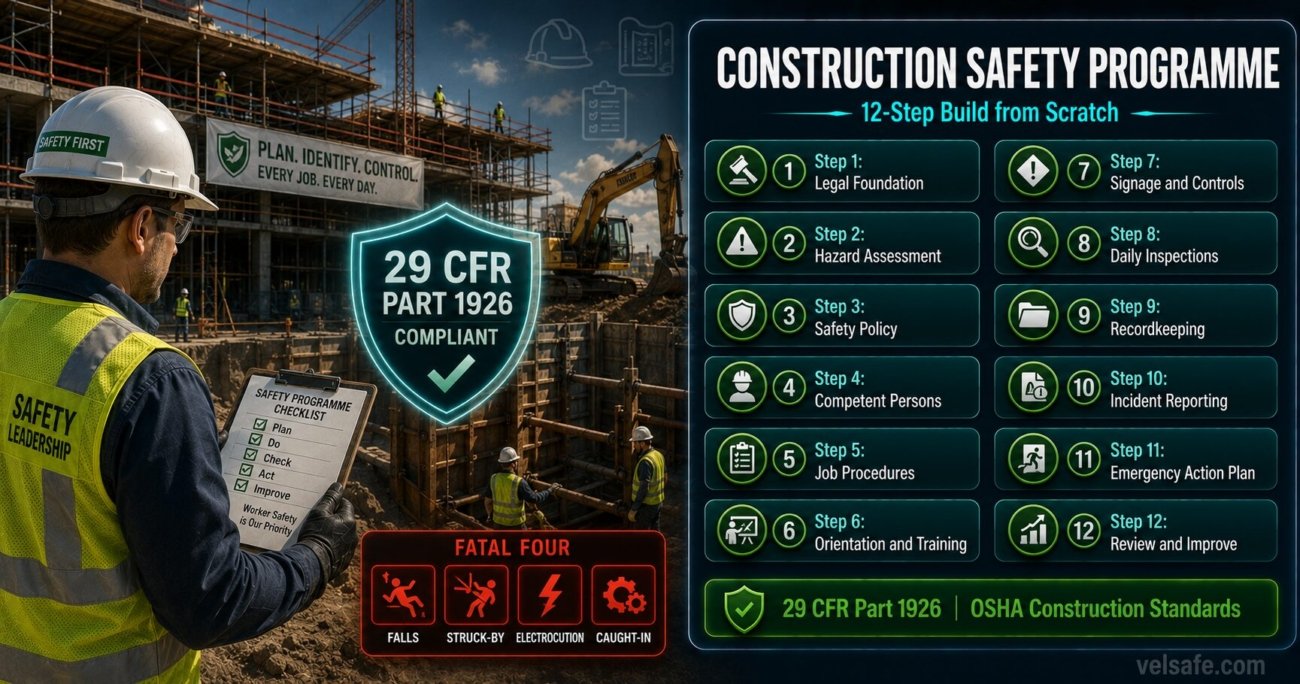
All 12 steps of a construction site safety programme: legal requirements under 29 CFR Part 1926, hazard identification, safety policy development, role assignments, job-specific procedures, training requirements, signage, daily inspections, recordkeeping, incident reporting, emergency planning, and programme review. Each step includes what is legally required, what best practice adds, and common mistakes to avoid.
Step 1: Establish Your Legal Foundation Under 29 CFR Part 1926
Before writing a single policy, you need to know what the law requires. OSHA’s construction safety standards are found in 29 CFR Part 1926. This is not optional reading. It is the minimum compliance baseline for every construction site in the United States.
The subparts most commonly applicable to general construction projects are:
- Subpart C (1926.20-35): General Safety and Health Provisions, safety programme requirements, competent person designations, first aid
- Subpart E (1926.95-106): Personal Protective and Life Saving Equipment for all hazard types
- Subpart K (1926.400-449): Electrical safety, grounding, lockout/tagout
- Subpart M (1926.500-503): Fall Protection, the leading cause of construction fatalities
- Subpart N (1926.550-556): Cranes, Derricks, Hoists, Elevators, and Conveyors
- Subpart P (1926.650-652): Excavations, trenching and soil classification
- Subpart Q (1926.700-706): Concrete and Masonry Construction
- Subpart R (1926.750-761): Steel Erection
Identify which subparts apply to your scope of work. This becomes the legal compliance checklist against which every element of your safety programme is measured.
Many new safety officers write a safety policy on day one based on general knowledge or copied templates before reviewing which OSHA subparts apply to their specific work scope. A policy that does not reference the applicable regulations cannot be used to defend against a citation. Start with the regulation, then write the policy to implement it.
Step 2: Conduct a Jobsite Hazard Assessment
A hazard assessment identifies the specific risks present on your site before work begins and as site conditions change. Under 29 CFR 1926.20(b)(2), employers must initiate and maintain programmes that provide for frequent and regular inspections of the jobsite by competent persons.
Your initial hazard assessment should systematically evaluate each work area and task for:
- Fall hazards: unprotected edges, floor openings, roof work, scaffold, ladders
- Struck-by hazards: crane loads, falling objects, moving vehicles, flying debris
- Caught-in or between hazards: excavations, unguarded machinery, trench collapses
- Electrical hazards: overhead power lines, underground utilities, temporary power
- Chemical hazards: concrete, adhesives, coatings, welding fumes, silica
- Environmental hazards: extreme heat, noise, confined spaces
Document the assessment with photographs and a written hazard log. The hazard assessment drives every subsequent element: what procedures are needed, what PPE is required, what training must be provided.
Repeat the hazard assessment at every major phase transition: when excavation begins, when structural steel goes up, when exterior work starts, when interior finishing begins. A hazard assessment done at project kickoff and never updated does not reflect the actual hazards present during the project’s later phases.
Step 3: Write a Site-Specific Safety Policy
The safety policy is the governing document of your safety programme. It does not need to be long. A two-page policy that workers can read, understand, and act on is more valuable than a 40-page document that sits unread in a binder.
A compliant construction safety policy must address:
- The company’s commitment to safety as a non-negotiable operational value
- The applicable OSHA standards that govern the work
- The roles and responsibilities of all personnel for safety performance
- The consequences of safety rule violations, applied consistently at all levels
- The process for reporting hazards, incidents, and near misses without fear of retaliation
- The review and update cycle for the policy itself
The policy must be posted on the site and reviewed with all workers during orientation.
Write your safety policy in plain, operational language. A policy written for workers should be understood by workers. If your site has Spanish-speaking workers, translate it. Post it at the site entrance, the toolbox area, and the break area.
Step 4: Assign Safety Roles and Designate Competent Persons
Under 29 CFR Part 1926, many activities require oversight by a competent person, defined in 29 CFR 1926.32(f) as one who can identify existing and predictable hazards and has authority to take prompt corrective measures. Competent persons must be designated for each regulated activity:
- Excavation and trenching (1926.651-652): must classify soil and inspect daily
- Scaffolding (1926.451): must supervise erection, alteration, and dismantling
- Fall protection (1926.502): must develop and supervise fall protection plans
- Confined space entry: must evaluate spaces and supervise entry
- Cranes and hoisting (1926.1400): qualified operators with specific certifications
Beyond OSHA-defined roles, your programme needs clear safety responsibility assignments for the project manager, site supervisors, subcontractor leads, and individual workers. Written role descriptions prevent the most common accountability failure on construction sites: everyone assuming someone else is responsible for safety.
OSHA’s competent person designation is not honorary. The person must actually be capable of identifying the relevant hazards and have authority to stop work. Designating a site foreman as the competent person for excavations without verifying they can correctly classify soil type and recognise trench instability signs is a compliance failure and a serious safety risk.
Step 5: Develop Job-Specific Safety Procedures
General safety policies set expectations. Job-specific procedures tell workers exactly what to do for high-risk tasks. Priority procedures to develop for most construction projects:
- Working at heights: fall protection plan, ladder safety, scaffolding erection and use
- Excavation and trenching: soil classification, shoring or sloping requirements, entry procedures
- Electrical work: lockout/tagout procedure, overhead line clearances, temporary power management
- Crane and hoisting operations: pre-lift planning, exclusion zones, signal procedures
- Confined space entry: atmospheric testing, rescue plan, attendant responsibilities
- Concrete cutting and grinding: silica exposure controls, wet cutting, respiratory protection
Procedures should be written at a reading level your workers can use. Walk workers through new procedures before they perform the task for the first time, not after.
Use a pre-task planning form for each high-risk task. Before beginning, the crew lead and crew members walk through the procedure, identify site-specific hazards for that day, confirm PPE is available, and sign the form. Pre-task planning forms are one of the most effective injury prevention tools available to construction sites.
Step 6: Conduct Site-Specific Orientation and Ongoing Training
Under 29 CFR 1926.21(b)(2), employers must instruct each employee in the recognition and avoidance of unsafe conditions before work begins. This training must be site-specific and delivered in a language the worker can understand.
Safety orientation must cover at minimum: the site safety policy, emergency evacuation routes and assembly points, the location of first aid facilities, PPE requirements for each site zone, the hazard reporting procedure, and the specific hazards relevant to the worker’s assigned tasks.
After initial orientation, deliver ongoing training through toolbox talks: short, focused safety discussions held at the start of the shift or week. Document every toolbox talk with a topic description and a signed attendance sheet.
A safety orientation conducted in English for a crew that primarily speaks Spanish does not satisfy 29 CFR 1926.21(b)(2), which requires training in a manner the employee can understand. Workers who did not understand the orientation are legally unoriented for OSHA purposes. Use bilingual supervisors, translated materials, or qualified interpreters.
Step 7: Install Required Safety Signage and Physical Controls
Safety signs, barriers, and physical controls communicate hazards and requirements to everyone on site. Required signage and controls for most construction sites include:
- Hard hat required signs at all site entry points
- PPE requirement signs in active work zones
- First aid station and fire extinguisher location markers
- Emergency contact numbers and nearest hospital route
- Barricades and warning tape around open excavations, floor openings, and roof edges
- GHS-compliant labels on all chemical containers
- No unauthorised entry signs on confined spaces and electrical enclosures
Inspect signage weekly. Signs that are missing, faded, or knocked down are not functioning as controls. Replace immediately.
Step 8: Implement Daily Site Safety Inspections
Under 29 CFR 1926.20(b)(2), frequent and regular inspections by a competent person are a legal requirement. A daily walk-through by the site supervisor or safety officer is the minimum for active construction sites. A daily inspection should cover:
- Fall protection: guardrails intact, floor openings covered, PFAS in use at height
- Electrical: temporary wiring in good condition, GFCIs in use, no overhead line encroachments
- Excavations: no tension cracks, proper shoring or sloping, safe access and egress
- Housekeeping: clear walkways, materials stored properly, no trip hazards
- PPE: workers wearing required protection for their assigned tasks
- Equipment: pre-use inspections completed, defective equipment tagged out
Document each inspection. Note what was found, what was corrected immediately, and what requires follow-up. Retain all inspection records.
Use a standardised daily inspection checklist rather than a blank notepad. A checklist ensures consistent coverage regardless of who conducts the inspection. When OSHA requests inspection records, a complete set of signed daily checklists is one of the most effective demonstrations of an active safety programme.
Step 9: Establish a Recordkeeping System
OSHA’s recordkeeping requirements under 29 CFR Part 1904 include maintaining an OSHA 300 Log of work-related injuries and illnesses, completing an OSHA 301 Incident Report for each recordable case, and posting the OSHA 300A Summary from February 1 to April 30 each year.
Beyond the Part 1904 requirements, an effective programme maintains:
- Safety orientation records with worker signatures and dates
- Toolbox talk records with topics, dates, and attendance
- Daily site inspection records
- Equipment inspection and maintenance records
- Competent person designation records
- Incident and near-miss investigation reports
- SDS files for all hazardous chemicals on site
Organise records so they can be produced quickly during an OSHA inspection. An inspector who cannot obtain training records will treat the absence as evidence that the training did not occur.
Step 10: Build a Non-Punitive Incident and Near-Miss Reporting System
Workers who fear punishment for reporting injuries or near misses will not report them. Unreported near misses are the most preventable source of serious injury information available. Every near miss that goes unreported is a missed opportunity to prevent a future serious or fatal incident.
Workers must know: who to report to, what information to provide, and what will happen after they report. The most important message is that reporting a hazard or near miss results in a fix, not discipline.
After every reported incident or near miss, conduct a root cause investigation focused on conditions and systemic failures, not individual blame. Root cause investigations produce corrective actions that prevent recurrence. Blame-focused investigations produce only deterrence of future reporting.
Safety incentive programmes that reward crews for zero incident reports create a direct incentive not to report. Workers close to a bonus for zero incidents will not report a near miss if reporting would end the incentive period. OSHA has specifically addressed this issue and can cite employers whose incentive programmes discourage reporting. Incentivise reporting and participation, not the absence of incidents.
Step 11: Develop and Practise Your Emergency Action Plan
Under 29 CFR 1926.35, construction employers must have a written emergency action plan covering escape procedures and routes, procedures for employees who remain to operate critical operations, procedures for accounting for all employees after evacuation, and the names of employees who can be contacted about the plan.
Specific plan elements for construction sites:
- Fire response: extinguisher locations, evacuation routes, assembly points, fire warden responsibilities
- Medical emergency: first aid designee, nearest hospital and route, emergency contact numbers
- Structural failure: immediate evacuation procedures, rescue service contacts
- Hazardous material release: spill response, emergency contacts including CHEMTREC (1-800-424-9300)
- Severe weather: shelter locations, work cessation criteria, monitoring procedures
Train every worker on the plan during orientation. Conduct a full evacuation drill at least once per major project phase. A plan that has never been practised will not function correctly under the stress of a real emergency.
Step 12: Review, Measure, and Continuously Improve
A safety programme written once and never updated is a static document, not an active programme. Schedule formal programme reviews at regular intervals:
- Weekly: Review daily inspection findings, incident reports, and near-miss reports. Identify patterns or recurring hazards.
- Monthly: Review training records for completeness and currency. Verify competent person designations are current for current site activities.
- Per phase: Update the hazard assessment at each major phase transition. Revise procedures when new tasks or equipment are introduced.
- Annually: Conduct a full programme audit against the applicable 29 CFR Part 1926 subparts. Review OSHA citation data for your industry to identify emerging enforcement priorities.
Use both lagging indicators (injury rates, OSHA citations) and leading indicators (near-miss reports, inspection findings, training completion rates) to measure programme performance. Leading indicators are more useful for prevention because they measure programme activity before incidents occur.
At the end of every project, conduct a safety post-mortem. What hazards were identified early and controlled effectively? What incidents or near misses occurred and what were the root causes? What would you do differently on the next project? A 30-minute end-of-project safety review with the site team is one of the highest-return activities a safety officer can perform.
Knowledge Check
Test your understanding of construction safety programme requirements.
Not necessarily. For excavations under 29 CFR 1926.651 and 652, the competent person must specifically be able to classify soil type, identify signs of instability, and determine the appropriate protective system. General construction experience does not substitute for specific competency in excavation hazard recognition. The employer must verify the designated person has the specific knowledge required for the hazard type they oversee.
No. 29 CFR 1926.21(b)(2) requires that each employee be instructed in the recognition and avoidance of unsafe conditions before beginning work. Informal observation is not a recognised substitute for structured orientation. The worker must receive a documented site-specific orientation covering hazards, emergency procedures, PPE requirements, and reporting procedures before performing any work.
Several problems. Near misses identify hazard conditions before they cause injury. The unguarded floor opening that was a near miss today is a fatal fall waiting to occur. Suppressing incident reports can constitute discouraging reporting under OSHA’s anti-retaliation provisions. The unguarded floor opening itself is a citable violation of 29 CFR 1926.502 regardless of whether a near miss occurred. The correct response is to immediately guard the opening, conduct a root cause investigation, and document both the finding and the corrective action.
Construction Safety Programme Compliance Checklist
✓ Applicable 29 CFR Part 1926 subparts identified for this project’s scope of work
✓ Initial jobsite hazard assessment completed and documented
✓ Written site-specific safety policy developed and posted on site
✓ Competent persons designated in writing for all required activities
✓ Job-specific procedures written for all high-risk tasks on this project
✓ Safety orientation conducted for all workers before first day of work
✓ Orientation delivered in languages workers can understand
✓ Required safety signage and physical controls installed
✓ Daily inspection process established with standardised checklist
✓ Recordkeeping system in place for all required OSHA and programme records
✓ Incident and near-miss reporting process communicated to all workers
✓ Emergency action plan written, posted, and practised