

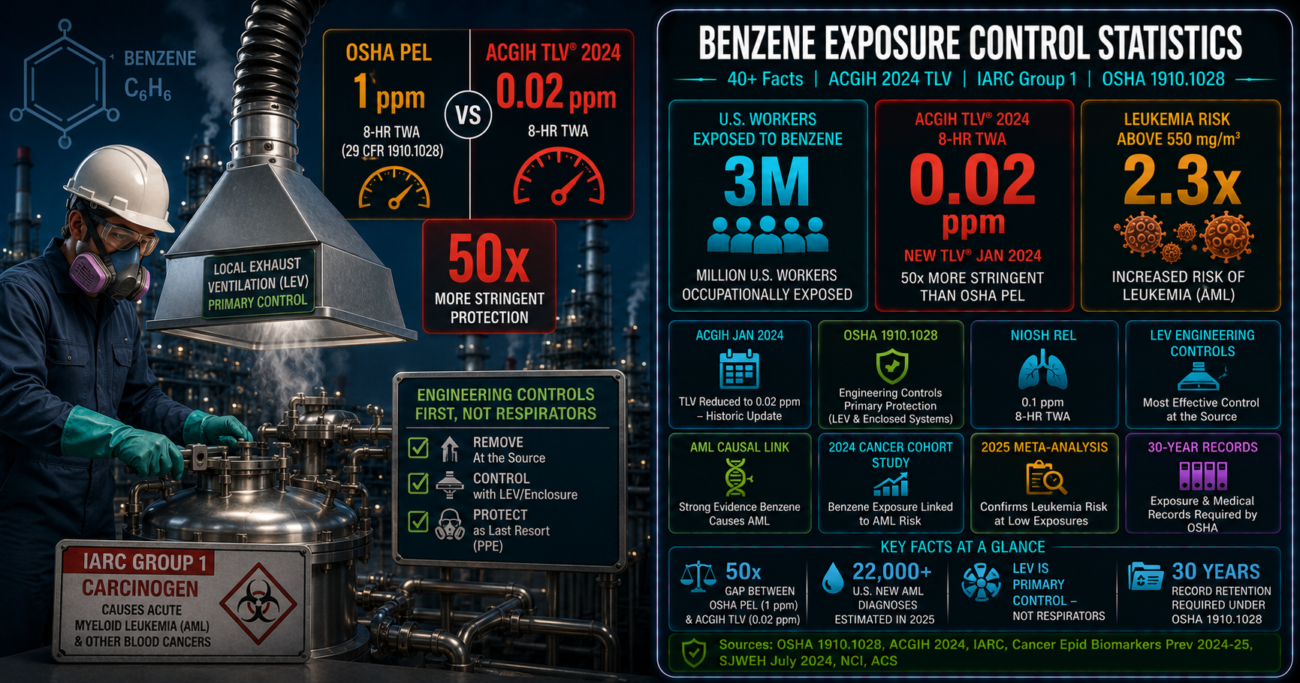
Benzene is one of the most studied occupational carcinogens in history, and its regulatory trajectory over the past four decades reveals a pattern of science repeatedly outrunning standards. OSHA’s current PEL of 1 ppm (29 CFR 1910.1028) was established in 1987 – a threshold that represented a significant improvement over prior standards at the time. In January 2024, ACGIH reduced its TLV to 0.02 ppm: 50 times more stringent, driven by evidence that adverse hematological effects occur in workers exposed to benzene at or below 1 ppm. NIOSH’s REL of 0.1 ppm sits between these two figures, reflecting a risk-based approach.
Engineering controls are OSHA’s preferred mechanism for achieving compliance with the benzene PEL – not respirators. Respirators are required as a backup when engineering controls cannot achieve the PEL, but OSHA’s 1910.1028 standard is explicit that engineering controls and work practice controls must be the primary means of reducing exposure. This article compiles 40+ statistics on benzene’s health effects, the regulatory limits framework, the exposed worker population, and what engineering controls accomplish in practice across the industries where benzene exposure is highest.
Editor's Choice: Key Benzene Exposure and Engineering Control Statistics
1. Benzene Regulatory Limits: A Three-Tier Framework and the 2024 ACGIH Reduction
- In January 2024, ACGIH reduced its benzene threshold limit value (TLV) from 0.5 ppm to 0.02 ppm for an 8-hour workday – a 25-fold reduction – and simultaneously eliminated the short-term exposure limit entirely. The revision was driven by a growing body of evidence, including Lan et al.’s finding that WBC and platelet counts were significantly lower in workers exposed to benzene at just 1 ppm compared to unexposed controls. (ACGIH 2024; WorkCare, February 2026; Frontiers in Public Health, May 2024)
- OSHA’s PEL of 1 ppm (29 CFR 1910.1028) was established in 1987 following years of regulatory and legal battles. It represents the legally enforceable floor. The 50-fold gap between OSHA’s PEL (1 ppm) and ACGIH’s 2024 TLV (0.02 ppm) is one of the largest divergences between regulatory and advisory benzene exposure standards in history, and reflects how significantly the scientific understanding of benzene’s hematotoxicity at low doses has evolved. (OSHA 1910.1028; ACGIH 2024)
- NIOSH’s REL of 0.1 ppm (10-hour TWA) sits between the two, with a 1 ppm short-term ceiling. NIOSH has historically characterized any benzene exposure as carrying leukemia risk and has recommended that exposure be maintained at the lowest feasible concentration – a risk-based rather than strictly feasibility-based standard. (NIOSH Pocket Guide to Chemical Hazards; WorkCare, 2026)
- OSHA’s benzene standard (1910.1028) also establishes an action level of 0.5 ppm (8-hour TWA). Exposures at or above the action level trigger additional requirements: employee monitoring, medical surveillance, record-keeping, and other provisions designed to ensure exposures are tracked and controlled before they reach the PEL. (OSHA 1910.1028)
- For the exempted subsegments – including distribution and sale of fuels where benzene is present as a component of a mixture rather than the primary substance – the older Table Z-2 limits apply: 25 ppm ceiling, 50 ppm peak for 10 minutes maximum. These legacy limits represent a substantially higher permitted exposure level for workers in fuel distribution roles who fall outside the benzene standard’s full scope. (OSHA 29 CFR 1910.1028(a)(2); OSHA annotated PEL table Z-1)
2. Benzene's Cancer Risk: What the 2024-2025 Research Shows
- IARC has classified benzene as a Group 1 carcinogen (carcinogenic to humans), the highest classification. The primary causal link is to acute myeloid leukemia (AML). IARC additionally characterizes benzene as possibly or probably increasing risk of acute lymphoblastic leukemia (ALL), chronic lymphocytic leukemia (CLL), multiple myeloma, and non-Hodgkin lymphoma. (IARC Monograph Vol. 120; NCI; ACS, 2026)
- The Cancer Epidemiology Biomarkers and Prevention (November 2024) published a population-based cohort study of 61,377 men aged 40-74 using a quantitative benzene job-exposure matrix. Cumulative benzene exposure above 550 mg/m3 was associated with an adjusted hazard ratio of 2.3 for leukemia (95% CI 1.1-4.5), 1.2 for lung cancer, and 1.4 for stomach cancer. Benzene exposure was also associated with additional cancer types after adjustment for smoking and alcohol. (DeMoulin et al., Cancer Epidemiol Biomarkers Prev, November 2024)
- A July 2024 study in the Scandinavian Journal of Work, Environment and Health analyzed more than 2.97 million persons in the Swiss National Cohort using a quantitative benzene job-exposure matrix. The study found elevated mortality risk of lymphohaematopoietic cancers in occupationally benzene-exposed workers, contributing to the growing European evidence base on low-level benzene exposure outcomes. (Ge, Spoerri, Egger, Rothman, Lan, Huss, Vermeulen. SJWEH, July 2024)
- A November 2025 meta-analysis in Cancer Epidemiology Biomarkers and Prevention analyzed nine cohort studies of occupational benzene exposure and found a 22% elevated risk of female genital cancers (cervical, ovarian, and endometrial combined) associated with benzene exposure (RR=1.22; 95% CI 1.03-1.44), primarily driven by mortality rather than incidence. (Shah, Shah, DeStefano, Bonetti, Boffetta, Seyyedsalehi. Cancer Epidemiol Biomarkers Prev, November 2025)
- The Frontiers in Public Health (May 2024) leukemia risk assessment study found that workers exposed to benzene below 1 ppm still showed adverse hematological effects. Lan et al., cited in that study, documented that total WBC and platelet counts were significantly lower in workers exposed to benzene at 1 ppm than in unexposed groups – providing direct evidentiary support for ACGIH’s 2024 TLV reduction. (Jin, Zhu, Wu et al. Frontiers in Public Health, May 2024)
- A comprehensive 2025 review in Annals of Medicine and Surgery (Paul et al., 2025) characterizes benzene as a “widespread environmental carcinogen” with a mechanism involving metabolic activation to reactive intermediates that form DNA adducts, disrupt hematopoiesis, and cause chromosomal damage. The review identifies the bone marrow as the primary target organ for benzene’s carcinogenic and hematotoxic effects. (Paul, Katwal, Aroori et al., Annals of Medicine and Surgery, 2025)
3. Who Is Exposed: Industries, Job Roles, and Exposure Levels
- Approximately 3 million workers in the United States are occupationally exposed to benzene across industries including adhesives, auto repair, chemical manufacturing, gas stations, paint, petroleum, rubber, shoe/leather, and shipping – with over half of exposed workers in some industries being women. (APHA Policy Brief citing Kauppinen et al. 2001; ATSDR)
- In the European and Canadian context, job-exposure matrix analysis of the Swiss National Cohort found that approximately 1-2% of the total working population had occupational benzene exposure at any point in time – translating to millions of exposed workers across high-income economies with significant regulatory frameworks in place. (Ge et al., SJWEH, July 2024)
- The Norwegian offshore petroleum industry study (2002-2018), which included 924 benzene measurements across job groups, found an overall geometric mean exposure of 0.004 ppm – well below OSHA’s PEL but worth monitoring against the ACGIH 2024 TLV of 0.02 ppm. Industrial cleaners had the highest geometric mean exposure (0.012 ppm), laboratory technicians and process operators had 0.004 ppm, and mechanics had 0.003 ppm. (SJWEH offshore study, 2022)
- OSHA’s benzene standard specifically identifies petroleum refining, rubber tire manufacturing, and benzene storage/transport as the highest exposure potential industries. Other workers with documented exposure include steel workers, printers, rubber workers, shoe makers, laboratory technicians, firefighters, and gas station employees. (OSHA.gov/benzene/exposure-evaluation)
4. Engineering Controls: OSHA's Preferred Approach and What Works
- OSHA’s benzene standard (29 CFR 1910.1028) is explicit that engineering controls and work practice controls must be the primary means of reducing benzene exposures to or below the PEL. Respirators are required as supplementary controls or as the primary control only in specific limited circumstances: emergency situations, operations performed less than 30 days per year, and situations where engineering controls have been demonstrated infeasible. (OSHA 1910.1028; OSHA Benzene SSDS Appendix A)
- OSHA’s evaluating exposure page states directly: “Exposure to benzene is controlled by limiting evaporation and preventing splashes and spills. Where exposures may occur, the preferred controls are engineering controls such as the use of hoods, canopies, and proper ventilation coordinated with the use of personal protective equipment.” (OSHA.gov/benzene/exposure-evaluation)
- For employers who can document that benzene is used in the workplace fewer than 30 days per year, OSHA allows any combination of engineering controls, work practice controls, or respirators to achieve PEL compliance. In all other circumstances, engineering controls must be the primary mechanism, with respirators as backup during the period needed to install controls or in situations where controls cannot achieve the PEL. (NCBI Bookshelf / ATSDR; OSHA 1910.1028)
- Local exhaust ventilation is the most widely deployed engineering control for benzene in applications where enclosed systems are not feasible. Effectiveness is highly dependent on: capture velocity (must be sufficient to overcome cross-drafts), hood design (flanged hoods are more efficient than plain openings), duct design (smooth surfaces, minimal bends), and exhaust fan capacity and maintenance. A poorly designed LEV system operating at insufficient capture velocity may provide false confidence while allowing exposures to exceed action levels. (OSHA ventilation guidance; industrial hygiene principles)
- Substitution – eliminating benzene from the process entirely – represents the highest level of the hierarchy of controls and should be evaluated before LEV is designed. In many industrial applications, benzene has been successfully replaced. However, substitute solvents including toluene and xylene also carry their own occupational health hazards – toluene is a reproductive toxicant and xylene affects the CNS – meaning substitution decisions require comparative hazard evaluation rather than assuming any aromatic solvent swap is an improvement. (OSHA hierarchy of controls; industrial hygiene comparative analysis)
5. OSHA 1910.1028: The Full Compliance Framework Employers Must Meet
- OSHA’s benzene standard requires initial exposure monitoring within 30 days of the introduction of benzene operations, with periodic monitoring tied to results: quarterly if PEL is exceeded, every 6 months if between action level and PEL, and annually if below action level with engineering controls in place. (OSHA 1910.1028(e))
- Medical surveillance is required for all workers exposed at or above the action level (0.5 ppm) for 30 or more days per year, and for any worker exposed in emergency situations. Initial examination within 60 days of assignment; periodic annual examinations thereafter. Required components include complete blood count with differential, quantitative platelet count, hematocrit, hemoglobin, and erythrocyte count. (OSHA 1910.1028(i); WorkCare, February 2026)
- Employees who wear respirators for at least 30 days per year must undergo a pulmonary function test every three years in addition to the standard medical surveillance components. (OSHA 1910.1028; WorkCare, 2026)
- Washington State’s benzene regulations (WAC 296-849-11020) require employers to establish permanent or temporary exposure control areas wherever airborne benzene concentrations are above, or can reasonably be expected to be above, the PEL. Boundaries must be visibly distinguished and only authorized personnel may enter. This state-level regulatory example illustrates how engineering controls and administrative controls interact: LEV reduces concentration, but access control prevents exposure of unprotected workers even in transitional areas. (WAC 296-849-11020, current through March 15, 2024)
- Record retention requirements are among the most demanding of any OSHA toxic substance standard: exposure monitoring records must be kept for 30 years; medical surveillance records must be kept for the duration of employment plus 30 years. These long retention requirements reflect benzene’s long latency period for leukemia development – cancers may not manifest for 10 to 30 years after exposure. (OSHA 1910.1028(m))
6. Respirator Requirements: When Engineering Controls Are Not Sufficient
- OSHA’s 1910.1028 benzene standard specifies that respirators are required when engineering controls cannot achieve the PEL – but not as a substitute for feasible engineering controls. The hierarchy is explicit: engineering controls first, then work practice controls, then respirators as backup. Organizations that rely on respirator programs as the primary benzene control without demonstrating engineering control infeasibility are not in compliance with 1910.1028’s intent. (OSHA 1910.1028(g); OSHA App A)
- All respirators used for benzene exposure must have joint MSHA and NIOSH approval (currently expressed as NIOSH approval since MSHA and NIOSH merged respirator approval authority). Organic vapor cartridges used with non-powered air-purifying respirators must have a minimum service life of four hours when tested at 150 ppm benzene at a flow rate of 64 L/min, 25 degrees C, and 85% relative humidity. (OSHA 1910.1028(g)(3))
- NIOSH’s IDLH for benzene is 500 ppm – the concentration at which an exposure of 30 minutes or less without a respirator would cause irreversible health effects or impair the ability to escape. SCBA or supplied-air respirators with escape SCBA are required at or above IDLH concentrations. (NIOSH Pocket Guide to Chemical Hazards)
7. Air Monitoring, Biological Monitoring, and Medical Surveillance
- Air monitoring for benzene is conducted using NIOSH Method 1501 (Hydrocarbons, Aromatic) – the standard analytical method for sampling and analysis of benzene in workplace air. Portable GC monitoring (NIOSH Method 3700) provides real-time screening capability for rapid assessment during operations or maintenance. (OSHA.gov/benzene/exposure-evaluation; NIOSH NMAM)
- Biological monitoring provides internal dose information that complements air monitoring. The primary urinary biomarkers are S-phenylmercapturic acid (S-PMA) and trans,trans-muconic acid (tt-MA), which reflect benzene metabolism in the body. The 2024 Frontiers in Public Health leukemia risk assessment study used these biomarkers to assess risk in workers exposed to low-level benzene – levels below the OSHA PEL where air monitoring alone may underestimate actual internal dose. (Jin et al., Frontiers in Public Health, May 2024)
- Medical surveillance required under 1910.1028 includes a complete blood count with differential leukocyte count, quantitative platelet count, hematocrit, hemoglobin, and erythrocyte count and indices. These components allow detection of hematological changes – suppressed WBC or platelet counts – that may precede leukemia development. Early detection of hematopoietic depression enables removal from further benzene exposure before irreversible damage occurs. (OSHA 1910.1028(i); WorkCare, February 2026)
- OSHA requires initial medical surveillance within 60 days of assignment to benzene-exposed work, with subsequent annual examinations. An initial examination is not required if the employer can document that the covered employee has had an equivalent examination within the prior 12 months. (OSHA 1910.1028(i)(2); WorkCare, 2026)
Key Takeaways for Industrial Hygienists, EHS Professionals, and Compliance Teams
Sources
Government and Regulatory Sources
- OSHA 29 CFR 1910.1028 – Benzene Standard: PEL 1 ppm TWA / 5 ppm STEL; action level 0.5 ppm; engineering controls as primary mechanism; medical surveillance requirements; 30-year recordkeeping
- OSHA – Benzene Exposure Evaluation: industries with highest exposure (petroleum refining, rubber tire, storage/transport); hoods, canopies, and ventilation as preferred controls; monitoring methods NIOSH 1501, 1500, 2549, 3700
- OSHA 1910.1028 Appendix A – Benzene SSDS: respirator requirements by concentration; engineering controls primary; less than 30 days exception; MSHA/NIOSH approval requirement
- OSHA Annotated Table Z-1 – OELs for benzene, NIOSH REL, ACGIH TLV; exempted segments under Z-2; update notes on current advisory limits
- EPA IRIS – Carcinogenic Effects of Benzene: Group 1 carcinogen; AML and other blood disorders; known human carcinogen by all routes of exposure
- Washington Administrative Code 296-849-11020 (current through March 15, 2024) – Exposure control areas for benzene; boundary requirements; authorized personnel only; visible demarcation methods
Research and Clinical Sources
- DeMoulin et al. Cancer Epidemiology Biomarkers and Prevention (November 2024) – 61,377 men cohort: AHR 2.3 for leukemia above 550 mg/m3, elevated lung and stomach cancer risk; quantitative benzene job-exposure matrix
- Ge, Spoerri, Egger, Rothman, Lan, Huss, Vermeulen. SJWEH (July 2024) – Swiss National Cohort: 2.97 million persons; 1-2% occupational benzene exposure prevalence; elevated LH cancer mortality; quantitative benzene JEM
- Shah, Shah, DeStefano, Bonetti, Boffetta, Seyyedsalehi. Cancer Epidemiol Biomarkers Prev (November 2025) – Female genital cancers meta-analysis: RR=1.22 (95% CI 1.03-1.44); 9 cohort studies; mortality RR=1.69
- Jin, Zhu, Wu et al. Frontiers in Public Health (May 2024) – Leukemia risk at low benzene levels; ACGIH TLV reduction to 0.02 ppm context; S-PMA and tt-MA biomarkers; Lan et al. findings on WBC/platelet suppression at 1 ppm
- American Cancer Society – Benzene and Cancer Risk (updated April 2026): OSHA 1 ppm PEL and 5 ppm STEL; NIOSH and EPA limits; IARC Group 1; 22,000 AML diagnoses 2025
- National Cancer Institute – Benzene: IARC Monograph 100F; leukemia and blood disorder risk; occupational CDC guidance
- WorkCare (February 2026) – Benzene Medical Surveillance: ACGIH TLV reduction January 2024 to 0.02 ppm; NIOSH REL 0.1 ppm; medical exam requirements; pulmonary function testing for respirator wearers; CBC components
- APHA – Reducing Occupational Exposure to Benzene: 3 million U.S. workers exposed; 1.4 million EU workers; industries listed; gender distribution in exposed populations