LAW: OSHA Abrasive Wheel Machinery
Two Measurements Account for Most Grinder Citations
and Both Change Every Time the Wheel Wears Down
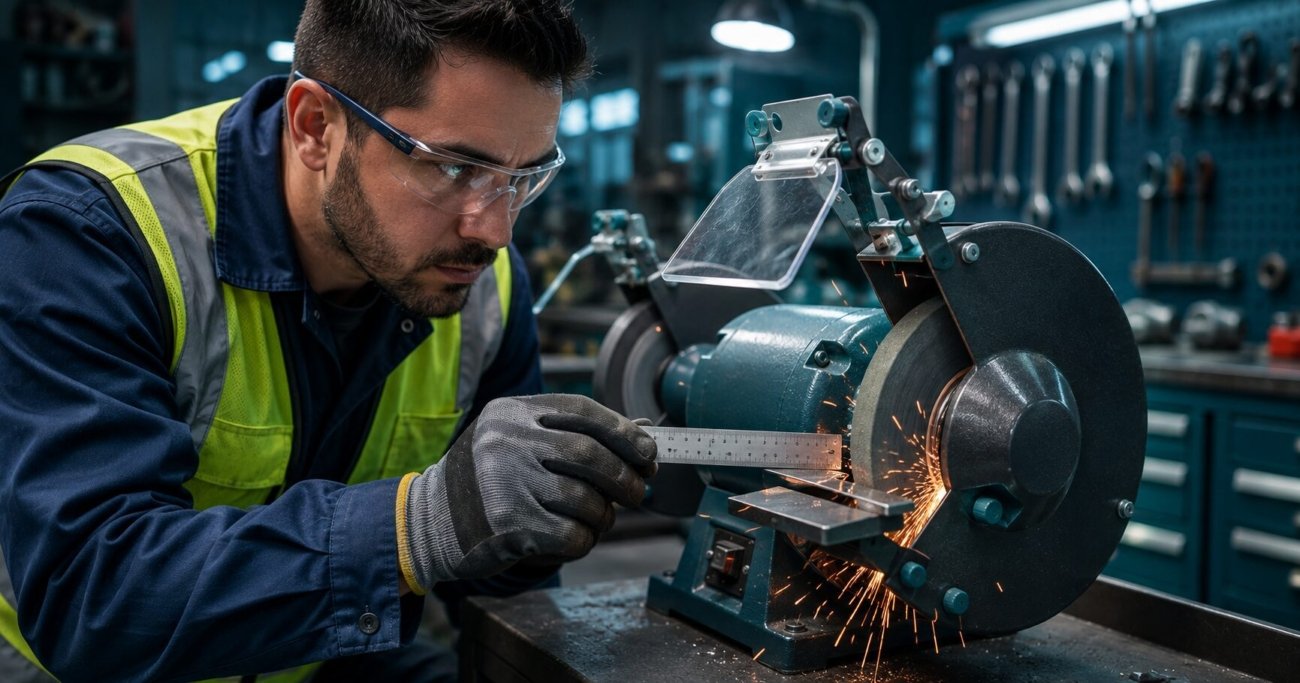
Work rest gap over 1/8 inch. Tongue guard gap over 1/4 inch. These two measurements under 29 CFR 1910.215 generate more OSHA citations than any other grinder requirement, not because they are complicated, but because both gaps grow every time the wheel wears and nobody adjusts them. This article covers what the standard actually requires and what auditors look for first.
$16,550
Max Penalty / Violation
OSHA maximum per-violation penalty for a serious violation under 29 CFR 1910.215, including work rest and tongue guard gap violations.
OSHA Penalty Schedule
1/8″
Work Rest Max Gap
Maximum allowable gap between the work rest and the wheel under 29 CFR 1910.215(a)(4). This gap grows as the wheel wears, requiring ongoing adjustment.
29 CFR 1910.215(a)(4)
1/4″
Tongue Guard Max Gap
Maximum allowable gap between the tongue guard (also called the safety tongue or spark deflector) and the wheel under 29 CFR 1910.215(b)(9).
29 CFR 1910.215(b)(9)
What This Law Covers and Why It Matters
Walk through almost any machine shop, welding operation, or maintenance facility and you will find a bench grinder. It may be the same one bolted to the corner workbench for fifteen years. The wheel guard is slightly bent. The work rest has drifted to a quarter inch from the wheel because nobody tracked the wear. The last wheel change happened without a ring test because it always has.
29 CFR 1910.215, OSHA’s abrasive wheel machinery standard, governs exactly this equipment. It specifies guard geometry, work rest and tongue guard clearances, wheel inspection and ring testing, speed compatibility verification, and PPE requirements. The standard applies to bench grinders, pedestal grinders, and floor-stand grinders in general industry. Most violations are not complex, they are gaps that grew slowly while nobody watched.
Compliance Table: Who Must Comply and With What
| Requirement |
Standard |
Specific Obligation |
| Safety guard |
1910.215(b) |
Guard must cover at least 270° of wheel periphery; opening must not exceed 90°; must cover spindle end, nut, and flange projections |
| Work rest gap |
1910.215(a)(4) |
Maximum 1/8 inch between work rest and wheel at all times; must be adjusted as wheel wears; strong enough to withstand workpiece force |
| Tongue guard gap |
1910.215(b)(9) |
Maximum 1/4 inch between tongue guard (safety tongue / spark deflector) and wheel; must be adjusted as wheel wears |
| Wheel inspection |
1910.215(d)(1) |
Visual inspection plus ring test (sound test) required before mounting any wheel; cracked or defective wheels must be destroyed |
| Speed compatibility |
1910.215(d)(3) |
Wheel rated RPM must equal or exceed the machine’s operating speed; never exceed the wheel’s maximum rated speed |
| PPE |
1910.133 |
Safety glasses with side shields minimum; face shield strongly recommended for full-face protection; hearing protection where noise exceeds PELs |
What 29 CFR 1910.215 Actually Requires
1. Safety Guard Requirements
Every bench and pedestal grinder must have a safety guard before operation. The guard opening must not exceed 90 degrees, meaning the guard covers at least 270 degrees of the wheel periphery, starting no more than 65 degrees above the horizontal plane of the wheel spindle. Side guards must cover the spindle end, nut, flange projections, and at least 75% of the wheel thickness. A grinder with a missing or bent guard that no longer meets geometry requirements is out of compliance and must not be operated.
2. Work Rest and Tongue Guard, the Two Most Cited Requirements
These two gaps account for the majority of grinder citations. Both are simple to verify, simple to fix, and simple to let slip as a wheel wears down over weeks of normal use.
Work Rest: Max 1/8 inch, 29 CFR 1910.215(a)(4)
The work rest provides a stable platform for workpieces during grinding. If the gap exceeds one-eighth of an inch, a workpiece can slip into the space between the rest and the wheel, causing sudden loading that can fracture the wheel. The work rest must be adjusted every time the wheel wears to a smaller diameter. A gap that was compliant on setup can be out of compliance by end of shift on a grinder under heavy use.
Tongue Guard: Max 1/4 inch, 29 CFR 1910.215(b)(9)
The tongue guard (also called the safety tongue or spark deflector) sits at the top of the wheel opening. Its purpose is to deflect fragments and sparks downward, away from the operator, in the event of wheel breakage. The maximum allowable gap is one-quarter inch. Like the work rest, this gap grows as the wheel wears and must be adjusted proactively.
3. Wheel Inspection, Ring Testing, and Speed Compatibility
Mounting a defective or incorrectly rated wheel is the most dangerous grinder error possible. Three checks must all pass before any wheel goes into service.
Step 1: Visual Inspection
Examine the entire wheel for cracks, chips, gouges, or damage. Check the arbor hole for radiating cracks. Any visible defect means the wheel must be destroyed, not set aside, destroyed, to prevent inadvertent use. A cracked wheel under grinding load will fail catastrophically. Never attempt to repair a damaged abrasive wheel.
Step 2: Ring Test (Sound Test)
Suspend the wheel and tap it lightly with a non-metallic implement. An undamaged wheel produces a clear metallic ring. A dull or dead sound indicates an internal crack that visual inspection would miss. This test must be performed before every wheel mounting. It takes less than 30 seconds and has prevented countless wheel failures.
Step 3: Speed Compatibility Verification
The wheel’s maximum rated RPM must equal or exceed the machine’s operating speed. This rating is marked on the wheel. Never operate a wheel beyond its rated speed, centrifugal stress increases with the square of rotational speed, and a wheel operated above rating can fail without warning. Verify before every mount: the machine RPM against the wheel’s rated maximum RPM.
4. PPE Requirements
Safety glasses with side shields are the minimum required eye protection for all grinder operation under 29 CFR 1910.133. A face shield is strongly recommended and required in many operations, worn over safety glasses, not instead of them. Hearing protection is required wherever noise monitoring demonstrates exposure exceeds OSHA permissible exposure limits. Gloves are not recommended during grinding: they can catch on the wheel and draw the hand into the grinding surface.
Penalties Table: What OSHA Can Impose
| Violation |
Classification |
Max Penalty |
| Work rest gap exceeds 1/8 inch |
Serious |
$16,550 |
| Tongue guard gap exceeds 1/4 inch |
Serious |
$16,550 |
| Guard missing or insufficient coverage |
Serious |
$16,550 |
| Wheel mounted without ring test or visual inspection |
Serious |
$16,550 |
| Wheel operated above rated RPM |
Serious / Wilful |
Up to $165,514 |
| Repeat or wilful violation of any 1910.215 requirement |
Repeat / Wilful |
Up to $165,514 |
Source: OSHA Penalty Schedule. Penalties adjusted annually. Wilful penalty applies where employer knowingly disregards requirements.
Common Failures That Trigger OSHA Citations
Gaps that were compliant at setup but never adjusted
The most common finding is a grinder that was set up correctly and then never adjusted as the wheel wore. Both the work rest and tongue guard gaps grow as the wheel diameter decreases. A grinder with a 7-inch wheel that was set up at 1/16-inch clearance may be at 3/16-inch or more by the time the wheel reaches 5 inches. No inspection, no adjustment, guaranteed citation.
No ring test documented at wheel change
Wheel changes that happen informally, no pre-mount inspection log, no ring test record, expose the employer to citation even when the actual inspection was performed. OSHA requires the test; the inspector asks for the record. If there is no record, there is no compliance. Document every ring test with wheel identity, date, and the operator who performed it.
Speed rating not verified before mount
Replacement wheels purchased from different suppliers may have different maximum RPM ratings even when the wheel dimensions appear identical. Without verifying the wheel’s marked maximum RPM against the machine’s operating speed before mounting, an employer is operating blind. A wheel operated above its rated speed can fail without warning, the centrifugal stress at failure is high enough to cause severe injury or death.
Guard removed for a specific task and not replaced
Guards are sometimes removed to accommodate a larger workpiece or an unusual grinding angle and then not reinstated. Any operation of a grinder without its guard is a serious violation regardless of how briefly the guard was absent. A guard that has been bent or damaged and no longer meets the geometry requirements must be replaced before the grinder returns to service.
Employer Responsibilities
Equipment and Documentation
Provide guarded machines before any worker operates them
Establish a gap adjustment schedule and log adjustments
Maintain records of ring tests and pre-mount inspections
Verify wheel speed ratings against machine RPM before every mount
Remove damaged wheels from service immediately and destroy them
Training and Worker Rights
Train workers before assignment to grinder tasks, not after
Document training with worker name, date, and content covered
Inform workers of their right to stop work on a non-compliant grinder
Provide PPE and enforce its use, glasses before power-on
Conduct noise monitoring where grinder use is regular
Compliance Checklist
Before Each Use
Work rest within 1/8 inch of wheel
Tongue guard within 1/4 inch of wheel
Safety guard in place and properly secured
Wheel visually free of cracks, chips, damage
Safety glasses worn before power-on
Before Every Wheel Mount
Visual inspection complete, no defects
Ring test performed, clear tone, no dead sound
Wheel max RPM confirmed against machine RPM
Flanges clean, undamaged, and correct size
Ring test result documented with date and operator
Weekly / Ongoing
Measure and log work rest and tongue guard gaps, adjust as needed
Inspect guard geometry for bending or damage from workpiece contact
Verify training records current for all grinder operators
Check noise monitoring data if grinder use is regular or heavy
Review any near-miss incidents involving wheel fragments or sparks
Legal Disclaimer
This article provides a general overview of OSHA requirements under 29 CFR 1910.215 for informational purposes only. It does not constitute legal advice and does not replace consultation with a qualified attorney, OSHA compliance specialist, or certified industrial hygienist. Penalty figures reflect current OSHA published maximums and are subject to annual adjustment. Regulatory requirements may vary based on state OSHA plan adoption, specific industry conditions, and individual workplace assessment. Always verify current regulatory requirements against the official eCFR and consult legal counsel for compliance decisions specific to your organisation.
Key Takeaways
The gaps are exact, not approximate
One-eighth inch for the work rest and one-quarter inch for the tongue guard are maximum allowable measurements, verifiable with a ruler. These gaps grow as wheels wear, meaning every grinder will eventually fall out of compliance without a documented adjustment routine. Measure weekly. Log the adjustment. The inspection record is your compliance evidence.
Ring test before every wheel mount, documented
A cracked wheel that passes visual inspection will fail the ring test. A wheel that passes both is still not in service until you have verified its rated RPM against the machine’s operating speed. All three checks are required. None is optional. Perform and document all three before every mount, the record is what OSHA asks for when they arrive.
Most grinder violations are maintenance failures, not setup failures
Grinders are typically set up correctly. The violations occur later, as wheels wear and gaps drift while nobody checks. The compliance programme that prevents citations is not the one that sets up grinders correctly, it is the one that inspects and adjusts them weekly throughout the wheel’s service life and documents every gap check and adjustment. The weekly log is the evidence that compliance was maintained continuously, not just at setup.
Frequently Asked Questions
Does 29 CFR 1910.215 apply to construction sites or only general industry?
29 CFR 1910.215 is a general industry standard. Construction sites are governed by 29 CFR 1926.303, which sets similar requirements for abrasive wheels and tools in construction. Many employers operate in both sectors, a maintenance shop at a construction company is typically governed by general industry standards while the construction work itself falls under 1926. When in doubt, apply the more protective standard and consult OSHA compliance assistance.
How often must work rest and tongue guard gaps be checked and adjusted?
OSHA requires that both gaps be maintained within their limits at all times, not just at setup. There is no specified frequency for adjustment checks in the standard, but a weekly measurement and adjustment log is the minimum defensible practice for any grinder under regular use. Heavy-use grinders may require more frequent checks. The key is a documented routine that demonstrates ongoing compliance, not a one-time setup record.
What happens if a grinder wheel breaks during operation?
A grinding wheel failure releases fragments at high velocity. The safety guard is designed to contain or deflect these fragments away from the operator. This is precisely why guard geometry requirements are not advisory, a guard opening exceeding 90 degrees, or a guard that has been bent or removed, fails to provide the designed containment. If a wheel breaks and a worker is injured, OSHA will inspect the guard geometry, the gap measurements, and the ring test records as part of the incident investigation.
Is a face shield required, or are safety glasses sufficient?
Safety glasses with side shields are the minimum required under 29 CFR 1910.133. A face shield is required when the hazard assessment determines that flying fragments or particles present a face hazard beyond what glasses protect. In most grinding operations, a face shield is the appropriate level of protection and is worn over glasses, not as a substitute for them. The employer’s PPE hazard assessment under 1910.132 must evaluate the specific operation and specify the required protection.
Can a worker refuse to operate a grinder with an out-of-spec gap?
Yes. Workers have the right under the OSH Act to refuse work they reasonably believe poses an imminent danger of death or serious physical harm, when the employer has been informed and has failed to correct the condition. An out-of-spec work rest or tongue guard gap, a missing guard, or an uninspected wheel all present conditions that could justify a refusal. Employers cannot discriminate against workers who exercise this right under Section 11(c) of the OSH Act.
What training does OSHA require for grinder operators?
29 CFR 1910.215 does not specify a detailed training curriculum, but training must be completed before a worker is assigned unsupervised grinder tasks. OSHA’s general PPE standard (1910.132) requires training on when PPE is required, what PPE is required, and how to wear, adjust, and maintain it. Training records must document the worker’s name, the date, and the subject matter covered, an employer who cannot produce training records for grinder operators is exposed to citation.
Are there state OSHA plans with different requirements for grinders?
Yes. Twenty-two states and territories operate their own OSHA-approved state plans. State plans must be at least as effective as federal OSHA but may adopt more stringent requirements. California (Cal/OSHA), Michigan (MIOSHA), and Washington (L&I) are among the states with active enforcement programmes that may have additional or differently structured requirements for abrasive wheel machinery. Always verify against the applicable state plan standards for operations in state-plan jurisdictions.
Sources
Government and Regulatory Sources
- 29 CFR 1910.215: Abrasive Wheel Machinery (eCFR): the primary OSHA standard governing bench and pedestal grinders in general industry, including guard geometry, gap requirements, wheel inspection, and speed compatibility.
- 29 CFR 1910.133: Eye and Face Protection: requires safety glasses with side shields as minimum eye protection for grinder operation; hazard assessment determines face shield requirement.
- 29 CFR 1910.132: General PPE Requirements: requires employer to perform hazard assessment and provide appropriate PPE; training requirements for all PPE including grinder eye and face protection.
- 29 CFR 1926.303: Abrasive Wheels and Tools (Construction): construction equivalent of 1910.215; applies to grinder use on construction sites and in construction tool rooms.
- OSHA Penalty Schedule: current maximum penalty amounts for serious, repeat, and wilful violations; adjusted annually for inflation.
Related VelSafe Articles
Worker Safety
How Lockout/Tagout Prevents Electrical Injuries at Work
The six-step LOTO procedure under OSHA 1910.147 for controlling hazardous energy during grinder maintenance, wheel changes, and guard adjustments.
Tips
8 Laser Safety Tips for Healthcare and Industry
Laser class hazards, PPE requirements, and safe work practices for healthcare and industrial workers, relevant for facilities with both grinder and laser cutting operations.
Worker Safety
Fire Extinguisher Classifications: A Worker Safety Guide
Fire class identification and extinguisher selection for machine shop and fabrication environments where grinding sparks present ignition risk to combustibles and flammables.
OSHA COMPLIANCE
Most Grinder Violations Are a Ruler Check Away From Being Fixed
Find more OSHA compliance guides, machine safety resources, and workplace law references at VelSafe.
Explore More Law Articles