

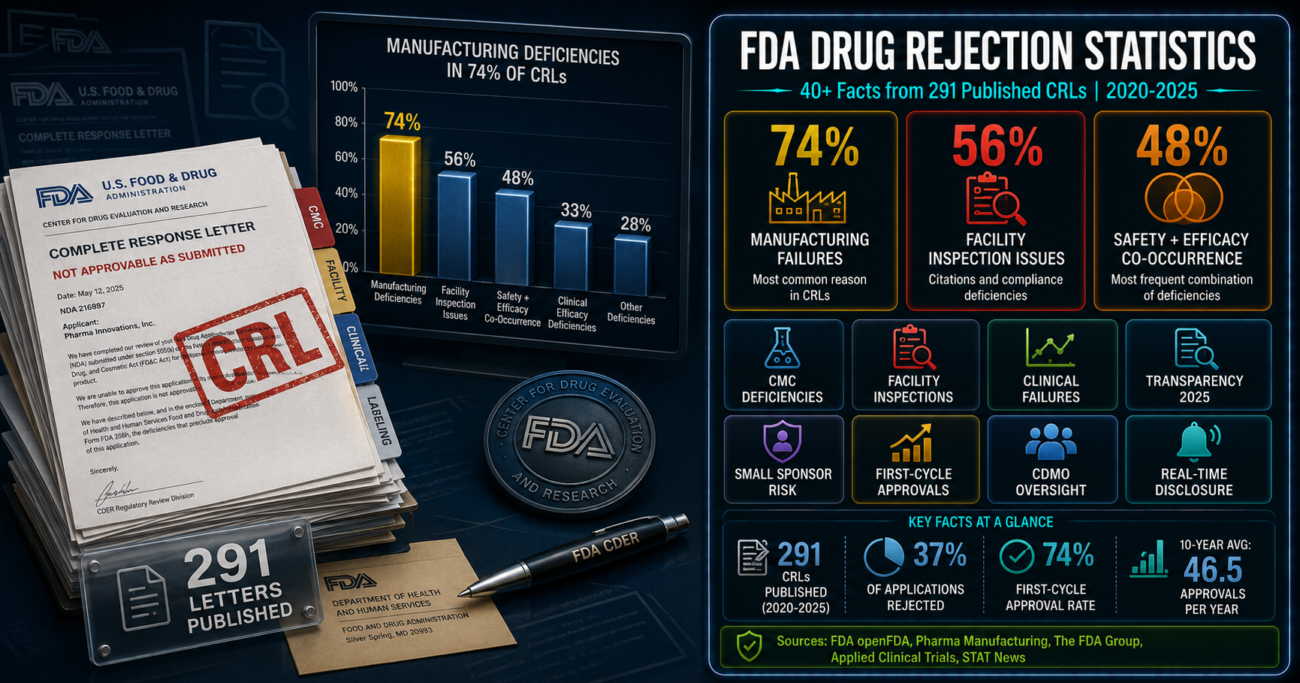
A Complete Response Letter is not the end of a drug application. It is the FDA telling a sponsor exactly what is wrong. For most of the FDA’s history, those specific reasons stayed private – shared with the applicant and no one else. That changed in July 2025, when the FDA published 202 CRLs from 2020 to 2024, and again in September 2025, when 89 more were added covering 2024 and 2025. For the first time, 291 letters describing the specific deficiencies behind hundreds of non-approvals are publicly accessible.
What the data shows is both instructive and sobering. Manufacturing and facility failures dominate. Clinical deficiencies cluster in predictable places – study design, non-U.S. populations, inadequate control arms. And 48% of letters cite both safety and efficacy problems simultaneously, suggesting that the issues rarely arrive in isolation. Below we have compiled 40+ statistics drawn from FDA records, independent CRL analyses, and regulatory intelligence sources to give drug developers and safety professionals the clearest picture yet of why applications fail.
Editor's Choice: Key FDA CRL Statistics
1. The FDA Transparency Shift: What 291 Published CRLs Represent
- The FDA published 202 Complete Response Letters from 2020-2024 on July 10, 2025, describing it as an act of radical transparency – the first centralized public database of CRLs in the agency’s history. (FDA press announcement, July 2025)
- A second batch of 89 CRLs from 2024-2025 was released on September 4, 2025, alongside an announcement that CRLs would be published promptly in real time going forward. (STAT News, September 2025)
- The July 2025 batch covered only since-approved applications. The September batch included letters for unapproved drugs such as Lykos Therapeutics’ MDMA therapy for PTSD, rejected in August 2024. (BioSpace, September 2025)
- 37% of BLAs and NDAs submitted during the 2018-2022 PDUFA cycle received a Complete Response Letter – and a CRL does not guarantee future approval upon resubmission. (Avalere Health, cited in Pharmacy Times, 2025)
- Several companies received multiple CRLs across the 2020-2024 period, including Alvotech, Azurity Pharmaceuticals, Celltrion, Coherus BioSciences, Dr. Reddy’s Laboratories, Eli Lilly, Pfizer, Sun Pharma, and Teva Pharmaceuticals. (Pharma Manufacturing, 2025)
2. Manufacturing and CMC Deficiencies: The Dominant CRL Category
- Out of 202 CRLs issued from 2020-2024, 150 (74%) involved quality or manufacturing issues, including problems with manufacturing processes, facility inspections, and CMC data – the dominant category across the entire dataset. (Pharma Manufacturing, 2025)
- Analysis of 89 CRLs from 2024-2025 found that 56% (50 letters) cited facility inspection-related approvability issues, making it the single most common deficiency in that cohort. (The FDA Group, September 2025)
- 74% of CRLs from 2020-2024 cited CMC deficiencies, with the FDA increasingly inspecting coherence between the submitted CMC package and actual commercial readiness – a gap often created by CDMO reliance. (Pharma Tech, 2025)
- CMC deficiency sub-categories include process validation failures, analytical method gaps, stability data deficiencies, container closure concerns, and drug substance impurity profile issues – none are discovered only late in development, yet they consistently surface at submission. (Assyro AI, 2026)
- In 2024, an estimated 85% of small biopharma companies outsourced API production and 77% outsourced finished dose manufacturing – creating a structural dependency on CDMOs whose inspection readiness directly affects CRL risk. (William Blair analysis, cited in Outsourced Pharma, 2025)
- Manufacturing-related issues were not evenly distributed across product types – injectables, biologics, and complex modalities received the highest proportion of CMC-related citations. (Outsourced Pharma AI analysis, 2025)
3. Clinical and Efficacy Deficiencies: Statistics on Trial Design Failures
- Over 30% of the 89 CRLs from 2024-2025 included clinical or clinical/statistical failures – inadequate efficacy data, poor study design, or safety profile concerns requiring additional trials. (The FDA Group, September 2025)
- 44% of CRLs cited clinical evidence gaps according to Compliance Insight’s analysis of the 2020-2024 dataset – including insufficient efficacy data, poor study design, and safety concerns. (Compliance Insight, 2025)
- 48% of CRLs cited deficiencies in both safety and efficacy domains simultaneously – the co-occurrence rate that signals multi-dimensional submission risk rather than isolated failures. (Applied Clinical Trials, 2025)
- CRLs frequently flagged issues not tied to clinical data itself but to how the study was designed or executed – inadequate control arms, non-U.S. population exclusivity, and failure to align with FDA guidance documents. (Auria Compliance, 2025)
- The Lykos Therapeutics MDMA rejection letter (August 2024) specifically cited unreported safety events at two clinical sites and concerns about abuse potential during the in-patient treatment process – an example of safety execution failures driving clinical CRLs. (BioSpace, September 2025)
- Over half of CRLs involved more than one major category of deficiency, requiring cross-functional remediation across clinical, CMC, labeling, and regulatory affairs teams simultaneously. (Auria Compliance, 2025)
4. The Transparency Gap: How Sponsors Previously Disclosed CRL Content
- A 2015 internal FDA analysis found that sponsors failed to disclose 85% of the agency’s concerns when announcing non-approvals publicly – a transparency gap the 2025 CRL releases were specifically designed to address. (BMJ cross-sectional study, cited in multiple analyses)
- Sponsors are under no legal obligation to reveal the full content of a CRL – many issue short press releases stating no safety concerns were raised and provide no further detail, regardless of the actual CRL content. (BioSpace, 2025)
- The July 2025 batch was limited to drugs that were subsequently approved – meaning the published CRLs represent the resolvable end of the rejection spectrum, not the full range of application failures. (BioPharma Dive, 2025)
- Many of the published CRLs were heavily redacted to remove trade secrets and confidential commercial information – particularly in CMC sections, where the most proprietary manufacturing details appear. (BioSpace, September 2025)
- 32 of the 202 letters in the July batch were issued in response to oncology applications, reflecting the high volume of cancer drug submissions relative to other therapeutic areas. (OncLive, 2025)
5. FDA Drug Approval Rate Statistics: Context for the CRL Dataset
- The FDA approved 50 novel drugs in 2024, with 48% classified as first-in-class, 52% targeting rare diseases, and 66% using one or more expedited review programs. (Pharmacy Times, 2025)
- The 10-year rolling average for FDA novel drug approvals is approximately 46.5 per year, with 2024 matching that average and 2025 coming in slightly below at 46. (BLA Regulatory, 2025)
- In 2024, 74% of approvals (37 out of 50) cleared on the first review cycle, and 68% (34 out of 50) were approved in the U.S. before any other global regulator. (BLA Regulatory, 2025)
- The FDA achieved a 94% PDUFA goal date compliance rate in 2024 – meaning the review timeline challenge for most sponsors is the quality of submissions, not the speed of FDA review. (BLA Regulatory, 2025)
- The 2022 dip to 37 approvals represents the lowest point of the decade – a year in which CRL issuance remained consistent, suggesting that external factors (pandemic inspection backlog, supply chain disruptions) contributed to the reduction rather than a change in FDA standards. (PMC analysis, 2025)
- Biologics represented 32% of 2024 drug approvals (16 out of 50), consistent with the 10-year trend of approximately one-third of approvals being biologics. The proportion dropped slightly in 2025 to 26%. (PMC, 2025)
6. Labeling, Bioequivalence, and Data Integrity Deficiencies
- Labeling deficiencies appeared in approximately 23% of CRLs – including missing or misleading usage instructions, safety warnings, and inconsistencies – most commonly in ANDA (generic drug) applications. (Compliance Insight, 2025)
- Facility inspection failures appeared in 20% of CRLs in the Compliance Insight analysis, flagging GMP site issues including uncontrolled processes, document gaps, and hygiene findings. (Compliance Insight, 2025)
- Data integrity and electronic records issues – unreliable data, missing audit trails, or Part 11 non-compliance – appeared as a distinct CRL category independent of CMC failures, suggesting that documentation practices themselves are evaluated separately from manufacturing quality. (Compliance Insight, 2025)
- Process validation issues – inadequate process qualification or failure to demonstrate ongoing control of critical process parameters – represent a technically solvable but resource-intensive CRL category requiring additional manufacturing runs and new stability studies. (Assyro AI, 2026)
- All 27 CRLs from the September 2025 batch cited facility inspection deficiencies, with four specifically tied to inspection timing challenges – three from COVID-related travel restrictions and one from a late-included manufacturing site. (Syner-G, 2026)
7. Expedited Pathways: How Fast-Track and Breakthrough Designations Interact with CRL Risk
- 66% of 2024 novel drug approvals used at least one expedited program, including fast track designation, breakthrough therapy designation, priority review, or accelerated approval – reflecting the FDA’s preference for moving transformative therapies forward quickly. (Pharmacy Times, 2025)
- Expedited designation does not eliminate CRL risk. The published letters show that breakthrough-designated drugs also received CRLs, typically for CMC or facility readiness gaps discovered at the manufacturing stage rather than during clinical review. (Auria Compliance, 2025)
- The FDA’s priority review program targets a 6-month review window compared to the standard 10 months – meaning sponsors using priority review have even less time to address manufacturing and CMC readiness before the PDUFA date. (Pharmacy Times, 2025)
- Since 2012, specialty drugs have accounted for more than half of FDA drug approvals in every single year, growing at approximately 3% per year since 2000 – a trend with direct implications for CMC complexity and CRL risk. (PMC, 2025)
- The 10-year average of 46.5 novel approvals annually means the baseline CRL rate of 37% of submitted applications translates to a substantial volume of rejection letters in any given year – now publicly accessible for the first time. (BLA Regulatory, 2025; Avalere Health)
8. What CRL Data Means for Drug Development and Regulatory Strategy
- The FDA’s stated goal in publishing CRLs was to allow drug developers to avoid repeating deficiencies that other sponsors have already addressed – the 291 letters are an industry-wide learning resource, not just a transparency gesture. (Applied Clinical Trials, 2025)
- Approximately 75% of CRLs concerned specific manufacturing challenges according to AI-generated review of the published letters, confirming that manufacturing readiness is the primary risk category across the entire dataset. (Outsourced Pharma, 2025)
- The CMC coherence gap – where the submitted package does not match the actual state of commercial readiness – is increasingly what FDA inspectors evaluate during pre-approval inspections, beyond standard GMP compliance. (Pharma Tech, 2025)
- The real-time CRL disclosure policy announced in September 2025 means future rejections will be visible to competitors almost immediately – creating both risk and intelligence opportunity for sponsors monitoring competitor application status. (STAT News, 2025)
Key Takeaways for Drug Development and Regulatory Safety Professionals
Sources
FDA Sources
- FDA openFDA – Complete Response Letters Database: 202 CRLs (2020-2024), July 2025 and ongoing updates
- FDA CDER – NDA and BLA Calendar Year Approvals 2020-2025
- FDA – Current Good Manufacturing Practice (CGMP) Regulations: facility inspection and process validation standards
Industry and Research Sources
- Pharma Manufacturing (2025) – 74% of 202 CRLs cited quality/manufacturing issues; analysis of July 2025 publication
- The FDA Group (September 2025) – Analysis of 89 CRLs from 2024-2025: 56% facility inspection issues, 30%+ clinical failures
- Applied Clinical Trials (2025) – 48% of CRLs cited both safety and efficacy deficiencies; CRL transparency initiative overview
- Pharmaceutical Technology (2025) – CMC and analytical gaps in CRLs: 74% CMC deficiency rate, tech transfer and CDMO risk
- Auria Compliance (2025) – CRL trends 2020-2024: multi-deficiency letters, small sponsor impact, study design failures
- Outsourced Pharma (2025) – CRL analysis: CDMO reliance, manufacturing deficiency patterns, biopharma outsourcing rates
- Syner-G Biopharma (2026) – 291 FDA CRLs decoded: biologics CMC strategy insights from both 2025 publication batches
- Compliance Insight (2025) – Top 10 FDA CRL drivers 2020-2024: deficiency category breakdown with percentages
- BLA Regulatory (2025) – FDA drug approval trends 2024-2025: first-cycle rates, PDUFA compliance, approval class composition
- STAT News (September 2025) – FDA announces real-time CRL disclosure policy; second batch of 89 letters released