
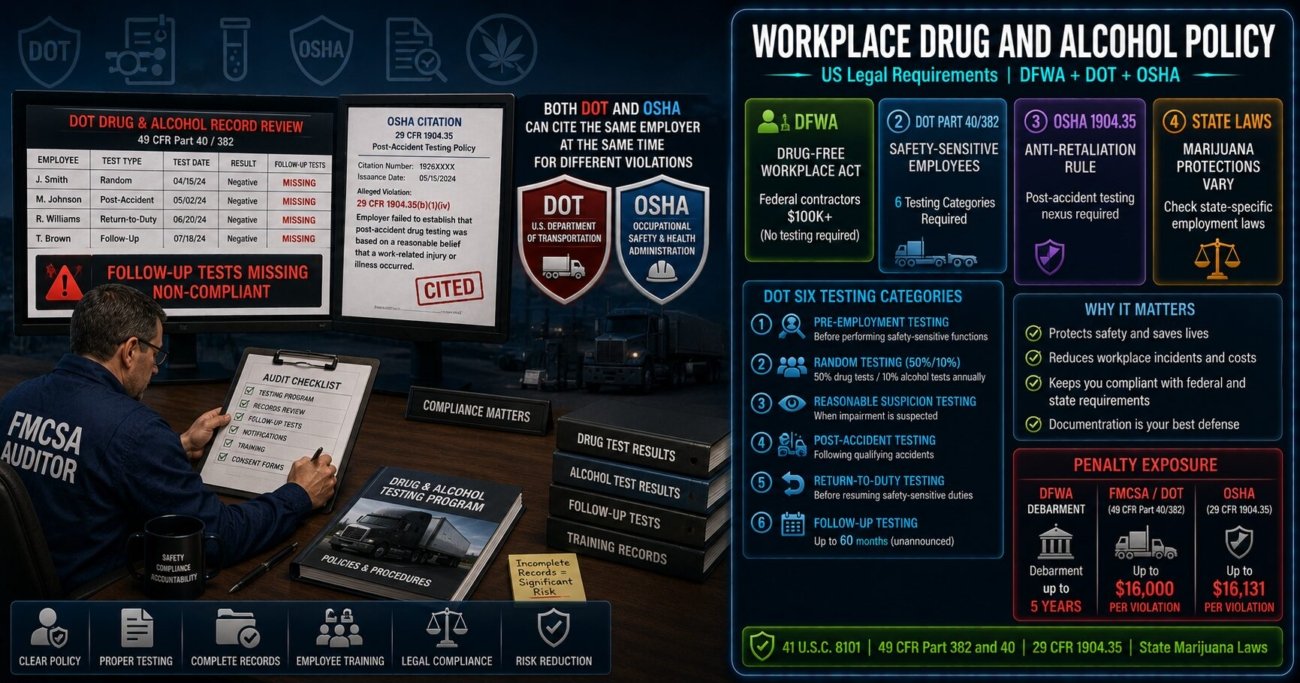
A transportation company with 200 commercial truck drivers is audited by the Federal Motor Carrier Safety Administration. The auditor reviews the company’s drug and alcohol testing programme and finds the following: the company’s designated employer representative has not completed the required training, the company failed to conduct return-to-duty follow-up testing on a driver who previously tested positive, and the company’s pre-employment testing records cannot confirm that all drivers were tested before performing safety-sensitive functions. Three violations. Each triggers enforcement action under 49 CFR Part 382.
A week later, an OSHA compliance officer reviewing a separate incident at the same company cites the employer for a post-accident drug testing policy that required testing following every recordable injury regardless of whether impairment was a plausible contributing factor. The citation notes that OSHA’s 2016 anti-retaliation rule, codified at 29 CFR 1904.35(b)(1)(iv), prohibits policies that discourage injury reporting, including blanket post-accident drug testing policies that lack reasonable suspicion criteria.
This scenario illustrates the central challenge of workplace drug and alcohol policy compliance in the United States: the legal framework is not a single statute but an overlapping set of federal regulations, agency-specific requirements, and state laws that apply differently depending on the employer’s industry, size, federal contractor status, and location. Getting the policy wrong in any of these dimensions creates enforcement exposure across multiple agencies simultaneously.
DOT auditors and OSHA compliance officers approach workplace drug and alcohol policy from different regulatory angles and with different enforcement priorities. DOT auditors verify that required testing categories are complete, that testing rates meet programme minimums, and that positive result management procedures are followed precisely. OSHA inspectors are more likely to examine whether testing policies create chilling effects on injury reporting. Both agencies can cite the same employer for different violations arising from the same testing programme. Employers should review their drug and alcohol programmes against both regulatory frameworks, not just the one they consider primary.
The Federal Legal Framework: Four Overlapping Systems
Four distinct federal legal frameworks govern workplace drug and alcohol programmes in the United States. They apply to different employer populations and create different obligations.
1. The Drug-Free Workplace Act of 1988 (41 U.S.C. 8101-8106): Applies to federal contractors with contracts of $100,000 or more and to recipients of federal grants of any amount. Covered employers must publish a written drug-free workplace policy, establish a drug awareness programme, notify employees of the policy and consequences of violation, and notify the contracting federal agency when an employee is convicted of a drug offence in the workplace. The DFWA does not require drug testing. Non-compliance can result in suspension of payments, termination of the contract, or debarment from federal contracting.
2. DOT Drug and Alcohol Testing Regulations (49 CFR Part 40 and Part 382/219/655/199/26): Apply to employers in DOT-regulated industries operating commercial motor vehicles, aircraft, railroads, pipelines, mass transit, and maritime vessels. Each DOT modal agency has its own implementing regulation (FMCSA Part 382, FAA Part 120, FRA Part 219, FTA Part 655, PHMSA Part 199, USCG). These regulations mandate specific testing categories, minimum annual random testing rates, specific drug panels, specific alcohol testing procedures, and specific consequences for positive results including immediate removal from safety-sensitive functions.
3. OSHA General Duty Clause (Section 5(a)(1) of the OSH Act) and 29 CFR 1904.35(b)(1)(iv): OSHA does not mandate drug testing except for specific circumstances in a small number of standards. However, OSHA’s General Duty Clause requires employers to maintain workplaces free from recognised hazards. Employee impairment is a recognised hazard in safety-sensitive work environments. Separately, OSHA’s anti-retaliation rule at 29 CFR 1904.35(b)(1)(iv) prohibits policies that discourage injury reporting, including drug testing policies that create retaliation risk by testing employees following injury reports without a legitimate safety basis.
4. State laws: All 50 states have their own frameworks governing private employer drug testing, which vary significantly in permitting or restricting pre-employment testing, random testing of non-safety-sensitive employees, medical marijuana user protections, notice and consent requirements, and testing procedures. Employers operating in multiple states must map each state’s requirements separately.
The most common compliance error for employers who believe they are exempt from DOT testing is misidentifying whether their employees perform safety-sensitive functions. DOT safety-sensitive function definitions are specific and may capture more employees than employers expect. An employee who performs vehicle maintenance, loads cargo on regulated vehicles, or dispatches regulated vehicles may qualify as performing a safety-sensitive function under some DOT modal regulations. Employers who are uncertain whether DOT testing applies should obtain a specific determination from a transportation attorney or a DOT compliance specialist before assuming exemption.
DOT Testing Requirements: What the Regulations Mandate
For employers subject to DOT testing regulations, 49 CFR Part 40 establishes the procedural requirements that apply across all modal agencies: urine specimen collection procedures, laboratory testing requirements, medical review officer (MRO) qualifications and procedures, substance abuse professional (SAP) requirements, and return-to-duty testing requirements. Part 40 requirements cannot be waived or modified by individual employers or contractors.
The six mandated testing categories under DOT regulations are:
- Pre-employment: Required before an employee first performs a safety-sensitive function. The employee must receive a verified negative result before beginning safety-sensitive duties. Pre-employment alcohol testing is required only under FMCSA (trucking) and FAA (aviation) regulations, not all DOT modal agencies.
- Random: The minimum annual random testing rate is set by each modal agency and can change based on industry-wide positive test rate data. FMCSA currently requires random drug testing at 50 percent of the average number of driver positions per year and random alcohol testing at 10 percent. Employees must be selected through a genuinely random process using a scientifically valid selection method.
- Reasonable suspicion: Required when a trained supervisor observes specific, contemporaneous, articulable observations of behaviour or appearance consistent with drug use or alcohol misuse. The supervisor must receive a minimum of 60 minutes of training on drug use indicators and 60 minutes on alcohol misuse indicators before making a reasonable suspicion determination.
- Post-accident: Required following accidents that meet specific criteria defined by each modal agency. For FMCSA-regulated employers, post-accident testing is required following a fatal accident, following an injury accident where any person requires immediate medical treatment away from the scene, or when a vehicle is towed from the scene. Testing must be completed within specific time limits (alcohol within 8 hours, drugs within 32 hours of the accident).
- Return-to-duty: Required after a positive test or refusal to test before the employee returns to safety-sensitive functions. Must be preceded by evaluation and clearance by a Substance Abuse Professional.
- Follow-up: Unannounced follow-up testing directed by the SAP for a minimum of 6 tests in the first 12 months following return to duty, continuing for up to 60 months based on SAP determination.
Return-to-duty testing receives most employer attention because it gates an employee’s return to safety-sensitive functions. Follow-up testing, which must continue for up to 60 months following return to duty per the SAP’s directive, is the most commonly missed ongoing obligation in DOT testing programmes. Employers who conduct return-to-duty testing but then allow follow-up testing to lapse are in violation of 49 CFR 40.307 for every required follow-up test that is not completed. DOT auditors specifically review follow-up testing records for employees who previously tested positive, and gaps in follow-up testing records generate separate citations for each missed test.
OSHA's Anti-Retaliation Rule and Post-Accident Testing
OSHA’s 2016 anti-retaliation rule at 29 CFR 1904.35(b)(1)(iv) added a frequently misunderstood restriction on post-accident drug testing that applies to all general industry employers, not only those subject to DOT testing. The rule prohibits employers from taking adverse action against employees for reporting work-related injuries or illnesses. OSHA has interpreted blanket post-accident drug testing policies – those that require testing following any recordable injury without regard to whether impairment was a plausible contributing factor – as potentially violating this prohibition because they create an implicit disincentive for injury reporting.
OSHA’s enforcement guidance on this rule specifies that post-accident drug testing is permissible when:
- The testing is required by a state law or federal regulation
- There is a reasonable possibility that drug or alcohol use was a contributing factor in the reported injury
- The testing is conducted consistently and does not single out employees who report injuries
Post-accident drug testing that is triggered only by the act of reporting an injury, without any nexus to potential impairment, is the specific practice OSHA’s rule targets. An employer whose policy requires testing following every OSHA-recordable injury, including a worker who cuts a finger on a paper edge, is implementing a policy that OSHA enforcement guidance characterises as potentially retaliatory.
Many employers in safety-sensitive industries believe that their DOT post-accident testing obligations insulate their post-accident testing policy from OSHA scrutiny. This is not accurate. DOT post-accident testing requirements apply to DOT-regulated accidents meeting specific criteria. OSHA’s anti-retaliation rule applies to the broader universe of all OSHA-recordable injuries. An employer may be required to conduct DOT post-accident testing following a qualifying accident and simultaneously prohibited from conducting testing following non-qualifying injuries if the testing policy lacks a reasonable suspicion nexus. The two frameworks co-exist and apply to different sets of events.
Marijuana: The Federal-State Legal Conflict and What It Means for Employers
Marijuana remains a Schedule I controlled substance under the federal Controlled Substances Act, making its use, possession, and distribution illegal under federal law regardless of state legalisation. For DOT-regulated employers, this resolves the conflict clearly: DOT regulations require testing for marijuana under federal standards, and a positive marijuana result is a DOT violation regardless of whether the employee is a state-licensed medical marijuana patient or used marijuana in a state where recreational use is legal.
For non-DOT employers, the marijuana compliance landscape is significantly more complex. As of 2026, the majority of US states have enacted either medical or recreational marijuana legalisation, and a growing number of those states have enacted employment protections that prohibit or restrict employers from taking adverse action against employees for off-duty marijuana use. The specific scope of these protections varies significantly by state:
- Some states prohibit adverse action against employees who test positive for marijuana unless the employer can demonstrate impairment at the time of the test
- Some states protect only medical marijuana patients, not recreational users
- Some states expressly allow employers to maintain zero-tolerance marijuana policies regardless of state legalisation
- Some states require employers to engage in an interactive process before taking adverse action against a medical marijuana patient who tests positive
Employers whose operations span multiple states must map the specific marijuana employment protections in each state where they have employees and tailor their testing and adverse action policies accordingly. A single national zero-tolerance marijuana policy that may be valid in some states may expose the employer to discrimination claims in states with employment protection statutes.
Penalty Exposure and Enforcement Consequences
The penalty consequences for workplace drug and alcohol policy violations differ significantly across the applicable regulatory frameworks:
- Drug-Free Workplace Act violations: Non-compliance can result in suspension of federal contract payments, contract termination, and debarment from federal contracting for up to five years. For grant recipients, violations can result in grant suspension or termination. Financial exposure depends on the size of the federal contract or grant involved.
- DOT testing violations: FMCSA civil penalties for drug and alcohol testing violations range from $1,000 to $16,000 per violation under 49 CFR Part 383. DOT audits can result in unsatisfactory safety ratings that affect commercial operating authority. Operating safety-sensitive employees who have not been tested as required, or who tested positive and have not completed return-to-duty procedures, creates per-employee per-day violation exposure.
- OSHA anti-retaliation violations: OSHA citations for 29 CFR 1904.35(b)(1)(iv) violations can result in serious violation penalties of up to $16,131 per violation. In cases where the anti-retaliation policy is found to have actually discouraged specific employees from reporting injuries, OSHA may pursue additional citations for each affected employee.
- State law violations: State drug testing law violations may result in private civil litigation by affected employees, regulatory penalties, and in states with marijuana employment protection statutes, discrimination claims with remedies that may include reinstatement, back pay, and attorneys’ fees.
Knowledge Check
Test your understanding of workplace drug and alcohol policy legal requirements.
Yes, for this scenario. Under 49 CFR 382.301, FMCSA requires pre-employment drug testing before a driver first performs a safety-sensitive function. Pre-employment alcohol testing under FMCSA is required only if the employer chooses to conduct it – it is not mandatory. If the employer does conduct pre-employment alcohol testing, the driver must receive a result below 0.04 before beginning safety-sensitive duties. The company’s decision not to conduct pre-employment alcohol testing is compliant. The mandatory pre-employment drug test returning negative satisfies the primary requirement. Note that the company must verify through a consortium or clearinghouse check that the driver has no unresolved prior DOT drug and alcohol violations from previous employers before the first safety-sensitive assignment under 49 CFR 382.301(d).
Likely yes in this state, but the policy itself may create OSHA exposure. In a state with recreational marijuana legalisation but no employment protection statute, an employer generally retains the right to enforce a zero-tolerance drug policy including termination for a positive marijuana test. However, the policy trigger – testing following any injury requiring medical treatment – may be vulnerable to OSHA scrutiny under 29 CFR 1904.35(b)(1)(iv) if OSHA determines that the policy lacks a reasonable suspicion nexus for injuries where impairment was not a plausible contributing factor. A hand laceration that could have occurred regardless of impairment may not satisfy OSHA’s reasonable possibility standard. The termination decision based on the positive test result may be defensible; the policy design that triggered the test may not be.
No, but the company must implement other DFWA requirements. The Drug-Free Workplace Act of 1988 does not require drug testing. It requires covered employers (federal contractors with contracts of $100,000 or more) to publish a written drug-free workplace policy, establish a drug awareness programme, notify employees of the policy and consequences, and report drug-related convictions. The DFWA’s drug testing obligations are separate from and additional to these requirements – many employers choose to implement testing for safety or liability reasons, but the statute does not mandate it. The company must implement the written policy, awareness programme, employee notification, and conviction reporting system, but is not legally required by the DFWA alone to conduct any drug testing.
Drug and Alcohol Policy Compliance Checklist
✓ Determined whether the Drug-Free Workplace Act applies (federal contracts of $100,000 or more, or federal grants of any amount)
✓ Determined whether DOT testing regulations apply (employees performing safety-sensitive functions in FMCSA, FAA, FRA, FTA, PHMSA, or USCG-regulated operations)
✓ Written drug and alcohol policy addresses all required elements: prohibited conduct, testing procedures, consequences, confidentiality, employee rights, and EAP resources
✓ For DOT employers: all six testing categories (pre-employment, random, reasonable suspicion, post-accident, return-to-duty, follow-up) are implemented with documented procedures
✓ For DOT employers: random testing rates meet current modal agency minimums (FMCSA: 50% drug, 10% alcohol)
✓ For DOT employers: supervisors have completed 60 minutes of drug awareness training and 60 minutes of alcohol misuse training before making reasonable suspicion determinations
✓ Post-accident testing policy specifies criteria for testing based on reasonable possibility of impairment, not automatic testing following any injury (OSHA 29 CFR 1904.35)
✓ Marijuana policy has been reviewed against the specific employment protection statutes in each state where employees are located
✓ For DOT employers: follow-up testing schedules for all employees with prior positive results are current and documented
✓ Policy has been reviewed by employment counsel within the past 12 months for compliance with state law changes
Sources
- 41 U.S.C. 8101-8106: Drug-Free Workplace Act of 1988
- 49 CFR Part 382: FMCSA Controlled Substances and Alcohol Use and Testing
- 49 CFR Part 40: DOT Procedures for Transportation Workplace Drug and Alcohol Testing Programs
- 29 CFR 1904.35(b)(1)(iv): OSHA Anti-Retaliation Rule (post-accident drug testing guidance)
- US Department of Labor: Drug-Free Workplace Resources and Compliance Guidance