

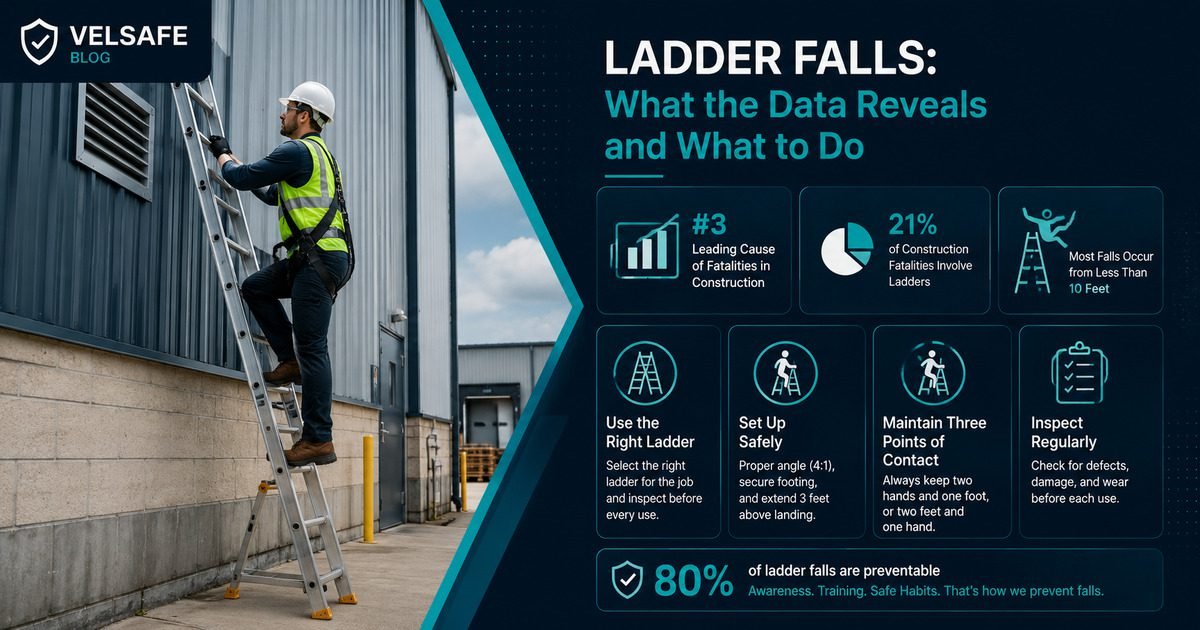
What the Injury Data Shows and Where Programmes Break Down
Ladder safety awareness refers to a worker’s and supervisor’s understanding of the specific risks associated with portable and fixed ladder use, the inspection requirements that apply under OSHA standards, and the setup and use procedures that prevent falls before they occur. In general industry, OSHA codifies these requirements under 29 CFR 1910.23. In construction, 29 CFR 1926.1053 governs. Both standards share the same underlying logic: the hazard is foreseeable and controllable.
Ladder falls kill workers across every covered sector. They occur in warehouses, manufacturing facilities, office buildings, and outdoor work sites. The BLS Census of Fatal Occupational Injuries consistently records more than 160 ladder-related fatalities per year. Yet the injury profile has not meaningfully declined in over a decade. The reason is not a lack of regulation. The reason is that the most common failures, including improper angle, use of damaged equipment, and inadequate supervision, recur because employers treat ladder safety as a training topic rather than a hazard control problem.
This article covers the injury data, the OSHA requirements that apply across general industry and manufacturing, the specific failure patterns behind most incidents, and what an effective ladder safety awareness programme actually requires to reduce incident rates.
1. Injury Profile: Who Is Getting Hurt and Where
- Falls to a lower level dominate the fatality data. BLS consistently records falls to a lower level as one of the leading fatal event types across all private industry sectors. Ladder falls are a primary mechanism within this category. The fatality count has remained relatively stable for over a decade, indicating that existing approaches are not sufficient to drive decline. (BLS CFOI, Annual Summary)
- The non-fatal injury rate is substantially higher. For every fatality, NIOSH estimates that many more workers sustain injuries ranging from sprains and fractures to traumatic brain injury. Approximately 20,000 ladder-related emergency room visits occur annually, making ladders one of the highest-volume sources of occupational injury requiring medical attention in general industry. (NIOSH, Falls Prevention)
- Most incidents involve workers using ladders routinely, not novices. Post-incident investigation data shows that the majority of injured workers were experienced employees performing tasks they had performed before. The incident was not caused by ignorance of ladders, but by a specific failure in setup, inspection, or use that had gone uncorrected across many prior uses. This is the programme failure, not an individual failure. (OSHA Publication 3124)
2. OSHA Requirements for Ladder Safety Across Industries
- The 2017 revision to 29 CFR 1910.23 significantly expanded general industry obligations. The updated standard, which took effect in January 2017, replaced the former 29 CFR 1910.25 and 1910.26 and aligned general industry requirements more closely with construction standards. Employers who trained workers prior to 2017 and did not update their programmes may be operating under obsolete requirements. (OSHA, 29 CFR 1910.23)
- Training must cover recognition, not just procedure. OSHA requires that training address hazard recognition, not only the steps for climbing. A worker trained only on the 4:1 angle rule but not on how to identify surface conditions or ladder defects has received incomplete training under both the general industry and construction standards. (29 CFR 1926.1053(b)(15))
- Retraining is required when observation shows inadequate training. Under 29 CFR 1926.1060, employers must retrain each worker who shows a lack of proficiency in using a ladder safely. The existence of an observed near-miss or sub-standard behaviour during a site visit creates a documented obligation to act. Employers who observe and do not respond have created a compliance exposure independent of any subsequent incident. (29 CFR 1926.1060)
3. The Setup and Use Failures Behind Most Ladder Falls
- These failures persist because they are tolerated, not because they are unknown. Post-incident investigations consistently find that supervisors were aware of sub-standard ladder practices before the incident. The barrier is not training; it is the absence of observable enforcement and feedback. A single supervisor who reinforces the 4:1 angle rule on a walk-through changes crew behaviour more durably than a classroom session. (OSHA 3124, Stairways and Ladders Safety Guide)
- Time pressure is the primary behavioural driver. Workers skip setup steps and hazard checks when the work culture treats ladder use as a routine, low-consequence activity. EHS programmes that have reduced incident rates have typically done so by building pre-task checks into the work authorisation process, not by adding training hours. (NIOSH, Falls in the Workplace Research)
4. Ladder Inspection: The Control Most Often Skipped
- Inspection is a critical pre-task step, not an annual event. OSHA requires pre-use inspection, not a quarterly check. This distinction matters practically. Ladder condition degrades with use and storage. A ladder that passed a quarterly inventory check may have developed a crack, a loose rung, or a worn foot pad in the interim. The standard’s logic is that the user who is about to climb is the last line of defence before an incident. (29 CFR 1910.23)
- The counterintuitive finding: painting ladders obscures defects. Many maintenance operations paint portable wooden ladders to protect them from the elements. OSHA explicitly prohibits painting portable wooden ladders (other than transparent finishes) because paint masks cracks, splits, and rotted sections that would otherwise be visible. This is a common workplace practice that creates a direct compliance and safety exposure. (OSHA Publication 3124)
5. Building Effective Ladder Safety Awareness Into Your Programme
- Awareness training and hazard control are not the same thing. A worker who completes a ladder safety course and then uses a damaged ladder on an uneven surface under time pressure has not been protected by that training. Effective programmes layer training with equipment controls (managed inventory), administrative controls (pre-task checks), and supervisory controls (observed reinforcement). Relying on training alone is the most common programme gap in general industry. (NIOSH)
- Microlearning supports awareness without increasing training burden. Short, targeted reminders delivered at the point of use or through mobile platforms maintain awareness across longer intervals between formal training sessions. For multi-site operations where ladder use is routine but not the primary job task, microlearning is the most cost-effective way to sustain awareness between annual refresher sessions. (OSHA, Training Resources)
- Document the programme, not just the training. In a post-incident OSHA investigation, the agency will ask for records of training, pre-task assessments, inspection logs, and corrective actions taken for prior near-misses. An organisation that has well-documented hazard controls and a clear inspection and tag-out process is in a substantially better position than one that can only produce training attendance records. (OSHA Recordkeeping)
Key Takeaways
Training Alone Does Not Prevent Ladder Falls
OSHA’s 2017 Update Changed General Industry Requirements
The Highest-Impact Action Is Inspection Before Every Use
Frequently Asked Questions
What OSHA standard applies to ladder safety in general industry?
How often must ladders be inspected under OSHA requirements?
What is the correct angle for setting up a portable ladder?
Can workers stand on the top two rungs of a step ladder?
What ladder should not be used near electrical hazards?
What is the three-point contact rule and why does it matter?
Does OSHA require ladder training to be documented?
Sources
Government and Regulatory Sources
- OSHA. (2017). 29 CFR 1910.23 : Ladders (General Industry) : primary regulatory standard for portable, fixed, and job-made ladders in non-construction workplaces.
- OSHA. (Current). 29 CFR 1926.1053 : Ladders (Construction) : construction ladder standard covering angle, extension, load rating, and training requirements.
- OSHA. (Current). Publication 3124 : Stairways and Ladders: A Guide to OSHA Rules : practical guidance document summarising employer obligations for ladder safety.
- BLS. (Annual). Census of Fatal Occupational Injuries (CFOI) : annual data on fatal work injuries by event type, including falls from ladders.
Research and Industry Sources
- NIOSH. (Current). Falls in the Workplace : NIOSH research and statistics on occupational fall hazards, including ladder-related injury rates and prevention evidence.
- OSHA. (Current). Falls: The Leading Cause of Worker Deaths : OSHA resource page on fall prevention across industries with ladder-specific data.