


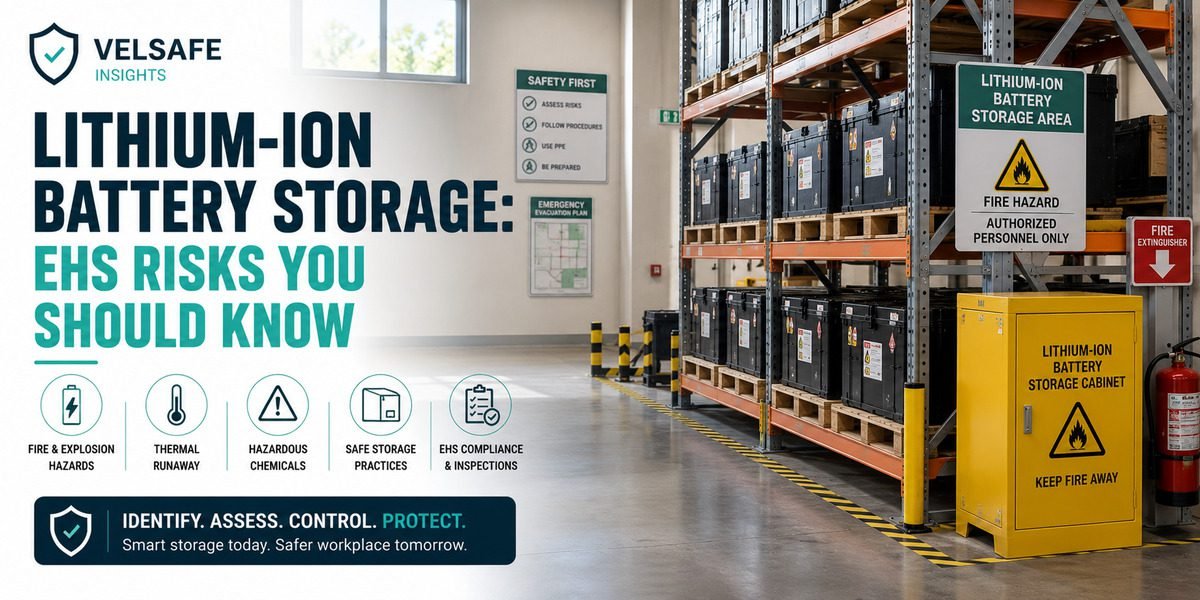
Large lithium-ion battery systems stored without adequate separation distances, ventilation, and gas detection create the conditions for thermal runaway to spread from cell to cell before detection systems can alert staff. OSHA’s General Duty Clause holds employers accountable when recognised storage hazards go unaddressed, and NFPA 855 sets specific installation and storage requirements that many facilities have not yet implemented. This analysis identifies the four storage failure categories most EHS programmes overlook, what the current regulatory framework requires, and where detection and monitoring gaps leave facilities exposed.
Why Storage Is the Highest-Risk Phase for Large Battery Systems
EHS programmes for large lithium-ion battery systems tend to concentrate attention on charging protocols and operational controls. This reflects a reasonable assumption: that active energy transfer creates the greatest hazard. The data on thermal events says otherwise. Storage is the phase where temperature fluctuations, mechanical damage from handling, and undetected cell degradation converge without the monitoring that operating systems typically carry.
Large-format battery systems present a concentration risk that small pack storage does not. A warehouse storing battery racks for electric forklifts, industrial equipment, or grid support installations may hold hundreds of kilowatt-hours of stored energy in a confined area. Individual cells in that storage arrangement may be mechanically intact but internally degraded, overcharged from a previous cycle, or at a state of charge that makes them unstable at ambient temperatures. None of these conditions are visible during a standard walkaround inspection.
The distinction between lithium iron phosphate (LFP) and nickel manganese cobalt (NMC) chemistries matters significantly in storage. NMC cells are more energy-dense and more thermally reactive at elevated temperatures. LFP cells are more stable but still require separation and ventilation controls. Many storage arrangements in industrial facilities mix chemistries, mix states of charge, and store batteries alongside other combustibles without regard for the specific requirements of each type.
The Four Storage Failure Points Most EHS Programmes Miss
Four specific failure categories appear repeatedly in post-incident analyses of large battery storage events. Each one is addressable with known controls. Each one is routinely overlooked in facilities that have not updated their EHS programmes to reflect the specific requirements of large-format battery storage.
Failure 1: Inadequate Separation Distances
NFPA 855 specifies separation distances between energy storage system units, between ESS units and walls, and between ESS areas and other occupancies. These distances exist to prevent cell-to-cell thermal runaway propagation and to maintain access corridors for emergency response. Most facilities storing large battery systems were not designed with these requirements in mind and have not been retrofitted to meet them.
The separation requirement is not simply about physical spacing. It also governs proximity to combustible materials, flammable liquids, ignition sources, and occupied areas. A battery storage arrangement that meets the spacing requirements between units but is located adjacent to a charging station or a packaging area with cardboard materials may still fail the overall separation analysis under NFPA 855 and the relevant local fire code.
Failure 2: Missing Ventilation and Gas Detection
Lithium-ion cells can vent gases during standby storage, particularly when they are degraded, overcharged, or exposed to elevated temperatures. These gases include hydrogen fluoride, carbon monoxide, and a range of flammable organic compounds. In enclosed storage spaces without mechanical ventilation and gas detection, these gases can accumulate to concentrations that are either toxic to workers who enter the area or ignitable if an ignition source is present.
NFPA 855 requires gas detection for indoor energy storage system installations that meet the standard’s thresholds. Many facilities have smoke detection in battery storage areas but not gas detection, which is a different measurement for a different hazard. Smoke detection does not alert to venting gases at pre-ignition concentrations. By the time smoke is detectable, a venting event has already progressed significantly.
Failure 3: Uncontrolled Temperature Environments
Temperature is the primary accelerant of cell degradation in storage. NMC cells stored consistently above 25°C experience accelerated capacity fade and increased internal resistance, both of which raise thermal runaway risk during subsequent charge cycles. LFP cells are more tolerant of temperature variation but still degrade faster under heat stress. Storage in unventilated warehouses, near loading dock doors in summer, or in direct sunlight constitutes an uncontrolled temperature environment.
Cold storage also creates risk in a different direction. Batteries stored below their minimum operating temperature and then charged immediately on retrieval are vulnerable to lithium plating, a condition that creates internal short circuit pathways. Facilities that store batteries in cold environments and then move them directly to charging bays without a temperature stabilisation period are creating a hazard that is difficult to detect and expensive to discover after an incident.
Failure 4: Mixed Chemistry or State-of-Charge Storage Without Controls
Facilities that operate multiple battery chemistries, or that receive batteries at varying states of charge from field operations, often store them without segregation. NMC and LFP cells have different optimal storage states of charge, different temperature tolerances, and different emergency response requirements. Storing them together without labelling, without chemistry identification systems, and without separate monitoring creates a situation where responders cannot immediately determine what they are dealing with if a thermal event begins.
What NFPA 855 and OSHA Require for Battery Storage
NFPA 855 is the primary standard that governs the installation and storage of stationary energy storage systems in the United States. It was first adopted in 2020 and has been updated since, with the 2023 edition currently in force in jurisdictions that have adopted it. Compliance with NFPA 855 is not automatically mandatory nationwide, since adoption occurs at the state and local jurisdiction level through the International Fire Code or locally adopted editions. However, OSHA’s General Duty Clause creates a parallel obligation regardless of local adoption status.
Under Section 5(a)(1) of the OSH Act, employers must provide employment and a place of employment free from recognised hazards that are causing or likely to cause death or serious physical harm. Thermal runaway in large battery storage areas is a recognised hazard. NFPA 855 provides the documented benchmark for what constitutes adequate controls. If NFPA 855 requires gas detection and an employer has not installed it, that absence becomes evidence of a General Duty Clause violation if a storage incident occurs.
A critical nuance that many EHS managers miss: OSHA 29 CFR 1910.307, which governs electrical equipment in hazardous locations, applies when battery storage areas can reasonably produce flammable gas concentrations. If off-gassing from degraded or damaged cells could reach an ignitable concentration in the storage space, the electrical equipment in that space may need to be rated for use in a hazardous location. This is a classification decision that requires a formal hazard area analysis, not a visual inspection.
Detection and Monitoring: The Gap Most EHS Teams Have
Detection and monitoring for large battery storage areas require a different approach than standard fire detection. Smoke alarms and heat detectors respond to conditions that already represent an advanced stage of a thermal event. For large battery systems, the value of early detection comes from identifying gas accumulation and temperature anomalies before visible smoke or flame develop.
Gas Detection Systems
NFPA 855 requires gas detection for indoor ESS installations. The detection system must be capable of identifying flammable gas concentrations before they reach the lower explosive limit and must be integrated with ventilation activation and alarm systems. Detectors must be positioned to capture gases that are lighter than air (hydrogen) and denser than air (some fluorinated compounds) depending on the chemistry stored. A single smoke detector installed on the ceiling of a battery storage room does not meet this requirement.
Temperature Monitoring
Continuous ambient temperature monitoring in battery storage areas provides two forms of value: it identifies storage conditions that accelerate degradation before any individual cell shows signs of failure, and it creates a record that can be reviewed after an incident. Battery management systems (BMS) integrated into the storage equipment typically monitor individual cell temperatures, but many large-format batteries in transit or interim storage are not connected to their operational BMS. These units rely entirely on ambient temperature controls in the storage space.
Thermal Imaging Programmes
Infrared thermal imaging conducted on a scheduled basis identifies cells and modules with elevated surface temperatures that indicate internal degradation or early-stage thermal events. This is an inspection tool, not a continuous monitoring system, but it provides a level of visibility into stored battery condition that visual inspection cannot match. Facilities storing large numbers of batteries for extended periods should establish an IR inspection frequency appropriate to their inventory turnover and chemistry risk profile.
Fire Suppression Compatibility
Lithium-ion battery fires require large volumes of water to cool cells to below the thermal runaway self-sustaining threshold. Standard dry chemical or CO2 suppression systems that interrupt combustion do not address the internal heat generation that drives thermal runaway. NFPA guidance and UL 9540A test data both indicate that water is the primary suppression agent for lithium-ion battery fires. Storage areas without sprinkler coverage and without a water source adequate to sustain cooling operations are not adequately protected, regardless of what other detection systems are in place.
Emergency Planning for Battery Storage Areas
Emergency response to a large battery thermal event in a storage area presents specific challenges that standard fire response protocols do not address. Fire departments responding to battery storage events require information about chemistry type, energy quantity, storage arrangement, and available water supply before they can develop an effective response strategy. Facilities that have not communicated this information to their local fire authority in advance are placing first responders at higher risk and potentially extending the duration and scope of the event.
NFPA 855 and the International Fire Code both contemplate pre-incident planning as part of ESS compliance. This includes providing the local authority having jurisdiction (AHJ) with documentation of the ESS installation: energy capacity, chemistry, location within the facility, separation distances, suppression systems in place, and emergency shut-off procedures. Facilities that have installed large battery systems without completing this disclosure step are not in full compliance with the applicable fire code framework, regardless of the physical installation quality.
One element that is frequently absent from emergency plans for battery storage areas is the decision protocol for when to shelter-in-place versus evacuate. Hydrogen fluoride and other gases produced during lithium-ion thermal events are highly toxic. Whether workers in adjacent areas should shelter or evacuate depends on gas detection readings, wind direction, building HVAC configuration, and the stage of the thermal event. This decision sequence requires pre-planning and cannot be improvised reliably under emergency conditions.
-
✓
AHJ Pre-Incident Plan Submitted: Document submitted to the local authority having jurisdiction with ESS chemistry, energy capacity, and layout per NFPA 855 and local fire code requirements.
-
✓
Gas Evacuation vs Shelter Protocol Defined: Decision tree based on gas detection alarm level, wind conditions, and event stage. Reviewed with all supervisors on each shift covering the storage area.
-
✓
Emergency Shut-Off Documented and Accessible: Location of emergency disconnects and shut-off controls labelled and included in first responder documentation. Signage posted at storage area entrances.
-
✓
Water Supply Confirmed for Suppression: Available water volume and flow rate at the storage area verified as adequate for sustained cooling of a large battery thermal event. Sprinkler coverage confirmed, or alternative water access planned.
-
✓
PPE for Responders Staged: Appropriate PPE for hydrogen fluoride and carbon monoxide exposure staged near the storage area exit. Response team trained on donning sequence and decontamination procedures.
Storage Is the Phase Most Programmes Underprotect
Most thermal events in industrial battery environments originate not during charging or operation but during storage, where temperature controls, separation distances, and gas detection are rarely implemented to the level NFPA 855 and OSHA require. Review your storage arrangement against all four failure categories before your next inspection cycle.
Gas Detection Is Not Optional for Indoor Storage
NFPA 855 requires gas detection for qualifying indoor ESS installations, and OSHA’s General Duty Clause creates a parallel obligation regardless of local fire code adoption status. Smoke detection alone does not satisfy this requirement. If your indoor battery storage area does not have gas detection integrated with ventilation and alarm systems, it is not in compliance.
Emergency Planning Must Happen Before an Event Occurs
Pre-incident documentation submitted to the local AHJ, shelter-versus-evacuation protocols, emergency shut-off location signage, and water supply confirmation cannot be improvised during an active thermal event. Facilities that have deployed large battery systems without completing these planning steps are operating with a significant emergency response gap. The decision to address that gap is a programme management decision, not a field decision. Make it now.
Frequently Asked Questions
Does NFPA 855 apply to my facility if my state has not adopted it?
NFPA 855 becomes binding law when adopted by a jurisdiction through the International Fire Code or a state or local ordinance. If your state has not adopted it, it is not legally required as a fire code matter. However, OSHA’s General Duty Clause still applies, and NFPA 855 sets the recognised standard of care for battery storage. Failure to follow it would likely be cited as evidence of a recognised hazard not being controlled in any post-incident OSHA investigation.
What is the difference between a stationary ESS and batteries stored in transit?
NFPA 855 covers stationary energy storage systems, meaning systems that are installed in a location for operational use. Batteries stored in a warehouse prior to installation, or batteries removed from service and awaiting disposal, may fall into a different regulatory category depending on how they are classified. Large quantities of batteries in interim storage should be reviewed under NFPA 855, the International Fire Code, and applicable DOT hazardous materials regulations for stored dangerous goods.
Can standard dry chemical fire extinguishers suppress a lithium-ion battery fire?
Standard dry chemical, CO2, and halon suppression systems interrupt combustion but do not address the internal heat generation that sustains thermal runaway in lithium-ion cells. Water is the primary cooling and suppression agent for lithium-ion fires, and it must be applied in large, sustained quantities to bring cells below the self-sustaining thermal runaway threshold. Fire extinguishers are appropriate for incipient-stage fires and for protecting egress, but they are not sufficient for managing an active battery thermal event involving large-format cells.
What temperature range is recommended for long-term lithium-ion battery storage?
Most lithium-ion cell manufacturers specify a storage temperature range of approximately 15°C to 25°C (59°F to 77°F) for long-term storage, with storage at around 50% state of charge recommended to minimise degradation. These are manufacturer-specific values, and the exact range varies by chemistry and cell format. Storage outside these conditions does not immediately create a safety event, but it accelerates degradation that increases risk during subsequent charge and discharge cycles. Always consult the manufacturer’s published storage specifications for the specific chemistry you are storing.
How do I determine if my battery storage area requires hazardous location electrical equipment?
OSHA 29 CFR 1910.307 applies when a location can produce ignitable concentrations of flammable vapour or gas. The determination requires a formal hazardous area classification analysis that considers the chemistry of gases that could be produced by the batteries stored, the ventilation rate of the space, and whether an ignitable concentration could accumulate under any foreseeable failure scenario. This analysis should be performed by or reviewed by a qualified electrical engineer and documented as part of the storage area’s safety programme. A visual assessment is not sufficient.
What is hydrogen fluoride and why is it a particular concern in battery storage areas?
Hydrogen fluoride (HF) is a highly toxic gas produced during thermal decomposition of the electrolyte in lithium-ion cells. It is colourless and has a sharp odour at concentrations above the odour threshold, but some individuals cannot detect it reliably by smell. Exposure to high concentrations causes severe respiratory injury, and systemic fluoride toxicity can be life-threatening even from skin exposure. NIOSH identifies HF as an immediately dangerous to life and health (IDLH) hazard at 30 ppm. Battery storage areas where cells could vent HF must have detection systems rated for HF and response procedures that include appropriate respiratory protection.
Does OSHA have a specific standard for lithium-ion battery storage in warehouses?
OSHA does not have a dedicated regulation specifically titled for lithium-ion battery storage. Compliance obligations are drawn from multiple standards: Section 5(a)(1) of the OSH Act (General Duty Clause) for recognised hazards, 29 CFR 1910.303 and 1910.307 for electrical equipment in storage areas, and OSHA’s general industry standards for hazardous materials, fire prevention, and emergency planning. The absence of a dedicated standard does not reduce the employer’s obligation to control recognised battery storage hazards.
Sources
- OSHA: General Duty Clause, Section 5(a)(1) of the OSH Act: Authority for citing employers who fail to control recognised battery storage hazards
- OSHA: 29 CFR 1910.307: Electrical equipment in hazardous locations: Applies to battery storage areas where flammable gas accumulation is possible
- NIOSH: Hydrogen Fluoride Hazard Information: IDLH designation and toxicological profile for HF gas produced during battery thermal events
- OSHA: Penalty Schedule: Current maximum penalties for serious violations referenced in this article
- NFPA: NFPA 855: Standard for the Installation of Stationary Energy Storage Systems: Primary source for separation, ventilation, gas detection, and suppression requirements
- UL: UL 9540A: Test Method for Evaluating Thermal Runaway Fire Propagation in Battery Energy Storage Systems: Testing standard referenced for thermal propagation and suppression analysis
- NFPA Research Foundation: Energy Storage System Safety Research: Source for thermal runaway temperature data and fire behaviour documentation
- EPRI: Energy Storage Safety Research: Risk assessment data and failure category analysis for stationary energy storage systems
Related VelSafe Articles
Foundational worker safety guidance for those who handle, charge, and operate large lithium-ion battery systems in industrial and warehouse settings.
Eight actionable safety tips specifically for warehouse environments operating large lithium-ion battery systems, from inspection to charging protocols.
A comprehensive guide to fire extinguisher classifications and selection, directly relevant to battery storage areas where the correct suppression agent is critical to responder safety.
VelSafe covers the full large lithium-ion battery safety series, from worker orientation and charging protocols to storage, disposal, and emergency response. Explore the complete series for your EHS programme.
