

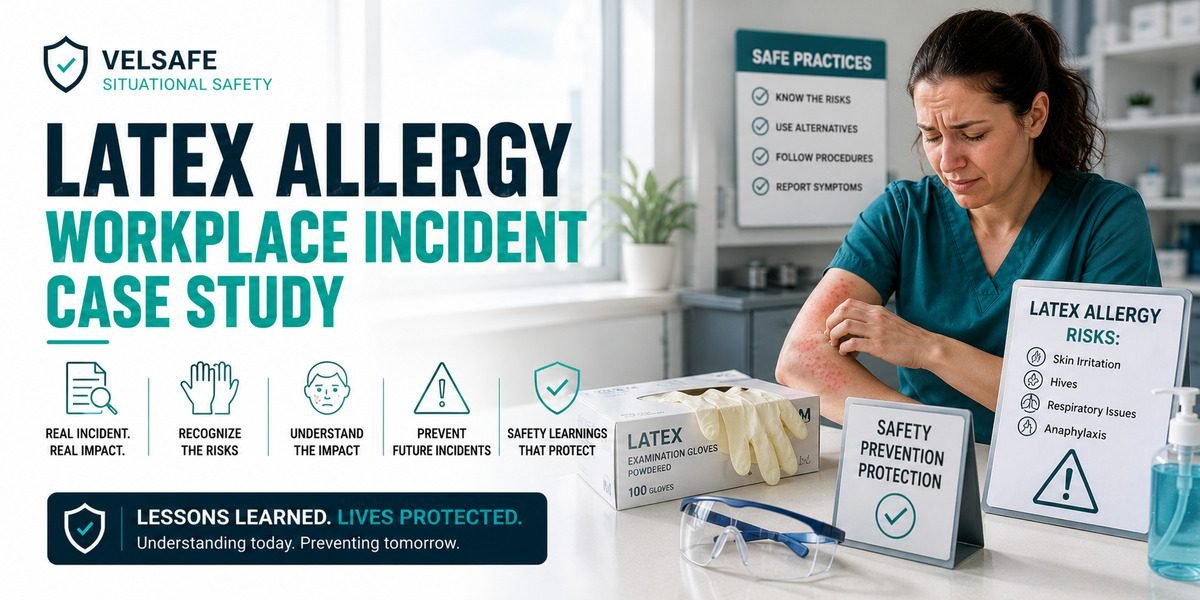
Healthcare worker examining a latex allergy skin reaction on her arm next to latex examination gloves

Latex Allergy at Work: What Went Wrong and Why

SITUATIONAL : Workplace Safety Case Study
A construction worker suffered anaphylactic shock after hours of latex glove use on a hospital renovation site. No screening. No alternatives. No emergency plan. This case study examines how a preventable incident became a life-threatening event.
This case study is a composite scenario based on documented patterns of latex allergy incidents in construction and healthcare settings. All employer and worker details are fictional. Regulatory citations are real.
1-6%
General Population
Estimated proportion of the general population sensitised to natural rubber latex proteins.
NIOSH, 1997
8-17%
Healthcare Workers
Estimated prevalence of latex sensitisation among healthcare workers who regularly use latex gloves.
NIOSH, 1997
$0
Cost of Prevention
Nitrile and vinyl gloves cost no more than latex alternatives. The cost of not substituting is measured in workers’ compensation, litigation, and OSHA citations.
OSHA Latex Allergy Page

The Situation: Four Facts That Defined This Incident

Location
Hospital Renovation Site
Active medical-wing renovation. Construction crews shared the building envelope with operating clinical areas. Ventilation was partially compromised during demolition phases.
Workers Involved
12 Construction Contractors
General contractors performing structural and finishing work. The employer required all workers to wear powdered latex examination gloves for infection control compliance in the clinical zone.
Outcome
Anaphylactic Reaction, Emergency Hospitalisation
One worker suffered anaphylaxis approximately four hours into the shift. A second reported hives and respiratory distress. Both required emergency treatment. One was hospitalised overnight.
Root Cause
No Hazard Assessment, No Substitution
The employer had not conducted a PPE hazard assessment, had not screened workers for latex sensitivity, and had not provided non-latex alternatives despite the known risk profile of the site.

Workplace Background: The Conditions Before the Incident

A regional hospital commissioned a multi-phase interior renovation of its surgical and outpatient wing. The project involved demolition, structural reinforcement, mechanical system upgrades, and finish carpentry. A mid-sized construction subcontractor was engaged for the interior finishing phase.

Because the renovation site bordered active clinical areas, the hospital’s infection control team required all contractors to observe healthcare facility PPE protocols. This included wearing powdered natural rubber latex gloves when working within 15 metres of patient care zones. The construction employer accepted this requirement and passed it to workers without a formal PPE hazard assessment or consideration of latex allergy risk.

No pre-work latex sensitivity screening was offered to workers. No non-latex glove alternatives were made available on site. The employer had no written latex allergy programme, no emergency response procedure specific to allergic reactions, and had not trained supervisors to recognise early symptoms of latex sensitisation.

Key Background Factor: Powdered latex gloves disperse aerosolised latex proteins when donned, removed, or snapped. In partially enclosed renovation spaces with compromised ventilation, ambient latex protein concentrations can reach levels sufficient to trigger sensitisation or provoke reactions in already-sensitised workers.

Incident Timeline: The Sequence of Events

07:00
Workers Arrive and Begin Gloving Up
Twelve construction workers arrive at the renovation site. The site supervisor distributes powdered latex examination gloves and instructs workers to glove up before entering the clinical transition zone. No health screening is conducted.
07:30
Work Begins in Enclosed Renovation Area
Workers begin drywall finishing and painting in a partially enclosed corridor adjacent to an outpatient waiting area. The ventilation system is operating at reduced capacity due to ongoing HVAC ductwork replacement.
09:15
First Worker Reports Skin Irritation
Worker A reports itching and redness on both hands to his supervisor. The supervisor interprets this as contact dermatitis from construction materials and advises him to wash his hands and re-glove. No medical evaluation is initiated.
10:45
Second Worker Reports Respiratory Symptoms
Worker B reports chest tightness and runny nose. He removes his gloves. His supervisor attributes the symptoms to dust from the renovation work. No incident report is filed and work continues for all crew members.
11:20
Worker A Collapses
Worker A, who had re-gloved after his earlier report, develops hives across his arms and face, then experiences throat tightening and difficulty breathing. He collapses near the work area. Co-workers call emergency services.
11:28
Emergency Services Arrive
Paramedics respond to the site. Worker A is treated for anaphylactic shock with epinephrine. Worker B is also evaluated and found to have moderate allergic response. Both are transported to the hospital emergency department.
11:45
Site Shutdown
The construction employer orders a work stoppage. Hospital infection control and facility management personnel begin reviewing the PPE protocol that had been applied to contractors. No EpiPen or anaphylaxis response kit was available on site.
Next Day
OSHA Notification and Investigation
Worker A was hospitalised overnight, triggering the OSHA recordkeeping requirement for hospitalisation. The employer contacts an attorney. OSHA compliance officers arrive to begin a site inspection.

What Went Wrong: Three Cascading Failures

Failure 1: No PPE Hazard Assessment

What Went Wrong
The employer accepted the hospital’s latex glove requirement without conducting its own written PPE hazard assessment under 29 CFR 1910.132(d). That assessment must identify the hazards present, determine what PPE is needed, and specify whether workers have conditions that contraindicate a particular type of PPE.
The Consequence
Latex allergy was a known, documented occupational health hazard at hospital renovation sites. By not assessing the specific hazard, the employer selected PPE that posed a greater risk to at least one worker than the hazard it was meant to mitigate.

Failure 2: No Hazard Communication for Latex

What Went Wrong
Natural rubber latex is classified as a chemical hazard capable of causing severe allergic reactions, including anaphylaxis. The employer had no HazCom programme element addressing latex. Workers were never told that the gloves they were required to wear could cause life-threatening reactions. OSHA’s Hazard Communication Standard (29 CFR 1910.1200) requires employers to communicate known chemical hazards to workers.
The Consequence
Worker A did not know that his earlier skin reactions were early warning signs of latex sensitisation. He re-gloved, continued working, and received a far larger latex protein dose, triggering anaphylaxis. Informed workers might have removed their gloves and sought medical attention after the first symptoms.

Failure 3: No Emergency Response Protocol

What Went Wrong
When Worker A reported symptoms at 09:15, his supervisor had no protocol for evaluating or escalating a potential allergic reaction. There was no anaphylaxis response kit on site, no designated medical response contact, and no procedure requiring immediate removal from the latex environment. Supervisors were not trained to recognise the progression from contact dermatitis to anaphylactic shock.
The Consequence
Worker A remained in the latex-protein-saturated environment for another two hours after reporting initial symptoms. The delay between symptom onset and anaphylaxis created a critical window during which early intervention could have prevented the collapse. The absence of an on-site epinephrine kit extended the time to treatment.

Investigation Findings: Regulatory Failures Identified

Standard / Obligation
Violation
Classification
29 CFR 1910.132(d) / General Duty Clause
No written PPE hazard assessment performed before requiring workers to wear latex gloves
Serious
29 CFR 1910.1200 (Hazard Communication)
Workers not informed of latex allergy hazard associated with required PPE; no HazCom training element covering latex proteins
Serious
General Duty Clause, Section 5(a)(1)
Employer failed to provide employment free from recognised hazards likely to cause death or serious harm; latex allergy was a documented, known hazard on the site type
Serious / Willful
29 CFR 1926.50 (Construction First Aid)
No first-aid provisions specific to allergic reaction or anaphylaxis; no epinephrine auto-injector on site despite known latex use requiring healthcare-protocol gloves
Other-Than-Serious
Source: OSHA General Duty Clause | 29 CFR 1910.132 | 29 CFR 1910.1200

Root Cause Analysis: Systemic to Equipment

Contributing Cause Severity Assessment
Absence of PPE Hazard Assessment Critical
The foundational failure. All downstream failures trace to this omission.
No HazCom Training for Latex Proteins High
Workers could not act on symptoms they were never informed to recognise.
No Latex-Free Alternatives Provided High
Nitrile, vinyl, or neoprene alternatives would have eliminated the hazard entirely at comparable cost.
Supervisor Not Trained on Allergy Response High
A trained supervisor would have removed Worker A from the latex environment after his 09:15 report, preventing anaphylaxis two hours later.
Powdered Gloves in Enclosed, Low-Ventilation Space Moderate
Powdered latex gloves aerosolise proteins. Compromised ventilation concentrated exposure. Powder-free gloves would have reduced, but not eliminated, this vector.
Analysis based on: NIOSH Publication 97-135 | OSHA Latex Allergy Guidance

Corrective Actions: What Must Happen Now

1

Replace All Latex Gloves with Non-Latex Alternatives

Immediately substitute all latex gloves with nitrile, vinyl, or neoprene alternatives across all company worksites. Document the substitution decision as part of the PPE hazard assessment record. This is the primary control and must be the first corrective action.
Hierarchy of Controls: Substitution | NIOSH Publication 97-135
2

Conduct a Written PPE Hazard Assessment

Perform a documented PPE hazard assessment for each task category on the renovation site and any similar projects. The assessment must identify chemical hazards such as latex proteins, evaluate whether chosen PPE types introduce new hazards, and certify the assessment in writing per 29 CFR 1910.132(d).
29 CFR 1910.132(d)
3

Update Hazard Communication Programme to Include Latex

Add natural rubber latex to the HazCom programme. Identify latex-containing products in the workplace inventory. Train all workers who may contact latex-containing materials on the hazards, symptoms of sensitisation and allergy, and what to do if symptoms occur.
29 CFR 1910.1200
4

Implement a Pre-Project Latex Sensitivity Screening Protocol

Before assigning workers to sites where latex exposure is possible, require a medical questionnaire addressing prior latex reactions, rubber product sensitivities, and related allergies (tropical fruit allergy is a documented cross-reactivity indicator). Workers who report relevant history must be evaluated by occupational medicine before assignment.
NIOSH Recommendation | OSHA General Duty Clause
5

Train All Supervisors on Allergic Reaction Recognition and Response

Supervisors must be able to recognise the progression from contact dermatitis to systemic allergic reaction to anaphylactic shock. Training must cover: when to remove a worker from a latex environment, when to call emergency services, and how to use an epinephrine auto-injector.
29 CFR 1926.50 | OSHA First Aid Requirements
6

Maintain Epinephrine Auto-Injectors on All Worksites with Chemical Hazards

Wherever the PPE hazard assessment identifies latex or other known anaphylaxis-risk agents, maintain at least one epinephrine auto-injector (EpiPen or equivalent) in the site first-aid kit. At least one supervisor per shift must be trained in its use.
29 CFR 1926.50 | Best Practice
7

Establish a Medical Removal Protocol for Symptomatic Workers

Any worker who reports skin irritation, hives, itching, respiratory symptoms, or eye reactions while working with latex must be removed from the latex environment immediately and evaluated medically before returning. This protocol must be written, communicated at orientation, and enforced by supervisors.
OSHA General Duty Clause
8

Require Latex Allergy Review in All Client PPE Protocols

When a client (such as a hospital) specifies PPE requirements for contractors, the employer must review those requirements for chemical hazards before accepting them. Clients may impose PPE requirements that conflict with the employer’s occupational health obligations. The employer cannot delegate its OSHA compliance to the client.
29 CFR 1910.132 | General Duty Clause

Lessons Learned: What Transfers to Other Workplaces

Client PPE Rules Are Not a Substitute for Your Own Hazard Assessment

When a client, host facility, or general contractor specifies PPE, that specification may reflect their hazard environment, not yours. An employer accepting a client’s PPE protocol without independent assessment has not met its obligations under 29 CFR 1910.132(d). The client’s requirement is an input to your assessment, not a replacement for it.
29 CFR 1910.132(d)

The Absence of a Specific OSHA Standard Does Not Mean the Hazard Is Unregulated

OSHA does not have a dedicated latex allergy standard. Some employers interpret this as meaning OSHA cannot cite them. This is incorrect. The General Duty Clause applies to any recognised hazard that may cause death or serious harm, regardless of whether a specific standard exists. Latex allergy is a well-documented occupational hazard with NIOSH and OSHA guidance available since 1997.
Section 5(a)(1), OSH Act of 1970

Early Symptom Reports Are Medical Events, Not Nuisances

Skin irritation, hives, and runny nose during a work task are not nuisances to be noted and dismissed. They are observable symptoms that may represent the early stages of a serious allergic response. In this case, the supervisor’s failure to act on Worker A’s first report created the conditions for anaphylaxis two hours later. Every symptom report during chemical exposure must trigger a structured response.
NIOSH Publication 97-135

Substitution Is the Right Control for Latex, Not Engineering Controls Alone

The hierarchy of controls places substitution above engineering and administrative controls. For latex allergy, substitution means replacing latex gloves with non-latex alternatives. This eliminates the hazard at the source. Improved ventilation reduces exposure but does not eliminate the risk for sensitised workers. Employers who apply engineering controls before substitution are applying the hierarchy backwards.
NIOSH Hierarchy of Controls

Prevention Checklist: Before Work Begins on Any Site with Latex

Planning Phase
Worker Onboarding
On-Site Controls
Review client PPE requirements for chemical hazards including latex
Conduct latex sensitivity screening questionnaire
Use only non-latex gloves (nitrile, vinyl, or neoprene)
Complete written PPE hazard assessment (29 CFR 1910.132(d))
Provide HazCom training covering latex allergy hazards
Maintain epinephrine auto-injector in site first-aid kit
Confirm non-latex glove availability for every task requiring hand protection
Train supervisors on allergy symptom recognition and escalation
Post written medical removal protocol at supervisor station
Assess ventilation adequacy in enclosed workspaces
Provide emergency contact card listing anaphylaxis response steps
Ensure nearest emergency medical facility is identified and route confirmed

Key Takeaways

Accepting a Client PPE Requirement Is Not a Hazard Assessment

When a hospital or other host facility specifies PPE for contractors, the employer must still conduct its own written assessment under 29 CFR 1910.132(d). That assessment must evaluate whether the specified PPE type introduces additional hazards, including allergic reactions, for the employer’s workforce. This step cannot be outsourced to the client.

Latex Allergy Is a Recognised Occupational Hazard in Construction and General Industry

NIOSH has documented latex allergy as a serious occupational health hazard since 1997. Healthcare is the most cited industry, but construction workers on healthcare renovation sites face the same exposure. Any employer requiring latex glove use has an obligation to assess the hazard, provide alternatives, and train workers on recognition and response.

The Supervisor’s Non-Response to Early Symptoms Was the Pivotal Failure

Worker A reported symptoms at 09:15. Anaphylaxis occurred at 11:20, over two hours later. Every minute between those times was an opportunity to remove the worker from the latex environment, initiate medical evaluation, and prevent a life-threatening event. Supervisor training, clear written escalation protocols, and a medical removal programme are not administrative formalities. In this case, their absence was the direct cause of the severity of outcome.

Frequently Asked Questions

Does OSHA have a specific standard for latex allergy in the workplace?

OSHA does not have a dedicated latex allergy standard. However, the General Duty Clause (Section 5(a)(1) of the OSH Act) requires employers to protect workers from recognised hazards likely to cause death or serious harm, including latex allergy. Additionally, 29 CFR 1910.132 (PPE hazard assessment), 29 CFR 1910.1200 (Hazard Communication), and 29 CFR 1926.50 (construction first aid) all have direct application when latex is in use.

What types of gloves can replace latex?

Nitrile gloves are the most widely adopted latex alternative and provide comparable barrier protection for most tasks. Vinyl gloves are suitable for lower-risk tasks but offer less puncture resistance. Neoprene gloves provide chemical resistance comparable to latex and are used in laboratory and chemical handling settings. For most construction and general industry tasks, nitrile is the preferred substitution.

How do I know if a worker is sensitised to latex before symptoms appear?

Pre-work latex sensitivity screening uses a structured medical questionnaire covering prior reactions to latex gloves, rubber products, or latex-containing materials, as well as cross-reactive allergens such as bananas, avocados, kiwi, and chestnuts (known latex-fruit syndrome). Workers with a positive history should be referred to occupational medicine for evaluation before assignment to tasks requiring latex PPE.

Can a worker develop latex allergy even if they have worn latex gloves before without problems?

Yes. Latex sensitisation is cumulative. A worker may wear latex gloves repeatedly without reaction and then develop sensitisation after sufficient cumulative exposure. Once sensitised, subsequent exposures can trigger reactions that range from contact dermatitis to anaphylaxis. Prior tolerance is not a reliable indicator of current safety.

What is the difference between latex irritant contact dermatitis and a true latex allergy?

Irritant contact dermatitis is a non-immune reaction caused by physical or chemical irritation from glove material, powder, or repeated hand washing. It presents as dry, red, and irritated skin. Type IV hypersensitivity (allergic contact dermatitis) is an immune-mediated reaction causing a delayed rash. Type I hypersensitivity is an immediate IgE-mediated allergic reaction to latex proteins and can cause anaphylaxis. Only a medical evaluation can distinguish between these.

What should a supervisor do if a worker reports skin irritation while wearing latex gloves?

Remove the worker from the latex environment immediately. Have the worker remove the gloves and wash their hands thoroughly. Do not allow re-gloving with latex until the worker has been medically evaluated. Document the symptom report as a potential occupational illness. Contact the site medical officer or emergency services if respiratory symptoms, hives, or swelling develop. This is the protocol whether or not the symptom appears serious.

Are construction employers responsible for ensuring compliance with a hospital’s PPE protocols?

Construction employers are responsible for their own compliance with OSHA standards regardless of what a client requires. When a hospital specifies latex gloves, the construction employer must evaluate whether that requirement creates a hazard for its workers. If it does, the employer must either negotiate a change to the specification, provide adequate alternatives, or decline work it cannot perform safely. The employer cannot use client direction as a defence against OSHA citations.

What must be in a site first-aid kit when latex-containing products are in use?

At a minimum, the first-aid kit should include materials for treating skin reactions such as antihistamine cream and oral antihistamines, and at least one epinephrine auto-injector where workers at known risk of anaphylaxis are present or where the PPE hazard assessment identifies anaphylaxis as a potential consequence. At least one person per shift must be trained in the use of an epinephrine auto-injector. These requirements derive from 29 CFR 1926.50 for construction and the General Duty Clause for general industry.

Sources

Government and Regulatory Sources

  • NIOSH. (1997). Preventing Allergic Reactions to Natural Rubber Latex in the Workplace. Publication No. 97-135. Primary guidance document on latex allergy prevalence, hazard recognition, and workplace controls.
  • OSHA. Latex Allergy. OSHA’s latex allergy resource page covering recognition, prevention, and employer obligations.
  • OSHA. 29 CFR 1910.132 – Personal Protective Equipment: General Requirements. Establishes the requirement for written PPE hazard assessment, covering selection and use of protective equipment.
  • OSHA. 29 CFR 1910.1200 – Hazard Communication Standard. Requires communication of chemical hazards, including natural rubber latex proteins, to workers who may be exposed.
  • OSHA. Section 5(a)(1), Occupational Safety and Health Act of 1970 – General Duty Clause. Basis for OSHA citations covering recognised hazards without specific standards, including latex allergy.

Research and Industry Sources

  • American Academy of Allergy, Asthma and Immunology (AAAAI). Latex Allergy. Clinical guidance on latex allergy types, symptoms, diagnosis, and anaphylaxis risk.
  • NIOSH. Hierarchy of Controls. Framework supporting substitution as the preferred control for occupational chemical hazards including latex.

Related VelSafe Articles

Situational
Lab Chemical Exposure: When Training Gaps Cost Workers
A case study on how incomplete HazCom training contributed to a serious chemical exposure incident, with OSHA citations and corrective action framework.
Situational
Industrial Ergonomics Incident: Case Study and Lessons
Examines a musculoskeletal injury case study from a manufacturing setting, covering root causes, OSHA obligations, and ergonomics programme requirements.
Worker Safety
Injury and Illness Prevention Program: IIPP Guide
A complete worker safety guide to building, documenting, and maintaining an Injury and Illness Prevention Programme, including hazard identification, corrective action, and recordkeeping requirements.
Protect Your Team From Preventable Chemical Hazards
VelSafe provides workplace safety and compliance training for construction, healthcare, and general industry. Explore our full library of case studies, guides, and worker safety resources.
Explore VelSafe Training

Comments are closed.