

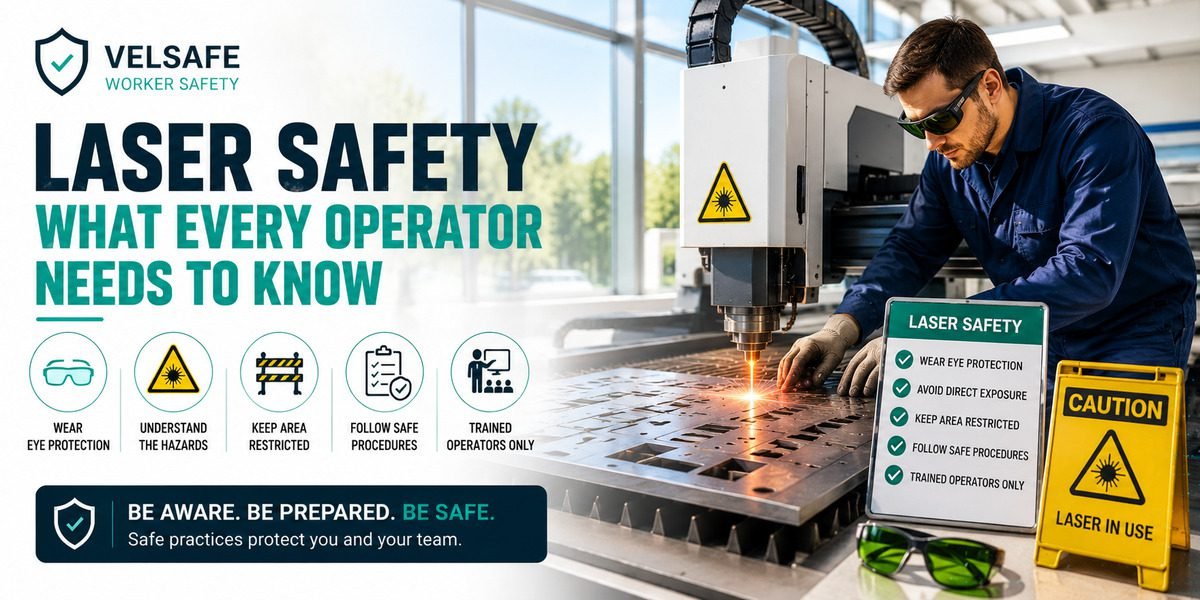
Laser Safety: What Every Operator Needs to Know

WORKER SAFETY — Laser Operations
Laser Safety for Operators
Hazards, Controls, and Required PPE
Class 3B and Class 4 lasers can permanently damage the human eye before the blink reflex activates. This guide covers laser hazard classes, engineering controls, correct eyewear selection, and what to do when exposure occurs.
>500 mW
Class 4 Threshold
Lasers above 500 milliwatts continuous wave are Class 4. Direct beam contact causes instant, irreversible eye and skin injury. All Class 4 work requires engineering controls and protective eyewear.
ANSI Z136.1
< 0.25s
Before Blink Reflex
The human blink reflex takes 0.15 to 0.25 seconds to close the eye. Class 3B and 4 lasers can cause permanent retinal damage in microseconds to milliseconds, far faster than any natural protection.
NIOSH, Laser Safety
OD 4+
Minimum Eyewear Rating
Laser protective eyewear must be rated to the specific wavelength and output power of the laser in use. An OD of 4 blocks 99.99% of laser energy. Standard safety glasses provide zero laser protection.
29 CFR 1910.133

Lasers are used in construction, manufacturing, medical settings, research laboratories, and across general industry for tasks including cutting, welding, measurement, alignment, and therapy. Operators in all of these settings face the same core hazards: eye injury, skin burns, electrical shock, toxic fumes, and fire. OSHA’s General Duty Clause (Section 5(a)(1)) requires employers to protect workers from recognised hazards even where no laser-specific federal standard applies, and 29 CFR 1910.132 requires a hazard assessment and appropriate PPE for every laser task. This article covers what laser operators need to know to work safely across all laser classes and workplace settings.

The most common laser injury in occupational settings is eye damage, because the eye focuses and amplifies laser energy onto the retina, often before the operator is aware of exposure. Skin burns are the second most reported injury, particularly with high-power industrial and medical lasers. Both categories of injury are preventable when operators understand the hazard class of the laser they are using and apply the correct controls consistently.

Whether you operate a construction laser level, a manufacturing cutting system, a laboratory research laser, or a medical device, the hazard assessment and control hierarchy outlined in this guide applies to your work. Read it before you begin any laser task.

Laser Hazard Classes: What Every Operator Must Know

The ANSI Z136.1 standard establishes the laser classification system used across all industries in the United States. Every laser used in a workplace must carry a classification label. Operators must read that label before any task begins. The class determines the required controls, the type of eyewear, and whether a Laser Controlled Area must be established.

Laser Hazard Classification by Risk Level (ANSI Z136.1)
Class 4 — High Power (>500 mW) EXTREME
Instant eye and skin injury from direct, reflected, or scattered beam. Can ignite materials. Mandatory engineering controls, eyewear, and controlled area. Common in industrial cutting, welding, and medical surgery.
Class 3B — Medium Power (5–500 mW) HIGH
Direct beam viewing causes immediate eye injury. Diffuse reflections are generally safe. Requires protective eyewear and beam controls. Common in laser laboratories, alignment tools, and research equipment.
Class 3R — Low-Risk Medium Power (1–5 mW) MODERATE
Small risk of eye injury with extended direct viewing. No skin hazard. Commonly found in construction laser levels and alignment devices. Avoid direct beam viewing.
Class 2 — Low Power Visible (<1 mW) LOW
Blink reflex provides adequate protection for momentary accidental viewing. Never stare deliberately. Common in barcode scanners and low-power pointers. No PPE required for incidental exposure.
Class 1 — Safe under Normal Use MINIMAL
Output is safe under all reasonable conditions of use. Common in CD/DVD players and enclosed laser printers. No special controls required.
Source: ANSI Z136.1, Safe Use of Lasers | NIOSH, Laser Safety Program
  • Check the label before every task. Every laser manufactured since 1976 must carry a classification label under 21 CFR Part 1040.10. If no label is visible, treat the laser as Class 4 until a qualified person confirms otherwise.
  • Class does not protect you if the laser is modified. Removing protective housings, disabling interlocks, or adjusting power beyond rated settings can change the effective hazard class. Never modify a laser without authorization.
  • Infrared and ultraviolet lasers carry invisible beams. A laser with no visible output is not a safe laser. Infrared and UV wavelengths cause injury without any warning sensation until after damage has occurred.
  • Beam reflections carry the same energy as the source. Specular (mirror-like) reflections from Class 3B and 4 lasers are hazardous. Remove watches, rings, and reflective tools from the work area before energising the laser.

Signs of Laser Exposure: When to Stop Work Immediately

Laser eye injuries frequently go unrecognised because the initial damage is painless. Retinal damage, in particular, can occur without any immediate sensation. Operators must know the warning signs and act immediately if any of the following occur during or after a laser task.

Eye Symptoms

Sudden visual disturbance, afterimage, flash blindness, blurred vision, or a dark or blank spot in the visual field. Any of these following beam exposure is a medical emergency. Do not wait to see if symptoms resolve.

Skin Symptoms

Redness, burning sensation, blistering, or any mark at the point of beam contact. Class 4 lasers can cause deep tissue burns that are more serious than they initially appear. Cover the area and seek medical attention.

Workplace Warning Signs

Unexpected reflections, smoke or burning smell from materials, tripped interlocks, or a beam that deviates from its expected path. Stop the laser, do not re-enter the area, and notify your supervisor and laser safety officer.
STOP WORK RULE:
If you suspect laser exposure to the eye, stop work immediately, do not rub the eye, and go to an emergency medical facility. Do not drive yourself. Inform the treating provider that the injury involves laser radiation and provide the laser class, wavelength, and output power if known. Time matters for diagnosis.

Safe Laser Work Procedure: Step by Step

The following procedure applies to all Class 3B and Class 4 laser operations across construction, manufacturing, laboratory, and healthcare settings. Class 1, 2, and 3R lasers require less rigorous controls, but operators should still complete steps 1 and 2 before any task.

1

Read the Equipment Label and Obtain the Standard Operating Procedure

Confirm the laser class, wavelength (in nanometres), maximum output power (in watts or milliwatts), and beam mode (continuous wave or pulsed). Every Class 3B and 4 laser operation must have a written Standard Operating Procedure (SOP) approved by the facility’s Laser Safety Officer (LSO). Do not start work without it.
2

Select and Inspect Laser Protective Eyewear (LPE)

LPE must be rated for the specific wavelength and optical density (OD) required by the laser in use. Check that the OD marking on the lens matches what the SOP specifies. Inspect lenses for scratches, cracks, or discolouration before every use. Scratched or damaged LPE must not be worn and must be taken out of service. Standard safety glasses, sunglasses, or tinted goggles are not laser protective and must not be substituted.
3

Establish and Secure the Laser Controlled Area (LCA)

Post laser warning signs at all entry points. Cover or remove reflective items from the work area (jewellery, watches, polished metal surfaces). Ensure all beam stops, baffles, and window covers are in place. No one should enter the LCA without approved LPE. For temporary outdoor laser use in construction, define the Nominal Ocular Hazard Distance (NOHD) and exclude all persons from that zone during operation.
4

Verify Beam Path and Align at Minimum Power

Before full-power operation, confirm the beam path is clear of obstructions and unintended reflective surfaces. When alignment is required, use the lowest power setting or a Class 1 alignment laser where available. Never use a high-power beam for alignment work. Confirm all interlocks are functional and that the emergency stop is accessible from your operating position.
5

Control Fumes, Gases, and Fire Hazards

Laser cutting and welding produce hazardous fumes and particulate, including metal fumes, volatile organic compounds, and potentially carcinogenic by-products depending on the material processed. Local exhaust ventilation (LEV) must be operating before the laser fires. Respiratory protection must match the contaminant generated. Class 4 lasers can ignite flammable materials, including common plastics and coatings. Verify no flammable materials are within the beam path or scatter zone.
6

Shut Down in the Correct Sequence

At the end of the task, shut down the laser per the SOP sequence, secure the key or interlock, and allow cooling time where applicable. Do not leave a powered laser unattended. Remove your LPE only after confirming the laser is fully shut down and the beam path is terminated. Record the task in the laser log, including any incidents, unusual beam behaviour, or equipment anomalies.

Do and Do Not: Core Laser Safety Rules

DO

  • Read and follow the written SOP for every laser task
  • Wear LPE rated for the specific wavelength and OD required
  • Post warning signs and secure the Laser Controlled Area before powering the laser
  • Remove all jewellery, watches, and reflective items before entering the LCA
  • Use the lowest power setting when aligning beams
  • Report all potential exposures, equipment faults, or near misses immediately
  • Know where the emergency stop and fire extinguisher are before work begins

DO NOT

  • Look into the beam or primary reflection of any Class 3B or 4 laser, ever
  • Substitute regular safety glasses, tinted lenses, or sunglasses for LPE
  • Operate a Class 3B or 4 laser without a written SOP and Laser Safety Officer approval
  • Disable, bypass, or override any laser interlock or safety device
  • Use a high-power beam for alignment, aiming, or pointing at people or animals
  • Enter the Laser Controlled Area without proper LPE and authorisation
  • Leave a powered laser unattended without securing the interlock

Emergency Response: What to Do After Laser Exposure

EMERGENCY RESPONSE SEQUENCE
1
Stop the laser immediately. Press the emergency stop or use the key interlock. Do not re-enter the area. Do not attempt to resume the task.
2
Eye exposure: do not rub or press on the eye. Cover the eye loosely with a clean cloth if desired. Do not apply any drops or medication. Transport the worker immediately to an emergency medical facility, or call emergency services.
3
Skin burns: cool running water for 10 minutes minimum. Do not apply ice, butter, or any household remedy. Cover with a clean, non-fluffy dressing. Seek medical attention for any burn larger than 1 centimetre or any burn on the face, hands, or joints.
4
Tell the treating medical provider the following: Laser class, wavelength in nanometres, output power in watts or milliwatts, duration of exposure, whether the exposure was direct beam or reflected, and what PPE was being worn at the time.
5
Notify the Laser Safety Officer and supervisor immediately. Complete an incident report. Secure the laser equipment until a full investigation is complete. Preserve all records of the laser settings, SOP in use, and LPE worn. Your employer is required under the General Duty Clause to investigate and correct the conditions that led to the exposure.

Supervisor Responsibilities: What You Must Do Before Work Begins

Verify Training Before Assignment

Every operator assigned to a Class 3B or 4 laser must have completed documented laser safety training specific to that laser class and wavelength. Generic hazard awareness training is not sufficient. Check training records before the shift, not after an incident occurs.

Confirm LPE Is Available and Correct

Laser protective eyewear must be stocked for the specific wavelengths in use at your facility. Confirm that enough units are available for all workers who may enter the controlled area, including visitors and maintenance personnel. A worker who cannot locate correct LPE before a task must not proceed.

Enforce the Controlled Area

Post warning signage before the laser is powered. Enforce the no-entry rule during operation. In construction settings, this includes overhead workers and passing contractors who may not be aware a laser is in use below. Never allow a laser to operate with unauthorised personnel within the NOHD.

Maintain the Laser Log

A laser use log recording dates, operators, laser system used, task performed, and any incidents or anomalies is essential for post-incident investigation and regulatory compliance. OSHA inspectors examining a laser workplace will request this log as part of any General Duty Clause investigation. It is also your legal protection when liability is questioned.

Worker Safety Checklist: Laser Operations

Before the Task

  • Read laser class label
  • Obtain written SOP
  • Inspect and wear correct LPE
  • Post laser warning signs
  • Remove all reflective items
  • Verify interlocks are active
  • Confirm ventilation is on
  • Clear and secure LCA boundary

During the Task

  • Keep LPE on at all times
  • Never look directly into beam
  • Monitor for unexpected reflections
  • Watch for smoke, burning smell
  • Keep unauthorised persons out
  • Do not modify laser settings
  • Stay within your authorised role
  • Stop if anything seems wrong

After the Task

  • Shut down per SOP sequence
  • Secure key or interlock
  • Allow equipment to cool
  • Remove LPE after shutdown confirmed
  • Remove signs and restore area
  • Log the task and any anomalies
  • Report any near misses
  • Store LPE correctly

Key Takeaways

The blink reflex will not protect you from Class 3B or 4 lasers

Permanent retinal damage from high-power lasers occurs in microseconds, far faster than the human blink reflex at 0.15 to 0.25 seconds. Laser protective eyewear rated for the correct wavelength and optical density is the only reliable protection. Standard safety glasses provide none.

Read the laser class label before every task, not just during training

Laser hazard class, wavelength, and output power determine the controls you need. These values are on every compliant laser label. If the label is missing or unreadable, treat the device as Class 4 until confirmed otherwise by a Laser Safety Officer. This habit prevents most occupational laser injuries.

OSHA uses the General Duty Clause to cite laser hazards: your employer must act

OSHA does not have a single comprehensive laser standard, but the General Duty Clause (Section 5(a)(1)) requires employers to control recognised hazards, including those from Class 3B and 4 lasers. A workplace that lacks written SOPs, correct LPE, a trained Laser Safety Officer, or a controlled area for Class 4 operations is citable under this provision. If your workplace is missing any of these elements, raise it with your supervisor now.

Frequently Asked Questions

Can a Class 2 laser from a laser pointer permanently damage my eyes?

Class 2 lasers emit below 1 milliwatt of visible light, and the blink reflex is generally sufficient to prevent injury from momentary accidental exposure. However, deliberately staring into any laser beam, including a Class 2 pointer, is not safe. Class 2M and some Class 3R pointers available on consumer markets exceed these limits, and many are sold without correct labelling. If in doubt about a device, treat it as Class 3R or above until confirmed.

Do laser levels used in construction require protective eyewear?

Most construction laser levels are Class 2 or Class 3R and do not require protective eyewear for routine operation, provided the operator avoids deliberate direct viewing. However, operators should never look directly into the beam or through telescoping equipment such as an optical level pointed at the laser source. If the laser level is Class 3B, LPE is required for all persons within the Nominal Ocular Hazard Distance. Always check the device label.

What does optical density (OD) mean on laser protective eyewear?

Optical density is a logarithmic measure of how much laser energy a lens blocks at a specific wavelength. OD 3 means the lens blocks 99.9% of laser energy; OD 4 means 99.99%; OD 5 means 99.999%. The required OD is calculated based on the laser’s output power and the Maximum Permissible Exposure for that wavelength. Your facility’s Laser Safety Officer determines the required OD for each laser in use. Never assume that a higher OD is always better, as very high OD lenses can reduce visibility and create other hazards.

Are the fumes from laser cutting and engraving dangerous?

Yes. Laser cutting and engraving generate fumes and particulate that vary by material. Cutting metals produces metal oxide fumes. Cutting plastics can release toxic compounds including hydrogen chloride from PVC. Engraving wood, leather, and composites generates fine particulate and volatile organic compounds. Local exhaust ventilation rated for the specific contaminants generated is required for all laser cutting and engraving operations. Respiratory protection must be selected based on the specific fumes produced, not a general dust mask.

What is a Laser Safety Officer and does my workplace need one?

A Laser Safety Officer (LSO) is an individual designated by the employer to establish and maintain a laser safety programme, evaluate hazards, ensure controls are in place, and approve SOPs for Class 3B and 4 laser operations. ANSI Z136.1 requires that any facility using Class 3B or 4 lasers designate an LSO. While OSHA does not have a specific laser standard that mandates an LSO by name, failure to control recognised Class 3B or 4 laser hazards is citable under the General Duty Clause, and the absence of an LSO is a significant compliance gap.

What should I do if I experience a flash or afterimage from a laser but feel no pain?

Treat it as a potential injury and report it immediately. Laser retinal injuries are frequently painless because the retina has no pain receptors. An afterimage, brief flash sensation, or any visual disturbance following beam exposure is a symptom that requires immediate ophthalmological evaluation. Waiting to see if symptoms resolve is inappropriate: early medical assessment can determine the extent of injury and is essential if any treatment options exist. Report the incident to your supervisor and the facility’s LSO before leaving the worksite.

Can I use the same laser protective eyewear for different lasers in my facility?

Only if the LPE is rated at the correct OD for every wavelength present in the lasers you are using. LPE is wavelength-specific: eyewear rated for a 1064nm Nd:YAG laser does not protect against a 532nm green laser, even if it looks similar. If your facility operates multiple lasers at different wavelengths, you may need separate LPE for each, or broadband LPE rated for all wavelengths present. Your LSO maintains an inventory of required LPE by laser and wavelength. Never borrow eyewear from another station without confirming it is rated for your laser.

Sources

Government and Regulatory Sources

  • NIOSH. Laser Safety. — NIOSH overview of occupational laser hazards, health effects, exposure controls, and protective measures across all laser classes.
  • OSHA. Laser Hazards. — OSHA guidance on laser hazard identification, General Duty Clause applicability, PPE requirements under 29 CFR 1910.132, and eye protection requirements under 29 CFR 1910.133.
  • FDA. 21 CFR Part 1040.10 and 1040.11. — Federal performance standards for laser products, including mandatory laser classification labelling requirements for all products sold in the United States.
  • OSHA Technical Manual, Section III Chapter 6: Laser Hazards. — Detailed OSHA technical guidance covering laser bioeffects, hazard evaluation, control measures, and Nominal Ocular Hazard Distance calculation methods.

Research and Industry Sources

  • American National Standards Institute. ANSI Z136.1: Safe Use of Lasers. — The national standard establishing laser classification, Maximum Permissible Exposure values, Laser Safety Officer requirements, and Nominal Ocular Hazard Distance methodology.
  • Laser Institute of America (LIA). — Industry body responsible for promoting laser safety education, publishing the ANSI Z136 family of standards, and providing LSO certification programmes.
Related VelSafe Articles

Worker Safety
Laboratory Biosafety: What Every Lab Worker Must Know
Covers biological hazard classification, containment levels, and worker protections for lab environments where laser equipment may be co-located with biological agents.
Tips
10 Lab Safety Awareness Tips for Every Worker
Actionable safety tips for laboratory workers, covering PPE selection, hazard communication, and safe work habits relevant to any lab environment.
Worker Safety
Large Lithium-Ion Battery Safety: What Workers Need to Know
Covers fire, thermal runaway, and electrical hazards from large-format lithium-ion systems commonly used alongside industrial laser equipment in manufacturing and construction settings.
Build Your Laser Safety Programme Today
VelSafe provides practical, regulation-grounded safety training for operators, supervisors, and safety professionals across construction, manufacturing, laboratory, and healthcare settings.
Explore VelSafe Training

Comments are closed.