
TIPS: Laser Safety
Laser Injuries Are Preventable
If You Know What Class You Are Working With
If You Know What Class You Are Working With
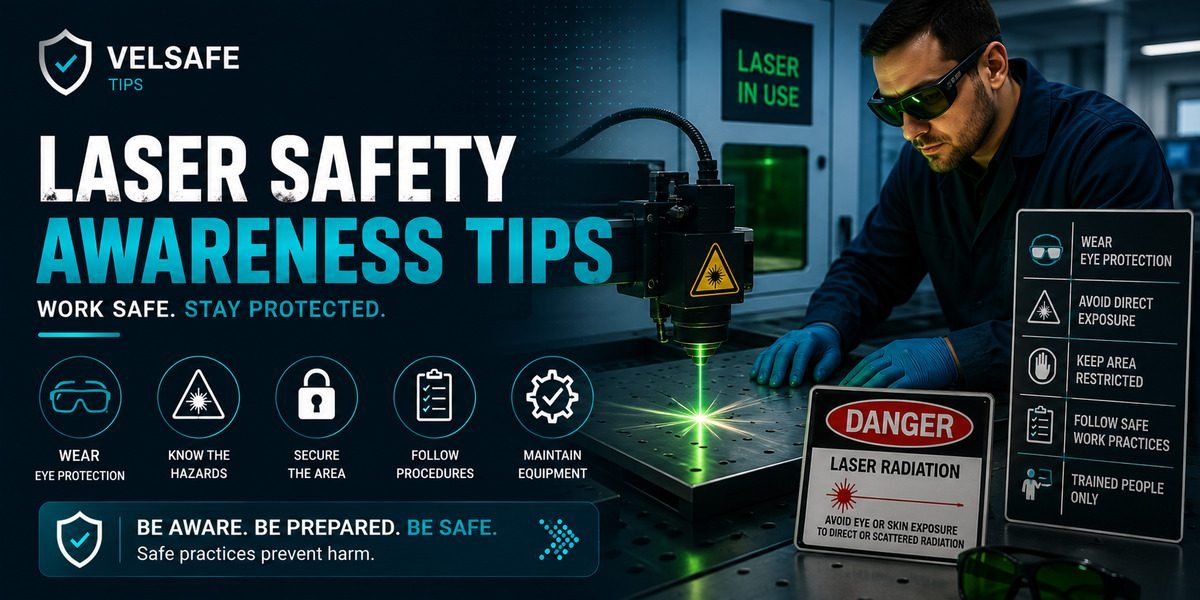
Class 3B and 4 lasers can permanently damage the retina faster than a blink reflex can respond. Apply these eight controls across every setting where lasers are energised.
7
Hazard Classes
ANSI Z136.1 and IEC 60825-1 define seven laser hazard classes from inherently safe to extreme danger.
IEC 60825-1:2014
0.25s
Blink Response Time
The average blink reflex takes 0.25 seconds. Class 3B and 4 lasers can cause permanent retinal injury within that window.
OSHA OTM Section III Ch. 6
500mW
Class 4 Threshold
Any laser above 500 milliwatts is Class 4. Surgical, industrial cutting, and welding lasers typically fall here. Written controls are mandatory.
FDA CDRH, 21 CFR 1040
Laser safety is a required component of any workplace where Class 3B or Class 4 lasers are used, whether that is a surgical suite, a manufacturing floor, or a semiconductor fabrication facility. OSHA’s General Duty Clause, combined with ANSI Z136.1, creates a binding obligation to identify laser hazards, establish controls, and train every person who may be exposed. The following eight tips address the controls most frequently absent during inspections and incident investigations.
Quick Summary: 8 Laser Safety Tips
Tip 1
Classify the laser and confirm controls match the class before any work begins.
Tip 2
Select the correct optical density eyewear rated for the laser’s wavelength and output.
Tip 3
Establish the Nominal Hazard Zone (NHZ) and enforce access restrictions before energising.
Tip 4
Apply strict beam path discipline; never point a laser at any person under any circumstances.
Tip 5
Conduct a visual pre-use inspection before every session. Never energise a damaged unit.
Tips 6, 7, 8
Train before access, post warning signs at every entry, and secure lasers when not in use.
Laser Safety Tips: Full Detail
1
Classify the Laser and Confirm Controls Match the Class
Why It Matters
Controls are tied directly to laser class. Using a Class 4 laser with Class 2 controls is a General Duty Clause violation and leaves workers fully exposed to retinal and skin burn risk.
What To Do
Check the manufacturer label and safety data sheet before first use. Confirm the class (1, 1M, 2, 2M, 3R, 3B, or 4) and cross-reference ANSI Z136.1 Table 1 for required controls. Document the classification in your hazard assessment.
Common Mistake
Assuming the class from output power alone without checking the wavelength. A 250mW laser at 532nm (green, visible) is Class 3B. At 1064nm (near-infrared, invisible), the hazard distance is far greater for the same output.
Pro Tip
Keep a one-page laser inventory for each work area listing class, wavelength, maximum output, NHZ distance, and required PPE. Laminate it and post it at the entry point next to the warning sign.
2
Select Optical Density Eyewear Matched to Wavelength and Output
Why It Matters
Generic safety glasses do not protect against laser exposure. Only eyewear rated with the correct Optical Density (OD) for the specific wavelength and beam power attenuates the beam sufficiently to prevent retinal injury.
What To Do
Calculate the required OD using the laser’s wavelength, output power, and beam characteristics per ANSI Z136.1 Appendix A. Select eyewear marked with the wavelength range and OD rating. Verify the fit does not allow peripheral beam entry.
Common Mistake
Sharing eyewear between lasers of different wavelengths. A lens rated for a 1064nm Nd:YAG laser does not protect against a 532nm green laser, even though they may look identical.
Pro Tip
Colour-code eyewear storage by wavelength range and label each pair with the wavelength it covers. Inspect lenses for scratches or damage before each use; any damage that reduces OD is a discard-and-replace condition.
3
Establish and Enforce the Nominal Hazard Zone Before Energising
Why It Matters
The Nominal Hazard Zone is the space within which the laser beam exceeds the Maximum Permissible Exposure limit for eyes or skin. Anyone inside the NHZ without approved PPE is at immediate injury risk.
What To Do
Calculate NHZ using ANSI Z136.1 formulas for your specific laser parameters. Mark boundaries with floor tape or rope barriers before activating the system. Post the NHZ on the warning sign at the room entry. Verify all unauthorised persons are outside the NHZ before energising.
Common Mistake
Calculating NHZ for the primary beam only and ignoring reflected and scattered beams. Specular reflections from polished surfaces can extend the NHZ far beyond the primary beam path.
Pro Tip
Remove or cover all highly reflective surfaces within the NHZ before laser use. Use matte-black beam stops and non-reflective targets where possible to eliminate unintended reflection paths.
4
Apply Beam Path Discipline and Never Aim at Any Person
Why It Matters
Most laser injuries result from beam misalignment, unintended reflection, or casual pointing. Beam path discipline is an active behaviour that must be practised consistently, not assumed.
What To Do
Keep the beam at or below waist height whenever possible. Terminate the beam path at a non-reflective beam stop at all times. Trace the entire beam path on a diagram before starting work. Never walk through a beam path without first verifying the laser is off and blocked.
Common Mistake
Performing beam alignment with the laser at full power because “it is easier to see.” Alignment must always begin at the lowest power that allows the task to be completed, with PPE worn throughout.
Pro Tip
Use a beam viewing card or camera-based viewer for invisible-wavelength beams. Never use your naked eye to check the beam position on any Class 3R, 3B, or 4 laser, even briefly.
5
Inspect the Laser System Before Every Session
Why It Matters
Damaged enclosures, cracked optics, or loose interlock wiring can allow beam escape outside the controlled path. Inspections catch these conditions before exposure occurs.
What To Do
Use a written pre-use checklist covering: enclosure integrity, interlock function, beam stop condition, PPE availability, warning light operation, and emergency stop accessibility. Do not energise until all items are confirmed. Record the check and the operator’s name.
Common Mistake
Bypassing interlocks because they “slow things down.” ANSI Z136.1 prohibits interlock defeat except under specific controlled conditions by an authorised Laser Safety Officer. Bypassing an interlock removes the primary engineering control for Class 3B and 4 systems.
Pro Tip
Test interlocks by activating them deliberately before beginning work. Document the test result. If an interlock fails to trigger the beam shut-off, remove the laser from service and tag it out until the fault is repaired.
6
Train Every Operator and Observer Before They Enter the Laser Area
Why It Matters
ANSI Z136.1 requires documented training for all personnel who work with or near Class 3B and 4 lasers. Training must cover hazard identification, required controls, emergency procedures, and reporting obligations. Untrained bystanders in healthcare and manufacturing settings are a common source of exposure incidents.
What To Do
Deliver laser safety training before authorising access. Training must cover the hazards specific to the lasers in use, not generic laser awareness. Maintain a training log with the date, content covered, and trainee signature. Repeat training when lasers are upgraded, procedures change, or an incident occurs.
Common Mistake
Training operators but not service technicians, students, or visiting professionals who also enter the laser area. Anyone who enters the NHZ must be trained and verified, regardless of their role or the reason for access.
Pro Tip
Use a laser area access log at the door. Every entry requires a printed name, training verification date, and purpose. The log makes training compliance auditable and creates a record of everyone present if an incident occurs.
7
Post ANSI-Compliant Warning Signs at Every Laser Area Entry Point
Why It Matters
Warning signs provide the first line of passive protection for anyone approaching a laser area. Without them, a person has no way to know a hazard exists before entry. FDA 21 CFR 1040.10 and ANSI Z136.1 both specify signage requirements for Class 3B and 4 lasers.
What To Do
Post a LASER RADIATION warning sign at every point of access to the laser area. The sign must state the hazard class, wavelength, maximum output, and required PPE. Include a visual warning indicator (illuminated sign or status light) that shows when the laser is energised. Update the sign if the laser or operating parameters change.
Common Mistake
Using a generic “CAUTION: LASER” sign that does not specify the class, wavelength, or PPE requirement. A generic sign provides no actionable information and does not meet ANSI Z136.1 signage requirements.
Pro Tip
Install an interlocked door with a beam-active indicator light wired to the laser key switch. When the laser is on, the light illuminates red and the door is locked. This eliminates inadvertent entry during active use without relying on a person to enforce access.
8
Secure Lasers and Control All Access When Equipment Is Not in Use
Why It Matters
An unsecured Class 3B or 4 laser in a shared facility can be energised by unauthorised personnel, including maintenance workers, cleaning staff, or students who may not recognise the hazard. ANSI Z136.1 requires positive control of all Class 3B and 4 systems when not attended by a trained operator.
What To Do
Remove the key or disable the key switch when leaving a laser unattended. Lock the access door to the laser area. For portable systems, secure them in a locked cabinet. Post an out-of-service tag if the system is undergoing maintenance. Never leave a Class 3B or 4 laser in standby with the key inserted in an unsupervised area.
Common Mistake
Leaving a laser in standby mode between procedures in a clinical or industrial setting with the assumption that only trained staff will access the room. Even momentary beam activation by an unauthorised person can cause permanent injury.
Pro Tip
Use a LOTO (Lockout/Tagout) procedure for all laser maintenance and servicing tasks. Under 29 CFR 1910.147, lasers with capacitors or stored electrical energy must be de-energised and discharged before any internal servicing, regardless of whether the beam is blocked.
Pre-Session Laser Safety Checklist
Complete this checklist before energising any Class 3B or 4 laser. Do not proceed until every item is confirmed. Record completion on the session log.
Check Item
Requirement
Laser classification confirmed
Class label matches SDS and hazard assessment on file
Correct OD eyewear available for all personnel
Eyewear rating matches laser wavelength and output; no scratches or damage
NHZ marked and clear of unauthorised persons
Boundaries posted; access log reviewed; all persons inside are trained
Interlocks tested and functional
Interlock activation confirmed to shut off beam; result logged
Warning signs posted at all entry points
Signs show class, wavelength, max output, and required PPE
Beam stop positioned and confirmed in place
Non-reflective beam stop terminates beam path at end of travel
Emergency stop accessible and tested
All operators know location and know how to activate immediately
Enclosure integrity verified
No cracks, gaps, or open panels on beam enclosure; all covers secured
Source: ANSI Z136.1 | OSHA OTM Section III Ch. 6
Key Takeaways
Class Determines Controls: Confirm Before Every Session
Laser hazard controls are not generic. Each class requires a specific set of engineering, administrative, and PPE controls defined by ANSI Z136.1. Applying the wrong tier of controls to a higher-class laser leaves workers exposed to hazards the controls were never designed to address.
Eye Protection Is Wavelength-Specific: Generic Glasses Provide No Protection
Standard polycarbonate safety glasses transmit most laser wavelengths without attenuation. Only eyewear with a verified Optical Density rating at the specific laser wavelength provides meaningful protection. Mixing eyewear across different laser systems is a common cause of preventable eye injury.
Training, Signage, and Access Control Must Cover Everyone in the Area, Not Just Operators
The majority of avoidable laser incidents involve bystanders, visitors, or support staff who were not trained or were not expected to enter the laser area. A laser safety programme limited to operators is incomplete. Anyone who may enter the NHZ, including service technicians, students, clinical support staff, and maintenance workers, must be trained, documented, and verified before access is permitted.
Frequently Asked Questions
What laser class requires a written laser safety programme?
ANSI Z136.1 requires a formal written laser safety programme for all facilities using Class 3B or Class 4 lasers. The programme must appoint a Laser Safety Officer (LSO), document hazard assessments, specify required controls and PPE, and include training records. Class 1, 1M, 2, 2M, and 3R lasers do not typically require a formal written programme, though basic safe-use practices still apply.
What does a Laser Safety Officer do?
The Laser Safety Officer (LSO) is the person responsible for overseeing the safe use of lasers at a facility. Under ANSI Z136.1, the LSO must have the authority to halt unsafe laser operations, conduct or approve hazard evaluations, review and approve standard operating procedures, ensure personnel training is completed, and maintain a current laser inventory. The LSO role must be formally assigned in writing.
Can OSHA cite a workplace for laser injuries if there is no specific laser OSHA standard?
Yes. OSHA’s General Duty Clause (Section 5(a)(1) of the OSH Act) requires employers to provide a workplace free from recognised hazards likely to cause death or serious harm. Laser hazards are recognised hazards with established industry control standards (ANSI Z136.1). An employer who fails to implement these controls can be cited under the General Duty Clause even though no laser-specific OSHA standard exists for general industry. OSHA’s Technical Manual, Section III, Chapter 6 provides guidance on how inspectors evaluate laser hazard controls.
What is the Nominal Hazard Zone and how is it calculated?
The Nominal Hazard Zone (NHZ) is the spatial region within which the beam irradiance or radiant exposure exceeds the applicable Maximum Permissible Exposure (MPE) for eyes or skin. The NHZ is calculated using the laser’s output power or energy, beam divergence, wavelength, and pulse duration, per the formulas in ANSI Z136.1 Appendix A. A Laser Safety Officer or qualified safety professional must perform or verify the NHZ calculation for each laser setup.
Are invisible lasers more dangerous than visible lasers?
Not necessarily more dangerous in terms of energy, but significantly more hazardous in practice because the aversion reflex does not activate. Visible lasers (400-700nm) trigger an involuntary blink and head-turn response that partially limits exposure duration. Invisible lasers, including near-infrared (700-1400nm) and far-infrared (above 1400nm) wavelengths, produce no visible cue, so the eye continues to receive the beam without protective response. For this reason, invisible-wavelength Class 3B and 4 lasers require additional administrative controls, including strict beam-path documentation.
What should I do if I think I have been exposed to a laser?
Immediately stop work and step out of the laser area. Do not rub the affected eye or skin. Report the exposure to your supervisor and the Laser Safety Officer at once. Seek medical evaluation by a physician familiar with laser injuries, even if you do not notice symptoms immediately. Some retinal injuries present without immediate pain or vision loss. Document the exposure conditions, including the laser class, wavelength, estimated exposure duration, and where on the body the exposure occurred. Report the incident using your facility’s incident reporting procedure.
Do medical lasers in healthcare settings need to follow the same ANSI Z136.1 controls as industrial lasers?
Yes. ANSI Z136.1 applies to laser use in all work settings, including healthcare. Medical lasers used in surgery and therapy are typically Class 3B or Class 4 devices and require the same engineering, administrative, and PPE controls as industrial lasers. ANSI Z136.3 provides supplementary guidance specifically for laser use in healthcare facilities. Healthcare facilities must also meet requirements under The Joint Commission, which references ANSI Z136.3 in its standards for laser safety programme management.
Government and Regulatory Sources
- OSHA. Technical Manual (OTM), Section III, Chapter 6: Laser Hazards: defines OSHA’s evaluation framework for laser hazard controls and General Duty Clause application.
- FDA. (2024). Laser Products and Instruments: 21 CFR Part 1040: manufacturer classification requirements and performance standards for laser products sold in the US.
- NIOSH. (2023). Laser Hazards in the Workplace: occupational exposure guidance and engineering controls for workplace laser programmes.
Research and Industry Sources
- Laser Institute of America. ANSI Z136.1: American National Standard for Safe Use of Lasers: the primary US consensus standard for laser hazard classification and control measures in all industries.
- International Electrotechnical Commission. IEC 60825-1:2014: Safety of laser products: international laser hazard classification standard harmonised with ANSI Z136.1 for Class 1 through 4 definitions.
Related VelSafe Articles
Tips
10 Lab Safety Awareness Tips for Every Worker
Practical safety tips for laboratory settings, covering chemical, biological, and physical hazards that co-exist with laser equipment in many research and healthcare environments.
Worker Safety
Laboratory Biosafety: What Every Lab Worker Must Know
Covers biosafety levels, primary containment controls, and PPE requirements for laboratory workers who may share a facility with Class 3B or 4 laser equipment.
Tips
10 Incident Investigation Tips for Safety Managers
Step-by-step guidance for investigating laser and other workplace safety incidents, including root cause analysis, documentation, and corrective action procedures that satisfy OSHA and ANSI reporting obligations.
Build a Complete Laser Safety Programme
VelSafe covers laser safety awareness, ANSI Z136.1 controls, and workplace hazard training for healthcare and manufacturing teams. Explore the full library.
Explore VelSafe Training