

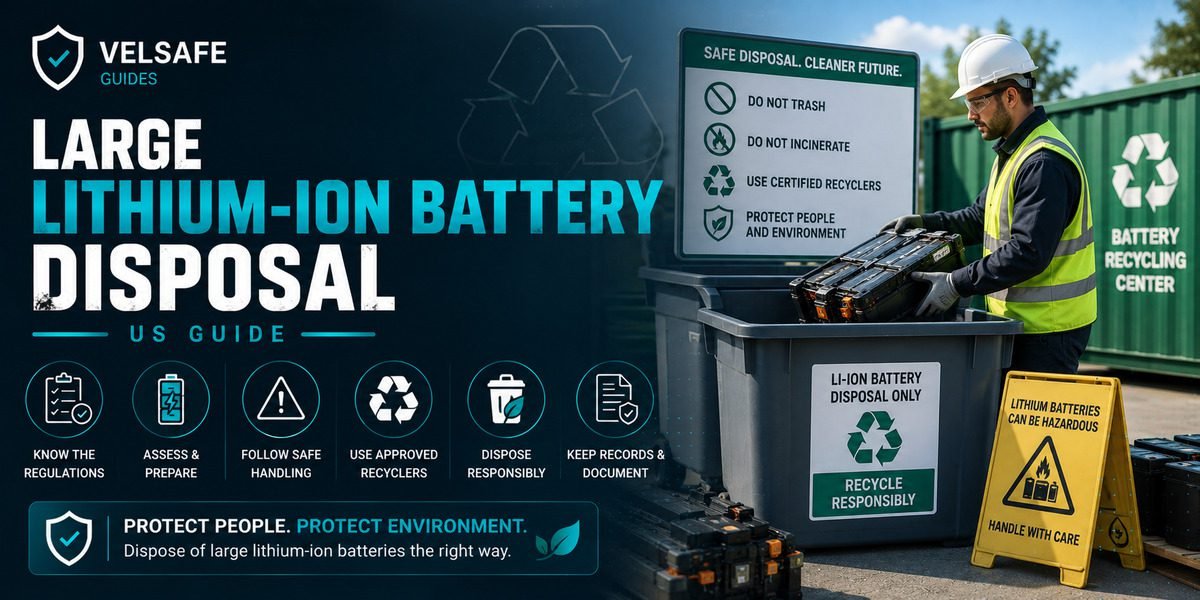
Federal rules under RCRA, the Universal Waste Rule (40 CFR Part 273), and DOT 49 CFR 173.185 set the compliance floor. This guide covers every step, from waste classification through documentation retention.
Large lithium-ion battery systems that have reached end of life are regulated as solid or hazardous waste under the Resource Conservation and Recovery Act (RCRA), with most qualifying for streamlined management under the Universal Waste Rule at 40 CFR Part 273. Misclassifying these batteries, failing to meet accumulation time limits, or shipping them without DOT-compliant packaging exposes your organisation to EPA civil penalties of up to $70,117 per day per violation and OSHA citations for hazardous material handling failures. This guide covers classification, accumulation requirements, approved disposal methods, DOT transport rules, and the documentation your facility must retain.
This is Part 5 of 6 in the VelSafe series on Large Lithium-Ion Battery Systems. Parts 1 through 4 cover introduction and hazard identification, storage, charging operations, and emergency response. Part 6 covers programme documentation and audit readiness.
Why Disposal Compliance Matters for Warehouses and Industrial Sites
Warehouses operating electric forklifts, automated guided vehicles (AGVs), or large uninterruptible power supplies (UPS) are accumulating spent battery packs at a rate that most compliance programmes have not caught up with. A 48-volt, 500 Ah forklift battery weighs several hundred kilograms and contains lithium compounds, electrolyte solvents, and in some formulations, cobalt and manganese oxides, all of which can be characteristic hazardous wastes under RCRA if they exceed regulatory toxicity thresholds.
The disposal risk is not only regulatory. Damaged, deeply discharged, or punctured batteries are prone to thermal runaway during handling. Facilities that store spent batteries alongside other waste streams, place them in general recycling, or crush them for metal recovery without proper controls have triggered fires with multi-day suppression operations and six-figure remediation costs. The regulatory framework exists precisely because the physical hazard is real.
Prerequisites Before Beginning Any Battery Disposal Process
Disposal errors most commonly occur when sites begin physically handling end-of-life batteries before establishing the compliance infrastructure. The following prerequisites must be in place before any battery is designated as waste.
Identify Your Handler Category
Under 40 CFR 273, Universal Waste handlers are classified as Small Quantity Handlers (less than 5,000 kg of universal waste accumulated at any time) or Large Quantity Handlers (5,000 kg or more). Large Quantity Handlers have additional notification, training, and response plan requirements. Calculate your maximum accumulation volume before you begin.
Verify State Requirements
Federal Universal Waste rules set the minimum floor. States including California, New York, Washington, and Minnesota operate EPA-authorised RCRA programmes with additional battery disposal requirements, shorter accumulation time limits, and specific recycler certification standards. Check your state environmental agency before assuming federal rules are sufficient.
Identify Approved Recyclers and Disposal Facilities
Universal Waste must go to a destination facility that is either a universal waste handler, a permitted hazardous waste treatment, storage and disposal facility (TSDF), or an approved recycler. Confirm the facility’s permit status with your state environmental agency before signing a contract. Keep a copy of their permit documentation on file.
Train Affected Workers
Large Quantity Handlers under 40 CFR 273.36 must ensure all employees who handle Universal Waste batteries are informed of proper handling and emergency procedures. OSHA 29 CFR 1910.1200 requires SDS access for chemical hazards from batteries. Training records must be retained to demonstrate compliance during an inspection.
Assess Battery Condition
A damaged or defective battery that cannot be managed in a way that prevents leaks or releases may not qualify for Universal Waste management and may require full RCRA hazardous waste management as a characteristic or listed waste. Conduct a visual and electrical assessment of each battery before assigning a disposal pathway. Damaged batteries require separate handling and containment.
Establish an Accumulation Start Date Record
The 12-month accumulation limit begins on the date a battery is first designated as Universal Waste. This date must be trackable for each unit or batch. Many facilities use a physical label on the battery or storage container showing the accumulation start date. Without this record, you cannot demonstrate compliance with the time limit during an EPA inspection.
Step-by-Step: Disposing of Large Lithium-Ion Battery Systems
Follow this procedure for each battery system designated for disposal. Steps 1 through 3 apply before the battery leaves the facility. Steps 4 through 8 cover transport and final transfer. Do not skip or reorder steps.
Classify the Battery as Waste and Determine the Management Pathway
Objective: Assign the correct regulatory classification before any physical disposal activity begins.
Determine whether the battery meets the EPA definition of a Universal Waste battery under 40 CFR 273.2. Most large lithium-ion batteries used in warehouse and industrial applications qualify because they contain hazardous materials but have been generated in a context that allows Universal Waste management. A battery qualifies unless it is leaking, cannot be managed in a way that prevents releases, or your state has excluded it from the Universal Waste programme.
If the battery does not qualify for Universal Waste management (for example, it is leaking or severely damaged), it must be managed as a full RCRA hazardous waste. This requires a waste determination under 40 CFR 262.11, use of a licensed hazardous waste transporter, completion of a Uniform Hazardous Waste Manifest, and transfer to a permitted TSDF. Contact your state environmental agency or a licensed hazardous waste consultant before proceeding.
Common Mistake: Assuming all lithium batteries automatically qualify for Universal Waste. Batteries that are leaking or that cannot be managed without spill risk must follow full RCRA hazardous waste procedures, not the Universal Waste shortcut.
Discharge the Battery to a Safe State of Charge
Objective: Reduce thermal runaway risk during storage and transport.
Where the battery can still accept a discharge cycle, reduce the state of charge (SOC) to 30 percent or below before storage for disposal. Many battery management systems (BMS) allow controlled discharge to a target SOC. Check the manufacturer’s BMS documentation for the correct discharge procedure for your specific battery system.
Do not attempt to discharge a physically damaged battery using standard equipment. A swollen, punctured, or crushed battery must be placed in a non-combustible containment container and moved directly to the damaged battery staging area. Coordinate immediately with your approved disposal facility for expedited removal.
Safety Note: Never discharge a battery by short-circuiting terminals or using improvised resistive loads. Only use discharge equipment rated for the battery’s voltage and capacity. A failed discharge attempt on a compromised battery can initiate thermal runaway.
Label and Store as Universal Waste
Objective: Meet labelling and storage requirements under 40 CFR 273 from the moment of waste designation.
Each battery designated as Universal Waste must be labelled with one of the following: “Universal Waste Battery(ies)”, “Waste Battery(ies)”, or “Used Battery(ies)”, per 40 CFR 273.14 (small quantity) or 273.34 (large quantity). The label must also show the accumulation start date.
Store Universal Waste batteries in a designated area that prevents leaks, keeps batteries contained in a way that prevents contact with incompatible materials, and is accessible to emergency response. The storage area must be separate from active battery charging and operation areas. Universal Waste batteries may not be stored outdoors without weatherproof containment.
Pro Tip: Use a dedicated Universal Waste battery log that records: battery serial number or asset ID, accumulation start date, approximate weight or quantity, condition (intact or damaged), and designated destination facility. This log serves as your primary compliance record during an EPA inspection.
Select a Permitted Recycler or Disposal Facility
Objective: Confirm your chosen destination facility is legally authorised to accept large lithium-ion batteries.
Universal Waste must be sent to a destination facility authorised under 40 CFR 273 Subpart E. Verify the facility’s authorisation status directly with your state environmental agency. Battery recyclers that accept lithium-ion batteries for metal recovery are the preferred environmental option and are typically authorised under the Universal Waste framework.
Ask the recycler for: their EPA ID number, state permit or authorisation letter, certificate of recycling (provided after processing), and evidence of downstream metal recovery practices. A reputable recycler will provide all of these without being asked. If a vendor cannot produce current permit documentation, do not use them. Downstream liability under RCRA follows the waste generator.
Package Batteries for Transport per DOT 49 CFR 173.185
Objective: Meet DOT packaging requirements for lithium batteries transported for disposal or recycling.
Large lithium-ion batteries (those with more than 100 Wh) are classified as Class 9 hazardous materials under DOT regulations and must be packaged, marked, and labelled per 49 CFR 173.185. Key requirements include: outer packaging must be strong and rigid, batteries must be protected against short circuits (terminals covered or insulated), and batteries must not move freely within the outer packaging.
Each package must bear the Class 9 lithium battery label (required for large batteries exceeding the small quantity exceptions) and the proper shipping name “Lithium ion batteries” (UN3480 for batteries alone, UN3481 if contained in or packed with equipment). The shipping description must include the UN number, proper shipping name, hazard class, packing group (if applicable), and quantity.
Critical: Damaged or defective lithium-ion batteries have additional DOT requirements. They must be transported under a DOT special permit or under the provisions of 49 CFR 173.185(f), which requires specific packaging, marking, and in some cases, shipper certification. Do not ship damaged batteries using standard lithium battery packaging.
Complete Shipping Documentation
Objective: Generate all required shipping documents before the carrier takes custody of the battery.
Universal Waste handlers are not required to use a Uniform Hazardous Waste Manifest for transport. However, DOT requires a shipping paper (bill of lading or other shipping document) that includes the required hazardous material description for the batteries being shipped. The shipping paper must accompany the shipment and be retained for the period required by DOT regulations.
If you are shipping batteries that do not qualify for Universal Waste management (damaged or leaking batteries requiring full RCRA treatment), you must use a Uniform Hazardous Waste Manifest and a licensed hazardous waste transporter with a current EPA ID number. Retain a signed copy of the manifest from the destination facility confirming receipt.
Transfer to the Permitted Facility and Obtain Confirmation
Objective: Confirm legal transfer of custody and obtain a receipt that closes the accumulation period.
Upon delivery to the recycler or disposal facility, obtain a signed delivery receipt or bill of lading confirmation showing: date of delivery, battery description and quantity, facility name and EPA ID, and the name of the receiving representative. This document is your evidence that the 12-month accumulation limit was met and that the batteries were transferred to an authorised facility.
After processing, request a certificate of recycling or destruction from the facility. This certificate confirms the batteries were processed at the permitted facility and is your downstream documentation showing you exercised due diligence in vendor selection.
Retain All Records
Objective: Maintain documentation sufficient to demonstrate compliance during an EPA or OSHA inspection.
Retain the following records for each disposal transaction: battery identification and accumulation log (showing start and end dates), destination facility permit or authorisation documentation, shipping documentation (bill of lading with hazmat description), signed delivery receipt, and certificate of recycling or destruction.
Universal Waste regulations under 40 CFR 273 do not specify a minimum retention period for Universal Waste shipping records. However, RCRA general record retention standards and state requirements vary. A minimum of three years from the date of shipment is a widely adopted industry practice. Consult your legal counsel or state environmental agency for jurisdiction-specific retention obligations.
Pro Tip: Store all disposal records in a dedicated battery disposal folder (physical or digital) organised by battery serial number or asset ID. During an EPA compliance audit, inspectors will ask for specific battery disposal records by asset. A well-organised system lets you produce the complete record for any battery within minutes.
Battery Disposal Compliance Checklist
Use this three-phase checklist for each battery disposal event. Complete all items before marking a disposal as closed in your records.
Before Disposal Begins
During Storage and Preparation
At Shipment and After Transfer
Common Disposal Mistakes and How to Avoid Them
The following errors are the most common triggers for EPA enforcement actions and OSHA citations in warehouse and industrial battery disposal programmes.
Sending Batteries to an Unauthorised Recycler
Generator liability under RCRA follows the waste from cradle to grave. If your recycler lacks proper authorisation and your batteries are later found at an unpermitted facility or contribute to an environmental release, you may bear partial or full remediation liability. Verify permits before every transfer, not just at initial vendor selection.
Exceeding the 12-Month Accumulation Limit
The most commonly cited Universal Waste violation is batteries held beyond 12 months. Facilities with low battery turnover often accumulate a batch and then forget the accumulation clock is running. A single battery held past 12 months can reclassify your entire storage batch as out-of-compliance.
Treating Damaged Batteries as Standard Universal Waste
Batteries that are leaking, swollen beyond specification, or cannot be managed without a risk of release do not automatically qualify for the Universal Waste pathway. Using standard Universal Waste procedures for a battery that should be managed as full RCRA hazardous waste is a classification violation, regardless of the battery’s chemistry.
Non-Compliant DOT Packaging for Transport
Large lithium-ion batteries transported without DOT-compliant packaging, proper shipping names, Class 9 labels, or required shipping papers violate 49 CFR Part 173. PHMSA can assess civil penalties against the shipper. Your carrier may also refuse the shipment mid-route if packaging does not meet requirements, leaving you with a non-compliant battery in transit.
Missing or Incomplete Records
Regulators assess compliance based on records, not intentions. An EPA inspector who finds batteries in storage with no accumulation start date labels and no disposal log has cause to cite multiple violations even if the facility actually transferred batteries on time. Missing records are themselves a violation, separate from any underlying management failure.
Ignoring State-Level Requirements
Federal Universal Waste rules are the minimum standard. States with EPA-authorised RCRA programmes can and do impose stricter requirements, including shorter accumulation time limits, facility registration requirements, and mandatory extended producer responsibility (EPR) fees. Operating in California, New York, Washington, or Minnesota and following only federal rules is a compliance gap.
Key Takeaways
Classify Before You Act
Choosing between Universal Waste management and full RCRA hazardous waste procedures is the first and most consequential disposal decision. Battery condition determines eligibility. Damaged or leaking batteries require full RCRA treatment regardless of chemistry. Getting this wrong at the start cascades into labelling, transport, and documentation violations.
The 12-Month Clock Starts the Day You Designate the Battery as Waste
Label the battery on that day and record it. Every facility that has been cited for exceeding the accumulation limit has one thing in common: no system for tracking the clock per unit. A calendar reminder set at 10 months gives you time to arrange transfer before the deadline, not after it.
RCRA Generator Liability Does Not End at the Gate
Transferring batteries to a recycler does not end your regulatory exposure. If that facility is unpermitted, mismanages the waste, or contributes to a release, RCRA’s generator liability provisions can reach back to you. Verify your recycler’s authorisation before every shipment, retain documentation, and request certificates of recycling. These records are your primary defence in any downstream enforcement action.
Frequently Asked Questions
Can I put spent lithium-ion batteries in general recycling or trash?
No. Large lithium-ion batteries are regulated waste and cannot be placed in general recycling streams or municipal solid waste. They must be managed as Universal Waste under 40 CFR 273 or as RCRA hazardous waste if they are damaged or leaking. Placing them in general waste streams violates RCRA and can trigger fires in waste collection and sorting facilities.
What is the difference between a Small Quantity and Large Quantity Universal Waste Handler?
Under 40 CFR 273, a Small Quantity Handler accumulates less than 5,000 kg of Universal Waste at any single time. A Large Quantity Handler accumulates 5,000 kg or more at any time. Large Quantity Handlers have additional requirements including notifying the EPA or your state environmental agency, maintaining trained employees on emergency procedures, and keeping more detailed records. Most warehouses operating large forklift or AGV fleets will qualify as Large Quantity Handlers.
Do I need a hazardous waste manifest to ship batteries for recycling?
Not for batteries managed under the Universal Waste Rule. Universal Waste handlers are exempt from the Uniform Hazardous Waste Manifest requirement under 40 CFR 273. However, DOT still requires a shipping paper (such as a bill of lading) with the correct hazardous material description for the batteries. If the batteries do not qualify for Universal Waste management and must be managed as full RCRA hazardous waste, a manifest is required.
What UN number do I use when shipping large lithium-ion batteries for disposal?
Large lithium-ion batteries shipped alone (not installed in equipment) use UN3480 under DOT 49 CFR 173.185. If the batteries are packed with or installed in equipment, the applicable UN numbers are UN3481 (packed with equipment) or UN3481 (contained in equipment). These are Class 9 hazardous materials. Your recycler or logistics provider should be able to confirm the correct UN number based on your specific battery configuration and shipment size.
How long do I need to keep battery disposal records?
The Universal Waste regulations do not specify a retention period for disposal shipping records. Requirements vary by jurisdiction and record type. A minimum of three years from the date of transfer is a common industry practice, and DOT shipping paper retention requirements under 49 CFR 172.201 generally require retention for two years. Some states require longer retention. Consult your state environmental agency or legal counsel for applicable retention obligations in your jurisdiction.
What happens if a battery catches fire during disposal storage?
A lithium-ion battery fire during disposal storage is an emergency response event requiring immediate notification of the fire department and, depending on the scale of any chemical release, potentially OSHA, EPA, and your local emergency planning committee (LEPC) under EPCRA reporting requirements. Large Quantity Universal Waste Handlers must have emergency procedures in place and trained employees per 40 CFR 273.36 before a fire occurs, not after. Follow your emergency response plan and coordinate with authorities on release reporting obligations.
Are there federal disposal requirements for batteries from electric forklifts specifically?
There is no OSHA or EPA regulation that addresses electric forklift batteries exclusively as a disposal category. Spent lithium-ion forklift battery packs are subject to the same RCRA and Universal Waste framework as other large lithium-ion batteries. Some forklift battery manufacturers offer take-back programmes that handle disposal logistics and documentation on your behalf, which can be a cost-effective compliance pathway if the programme meets Universal Waste destination facility requirements.
Do state extended producer responsibility (EPR) laws affect how I dispose of batteries?
Several states, including California and New York, have enacted battery stewardship laws that require manufacturers and retailers to fund and operate battery collection and recycling programmes. For industrial end users, these laws generally do not change your disposal obligations but may expand the number of authorised collection and recycling options available to you. Check with your state environmental agency to understand whether any EPR programme in your state covers large industrial batteries and what collection infrastructure is available.
Sources
Related VelSafe Articles
Part 1 of 6: Hazard identification, thermal runaway risks, and the fundamental safety controls every worker handling large battery systems must understand.
The complete legal framework for transporting lithium batteries under DOT regulations, including packaging requirements, UN numbers, and what PHMSA penalties look like in practice.
Actionable tips for warehouse safety coordinators and supervisors covering storage, charging, inspection, and emergency response for large lithium-ion battery systems in warehouse environments.
VelSafe covers the full battery lifecycle: from hazard identification through storage, charging, emergency response, disposal, and audit readiness. Explore the complete six-part series.