
Part 3 of 6: Safe Transportation (US)
PHMSA classifies large lithium-ion batteries as Class 9 Hazardous Materials under 49 CFR 173.185. Any employer who ships, receives, or arranges for the transport of these batteries by road, rail, or air within the United States is subject to the Hazardous Materials Regulations (HMR). The consequences of noncompliance are not administrative footnotes: PHMSA can assess civil penalties up to $84,425 per violation per day, and incidents involving improperly packaged batteries have resulted in vehicle fires, cargo losses, and criminal referrals.
This article covers the federal legal framework governing large lithium-ion battery transport, the specific obligations under 49 CFR 173.185 and Part 172, the penalty structure, and the documentation and training failures most commonly cited by PHMSA investigators. It is Part 3 of a six-part series on large lithium-ion battery systems in US workplaces.
1. The Legal Framework: Who Governs Lithium Battery Transport
Three federal agencies have jurisdiction over lithium-ion battery transport in the United States. PHMSA, a division of the US Department of Transportation (DOT), sets the core requirements under the Hazardous Materials Regulations at 49 CFR Parts 100 through 185. The Federal Motor Carrier Safety Administration (FMCSA) enforces compliance on roadway shipments. The Federal Aviation Administration (FAA) and International Air Transport Association (IATA) govern air transport, which is significantly more restrictive for large lithium batteries.
The HMR apply to any “hazmat employer” who employs hazmat employees involved in offering, accepting, or transporting hazardous materials in commerce. For lithium-ion battery transport, this includes warehouse operators, fleet managers, procurement teams arranging shipments, and any employee who prepares packages, signs shipping papers, or loads vehicles carrying these batteries.
The specific rule governing large lithium batteries is 49 CFR 173.185. This section defines classification thresholds, packaging requirements, state of charge limits, testing requirements, and special conditions for damaged or defective batteries. Violations of 173.185 are among the most frequently cited hazmat enforcement actions involving battery shipments.
2. Compliance Table: Who Must Comply and With What
| Role | Applicable Standard | Specific Obligation |
|---|---|---|
| Warehouse / Facility Operator | 49 CFR 173.185; 49 CFR 172.200 | Package, mark, label, and prepare shipping papers for outbound battery shipments |
| Fleet / Transport Manager | 49 CFR 172.500; 49 CFR 177.800 | Placard vehicles where required; verify driver training and emergency response information |
| HR / Training Manager | 49 CFR 172.702, 172.704 | Ensure all hazmat employees are trained within 90 days and retrained every 3 years |
| EHS / Safety Manager | 49 CFR 172.600; 29 CFR 1910.1200 | Maintain emergency response information and SDS; verify UN 38.3 test certification |
| Procurement / Receiving | 49 CFR 173.185(a)(3) | Verify incoming batteries carry proof of UN 38.3 testing; reject noncompliant shipments |
| Carrier / Driver | 49 CFR 177.817; 49 CFR 172.602 | Carry shipping papers and emergency response information; keep papers accessible during transport |
3. What 49 CFR 173.185 Actually Requires
The regulation applies different tiers of requirements based on battery size. For this series, the relevant tier is “large” lithium batteries: lithium-ion cells exceeding 20 Wh and lithium-ion batteries exceeding 100 Wh. Industrial forklift batteries, energy storage units, and large AGV battery packs used in warehouses typically fall in this category.
a. UN 38.3 Testing
All lithium batteries offered for transport must have passed the UN Manual of Tests and Criteria, Part III, Section 38.3 test sequence. This applies to both new and refurbished battery packs. When a battery is transported for the first time after manufacture or rebuild, the shipper must be able to provide a summary of the UN 38.3 test results upon request. Batteries without test documentation cannot legally be shipped under the standard lithium battery provisions.
b. State of Charge Limits
For most standard large lithium-ion battery shipments, there is no general SOC cap under the HMR for non-defective batteries in compliant packaging. However, 49 CFR 173.185(f) requires that damaged, defective, or recalled lithium batteries shipped for disposal or recycling be at or below 30% state of charge unless an alternative procedure is approved by PHMSA. This distinction matters: sending a thermally compromised forklift battery at full charge for service is a violation.
c. Packaging Requirements
Large lithium-ion batteries must be packed in strong outer packaging. Each battery must be protected against short circuit (individual protective covers, insulation between terminals, or secured in a rigid inner packaging). Batteries must be secured against shifting in transit. Palletized shipments must be fully enclosed in shrink-wrap or other outer containment meeting 49 CFR 173.185(c)(2) requirements. Standard UN-tested packaging is required unless a special permit authorises an alternative.
d. UN Numbers and Proper Shipping Names
The correct UN number depends on the shipping configuration. UN 3480 applies to lithium-ion batteries shipped by themselves. UN 3481 applies to lithium-ion batteries packed with equipment. UN 3537 applies to lithium-ion batteries contained in equipment. Using the wrong UN number on shipping papers or markings is a citable violation, even when the physical packaging is otherwise correct.
e. Marking and Labeling on Packages
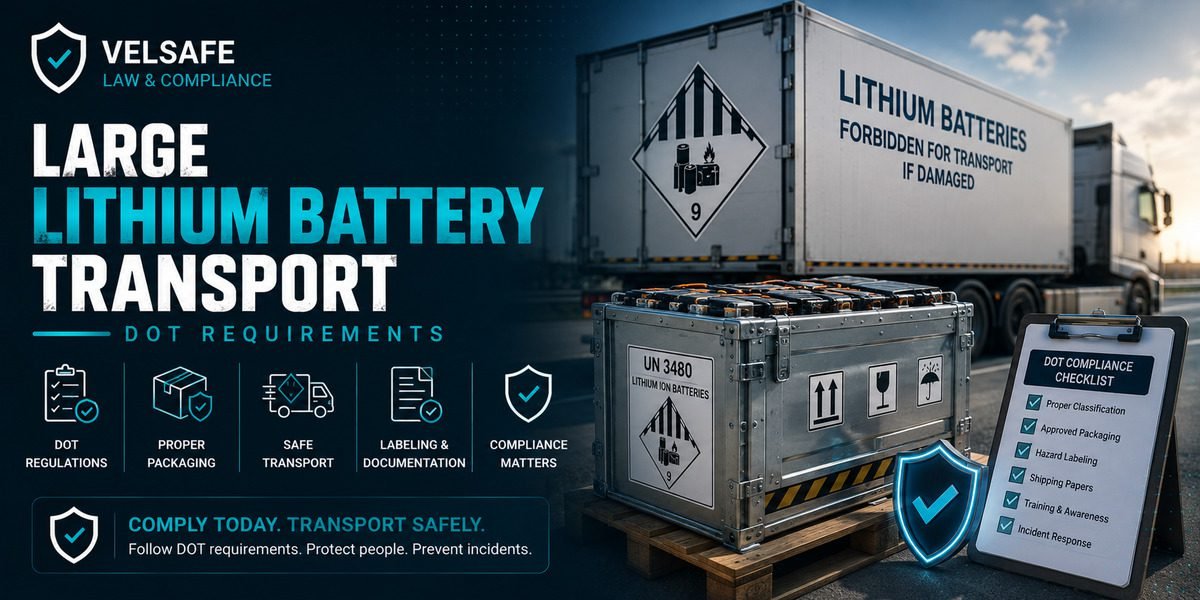
Each package must display the lithium battery mark specified in 49 CFR 172.345. This is a rectangular mark with a pictogram of a battery, the UN number, and the hazmat emergency telephone number. The outer package must also carry the Class 9 hazardous materials label (minimum 100mm x 100mm) and the proper shipping name. Missing or incorrect marks on a single package constitute a separate violation for each package affected.
4. Shipping Papers, Emergency Response, and Placarding
5. Hazmat Employee Training Requirements
Anyone who performs, supervises, or directly supports the transport of hazardous materials is a “hazmat employee” under 49 CFR 171.8. This includes warehouse workers who pack and label batteries, shipping clerks who prepare documents, and fleet supervisors who direct drivers. Untrained hazmat employees are one of the most common triggers for PHMSA citations.
Training records must be kept for each hazmat employee and be available for PHMSA inspection. Records must include the employee’s name, the most recent training completion date, a description of materials covered, and the name of the trainer. The recurrent training cycle is every three years. There is no grace period: a hazmat employee whose training has lapsed is in violation on the day it expires.
6. Penalties Table: What PHMSA Can Impose
| Violation Type | Maximum Civil Penalty | Common Triggers |
|---|---|---|
| General HMR Violation | $84,425 per violation/per day | Missing labels, incorrect UN number, improper packaging, absent shipping papers |
| Violation Resulting in Death, Serious Illness, or Severe Injury | $196,992 per violation | Thermal runaway during transport due to improper packaging or exceeding SOC limits |
| Untrained Hazmat Employee | $84,425 per employee per day | Lapsed training records, new employee shipping before 90-day training completion |
| Criminal Violation (wilful misconduct) | Up to $500,000 (corporation) / $250,000 (individual) + imprisonment | Deliberate misclassification, falsified test documentation, knowingly shipping dangerous batteries |
| Minimum Civil Penalty | $499 per violation | Minor paperwork deficiencies with no safety impact; first-time, good-faith violations |
Penalty amounts are adjusted annually under the Federal Civil Penalties Inflation Adjustment Act (28 U.S.C. 2461). Figures shown reflect 2024 PHMSA published amounts. Source: PHMSA Enforcement Penalties
7. Common Failures That Trigger PHMSA Citations
Missing or Incorrect Lithium Battery Mark
The lithium battery mark required by 49 CFR 172.345 is not the same as the Class 9 label. Both must appear on every package. Using only the Class 9 label, or applying an outdated mark format, constitutes a separate violation per package. This is the most frequently cited deficiency in PHMSA hazmat inspections involving lithium batteries.
No UN 38.3 Test Documentation Available
PHMSA investigators can request a summary of UN 38.3 test results at any point in the supply chain. Manufacturers typically provide this; the failure occurs when the shipper or receiver cannot produce it because it was never requested during procurement. A battery without accessible test documentation cannot be compliantly shipped.
Shipping Damaged or Degraded Batteries Without SOC Compliance
Returning a swollen, leaking, or thermally event-affected battery for service without reducing it to 30% SOC or less (or obtaining a PHMSA special permit) is a violation of 49 CFR 173.185(f). This is a high-risk failure: damaged batteries at high charge states have caused fires during transport. PHMSA treats this category of violation seriously in post-incident enforcement actions.
Incorrect UN Number on Shipping Papers and Packages
UN 3480, 3481, and 3537 are not interchangeable. Using UN 3480 when the batteries are packed with equipment (which requires UN 3481) means your emergency response information references the wrong configuration. First responders relying on incorrect UN numbers may apply the wrong response procedures in an emergency, which is the precise safety risk the HMR is designed to prevent.
Lapsed or Absent Hazmat Employee Training Records
Many warehouse operators train employees once at hire and never recertify them. The three-year recurrent training requirement at 49 CFR 172.704 is absolute. High employee turnover in warehouse settings compounds this: a new shipping clerk who packages a battery before completing their 90-day training cycle is a compliance gap on their first day on the job.
8. Employer Responsibilities: What Management Must Own
PHMSA enforcement actions name the “hazmat employer” in citations, not individual employees. The organisation is liable for every HMR violation in its operations, including those committed by third-party carriers shipping on the employer’s behalf if the employer prepared the shipment. Delegating to a freight broker does not transfer legal responsibility for the offer-for-transport compliance obligations.
Management’s core obligations include: maintaining a current emergency response plan for battery incidents during transport; keeping UN 38.3 test documentation for every battery model in the facility’s fleet; auditing outbound shipments at least quarterly for compliance with marking, labeling, and paperwork requirements; and maintaining a hazmat training programme with current records for every person in the shipping function.
Employers in the warehouse sector should also account for forklift battery removal and replacement logistics. When a facility pulls a battery from a lift truck for service or exchange, and that battery leaves the premises by road, the removal triggers full HMR compliance obligations. Many warehouse operators do not realise that battery swap programmes operated by their vendor still expose the employer to PHMSA liability if the employer prepared or arranged the pickup.
Legal Disclaimer
Key Takeaways
Large Batteries Require Full HMR Compliance
Any lithium-ion battery exceeding 100 Wh per unit is classified as a large lithium battery under 49 CFR 173.185. This triggers specific packaging, marking, labeling, shipping paper, UN 38.3 test, and hazmat employee training requirements. These are not best practices: they are legal obligations.
Each Package and Each Employee Is a Separate Violation
PHMSA assesses penalties per violation, and each non-compliant package or each untrained hazmat employee can constitute a distinct violation. A single outbound shipment with 12 incorrectly labelled packages exposes the employer to 12 separate citation counts, each carrying a maximum penalty of $84,425 per day.
Damaged Battery Transport Is the Highest-Risk Failure
Shipping a swollen, leaking, or thermally compromised large lithium-ion battery without meeting the 30% SOC limit and specific packaging requirements under 49 CFR 173.185(f) is the single failure most likely to result in both a fire incident and the maximum penalty tier. Establish a written damaged-battery return protocol before the next service call, not after one.
Frequently Asked Questions
Does the HMR apply if I only transport batteries within my own facility yard?
The HMR applies to transportation in commerce on public roads. Movement strictly within a fenced, private facility on private roads that does not involve a public roadway is generally outside HMR jurisdiction. However, once the vehicle exits onto a public road, including during a routine inter-building transfer across a public street, full HMR obligations apply. Consult legal counsel before relying on an “internal only” exemption.
Can we ship a large lithium-ion battery by air?
Large lithium-ion batteries (those exceeding 100 Wh) are prohibited on passenger aircraft under IATA Dangerous Goods Regulations and FAA rules. They may be shipped as cargo on cargo-only aircraft under specific conditions, including the Cargo Aircraft Only (CAO) label, state of charge at or below 30%, and compliance with IATA Section II requirements. This restriction is stricter than the ground transport rules and catches many shippers by surprise.
What is the CHEMTREC number and do we have to use it?
CHEMTREC (Chemical Transportation Emergency Center) is a 24-hour emergency response telephone service widely used to satisfy the 49 CFR 172.604 requirement for a 24-hour emergency contact number. Employers are not required to use CHEMTREC specifically: any 24-hour number staffed by a knowledgeable person who can provide emergency response guidance for lithium batteries qualifies. CHEMTREC is the most common choice because it meets the requirement reliably at low cost relative to staffing an in-house line.
Does the carrier bear any responsibility for HMR violations, or is it all on the shipper?
Responsibility is shared. The shipper (the employer offering the batteries for transport) is responsible for correct classification, packaging, marking, labeling, and shipping papers. The carrier is responsible for placarding the vehicle, maintaining the shipping papers in the cab, and ensuring its drivers are trained hazmat employees. Both parties can be cited simultaneously in the same enforcement action if both have distinct violations.
How does PHMSA find out about violations if there is no incident?
PHMSA conducts unannounced compliance inspections at shippers’ facilities and at carrier loading docks, and it inspects vehicles at roadway checkpoints. Inspections can be triggered by an incident, a complaint, or a random inspection programme. PHMSA also reviews accident reports submitted by carriers under 49 CFR 171.15 and 171.16. Violations that appear on shipping papers or package markings are visible to any inspector who examines the load.
Is there a PHMSA special permit available for situations not covered by the standard rules?
Yes. PHMSA issues special permits (formerly called “exemptions”) under 49 CFR 107 Subpart B for situations where standard HMR provisions are not practical or where an alternative approach provides equal or greater safety. This can apply to oversized battery modules, unique battery chemistries, or return-of-damaged-battery logistics that cannot meet the standard SOC requirements. The application process requires written justification and documentation of the alternative safety measures proposed.
What records must we keep to demonstrate compliance during a PHMSA inspection?
Inspectors will typically ask for hazmat employee training records (name, date, topics covered, trainer name), UN 38.3 test summaries for each battery model, your emergency response plan, and copies of recent shipping papers. The HMR does not specify a single retention period for all records, but many employers retain shipping papers and training records for three to five years to cover both the HMR training cycle and general statute of limitations considerations. Requirements vary: consult your legal counsel for specific retention guidance.
Frequently Asked Questions
Does DOT have a specific regulation for large lithium battery transport?
What is the watt-hour threshold that changes packaging requirements?
What state-of-charge limit applies to large lithium-ion batteries during transport?
Who must receive hazmat employee training before preparing lithium batteries for transport?
What is the maximum PHMSA civil penalty for a lithium battery transport violation?
Are lithium batteries prohibited on passenger aircraft?
What must a shipping paper for a hazmat lithium battery shipment include?
Sources
Government and Regulatory Sources
- 49 CFR 173.185: Lithium Cells and Batteries (eCFR): classification thresholds, packaging requirements, SOC limits, and defective battery provisions for ground transport.
- 49 CFR 172 Subpart H: Hazmat Employee Training Requirements (eCFR): general awareness, function-specific, safety, and security training obligations under 172.702 and 172.704.
- PHMSA: Hazmat Enforcement Penalties: current civil penalty amounts under 49 U.S.C. 5123, adjusted annually by PHMSA.
- PHMSA: Lithium Battery Guide: DOT guidance on lithium battery classification, packaging, and transport requirements for shippers.
Research and Industry Sources
- IATA Dangerous Goods Regulations: International Air Transport Association standards for lithium battery air transport, including prohibition on passenger aircraft.
- UN Manual of Tests and Criteria, Section 38.3: test methodology for lithium batteries required before transport classification is assigned.
- OSHA 29 CFR 1910.1200: Hazard Communication Standard: requires SDS and labelling for chemical hazards including lithium battery hazard communication in workplace settings.