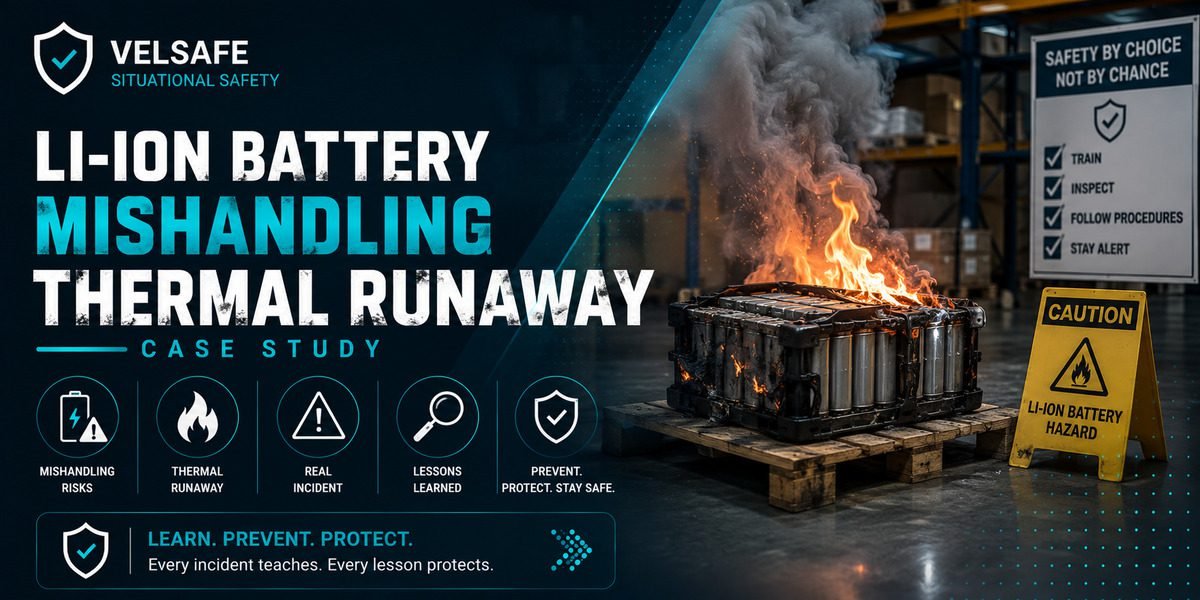
When a Battery Swap Goes Wrong: A Warehouse Thermal Runaway Case Study
An untrained worker. A damaged battery pack that no one reported. A battery swap performed without lockout/tagout or PPE. Two workers suffered chemical burns, and a charging bay was destroyed. This is the sequence of failures that made it happen.
Note: This scenario is a composite case study drawn from documented workplace battery incidents. All names, locations, and identifying details are fictional. Regulatory failures are representative of findings in real OSHA enforcement actions.
900+
Peak Temp (F)
Industrial lithium-ion batteries can exceed 900 degrees Fahrenheit during uncontrolled thermal runaway, hot enough to re-ignite after apparent extinguishment.
OSHA Hazard Alert, 2021
30+
Toxic Compounds
Thermal runaway in lithium-ion cells can release more than 30 hazardous compounds, including hydrogen fluoride, carbon monoxide, and volatile organic compounds.
NIOSH, Chemical Emergencies
100%
Preventable
Every failure in this incident was preventable with proper inspection, training, lockout/tagout, and PPE. No equipment fault was found. The root cause was procedural breakdown at every step.
OSHA Hazard Communication
Thermal runaway in a large lithium-ion battery system does not require an equipment defect. A damaged cell, an untrained handler, a missed inspection, and absent PPE are sufficient. This case study examines how each of those failures occurred in sequence at a regional warehouse distribution center and what the employer should have had in place at every step.
The battery pack involved was a 48-volt, 500 Ah lithium-ion module powering an electric counterbalance forklift. It had been damaged 11 days earlier in a minor bay collision. The damage was not reported, the battery was not inspected, and no hold was placed on the forklift. On the day of the incident, a warehouse associate was verbally instructed to perform a battery swap before the morning shift, a task he had not been trained to do.
Eight minutes after the swap began, the charging bay was on fire. This article documents exactly what failed and what every warehouse, distribution centre, and facilities team handling large lithium-ion battery systems must do differently.
The Scenario: What the Workplace Looked Like
The facility was a 280,000-square-foot regional distribution centre operating two forklift shifts daily. The fleet included 18 electric counterbalance forklifts, all powered by large lithium-ion battery modules. The charging bay held 22 battery positions along two walls, each with a dedicated charger. Battery swaps were supposed to follow a documented procedure requiring the forklift to be shut down, parked in a designated position, and the battery removed using a powered battery extractor.
Location
Charging Bay, Building B
Regional distribution centre. Charging bay attached to main warehouse floor with a single roll-up door for ventilation, partially blocked by stored pallets.
Workers Involved
2 Workers Exposed
Worker A (battery swap, no battery handling training). Worker B (entered bay to assist after smoke visible, also no PPE).
Outcome
2 Injured, Bay Destroyed
Chemical burns to hands and forearms (Worker A), respiratory exposure to toxic off-gases (Worker B). Full charging bay destruction. Three adjacent batteries also damaged.
Root Cause
5 Compounding Failures
Prior battery damage not reported. Untrained worker assigned. No lockout/tagout. No PPE. Improper extraction technique applied to compromised cells.
Incident Timeline: 8 Minutes from Start to Fire
The sequence of events unfolded quickly. From the moment Worker A began the battery swap to the moment the fire suppression system activated, less than eight minutes passed. Each step in that window contained at least one opportunity to stop the outcome.
6:47 AM
Battery Swap Begins
Worker A locates Forklift #7 in the charging bay. The forklift is on and the parking brake is not confirmed set. No lockout/tagout procedure is initiated. Worker A does not have a face shield or chemical-resistant gloves.
6:51 AM
Cracking Sound Noticed, Ignored
Worker A tilts the 600 lb battery module at an angle during extraction, placing mechanical stress on cells in the corner that was deformed in the earlier collision. A crackling sound is audible. Worker A continues the swap.
6:53 AM
Smoke Visible from Battery Housing
Smoke begins rising from the corner of the battery housing. The thermal runaway process has started in the compromised cell group. No alarm has sounded. Worker A remains at the extractor controls.
6:54 AM
Worker B Enters the Bay
Worker B, passing the bay entrance, sees the smoke and enters to assist. Neither worker attempts to leave the immediate area or call for emergency services.
6:55 AM
Thermal Runaway Fully Engaged
Flames erupt from the battery housing. Toxic off-gases fill the partially enclosed charging bay. Both workers are directly exposed. Worker A sustains burns to hands and forearms from the battery housing contact. Worker B inhales combustion gases.
6:56 AM
Suppression Activates, Workers Evacuate
The facility’s automatic fire suppression system discharges. Workers exit the bay. Three additional battery packs in adjacent charging positions are already overheating from radiant heat.
7:02 AM
Emergency Services Arrive
Fire department arrives with hazmat-trained personnel. The facility does not have a lithium-ion battery emergency response plan on file. Incident command is delayed while the emergency coordinator locates battery safety data sheets.
7:34 AM
Fire Extinguished
Fire extinguished after 39 minutes. Charging bay declared a loss. Both workers transported for medical treatment. OSHA notified within the mandatory reporting window.
What Went Wrong: Five Compounding Failures
No single failure caused this incident. Each failure removed a layer of protection and made the next failure more likely to result in injury. Addressing only one of these would not have been sufficient. Each one represented an independent opportunity to stop the outcome.
Failure 1: Damage Not Reported or Quarantined
The battery module had visible cell deformation from a forklift collision 11 days before the incident. The operator who caused the collision did not report it. No supervisor inspected the battery. No hold was placed on the forklift or the battery. The damaged pack continued in service through four charging cycles before the incident. Under the OSHA General Duty Clause (Section 5(a)(1)), employers are required to identify and control recognised hazards. A damaged lithium-ion battery is a recognised hazard with a published OSHA hazard alert.
Failure 2: Untrained Worker Assigned the Task
Worker A had completed general forklift operator training but had never received battery handling instruction. The verbal instruction to “swap the battery on #7” came from a shift lead who assumed the task was within Worker A’s competency. Battery handling for large industrial lithium-ion systems requires specific training covering pre-swap inspection, extraction equipment operation, and emergency response. Assigning an untrained worker to a hazardous task without written verification of competency is a procedural failure with direct regulatory consequences under 29 CFR 1910.132, which requires employers to assess hazards and ensure workers are capable of performing tasks safely.
Failure 3: No Lockout/Tagout Before Battery Removal
The forklift was not shut down and de-energised before the battery swap began. The OSHA standard at 29 CFR 1910.147 requires that energy be controlled before servicing equipment, and battery removal from a powered forklift qualifies as servicing. An energised forklift during battery extraction creates an additional arc flash and electrical hazard on top of the chemical hazard from the battery itself. This failure was not incidental: the facility had a written LOTO programme that did not include battery swap procedures.
Failure 4: No PPE at the Battery Swap Station
The charging bay did not have a designated PPE station. No face shields, chemical-resistant gloves, or acid-resistant aprons were staged at the swap location. Worker A performed the entire extraction procedure with bare hands and no eye protection. When thermal runaway began, no PPE was available for either worker. The facility had a PPE assessment on file under 29 CFR 1910.132, but it had not been updated since the transition from lead-acid to lithium-ion batteries two years earlier, and did not specify chemical-resistant PPE for battery handling tasks.
Failure 5: Improper Extraction Technique on Damaged Cells
Worker A tilted the battery module at an acute angle during extraction, placing direct mechanical stress on the already-deformed cell group. Even an undamaged battery module should never be tilted sharply during extraction. Applied to cells that had already experienced internal structural damage from the earlier collision, the additional mechanical stress was sufficient to initiate separator failure and begin the exothermic reaction chain of thermal runaway. Pre-swap inspection is the first line of defence against this scenario: if the damage had been identified, the battery would have been quarantined and this failure would not have occurred.
Regulatory Failures: What the OSHA Investigation Found
Post-incident investigation identified four distinct areas of regulatory non-compliance. Each citation addressed a failure that had existed before the incident, not a failure created by it. The regulatory exposure was present every day the damaged battery remained in service without a hazard control.
Standard
Violation
Classification
General Duty Clause, Section 5(a)(1)
Employer failed to control a recognised battery damage hazard. Damaged battery remained in service without inspection or quarantine.
Serious
29 CFR 1910.147 (LOTO)
No lockout/tagout procedure applied before battery removal from energised forklift. Written LOTO programme did not cover battery swap tasks.
Serious
29 CFR 1910.132 (PPE)
PPE hazard assessment had not been updated after transition from lead-acid to lithium-ion batteries. No chemical-resistant PPE at battery swap station.
Serious
29 CFR 1910.1200 (HazCom)
Safety Data Sheets for lithium-ion battery modules were not readily accessible in the charging bay. No training records for workers on battery SDS content.
Without damage reporting, all downstream controls fail. This is the foundational systemic failure.
Task Assignment Without Competency VerificationHigh
An untrained worker performing a high-hazard task creates direct exposure to the consequences of both prior failures.
LOTO Programme Gap (Battery Swap Not Covered)High
A written LOTO programme that does not cover all energy sources for all tasks provides false assurance of compliance.
PPE Assessment Not Updated After Battery Type ChangeModerate
Lead-acid and lithium-ion batteries present different chemical hazard profiles. PPE requirements differ and must be reassessed when battery chemistry changes.
The damaged cell group was the immediate cause of thermal runaway, but without the systemic failures above, the battery would never have reached the extraction stage.
Source: OSHA General Duty Clause, Section 5(a)(1)
Corrective Actions: What the Employer Was Required to Implement
Following the OSHA investigation, the employer was required to implement corrective actions addressing each cited standard. These actions are presented in the order an employer should implement them when transitioning from lead-acid to lithium-ion battery systems, or when auditing an existing lithium-ion battery programme.
1
Establish a Formal Battery Damage Reporting System
Every forklift operator must be required, as a condition of equipment use, to report any collision or impact that could affect the battery pack immediately after it occurs. The report must be written, timestamped, and routed to the maintenance supervisor. Any battery involved in a reportable impact must be locked out and quarantined pending physical inspection by a qualified person before the forklift returns to service. This system must be documented in the facility’s written safety programme.
2
Restrict Battery Handling to Trained, Authorised Workers
Battery swap procedures for large lithium-ion systems must be performed only by workers who have completed specific battery handling training covering: pre-swap inspection steps, proper use of battery extraction equipment, PPE requirements, thermal runaway recognition, and emergency response procedures. A written authorisation list must be maintained. No verbal assignment to a non-authorised worker is permissible for this task. Training records must document completion and competency verification.
3
Update the LOTO Programme to Include Battery Swap Procedures
The written lockout/tagout programme must be updated under 29 CFR 1910.147 to include battery removal from electric forklifts as a covered task. The procedure must specify: forklift shutdown sequence, key removal, parking brake confirmation, and written verification before the battery extractor is operated. The programme must be reviewed annually and whenever the equipment or battery type changes. All authorised battery handlers must be trained on the updated procedure before performing swaps.
4
Station PPE at Every Battery Charging and Swap Location
A dedicated PPE station must be installed at the entrance to each charging bay. Required items: chemical-resistant gloves rated for lithium-ion battery contact, face shield or splash goggles, flame-resistant apron, and closed-toe chemical-resistant footwear. The PPE hazard assessment under 29 CFR 1910.132 must be updated specifically for lithium-ion battery handling tasks. PPE must be inspected monthly and replaced when damaged. Workers must be trained on donning and doffing procedure before entering a charging bay for any battery handling task.
5
Post Battery SDS in Charging Bay and Train All Handlers
The Safety Data Sheet for each lithium-ion battery model in use must be posted or immediately accessible in the charging bay per 29 CFR 1910.1200. Workers who handle batteries must receive HazCom training covering: the specific chemical hazards in the SDS (thermal runaway off-gases, electrolyte exposure), first aid procedures for exposure, and how to access the SDS during an emergency. SDS must be updated when battery models change. Emergency services must also be provided with SDS information at the time of a battery incident to enable proper hazmat response.
6
Develop a Written Emergency Response Plan for Battery Thermal Events
The facility must have a written emergency response procedure specifically for lithium-ion battery thermal runaway events. The plan must include: immediate evacuation route from the charging bay, fire department pre-notification with SDS information, suppression agent guidance (large volumes of water for temperature reduction, not standard dry chemical), cooling and monitoring period after apparent extinguishment (lithium-ion fires can re-ignite), and re-entry authorisation criteria. The plan must be reviewed with local fire services and all affected workers annually.
Lessons Learned: What Transfers to Other Workplaces
The failures in this incident are not specific to this facility. They are structural failures that occur across distribution centres, manufacturing plants, and any workplace that has adopted electric forklifts with large lithium-ion battery packs without updating its safety programme to reflect the different hazard profile of lithium-ion versus lead-acid batteries.
Lesson 1: A Battery That Looks Fine After a Collision Is Not Fine
Lithium-ion battery damage is often internal. A cell group can sustain separator damage in a collision without any visible external deformation. The battery continues to function normally through subsequent charge cycles while internal degradation progresses. Every battery involved in a collision, impact, or drop must be treated as potentially compromised regardless of appearance. The pre-swap visual inspection is a necessary but insufficient test for post-collision batteries: a damaged pack must be sent for professional evaluation.
OSHA Hazard Alert, Lithium-Ion Batteries, 2021
Lesson 2: Switching Battery Chemistry Requires a Full Programme Review
Lead-acid and lithium-ion batteries are not interchangeable from a safety programme standpoint. They have different charging requirements, different thermal hazard profiles, different PPE requirements, different fire suppression responses, and different disposal rules. An employer who replaces lead-acid batteries with lithium-ion packs without updating the LOTO programme, PPE assessment, HazCom training, and emergency response plan is operating with a safety programme designed for a different hazard. This facility’s PPE assessment was two years out of date at the time of the incident.
OSHA HazCom Standard, 29 CFR 1910.1200
Lesson 3: Thermal Runaway Warnings Are Not Optional to Report
Worker A heard a crackling sound during the extraction and continued the procedure. Workers who are not trained to recognise thermal runaway warning signs (heat, swelling, crackling, hissing, chemical odour, or smoke from a battery housing) will not respond correctly when they occur. Training must include explicit instruction on what to do when a warning sign appears: stop all handling, move away from the battery, activate the alarm, call emergency services, and do not attempt manual intervention. The emergency response plan must be practiced before it is needed.
NFPA 855, Energy Storage Systems
Lesson 4: The Charging Bay Is a Hazardous Location Requiring Controls
A charging bay holding 20 or more large lithium-ion battery packs is a high-concentration hazardous energy environment. Ventilation, PPE availability, suppression system coverage, SDS accessibility, and worker access restrictions are not optional programme enhancements for this space. They are the baseline controls. A partially blocked ventilation door, no PPE at the entrance, and no access restriction for untrained workers created the conditions in which this incident could occur. Charging bays should be assessed as hazardous locations using the same rigour applied to chemical storage rooms.
Use this checklist to verify that your lithium-ion battery handling programme addresses every failure category identified in this incident. Each section represents a control layer that was absent or incomplete in the facility described above.
Damage Reporting Controls
Written collision reporting procedure for forklift operators
Damaged battery lockout-and-quarantine protocol
Qualified-person inspection required before battery returns to service
Post-collision inspection procedure documented
Reporting verified in pre-shift safety briefings
Training and Authorisation
Battery handling training completed before any swap task
Written authorised handler list maintained and current
Training includes thermal runaway warning signs
Emergency response procedures included in training
Training records retained with competency verification
Lockout/Tagout Compliance
Battery swap included in written LOTO programme
LOTO procedure covers all energy sources (electrical, kinetic)
Workers trained on LOTO procedure for battery tasks
LOTO equipment (locks, tags) available in charging bay
Annual review of LOTO programme completed
PPE and Charging Bay Controls
PPE assessment updated for lithium-ion battery hazard profile
Chemical-resistant gloves and face shield at every swap station
FR apron and closed-toe protective footwear available
Charging bay ventilation unobstructed and functional
PPE inspected monthly and replaced when damaged
Hazard Communication
SDS for each battery model posted or accessible in bay
HazCom training covers thermal runaway off-gas hazards
SDS updated when battery model changes
Emergency services pre-provided with SDS information
SDS review included in battery handler training
Emergency Response
Written thermal runaway emergency response plan in place
Evacuation route from charging bay clearly marked
Fire department pre-briefed on battery hazard and SDS
Suppression guidance covers lithium-ion re-ignition risk
Emergency plan reviewed and practiced annually
Key Takeaways
Damage Reporting Is the First Control, Not the Last
Every other safety control in this incident depended on the damaged battery being identified before it reached the extraction stage. When damage reporting fails, all downstream controls fail with it. A written, mandatory, timestamped damage reporting requirement is not a procedural formality: it is the mechanism that activates every other layer of protection.
Changing Battery Chemistry Requires a Full Programme Update
An employer who transitions from lead-acid to lithium-ion battery systems without updating LOTO procedures, PPE assessments, HazCom training, and emergency response plans is managing a different hazard with the wrong programme. Every element of the battery handling safety programme must be reviewed at the point of chemistry change, not deferred to the next annual review cycle.
Verbal Task Assignment Is Not Competency Verification
Telling a worker to perform a task is not the same as verifying they are trained and authorised to perform it safely. Battery handling for large lithium-ion systems requires documented training, competency verification, and written authorisation before any task assignment. A verbal instruction that assumes competency transfers the risk of that assumption directly to the worker. The corrective action in this incident required the employer to implement a written authorisation system. That system should have existed before the first battery swap was performed.
Frequently Asked Questions
What is thermal runaway in a lithium-ion battery?
Thermal runaway is a self-sustaining exothermic reaction within a lithium-ion cell that once started cannot be stopped by removing the heat source. It occurs when a cell’s internal temperature reaches a threshold that triggers further chemical reactions, generating more heat than the cell can dissipate. The result is rapid temperature escalation, gas venting, potential fire, and the risk of propagation to adjacent cells. Physical damage, overcharging, external heat, and manufacturing defects are all recognised triggers.
Is OSHA required to be notified after a battery fire injures workers?
Yes. Under 29 CFR 1904.39, employers must report any work-related in-patient hospitalisation to OSHA within 24 hours of learning of it. Fatalities must be reported within 8 hours. An amputation or loss of an eye must also be reported within 24 hours. Both workers in this scenario received hospital treatment for chemical burns and respiratory exposure, triggering the 24-hour reporting requirement. Failing to report within these timeframes is itself a separate OSHA violation.
What type of fire extinguisher should be used on a lithium-ion battery fire?
Large volumes of water are the primary response for industrial lithium-ion battery fires, used to cool the battery and surrounding area rather than to extinguish in the traditional sense. Standard dry chemical extinguishers do not control the thermal runaway reaction. CO2 extinguishers are not effective for large battery fires. Many fire departments use continuous water application to cool the battery for extended periods after apparent extinguishment, because lithium-ion fires can re-ignite hours after the visible flame is out. Consult your battery manufacturer’s emergency response guidance and coordinate with local fire services before an incident occurs.
What toxic gases does a lithium-ion battery release during thermal runaway?
Thermal runaway in lithium-ion batteries can release hydrogen fluoride (HF), carbon monoxide, carbon dioxide, and a range of volatile organic compounds depending on the electrolyte chemistry and cell design. Hydrogen fluoride is particularly hazardous because it penetrates skin and causes deep tissue damage, sometimes with delayed symptoms that mask the severity of exposure. Workers who are exposed to battery off-gases must receive immediate medical evaluation even if they initially feel unwell only in a minor way.
Does LOTO apply to battery swaps on electric forklifts?
Yes. Removing a battery from an electric forklift is a servicing task involving a significant energy source, and 29 CFR 1910.147 applies. The forklift must be de-energised and the battery disconnect verified before extraction begins. Many facilities omit battery swaps from their LOTO programme because operators do not think of battery removal as “servicing” in the traditional sense. OSHA’s enforcement position is that any work on equipment with hazardous energy requires LOTO controls, and a 600-pound lithium-ion battery module is a significant hazardous energy source.
How should a warehouse respond when a battery shows thermal runaway warning signs?
Warning signs include: heat from the battery housing, swelling or deformation of the casing, crackling or hissing sounds, chemical odour, or visible smoke. If any of these appear, workers must stop handling the battery immediately, move away from the immediate area at least 50 feet, activate the fire alarm, call emergency services, and not attempt to move, open, or intervene with the battery. Under no circumstances should a worker re-enter the area to retrieve the battery or continue the swap. The response should be treated as a fire emergency from the first warning sign.
Can a lithium-ion battery damaged in a collision be returned to service?
Not without professional inspection. A battery that has been involved in any impact sufficient to deform the housing or any component must be removed from service immediately and evaluated by the battery manufacturer or a qualified technician before it returns to use. Visual inspection by facility staff is not sufficient to rule out internal cell damage. Some manufacturers provide diagnostic testing services. If internal damage is confirmed or cannot be ruled out, the battery must be disposed of according to the manufacturer’s guidance and applicable local regulations for lithium battery disposal.
Sources
Government and Regulatory Sources
OSHA. (2021). Lithium-Ion Battery Hazard Alert – Thermal runaway temperatures, toxic gas release profile, and employer controls.
OSHA. 29 CFR 1910.147 – Control of Hazardous Energy (Lockout/Tagout) – Standard requiring energy control before servicing equipment, including electric forklifts.
OSHA. 29 CFR 1910.132 – Personal Protective Equipment – Employer obligation to assess hazards and provide appropriate PPE.
OSHA. 29 CFR 1910.1200 – Hazard Communication Standard – SDS requirements and worker training obligations for hazardous chemicals including lithium-ion batteries.
OSHA. OSH Act Section 5(a)(1) – General Duty Clause – Employer obligation to provide a workplace free from recognised hazards likely to cause death or serious physical harm.
Research and Industry Sources
NFPA. NFPA 855 – Standard for the Installation of Stationary Energy Storage Systems – Fire protection requirements and emergency response guidance for lithium-ion energy storage.
NIOSH. Chemical Emergency Preparedness Resources – Toxic compound identification and occupational exposure guidance for chemical emergencies including battery incidents.
Related VelSafe Articles
Worker Safety
Large Lithium-Ion Battery Safety: What Workers Need to Know
The foundation guide for Part 1 of this series: hazard identification, safe charging practices, and what every worker must know before handling large industrial lithium-ion battery systems.
Tips
8 Large Lithium-Ion Battery Safety Tips for Warehouses
Actionable tips for warehouse supervisors and safety coordinators covering the most frequently violated battery handling controls in distribution centre operations.
Situational
Battery and Charger Safety During Holiday Downtime: Fire and Leak Prevention
A case study in the specific hazards created when battery charging continues unattended during reduced staffing periods, covering fire prevention controls and emergency response preparation.
Build Your Battery Handling Programme Before the Incident Happens
VelSafe covers the full lithium-ion battery safety series for warehouses, distribution centres, and manufacturing facilities. Every article in the series is built on OSHA standards and real incident analysis.
VelSafe Staff is the editorial team at VelSafe.com, a workplace safety and compliance content platform. Our team of safety professionals, regulatory specialists, and compliance writers produces guides, tips, and insights on OSHA regulations, pharmaceutical GMP, healthcare compliance, and occupational health across construction, manufacturing, oil and gas, and life sciences sectors..