

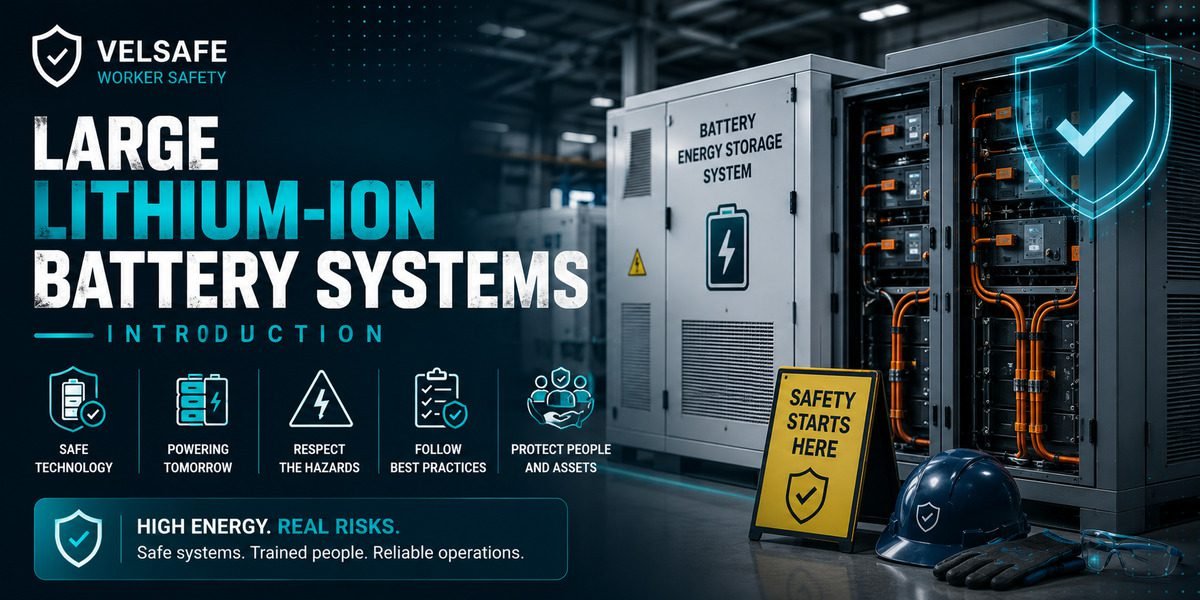
Part 1 of 6. This article introduces the hazards, regulatory framework, and safe-work foundation every worker and supervisor needs before operating or working near large lithium-ion battery systems.
Runaway
Fluoride
Duty Clause
Large lithium-ion battery systems power forklifts, automated guided vehicles, energy storage systems, and industrial tools in warehouses and manufacturing facilities across the country. These systems carry serious hazards: thermal runaway can release toxic gases, cause fires, and trigger explosions that injure workers in seconds. This article introduces the six key areas every worker and supervisor needs to understand before working near or with large lithium-ion battery systems.
This is Part 1 of 6 in the Large Lithium-Ion Battery Safety series. It covers what these systems are, why they are found in modern workplaces, and the fundamental hazards that make them different from other power sources. Parts 2 through 6 will cover inspection, charging, storage, emergency response, and regulatory compliance in detail.
Why This Matters: Large Li-Ion Systems Are Not Like Small Consumer Batteries
Industrial lithium-ion battery systems store significantly more energy than the battery in a phone or laptop. A large forklift battery pack can hold enough energy to power a home for several days. When that energy is released uncontrolled, the consequences are severe and rapid.
Workers and supervisors who treat large lithium-ion batteries as a low-risk power source are making a preventable mistake. The hazards are real, documented, and manageable with the right knowledge and controls.
What Are Large Lithium-Ion Battery Systems?
A large lithium-ion battery system is any lithium-ion energy storage unit that exceeds the energy capacity of common consumer electronics. In workplace settings, these include battery packs for forklifts, automated guided vehicles (AGVs), industrial power tools, uninterruptible power supplies (UPS), and stationary energy storage systems (ESS) used for facility power management.
Forklift and AGV Battery Packs
Lithium-ion forklifts are replacing lead-acid battery models across warehouses. These packs are heavier, charge faster, and require specific handling procedures different from traditional lead-acid systems.
Stationary Energy Storage Systems (ESS)
ESS units store power for facilities, acting as backup or peak-shaving systems. These can range from cabinet-sized units to large room-scale installations. NFPA 855 governs their installation and safety requirements.
Industrial Power Tools and Equipment
High-capacity lithium-ion batteries power heavy-duty tools including floor scrubbers, pallet jacks, and large construction equipment. Workers in tools and general industry settings encounter these daily.
Uninterruptible Power Supplies (UPS)
Data centres, hospitals, and manufacturing facilities use large lithium-ion UPS units to maintain power continuity. Workers in these environments may be near these systems during maintenance, cleaning, or equipment moves.
Hazard Overview: The Three Core Risks
Every large lithium-ion battery system presents three interconnected hazard categories. Understanding each one is the starting point for working safely around these systems.
The most severe hazard. A single defective or damaged cell can trigger a cascade that affects adjacent cells. The reaction generates intense heat and is not stopped by disconnecting power.
Thermal runaway releases hydrogen fluoride (HF), carbon monoxide (CO), and other toxic gases. HF penetrates skin and causes internal damage before symptoms appear. Conventional fire suppression does not neutralise these gases.
Physical damage to a lithium-ion battery can release electrolyte fluids that are flammable and corrosive. Workers who touch or inhale these materials without PPE face chemical burns and respiratory injury.
Signs of Danger: When to Stop Work and Report
Workers near large lithium-ion battery systems must know the warning signs of a developing problem. These signs can appear minutes or hours before a thermal runaway event. Acting immediately on these signals prevents injury.
Unusual Heat or Swelling
A battery that is hot to the touch outside of normal charging or that appears to be swelling or deforming is showing signs of internal failure. Stop use immediately, do not attempt to move it without supervisor approval, and notify your supervisor.
Hissing, Popping, or Venting Sounds
These sounds indicate internal pressure building inside the battery housing. This is an emergency signal. Do not investigate the source. Move away from the area, alert others, and contact your supervisor and emergency services immediately.
Burning Odour or Visible Smoke
A sharp chemical or burning smell near a battery system, or any visible smoke, means thermal runaway may be starting. Evacuate the area. Do not use a standard fire extinguisher on a lithium-ion fire without specific training. Activate the site emergency plan.
Visible Physical Damage
Any crack, dent, puncture, or visible damage to a battery casing must be reported before the battery is used or charged. A damaged cell can fail at any time, including during charging. Tag the battery out of service and report it immediately.
Error Codes or Charging Failures
Battery management systems (BMS) display error codes when internal conditions fall outside safe limits. A battery that repeatedly fails to charge, loses charge unusually fast, or displays error codes must be removed from service and inspected by a qualified technician.
Basic Safe Work Principles for Large Li-Ion Battery Systems
These five principles apply every time you work near or with a large lithium-ion battery system. Specific procedures for charging, inspection, and storage are covered in Parts 2 through 4 of this series.
Know Your System Before You Touch It
Every large lithium-ion battery system has a specific manual, safety data sheet (SDS), and set of operating procedures. Read them before your first interaction with the equipment. If training has not been provided, request it from your supervisor before beginning work.
Inspect Before Each Use
A visual inspection takes less than two minutes and can prevent a serious incident. Check the casing for damage, check connections for corrosion or loose fittings, and confirm the battery management system is showing normal operating status. Do not skip this step when you are in a hurry.
Use Only Approved Chargers and Equipment
Using an incompatible charger or charging cable with a large lithium-ion battery system can cause overcharging, heat buildup, and cell damage. Only use the charger and cable specified by the manufacturer. Never use adaptors or substitute equipment without written approval from your safety team.
Report Damage or Abnormal Behaviour Immediately
A battery that shows any of the warning signs listed in the previous section must be reported before any further use. Workers who continue to use damaged or malfunctioning battery systems risk injury to themselves and their colleagues. Reporting is not optional, and no production target justifies operating a compromised system.
Know the Emergency Plan Before an Emergency Happens
Every facility using large lithium-ion battery systems must have an emergency response plan. Know where the assembly point is, how to activate the alarm, and who to call. Thermal runaway develops rapidly. Workers who must think through the plan during an event are already behind.
Do and Do Not: Foundation Rules
Do
- Complete training before operating any large lithium-ion battery system
- Inspect the battery and connections before each shift or use
- Use only manufacturer-approved chargers and cables
- Store batteries in designated, ventilated areas away from combustibles
- Report any damage, error codes, or unusual heat to your supervisor immediately
- Know where fire suppression equipment and evacuation routes are located
- Follow all posted signage and lockout/tagout procedures near battery charging areas
Do Not
- Do not use a battery with visible damage, swelling, or abnormal heat
- Do not use unapproved chargers, cables, or adaptors
- Do not charge a battery near flammable materials or in an unventilated space
- Do not leave a charging battery unattended overnight without an automated monitoring system
- Do not attempt to open, repair, or modify a lithium-ion battery yourself
- Do not ignore error codes or repeated charging failures
- Do not attempt to fight a lithium-ion fire without specific training and proper suppression equipment
Emergency Response: First Actions
If you see signs of thermal runaway, fire, or venting gases from a large lithium-ion battery system, take these steps in order. Do not deviate.
Evacuate Immediately
Move away from the battery and alert everyone in the area. Do not stop to collect belongings. Toxic gases can be released within seconds of the first visible signs. Get out first.
Activate the Alarm and Call Emergency Services
Pull the nearest fire alarm and call emergency services (911). Tell them specifically that a lithium-ion battery system is involved. This matters: lithium-ion fires require different suppression approaches than standard fires.
Do Not Re-Enter Until Cleared
Lithium-ion battery fires can reignite hours after appearing extinguished. Do not re-enter the affected area until the fire department or a qualified technician has confirmed the system is stable and the area is clear.
Report the Incident to Your Supervisor
All lithium-ion battery incidents must be documented and reported. If any worker was exposed to gases, smoke, or electrolyte, they must be evaluated by medical personnel. Do not wait for symptoms to appear before seeking evaluation.
Supervisor Responsibilities
Under OSHA’s General Duty Clause (Section 5(a)(1)), employers must protect workers from recognised hazards. For supervisors overseeing workers who operate near or with large lithium-ion battery systems, that means establishing and enforcing specific programme elements before an incident occurs.
Provide Training Before First Exposure
Workers must receive documented training on the specific battery systems they will operate or work near before beginning work. Training must cover hazard recognition, normal operating limits, and emergency response procedures.
Establish a Reporting System
Workers must have a clear and accessible way to report battery damage, abnormal behaviour, or near-miss incidents. A reporting process that requires paperwork or supervisor approval before a worker can remove a damaged battery from service is not adequate.
Maintain Safety Data Sheets
Under 29 CFR 1910.1200 (Hazard Communication), employers must maintain safety data sheets (SDS) for hazardous chemicals in the workplace. Lithium-ion battery electrolytes are covered. SDS must be accessible to workers during all shifts.
Post Emergency Procedures in Charging Areas
Emergency response steps, the emergency contact number, and the location of the nearest fire suppression equipment must be posted visibly in all battery charging and storage areas. Workers should not need to search for this information during an incident.
Worker Safety Checklist
Use this checklist as a reference at each phase of your interaction with large lithium-ion battery systems.
Before Starting Work
- Training completed and documented
- SDS available for the battery system
- Visual inspection of battery completed
- No visible damage, swelling, or leaks
- BMS shows normal operating status
- Emergency response plan reviewed
During Operations
- No unusual heat, sounds, or odours noted
- Approved charger and cables in use only
- Battery not exposed to impacts or dropped
- Charging area is ventilated and clear of combustibles
- Any anomalies reported immediately
- No modification or repair attempted by unauthorised personnel
After Each Shift
- Battery returned to designated storage area
- Any damage or incident documented and reported
- Damaged or suspect batteries tagged out of service
- Charging area left clear and safe
- Handoff notes provided to incoming shift supervisor
- All PPE returned to designated location
Key Takeaways
Large Li-Ion Systems Require Specific Knowledge
These systems are not simply bigger versions of consumer batteries. Thermal runaway, hydrogen fluoride gas, and electrolyte exposure are hazards that require specific training, controls, and emergency procedures. No worker should operate these systems without that foundation.
Warning Signs Appear Before Thermal Runaway
Heat, swelling, unusual sounds, and error codes are the warning system that precedes a serious incident. Workers who recognise these signs and act immediately on them can prevent injury. Ignoring them, even briefly, can allow conditions to escalate beyond control.
Reporting Is Not Optional, and No Production Target Justifies Operating a Compromised System
OSHA’s General Duty Clause requires employers to address recognised hazards. Workers have the right to refuse work they reasonably believe poses imminent danger under Section 11(c) of the OSH Act. If a battery shows warning signs, removing it from service and reporting it is not a disruption. It is the job.
Frequently Asked Questions
What is thermal runaway in a lithium-ion battery?
Thermal runaway is a self-reinforcing chemical reaction inside a lithium-ion battery cell in which heat accelerates the reaction, which generates more heat. Once started, the process cannot be stopped by removing the power source. It can result in fire, explosion, and the release of toxic gases including hydrogen fluoride and carbon monoxide.
What OSHA regulations cover large lithium-ion battery systems?
OSHA does not have a single dedicated standard for lithium-ion battery systems. Enforcement occurs primarily under Section 5(a)(1) of the OSH Act (the General Duty Clause), which requires employers to protect workers from recognised serious hazards. Related standards include 29 CFR 1910.303 (electrical systems), 29 CFR 1910.178 (powered industrial trucks), and 29 CFR 1910.1200 (Hazard Communication for battery electrolytes). NFPA 855 governs stationary energy storage system installation.
Is hydrogen fluoride gas dangerous even in small amounts?
Yes. Hydrogen fluoride (HF) is a serious hazard at low concentrations. It is colourless and its odour may not be detectable at harmful levels. HF penetrates skin and can cause systemic toxicity including cardiac effects before visible burns appear. Standard smoke detectors do not detect HF gas. Workers exposed to it during a battery event must receive medical evaluation immediately, even if they feel no symptoms.
Can I use a regular fire extinguisher on a lithium-ion battery fire?
Only trained personnel with appropriate suppression equipment should attempt to intervene in a lithium-ion battery fire. Large water volumes are often used by fire departments to cool the battery and prevent reignition, but this is not something an untrained worker should attempt. The priority for workers without specific training is to evacuate, activate the alarm, and call emergency services.
How is a lithium-ion forklift battery different from a lead-acid forklift battery in terms of safety?
Lead-acid batteries primarily present risks from hydrogen gas release during charging and from the corrosive acid in the electrolyte. Lithium-ion batteries eliminate hydrogen offgassing during normal operation but introduce the thermal runaway hazard and toxic gas release risk if damaged or misused. Charging procedures, storage requirements, emergency response, and inspection protocols differ significantly between the two technologies.
What training do workers need before operating a lithium-ion forklift or working near a large ESS?
Training must cover the specific system being operated, including the manufacturer’s operating procedures, hazard recognition, inspection requirements, charging procedures, storage rules, and emergency response. For powered industrial trucks, 29 CFR 1910.178(l) requires formal training and evaluation before operation. ESS and general battery system training requirements are governed by the General Duty Clause. Employers must document all training provided.
What comes next in this six-part series?
Part 2 covers the pre-use inspection process for large lithium-ion battery systems: what to check, how to document findings, and when to remove a battery from service. Part 3 covers safe charging procedures. Parts 4 through 6 address safe storage, emergency response in depth, and regulatory compliance requirements for employers.
Sources
Government and Regulatory Sources
- OSHA: Lithium-Ion Batteries Hazard Alert: primary OSHA reference for thermal runaway hazards, toxic gas release, and worker protection obligations for lithium-ion battery systems.
- OSH Act Section 5(a)(1): General Duty Clause: the primary enforcement mechanism for lithium-ion battery hazards in workplaces without a specific OSHA standard.
- OSHA 29 CFR 1910.178: Powered Industrial Trucks: governs operator training and safe operation requirements for electric forklifts including lithium-ion battery models.
- OSHA 29 CFR 1910.1200: Hazard Communication Standard: requires employers to maintain SDS and provide hazard information for battery electrolytes and related chemicals.
Research and Industry Sources
- NFPA 855: Standard for the Installation of Stationary Energy Storage Systems: the primary installation and safety standard for large stationary lithium-ion battery energy storage systems.
- NIOSH: Chemical Hazards Emergency Response: guidance on hazardous chemical exposures including hydrogen fluoride, relevant to lithium-ion battery thermal runaway events.
Related VelSafe Articles
VelSafe provides workplace safety training and reference content for frontline workers and supervisors. Explore the full library at velsafe.com.
Explore VelSafe Training