

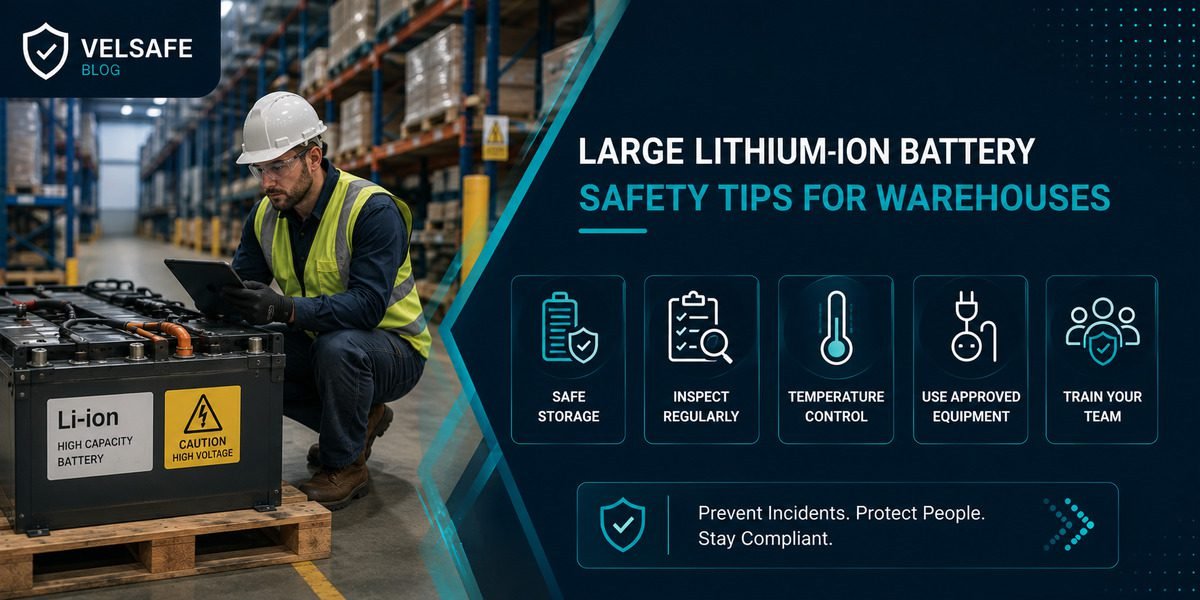
Thermal runaway, improper charging, and missing hazard communication labels are the primary failure points when warehouses handle large lithium-ion battery systems. These 8 tips cover the storage, charging, inspection, and emergency response controls that directly prevent fires, injuries, and OSHA citations under the General Duty Clause.
Maximum OSHA penalty under the General Duty Clause when battery hazards are uncontrolled and a worker is exposed to risk of injury or death.
Swelling and heat buildup precede gas venting, which precedes ignition. Workers who recognise Stage 1 can prevent the fire. Workers who miss it face Stage 3.
The primary US standard governing installation, separation distances, ventilation, and fire suppression for large-format lithium-ion battery systems in commercial and industrial settings.
Large lithium-ion battery safety is a compound obligation. OSHA does not have a single dedicated regulation for lithium-ion battery hazards, but the General Duty Clause (Section 5(a)(1) of the OSH Act) requires employers to protect workers from recognised hazards. Battery incidents have triggered General Duty Clause citations at warehouses, distribution centres, and manufacturing facilities across the country. NFPA 855 (2023) addresses installation and fire control. The Hazard Communication Standard (29 CFR 1910.1200) covers chemical exposure. The Emergency Action Plan standard (29 CFR 1910.38) requires documented response procedures.
These 8 tips address the controls that appear most frequently in post-incident OSHA investigations and that training covering large lithium-ion batteries, Parts 1 through 6, addresses directly. They apply to any setting where large-format battery systems are stored, charged, or operated: electric forklift fleets, warehouse energy storage systems, and industrial tool battery banks.
The 8 Tips: Quick Reference
Store Batteries in Designated, Ventilated Areas
Inspect Every Battery Before Each Charge Cycle
Use Only Manufacturer-Approved Chargers and Cables
Never Charge Batteries Without Active Monitoring
Recognise Thermal Runaway Warning Signs Early
Maintain and Post a Written Charging Protocol
Train Workers on HazCom Labels and Safety Data Sheets
Develop and Practise Your Battery Emergency Response Plan
The 8 Tips in Detail
Store Batteries in Designated, Ventilated Areas
Lithium-ion batteries release flammable gases and heat during charging and failure events. Storing them in unventilated areas concentrates those gases and removes the dissipation that slows early-stage thermal events. NFPA 855 specifies ventilation and separation distance requirements for battery installations precisely because unventilated storage accelerates fire spread.
Designate a specific storage area with mechanical ventilation, clear separation from combustible materials, posted capacity limits, and fire suppression access. Ensure NFPA 855 separation distances are met for your battery size and chemistry. Never store damaged or swollen batteries with functional units. Contact your local authority having jurisdiction (AHJ) before installing or expanding battery storage.
Treating the charging station as the storage area. Charging and storage are separate functions with different space and ventilation requirements. Batteries left indefinitely on chargers in warehouse corners are neither properly stored nor properly charged.
Permit requirements for large-format battery systems are increasingly common under NFPA 1 and local fire codes. Violations found during inspections result in immediate corrective action orders. Confirm permit status before installing new battery storage capacity.
Inspect Every Battery Before Each Charge Cycle
A battery with internal damage, cracked housing, swollen cells, or compromised connections will not behave predictably during charging. Charging an already-stressed battery adds heat to a system at risk. Pre-charge inspection is the single most reliable point at which a failing battery can be identified before it becomes a fire.
Check the battery casing for cracks, bulging, or deformation. Inspect connectors and cables for fraying, burn marks, or corrosion. Smell for unusual chemical odours. Check the battery management system (BMS) indicator if present. If any defect is found, remove the battery from service immediately and follow your isolation and disposal procedure. Document the inspection by date and operator.
Conducting inspections only after a problem is visible to the naked eye. A swollen cell or discoloured connector is already a late-stage indicator. Train workers to notice early signs: unusual warmth, slight case deformation, or unexpected BMS warning codes.
Post a two-minute inspection checklist at every charging station. Workers who have a visible, specific list complete inspections more consistently than workers relying on memory. Documented inspections also support your position in a post-incident OSHA investigation.
Use Only Manufacturer-Approved Chargers and Cables
Large lithium-ion batteries require chargers matched to their specific voltage, current, and chemistry. A mismatched charger can overcharge cells, bypass the battery management system safety cutoffs, or apply current profiles the battery was not designed to handle. All of these conditions accelerate degradation and increase the probability of thermal runaway.
Verify that every charger on the floor appears in the manufacturer’s approved equipment list for the battery model it serves. Physically label each charger with the battery models it is approved for. Prohibit the use of universal or substitute chargers. When a charger fails, replace it with an approved unit, not the closest available alternative.
Using a compatible-looking connector as a proxy for an approved charger. Physical compatibility does not mean electrical compatibility. A charger from a different manufacturer may connect successfully and still deliver incorrect charge parameters that damage the battery across multiple cycles.
Keep a master charger-to-battery pairing list in your equipment room and update it every time you add a new battery model. Include the charger model number, approved battery model, and rated voltage and current. Make this list part of new equipment onboarding so mismatches are caught before chargers reach the floor.
Never Charge Batteries Without Active Monitoring
Battery fires during charging can escalate from detectable heat to uncontrollable fire in minutes. A fire that starts during an unattended overnight charge has no one to activate suppression, call emergency services, or evacuate the area. The earliest intervention window, when a thermal event is still containable, requires someone present and trained to act.
Require active supervision or automated monitoring for all charging operations. If batteries must charge outside staffed hours, install battery monitoring systems with audible and remote alarms that trigger on temperature rise, voltage deviation, or gas detection. Ensure the local fire suppression system covers the charging zone. Never disable BMS alarm features to avoid interruptions.
Assuming the fire suppression system substitutes for monitoring. Suppression systems activate after a fire reaches a trigger threshold. They do not prevent the fire or provide early warning. Monitoring systems serve a different function and are not interchangeable with suppression equipment.
Schedule charging cycles to complete before the end of shifts where possible. Fully charged batteries should be removed from chargers promptly. Overcharging after 100% completion is a known source of heat accumulation, even in systems with automatic cutoff features that may not always function as intended.
Recognise Thermal Runaway Warning Signs Early
Thermal runaway is an exothermic chain reaction inside the battery cell that, once fully initiated, cannot be stopped by external cooling alone. Precursor signs occur before this point of no return. Workers who recognise and act on early signs can isolate the battery and prevent the event entirely rather than responding to an active fire.
Train all workers handling large batteries to recognise: battery case swelling or deformation, unusual heat during or after charging, hissing or crackling sounds, a sharp chemical or sweet odour from electrolyte venting, and visible smoke. Any single sign requires immediate isolation of the battery and activation of the emergency response procedure. Workers must not need supervisor approval to act.
Waiting for confirmation from a supervisor before acting on a warning sign. If a worker smells venting gases or sees swelling, the time to act is immediately. The emergency procedure should give frontline workers authority to isolate a battery without requiring authorisation from above.
Post a laminated warning sign card at every charging station listing the five early warning signs and the isolation procedure. Visual prompts during training are retained more consistently than verbal-only instruction, especially for workers responding under stress.
Maintain and Post a Written Charging Protocol
Without a written protocol, charging decisions are made informally by whoever is on shift. Informal practices vary by operator and experience level. OSHA inspectors examining a workplace after a battery incident will ask for the written charging procedure. Its absence directly supports a General Duty Clause citation by demonstrating that the employer failed to establish a safety system.
Write a charging protocol covering: approved charger-battery pairings, pre-charge inspection steps, maximum charge duration, supervision or monitoring requirements, disconnection procedure at completion, and what to do when a defect is found. Post it at every charging station. Review it annually and after any battery incident. Require operators to sign acknowledgement of the protocol.
Writing a protocol that exists only in the safety binder and is never seen by the workers who need it. A protocol that is not accessible, posted, and reinforced during onboarding has no operational value. The document is not the compliance item; the behaviour it produces is.
Include a clear Stop and Report rule: if anything unexpected occurs during charging (heat, smell, sound, BMS alarm), the operator stops the charge, disconnects if safe, and reports immediately. A one-sentence rule every worker can repeat is more useful than a five-page document they do not remember.
Train Workers on HazCom Labels and Safety Data Sheets
Large lithium-ion batteries are chemical systems. Under OSHA’s Hazard Communication Standard (29 CFR 1910.1200), employers must ensure workers can access and understand Safety Data Sheets (SDS) for battery products. The SDS contains first aid procedures for electrolyte exposure, fire-fighting guidance specific to the battery chemistry, and the PPE requirements for handling damaged units.
Obtain the SDS from your battery manufacturer for every battery model in use and ensure it is accessible to all workers who handle batteries. Train workers on the GHS label sections specific to lithium-ion batteries: fire hazard and toxic gas pictograms, the flammable gas signal word, and the emergency response section. Confirm your emergency response plan aligns with the SDS fire-fighting instructions for your specific chemistry.
Filing the SDS and never referring to it again. Workers responding to a venting or burning battery need to know whether water suppression is appropriate for their specific chemistry or whether a specific agent is recommended. Consulting the SDS during an active incident is too late.
Create a one-page emergency reference summary from the SDS for your specific battery models. Include: the battery chemistry type, venting gases produced, first aid for skin and eye contact, and the specific fire response method. Post it at charging stations and the emergency kit location. Update it whenever you change battery models.
Develop and Practise Your Battery Emergency Response Plan
A battery fire is high-intensity, rapidly evolving, and chemically distinct from ordinary warehouse fires. Workers who have never rehearsed the response will improvise under stress, often in ways that worsen the outcome: applying incorrect suppression agents, approaching an active thermal runaway, or failing to evacuate non-essential personnel before responders arrive.
Write a battery-specific emergency response procedure covering: detection and alarm, notification steps, evacuation of the charging area, fire suppression appropriate to the battery chemistry, isolation of the battery from the power source when safe, and coordination with the fire department. Conduct a tabletop drill at least annually and a physical drill with simulated battery isolation whenever you add new equipment or staff.
Relying on the generic fire emergency plan for battery-specific events. A lithium-ion battery fire has different suppression requirements, different toxic gas concerns, and a different re-ignition risk profile than ordinary combustible materials. The generic plan is not sufficient for this specific hazard type.
Invite your local fire department to review your battery storage setup and emergency plan before an incident. Fire departments are increasingly familiar with lithium-ion battery events and can advise on the suppression approach they will use when they arrive. Coordination in advance means faster, more effective response when a real event occurs.
Battery Handling Compliance Checklist
| Control Area | Verification Item | Standard Reference |
|---|---|---|
| Storage | Designated zone with ventilation, clear aisle access, and posted capacity limits | NFPA 855:2023, NFPA 1 |
| Pre-Charge Inspection | Visual inspection completed and documented before each charge cycle per battery unit | OSHA General Duty Clause |
| Charging Equipment | All chargers matched to approved battery models per manufacturer specifications | 29 CFR 1910.303 |
| Monitoring | Active supervision or automated alarm system in place for all charging operations | NFPA 855:2023, Section 10 |
| Hazard Communication | SDS accessible for all battery models; workers trained on GHS labels and first aid | 29 CFR 1910.1200 |
| Written Protocol | Charging protocol posted at every charging station; operators trained and signed off | OSHA General Duty Clause |
| Emergency Response | Battery-specific emergency response plan written, posted, and drilled within 12 months | 29 CFR 1910.38, NFPA 855 |
| Disposal | Damaged or depleted batteries segregated and managed per EPA universal waste guidance | 40 CFR Part 273 |
Key Takeaways
Early Warning Response Prevents Fires
Most large lithium-ion battery fires are preceded by detectable warning signs: swelling, unusual heat, chemical odours, or BMS alarms. Workers trained to recognise and act on these signs at the first stage prevent incidents that suppression systems cannot contain once thermal runaway is fully initiated. First-stage recognition is a trainable skill, not a technical specialisation.
Written Protocols Are the Compliance Baseline
OSHA inspectors examining a post-incident workplace will ask for written procedures. A warehouse without a documented charging protocol, inspection record, or battery-specific emergency plan cannot demonstrate it took the hazard seriously. Written systems create accountability and are the minimum expectation under the General Duty Clause for a recognised hazard of this severity.
Battery Safety Spans Three Regulatory Frameworks
Large lithium-ion batteries are simultaneously electrical systems (29 CFR 1910.303), chemical systems (29 CFR 1910.1200), and fire hazards (NFPA 855). Effective safety management requires all three frameworks, not just fire suppression. Training, hazard communication, inspection, and emergency planning must each be addressed as distinct obligations, not combined under a single generic battery safety programme that satisfies none of them adequately.
Frequently Asked Questions
Does OSHA have a specific regulation for lithium-ion battery safety in warehouses?
OSHA does not have a dedicated lithium-ion battery standard. Employers are required to control battery hazards under the General Duty Clause (Section 5(a)(1)), which requires protection from recognised hazards likely to cause serious harm. The electrical standard (29 CFR 1910.303), hazard communication (29 CFR 1910.1200), and emergency action plans (29 CFR 1910.38) all apply to battery operations depending on the specific activities involved.
What does NFPA 855 require for warehouse battery storage?
NFPA 855 (2023 edition) covers separation distances between battery installations and occupant areas, ventilation requirements, fire suppression specifications, and monitoring system requirements. Specific requirements vary by battery chemistry, energy capacity, and the occupancy classification of the facility. Your local authority having jurisdiction (AHJ) determines which edition applies in your jurisdiction and whether a permit is required.
What are the warning signs of thermal runaway in a lithium-ion battery?
Early signs include battery case swelling or deformation, unusual heat to the touch during or after charging, hissing or crackling sounds, and a sharp chemical or sweet odour from electrolyte vapour. Later signs include visible smoke and rapid temperature rise. Any of these signs requires immediate isolation of the battery and activation of the emergency response procedure. Do not wait for more than one sign before acting.
Can workers use water to extinguish a lithium-ion battery fire?
Water can cool an actively burning lithium-ion battery and reduce fire spread to adjacent materials, but large volumes are required and the approach carries significant risk. Workers should not attempt to fight an established lithium-ion battery fire. The correct response is to evacuate the area, call the fire department, and allow trained responders to manage the event. Always consult the battery manufacturer’s SDS for the fire-fighting recommendations specific to your battery chemistry.
What training do workers need before handling large lithium-ion batteries?
Workers who handle, charge, or store large lithium-ion batteries need training on: battery chemistry hazards and GHS labels, pre-charge inspection procedures, the charging protocol, thermal runaway warning signs, the emergency response procedure specific to battery events, and how to access and interpret the SDS for their battery models. Training must be documented, conducted before initial assignment, and repeated after significant equipment or procedure changes.
How should damaged or end-of-life lithium-ion batteries be disposed of?
Large-format lithium-ion batteries may qualify as universal waste under EPA regulations (40 CFR Part 273), which allows simplified management through designated collection or recycling facilities. Damaged batteries with electrolyte leaks may require handling as hazardous waste. Contact your battery manufacturer for take-back or recycling options, and check with your state environmental agency for any state-level requirements that exceed the federal baseline.
What should a battery-specific emergency response plan include?
A battery emergency response plan should include: the alarm and notification procedure, evacuation steps for the charging area, fire suppression method specific to the battery chemistry from the SDS, the procedure for isolating the battery from its power source when safe, fire department contact information, and re-entry criteria. The plan should be drilled at least annually and reviewed after any battery incident or significant equipment change.
Sources
Government and Regulatory Sources
- OSHA: OSH Act Section 5(a)(1), General Duty Clause: basis for employer citations when battery hazards are recognised but uncontrolled and workers are exposed to risk of serious injury.
- OSHA 29 CFR 1910.1200: Hazard Communication Standard: requires SDS access and GHS label training for workers exposed to chemical hazards including battery electrolytes and venting gases.
- OSHA 29 CFR 1910.38: Emergency Action Plans: requires written emergency action plans for applicable employers, including battery fire response procedures.
- EPA 40 CFR Part 273: Universal Waste Management: federal regulations governing management and disposal of batteries including large-format lithium-ion units in commercial settings.
Research and Industry Sources
- NFPA 855: Standard for the Installation of Stationary Energy Storage Systems (2023): covers storage separation, ventilation, fire suppression, and monitoring requirements for large-format battery systems in commercial and industrial facilities.
- UL 9540: Standard for Energy Storage Systems and Equipment: safety testing and certification standard for battery storage systems, referenced by NFPA 855 for qualifying and listing commercial installations.
- U.S. Consumer Product Safety Commission: Lithium-Ion Battery Safety: CPSC guidance on battery failure modes, incident tracking data, and safety recommendations for commercial battery users.
- OSHA Penalty Schedule: current maximum penalty amounts for serious, repeat, and wilful violations including General Duty Clause citations for uncontrolled battery hazards.
Related VelSafe Articles
VelSafe covers workplace safety training and compliance content across chemical hazards, warehouse safety, health and safety management, and industrial tools. Explore the full training library for your team.