

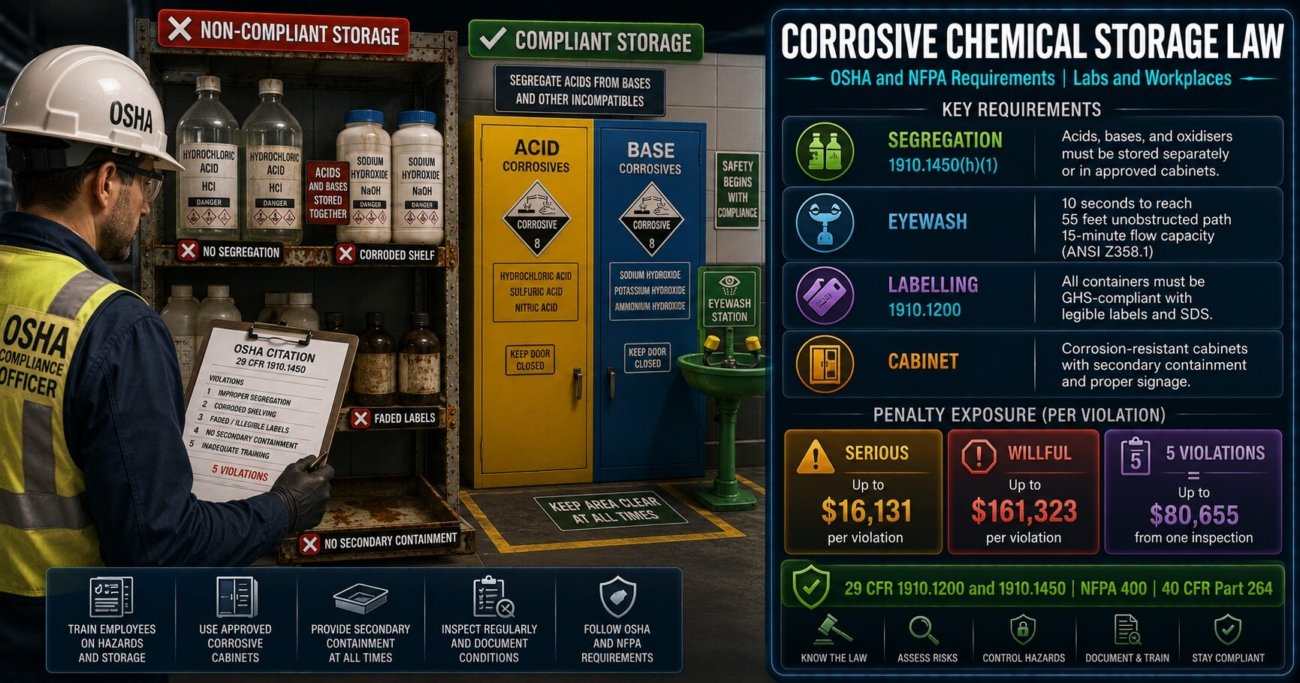
An OSHA compliance officer arrives at a pharmaceutical quality control laboratory following a complaint from a former employee. During the walk-through, she observes the following: twelve bottles of concentrated hydrochloric acid stored on a standard metal shelf adjacent to six containers of 30 percent sodium hydroxide solution. No secondary containment is present. The shelf has visible corrosion at the contact points. Three bottles have faded labels. The laboratory’s Chemical Hygiene Plan lists these chemicals but does not specify storage location, segregation requirements, or quantity limits. The eyewash station is 40 feet from the storage area and behind a closed door.
The inspector issues citations for five separate violations: failure to segregate incompatible corrosives under 29 CFR 1910.1450(h)(1), inadequate container labelling under 29 CFR 1910.1200(f), absence of secondary containment under the Chemical Hygiene Plan requirements, failure to provide an eyewash station within the required reach of the storage area under 29 CFR 1910.151(c), and failure to maintain the Chemical Hygiene Plan with specific storage procedures under 29 CFR 1910.1450(e).
Each citation is a separate enforcement action. The five citations carry a combined penalty assessment that triggers a formal settlement negotiation. This scenario is not unusual. Corrosive chemical storage violations are among the most common citations in laboratory and manufacturing inspections, and most of them follow predictable, preventable patterns.
OSHA inspectors evaluating corrosive chemical storage apply a multi-standard framework: 29 CFR 1910.1200 (Hazard Communication), 29 CFR 1910.1450 (Occupational Exposure to Hazardous Chemicals in Laboratories), 29 CFR 1910.151 (Medical Services and First Aid), and 29 CFR 1910.106 (Flammable Liquids, when corrosives are stored with flammables). For EPA-regulated facilities, 40 CFR Part 264 imposes additional requirements for corrosive hazardous waste. A finding in one standard often leads inspectors to examine the corresponding requirements in adjacent standards. A labelling deficiency frequently reveals a Chemical Hygiene Plan deficiency. A missing eyewash station frequently reveals a storage location deficiency.
The Legal Framework for Corrosive Chemical Storage
Corrosive chemical storage in US workplaces is governed by a framework of overlapping federal standards. Understanding which standards apply to a specific facility requires characterising the facility type, the quantity and type of corrosives present, whether corrosive waste is generated, and whether the facility handles both corrosives and flammable materials.
29 CFR 1910.1200 (Hazard Communication Standard): Applies to all general industry employers. Requires that all corrosive chemical containers bear GHS-compliant labels with the product identifier, signal word (DANGER for strong corrosives), hazard pictograms, hazard statements, precautionary statements, and supplier information. Also requires that Safety Data Sheets be accessible and that employees receive training on corrosive chemical hazards before initial assignment.
29 CFR 1910.1450 (Occupational Exposure to Hazardous Chemicals in Laboratories): Applies specifically to laboratory use of hazardous chemicals, defined as workplaces where laboratory quantities are handled. Requires a written Chemical Hygiene Plan (CHP) that must include specific procedures for handling corrosive chemicals, storage segregation requirements, and PPE requirements. The CHP must be accessible to employees and kept current.
29 CFR 1910.151(c) (Medical Services and First Aid): Requires that suitable facilities for quick drenching or flushing of the eyes and body be provided within the work area for immediate emergency use wherever employees may be exposed to corrosive materials. ANSI Z358.1 specifies that plumbed eyewash stations must be reachable within 10 seconds (typically interpreted as approximately 55 feet) of corrosive exposure.
NFPA 400 (Hazardous Materials Code): Governs storage quantities and cabinet requirements for corrosive materials. Sets maximum allowable quantities (MAQs) per control area, requires secondary containment for liquid corrosives, and specifies storage cabinet construction standards for corrosive liquids.
40 CFR Part 264 (EPA Hazardous Waste Standards): Applies when facilities generate corrosive hazardous waste (pH 2 or below, or 12.5 or above, under 40 CFR 261.22). Requires compatible containers, labelling as hazardous waste, and storage time limits based on generator category.
Facilities often operate under the assumption that either OSHA or NFPA applies to their corrosive storage, not both. In practice, OSHA standards establish the minimum employee safety requirements and NFPA codes establish the minimum fire and hazard protection requirements for the same storage scenario. Both apply simultaneously. A storage arrangement that satisfies OSHA labelling and training requirements but exceeds NFPA maximum allowable quantities is non-compliant. A storage arrangement that meets NFPA quantity limits but lacks GHS labelling is also non-compliant.
The Segregation Requirement: Acids, Bases, and Oxidisers Must Not Share Storage
The most commonly cited corrosive storage violation is co-storage of incompatible materials. The three-way incompatibility among acids, bases, and oxidising acids creates the following mandatory segregation requirements:
- Acids and bases must not be stored together. Contact between concentrated acids and bases produces rapid exothermic neutralisation reactions that can boil the solution, generate steam, and violently eject liquid from open containers. The standard approach is separate locked cabinets or separate designated storage zones with sufficient physical separation to prevent contact in the event of a container failure.
- Oxidising acids must be stored separately from organic acids and from flammable materials. Nitric acid and perchloric acid are both oxidising acids that can react violently with organic materials including acetic acid, formic acid, and organic solvents. Nitric acid must be stored away from flammable and combustible materials, organic acids, and reducing agents.
- Chromic acid and permanganate solutions must be stored separately from all organic materials. Both are powerful oxidisers that can initiate combustion on contact with organic matter, including laboratory cleaning materials, paper, and organic solvents.
Under 29 CFR 1910.1450(h)(1), the Chemical Hygiene Plan must specifically address storage segregation. The plan must not simply state that chemicals should be stored compatibly – it must identify the specific incompatibilities relevant to the chemicals present at the facility and specify the physical storage arrangement that maintains segregation.
Storing chemicals alphabetically is the single most dangerous storage practice in laboratory settings because it systematically places incompatible materials adjacent to each other. Acetic acid (organic acid) stored alphabetically near ammonia (base) is a potential reaction pair. Nitric acid stored near organic solvents beginning with the same letter is a fire and explosion hazard. Chemical Hygiene Plans that specify compatibility-based storage and laboratory staff who understand the incompatibility framework are the required controls. Alphabetical storage does not satisfy the segregation requirement under 29 CFR 1910.1450(h)(1) under any interpretation.
Container and Cabinet Requirements: What the Law Specifies
Container material compatibility with the stored corrosive is a regulatory requirement, not a purchasing preference. The Chemical Hygiene Plan under 29 CFR 1910.1450 must address container selection, and OSHA’s General Duty Clause (Section 5(a)(1)) requires elimination of recognised hazards – which includes storing corrosives in containers that react with the chemical.
Material compatibility requirements by corrosive type:
- Strong mineral acids (hydrochloric, sulfuric, phosphoric): Glass or high-density polyethylene (HDPE). Avoid carbon steel, galvanised metal, and some plastics including PVC for concentrated formulations.
- Hydrofluoric acid: Polyethylene or PTFE (Teflon). Never glass – hydrofluoric acid etches and dissolves glass.
- Strong bases (sodium hydroxide, potassium hydroxide): Polyethylene or polypropylene. Concentrated sodium hydroxide degrades glass containers over time and can cause failures.
- Nitric acid: Glass or stainless steel. Avoid contact with organic materials, aluminium, and many common plastics.
- Oxidising acids (perchloric acid): Glass only for storage. Perchloric acid contaminated with organic material can form explosive perchlorates – container compatibility is critical.
Storage cabinets for corrosive liquids under NFPA 400 must be constructed of corrosion-resistant materials (polyethylene, epoxy-coated steel, or stainless steel), must provide secondary containment at the base sufficient to hold the largest container plus 10 percent of the aggregate volume, and must be clearly identified with corrosive warning signage. Metal shelves in corrosive storage cabinets are non-compliant if the stored materials will react with the shelf material.
Flammable storage cabinets and corrosive storage cabinets are not interchangeable. Flammable cabinets are designed with steel construction and self-closing doors to contain fire – but steel corrodes in acid vapour environments. Corrosive cabinets are designed with corrosion-resistant construction and secondary containment – but do not provide the fire protection of a flammable cabinet. Storing acids or bases in a flammable storage cabinet is non-compliant because the steel construction will corrode, compromising the cabinet’s structural integrity. Storing flammable solvents in a corrosive cabinet is non-compliant because the cabinet does not meet the fire protection design requirements of NFPA 30 or OSHA 1910.106.
Eyewash Station Requirements: The 10-Second Rule
Under 29 CFR 1910.151(c), suitable facilities for quick drenching or flushing of the eyes and body must be provided within the work area for immediate emergency use wherever employees may be exposed to corrosive materials. ANSI Z358.1-2014, the American National Standard for Emergency Eyewash and Shower Equipment, provides the specific implementation requirements referenced by OSHA compliance policy:
- Travel distance: Eyewash stations must be reachable within 10 seconds of the hazard, which ANSI Z358.1 interprets as approximately 55 feet of unobstructed travel. The path must be free of obstructions, must not require opening doors or descending stairs, and must be on the same level as the corrosive exposure point.
- Flow rate and duration: Plumbed eyewash stations must deliver at least 0.4 gallons per minute for a minimum of 15 continuous minutes at a tepid temperature (between 60 and 100 degrees Fahrenheit).
- Activation: The station must be capable of being activated in one second or less and must remain in the open position without requiring the user to hold it open, allowing the user to use both hands to hold the eyelids open during flushing.
- Weekly testing: Plumbed eyewash stations must be activated weekly to flush the supply line and verify proper operation. This testing must be documented.
- Self-contained units: Portable eyewash units are acceptable only as supplementary equipment where plumbed units are not feasible. They must be inspected to verify solution level and expiration date and must be replaced according to the manufacturer’s schedule.
OSHA’s inspection practice treats the distance and travel path requirements as non-negotiable. An eyewash station that is 60 feet away, or that requires passing through a door or descending a step, is non-compliant regardless of how modern or well-maintained the unit is.
Civil Penalty Exposure for Corrosive Storage Violations
OSHA classifies corrosive storage violations by severity. The current OSHA penalty schedule (adjusted annually for inflation) sets the following civil penalty ranges:
- Serious violations: Up to $16,131 per violation. A serious violation exists when there is a substantial probability that death or serious physical harm could result and the employer knew or should have known of the hazard. Most corrosive storage violations – missing segregation, absent eyewash stations, inadequate labelling – are classified as serious.
- Willful violations: $11,524 to $161,323 per violation. A willful violation occurs when the employer was aware of the hazardous condition and made no reasonable effort to eliminate it. Repeated non-compliance following prior citations, or documented knowledge of the requirement combined with failure to implement it, can support a willful classification.
- Repeat violations: Up to $161,323 per violation for violations identical or substantially similar to a prior citation within five years.
The five-citation scenario from the opening of this article – which involved a single walk-through of one laboratory – illustrates how corrosive storage violations multiply. Each standard that is violated generates a separate citation. An employer who stores acids and bases together, in improperly labelled containers, without secondary containment, without a compliant eyewash station, and without a specific Chemical Hygiene Plan procedure is not committing one violation – they are committing five. At the serious violation penalty level, that is potential exposure of up to $80,655 from a single inspection of a single room.
OSHA provides penalty reductions for good faith compliance efforts, small employer size, and demonstrated history of compliance. These reductions can reduce the assessed penalty by up to 95 percent in some cases. However, penalty reduction is not a compliance strategy. Penalty reductions are applied after citation, not in lieu of compliance. An employer who relies on penalty reductions to manage the cost of non-compliance is accepting ongoing worker exposure to corrosive chemical hazards, ongoing enforcement risk, and the reputational consequences of a public citation record.
Knowledge Check
Test your understanding of corrosive chemical storage legal requirements.
No. Acetic acid is an organic acid. Nitric acid is an oxidising acid. These two materials must not be stored together because nitric acid can oxidise acetic acid in the event of a mixed spill or vapour contact, creating a fire and potentially explosive reaction hazard. The segregation requirement under 29 CFR 1910.1450(h)(1) and the General Duty Clause requires that all incompatible chemicals be stored separately. Segregating acid from base is necessary but not sufficient – segregation within the acid category based on oxidising versus non-oxidising character is also required. The Chemical Hygiene Plan must specifically identify this incompatibility and specify separate storage.
It depends. Portable self-contained eyewash units are acceptable under ANSI Z358.1 as supplementary emergency eyewash equipment where plumbed units are not feasible. However, they must still meet the performance requirements: 0.4 gallons per minute flow rate, 15-minute minimum capacity, tepid water temperature, and one-second or less activation. They must be inspected regularly to verify solution level and must be replaced before the solution expiration date. If the portable units meet these requirements and are positioned within 10 seconds of corrosive exposure points, they satisfy the requirement. Self-contained units that contain less than 15 minutes of solution, or that have expired solution, or that are not within the required travel distance, do not satisfy the requirement regardless of their location.
Potentially not, for multiple reasons. First, a facility generating 200 kg per month of corrosive hazardous waste over a calendar month likely qualifies as a Large Quantity Generator (LQG) under 40 CFR 262, which imposes specific storage requirements including a 90-day storage limit, a hazardous waste management plan, and EPA notification. Second, original product containers used for waste storage must be compatible with the waste being stored, which original HCl containers may be if they are HDPE or glass, but the containers must also be labeled as Hazardous Waste with accumulation start date and waste description under 40 CFR 262.17(a)(5). Third, the containers must be kept closed except when adding waste. The practice of storing waste in original product containers is acceptable only if the containers are compatible, properly labelled as hazardous waste, and managed in compliance with the applicable generator category requirements.
Corrosive Chemical Storage Compliance Checklist
✓ All corrosive containers bear GHS-compliant labels with signal word, hazard pictograms, hazard statements, and precautionary statements (29 CFR 1910.1200)
✓ Acids and bases are stored in physically separate areas or cabinets with no possibility of contact in the event of container failure
✓ Oxidising acids (nitric, perchloric, chromic) are stored separately from organic acids, flammables, and reducing agents
✓ Container materials are compatible with the corrosive chemical stored (no steel for acids, no glass for HF, no carbon steel for NaOH)
✓ Corrosive storage cabinets are constructed of corrosion-resistant material with secondary containment at the base
✓ The Chemical Hygiene Plan specifically identifies segregation requirements and storage locations for corrosives present at the facility
✓ An eyewash station is reachable within 10 seconds (approximately 55 feet unobstructed) of every corrosive storage and use area
✓ Eyewash stations are activated weekly and the test is documented
✓ Spill containment materials compatible with the specific corrosive are available in the storage area
✓ Corrosive hazardous waste is labelled, tracked, and stored within the applicable generator category time limit
Sources
- 29 CFR 1910.1200: Hazard Communication Standard (GHS labelling, SDS, and training requirements)
- 29 CFR 1910.1450: Occupational Exposure to Hazardous Chemicals in Laboratories (Chemical Hygiene Plan, segregation)
- 29 CFR 1910.151(c): Medical Services and First Aid (eyewash station requirement)
- NFPA 400: Hazardous Materials Code (storage cabinets, MAQs, secondary containment)
- 40 CFR Part 264: EPA Standards for Owners and Operators of Hazardous Waste Treatment, Storage, and Disposal Facilities