


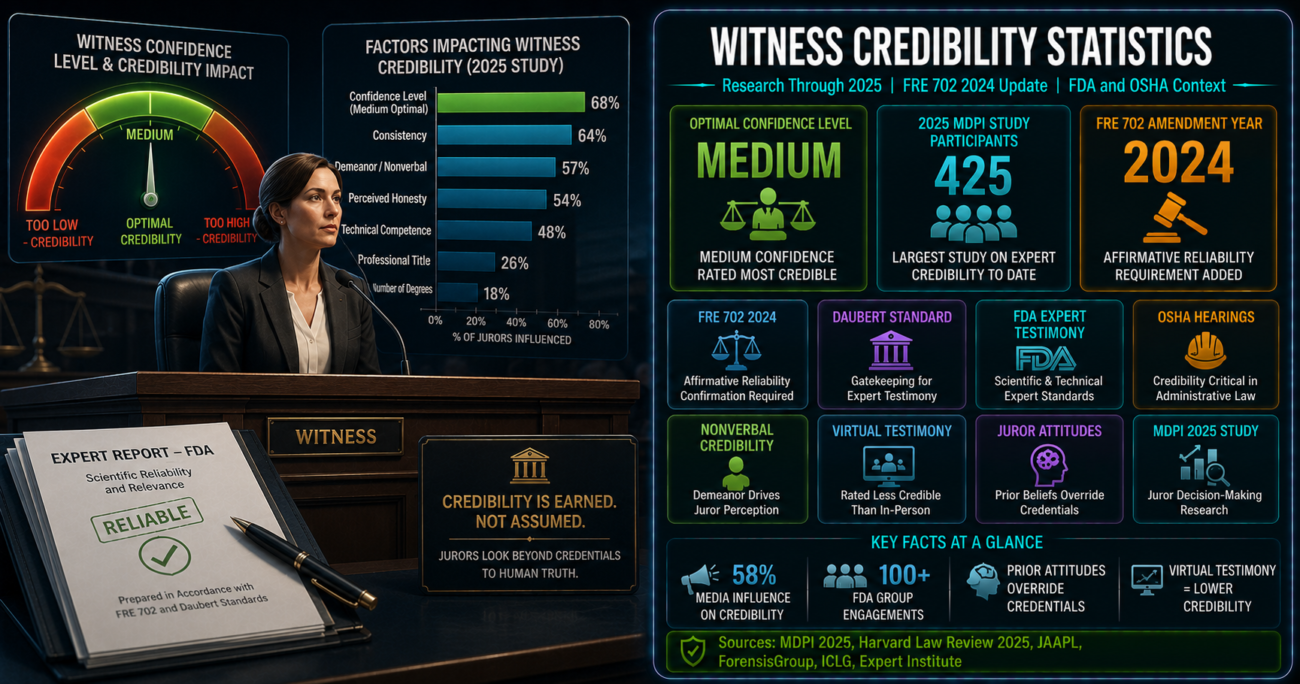
Expert witnesses in regulatory hearings – before the FDA, OSHA, and the courts that review their decisions – carry weight that extends well beyond the technical content of their testimony. Research consistently shows that jurors and judges evaluate witnesses through multiple lenses simultaneously: the confidence with which testimony is delivered, consistency with documentary evidence, nonverbal behavior, and the setting in which testimony is given. Each of these dimensions is measurable and, increasingly, documentable in peer-reviewed literature.
The legal framework governing expert testimony also shifted materially in 2024. The amended Federal Rule of Evidence 702 requires trial judges to affirmatively confirm – rather than presume – that expert opinions are based on sufficient facts and applied reliably. This change has practical implications for expert preparation in regulatory matters, where FDA and OSHA interpretations may be contested and challenged by opposing experts. Below we compile what the current research and regulatory practice tell us about witness credibility, conduct, and outcome in regulatory proceedings.
Editor's Choice: Key Witness Credibility Findings for 2024-25
1. The Confidence Calibration Research: Why Medium Beats High
- A landmark study published in the Journal of the American Academy of Psychiatry and the Law found that moderate levels of manipulated confidence yielded the highest credibility ratings from jurors. Both overly confident and hesitant witnesses were rated as less trustworthy than those presenting at a balanced, measured level. (JAAPL, 2009 – foundational study still cited in Expert Institute 2024 analysis)
- The Expert Institute’s 2024 review of this evidence notes that “medium confidence levels resulted in slightly higher credibility rankings than high confidence levels, although both groups scored better than witnesses who appeared to have low confidence.” The practical implication is that witness preparation should aim for grounded authority, not assertive certainty. (Expert Institute, September 2024)
- When selecting expert witnesses, counsel should research litigation history carefully. Highly experienced experts may be labeled as “hired guns”, which damages credibility even when their technical qualifications are unimpeachable. Prior cross-examination history is a predictor of how effectively a witness will perform under pressure. (Expert Institute, 2024)
- Verbal and nonverbal markers of optimal confidence include: a moderated, stable tone of voice; clarity in speech; moderately paced delivery; willingness to acknowledge uncertainty; smooth narrative statements; good posture; consistent eye contact; and accurate hearing and response. These are trainable behaviors that trial consultants address in witness preparation. (JAAPL, Expert Witness Confidence study)
- An unexpected 2025 finding complicates the confidence picture: a study published in the British Journal of Psychology (July 2025) found that witnesses who stammer were rated as less confident but more likeable and trustworthy than non-stammering witnesses by mock jurors. This suggests that perceived effortfulness and authenticity can increase trustworthiness even when delivery fluency is reduced. (NCBI / British Journal of Psychology, July 2025)
2. When Juror Attitudes Override Expert Credentials: 2025 Research
- A 2025 study published in MDPI Behavioral Sciences (N=425) found that prior juror attitudes toward the legal defense at issue predicted verdict outcomes regardless of expert witness credentials or testimony content. Jurors with positive prior attitudes toward the insanity defense were significantly more likely to endorse NGRI verdicts even when expert testimony was weak. (Cain and Smith, MDPI, October 2025)
- The study confirmed that expert witness education and experience have an influence on credibility perception, and for the first time demonstrated that training and experience can separately and comparably impact juror perception – meaning either factor alone can drive credibility even without the other. (Ferreria and Wingrove, 2024, cited in MDPI 2025)
- In complex regulatory hearings – where agency rulemaking, inspection findings, or GMP violations are contested – this research has a direct parallel: decision-makers often arrive with existing mental models of what regulatory compliance looks like. Expert testimony that acknowledges this and addresses it explicitly is more likely to shift perception than testimony that simply presents technical evidence. (regulatory litigation practice; ForensisGroup, 2025)
- A 2025 study on inattentional blindness (Taylor and Francis, published May 2025) found that witnesses who failed to notice a crime due to divided attention were rated as less credible even when expert testimony explained the psychological phenomenon. This suggests that certain credibility deficits are difficult to remediate through expert explanation alone. (Tandfonline, May 2025)
3. Nonverbal Behavior and Virtual Testimony: What Reduces Credibility
- Research consistently finds that video testimony is rated less credible than in-person appearances. Mock jurors find in-person witnesses more eloquent, pleasant, and believable, and judges have reported that live observation changed their views on credibility in ways that video did not allow. (existing witness credibility research)
- For FDA and OSHA regulatory proceedings, which have increasingly used remote or hybrid formats, the practical implication is that expert witnesses appearing by video link should invest additional preparation time in camera placement, lighting, audio quality, and background presentation – each of which affects perceived professionalism and trust. (regulatory practice; witness preparation standards)
- Genuine smiling, upright posture, and clear vocal tone add to the sense that a witness is telling the truth, while fake smiles, fidgeting, or flat tone reduce that impression. Research shows these subtle signals often determine whether a witness is perceived as genuine or deceptive, even when the factual content is identical. (JAAPL credibility studies)
- The three primary drivers of expert witness perceived credibility are consistently identified as: knowledge, trustworthiness, and likability. A study found that likeability was significantly related to jurors’ perception of trustworthiness but not directly to knowledge or to sentencing decisions – meaning a highly likeable but technically thin expert can appear trustworthy without being persuasive on the merits. (JAAPL, Credibility in the Courtroom, 2009)
- An important cross-gender finding: the likeability study of 210 mock jurors also examined the effects of juror gender on expert witness perception, finding that juror extroversion positively predicted credibility ratings across both genders, suggesting that advocate-style witnesses may be rated more highly by extroverted jurors regardless of content. (JAAPL, 2009)
4. Federal Rule of Evidence 702 Amended in 2024: What Changed for Regulatory Expert Testimony
- The Daubert standard, established in Daubert v. Merrell Dow Pharmaceuticals (1993), places the responsibility on trial judges to act as “gatekeepers” of scientific evidence, evaluating methodology and reasoning rather than simply accepting credentials or reputation. It was extended to non-scientific expert testimony in Kumho Tire Co. v. Carmichael (1999). (LII Cornell Law; ForensisGroup, 2025)
- The 2024 amendment to Federal Rule of Evidence 702 tightened the admissibility standard by requiring courts to affirmatively confirm that an expert’s opinion is “more likely than not” based on sufficient facts and methods reliably applied – shifting from presumption of reliability to confirmed reliability. (Harvard Law Review, February 2025)
- The practical consequence in regulatory litigation: unsupported conclusions – where an expert states a result without clearly explaining the reasoning path – are now a primary ground for exclusion under the post-2024 FRE 702 framework. An analytical gap between the data relied on and the conclusion offered is also an exclusion risk under the Joiner decision (522 U.S. 136). (ForensisGroup, 2025; Harvard Law Review, 2025)
- For FDA and OSHA-related expert testimony specifically, this means experts must be prepared to explain not only what the applicable regulation requires, but how the facts of the case map onto that requirement. Regulatory expertise without case-specific application is increasingly at risk of exclusion under the amended standard. (ForensisGroup, 2025; ICLG Drug and Medical Device Litigation Report, 2025)
- In regulatory agency proceedings (as distinct from federal court), agencies like the FDA and OSHA have administrative discretion to accept or reject expert input, but courts have overturned agency decisions for improperly ignoring credible expert testimony. The leading cases include Universal Camera Corp. v. NLRB (340 U.S. 474, 1951) and Motor Vehicle Manufacturers Ass’n v. State Farm (463 U.S. 29, 1983). (ForensisGroup, 2025)
5. Expert Testimony in FDA and OSHA Regulatory Proceedings: What Distinguishes Effective Witnesses
- ProPharma’s FDA expert witness team – described as the largest team of former FDA professionals in any consulting firm, including former reviewers, inspectors, compliance officers, and division directors – emphasizes that FDA regulatory litigation often turns on understanding what FDA would have expected, not just what the written standard requires. Credibility in this context is inseparable from demonstrated insider understanding. (ProPharma Group, 2025)
- FDA drug and medical device litigation routinely involves multi-expert panels: regulatory affairs experts, engineers, pharmacists, chemists, epidemiologists, and physicians reviewing the same manufacturing records, adverse event reports, and compliance data from different professional perspectives. Each expert’s credibility affects the overall case narrative. (ICLG Drug and Medical Device Litigation Report, April 2025)
- Epidemiologists are specifically retained in FDA product liability cases to evaluate MAUDE adverse event database records, FAERS data, and clinical literature – assessing whether reported events, taken collectively, suggest a product defect or alternative causation. The quality of their testimony depends heavily on their ability to explain relative risk and statistical significance to non-specialist triers of fact. (ICLG, April 2025)
- OSHA safety expert witnesses in workplace injury and fatality litigation must be able to interpret cited violations, inspection findings, hazard assessments, and industry practice standards in terms that demonstrate both technical knowledge and practical relevance to the specific incident. (LegacyMark Safety, April 2026)
- In FDA regulatory proceedings, OPDP (Office of Prescription Drug Promotion) enforcement and off-label promotion cases often involve expert witnesses addressing both the scientific validity of promotional claims and the regulatory standards for fair balance and substantiation – a dual-expertise requirement that narrows the available witness pool and raises the stakes for credibility. (ProPharma Group expert witness services, 2025)
6. Consistency, Media Influence, and External Credibility Threats
- Regulatory tribunals and courts rely heavily on how well a witness’s testimony aligns with external evidence – records, documents, inspection reports, and other witnesses. Witnesses who seem overly polished or whose accounts are identical-sounding across multiple persons raise rehearsal suspicions that undermine the perceived spontaneity of their testimony. Consistency must be natural and document-supported. (witness credibility research; litigation practice)
- Inconsistency with documentary evidence is the most damaging credibility failure in regulatory proceedings. When a witness’s account contradicts written records, batch documents, inspection logs, or prior statements, cross-examiners will exploit the gap systematically. In FDA proceedings especially, where documentation trails are extensive, inconsistency is rarely recoverable once exposed. (regulatory litigation practice)
- 58% of respondents in survey research agreed that media reporting directly affects the perceived reliability of witness testimony. In high-profile regulatory cases – product liability matters, mass tort litigation, or FDA enforcement actions – pre-trial media coverage can establish a credibility narrative before a witness takes the stand. (survey data)
- Research on memory reliability has found that when jurors believe witness memory is unreliable, they are less likely to convict or rule favorably based solely on witness statements, even expert ones. This creates a credibility gap particularly in cases that rely on recollection of events that occurred years before the proceeding – a common pattern in occupational disease and long-latency toxic exposure litigation. (witness credibility research)
- The 2022 Johnny Depp-Amber Heard trial provided a documented case study of expert psychiatric testimony effects at scale: a 2025 study (British Journal of Psychiatry) found that viewing cross-examination clips affected viewers’ attitudes toward the mental health of both parties, demonstrating that expert witness performance in high-profile cases can shape broader public attitudes toward credibility issues beyond the immediate proceeding. (British Journal of Psychiatry Bulletin, February 2025)
Key Takeaways for Legal Teams and Regulatory Affairs Professionals
Sources
Research Studies (Peer-Reviewed)
- Cain and Smith, MDPI Behavioral Sciences (October 2025) – The Impact of Expert Witness Knowledge on Perceived Credibility: 425 participants, prior juror attitudes overriding expert credentials, NGRI endorsement study
- Taylor and Francis (May 2025) – Expert testimony and demonstrations in inattentional blindness cases: witness credibility perception when attention failures are involved
- NCBI / British Journal of Psychology (July 2025) – Eyewitness testimony by individuals who stammer: less confident but more likeable and trustworthy in mock juror ratings
- British Journal of Psychiatry Bulletin (February 2025) – Trial by YouTube: effects of expert psychiatric witness testimony on viewers’ opinions (Depp-Heard case study, N=38)
- Journal of the American Academy of Psychiatry and the Law – Expert Witness Confidence and Juror Personality: moderate confidence yields highest credibility ratings; juror extroversion positively predicts credibility
- Journal of the American Academy of Psychiatry and the Law – Credibility in the Courtroom: How Likeable Should an Expert Witness Be? Likeability and trustworthiness relationship; 210 mock jurors
Legal and Regulatory Sources
- Harvard Law Review (February 2025) – Federal Rule of Evidence 702: 2024 amendment requiring affirmative judicial confirmation of expert reliability, shift from presumption to confirmation
- ForensisGroup (2025) – Can Agencies Reject Expert Testimony? Universal Camera Corp. v. NLRB, Motor Vehicle Mfrs. v. State Farm, APA Section 706 and judicial review of agency expert dismissal
- ForensisGroup (2026) – Daubert Standard Guide: unsupported conclusions, analytical gaps, FRE 702 admissibility framework post-2024 amendment
- ICLG (April 2025) – Expert Witness Practice in U.S. Drug and Medical Device Litigation: multi-expert panels, MAUDE/FAERS database analysis, epidemiologist roles
- Expert Institute (September 2024) – Expert Witness Credibility: What Factors Influence Perception? Confidence calibration, hired gun risk, litigation history
- ProPharma Group – FDA Expert Witness Services: former FDA officials, 100+ engagements, drug, biologics, device and GxP litigation support
- LegacyMark Safety (April 2026) – OSHA Expert Witness Role in Safety Litigation: regulatory standard interpretation, workplace injury and fatality cases
