

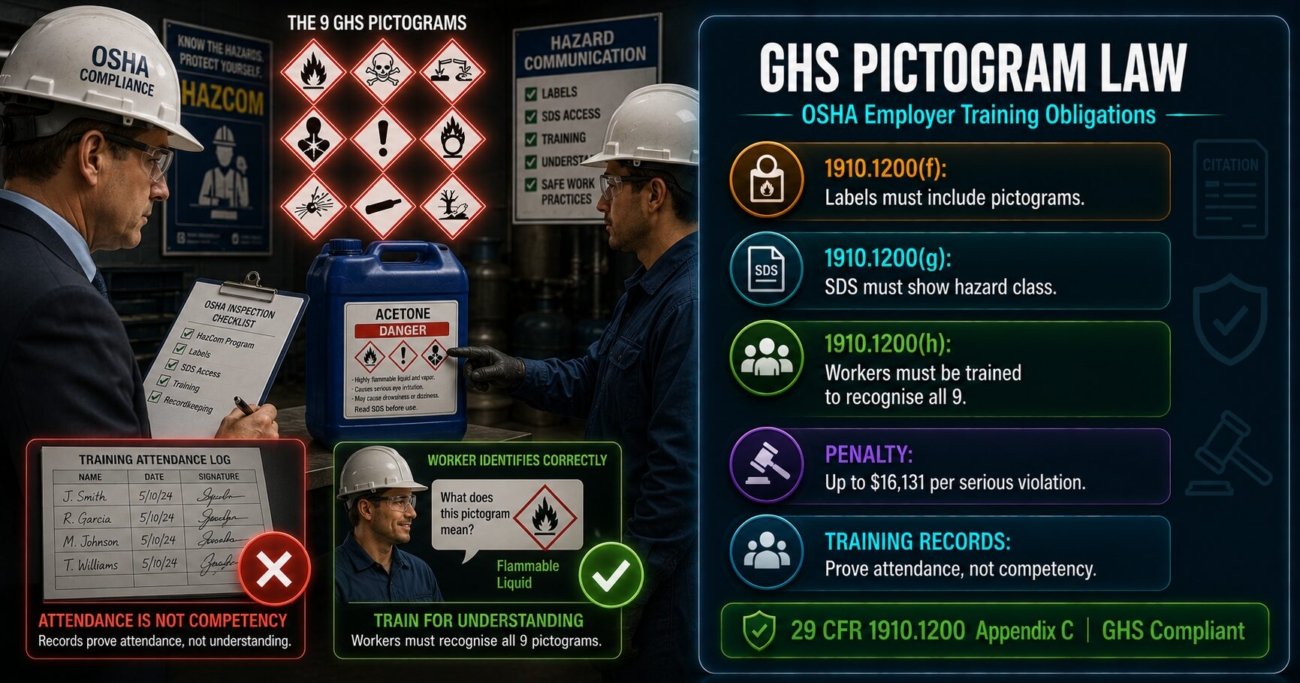
An OSHA compliance officer arrives at a chemical blending facility for a scheduled inspection. During the walk-through, she asks five workers to identify the pictogram on a container of isopropyl alcohol. None of the five can correctly identify the flame pictogram or explain what it means. Two have never heard the word pictogram.
The employer has a signed training log showing that all five workers completed HazCom training eighteen months ago. The inspector does not accept the log as evidence of compliant training. She cites the employer under 29 CFR 1910.1200(h) for failing to ensure that workers were trained to recognise the hazards communicated by chemical labels, including pictograms.
Under OSHA’s Hazard Communication Standard, pictogram training is not optional and it is not satisfied by a signature on a training record. It requires demonstrable worker competency. This guide explains the legal obligations around GHS pictograms: what employers must do, what workers must be able to demonstrate, and where compliance most commonly fails.
The Legal Basis for GHS Pictogram Requirements
GHS pictograms entered US federal law through OSHA’s 2012 revision of the Hazard Communication Standard (29 CFR 1910.1200), which aligned the HCS with the United Nations Globally Harmonised System of Classification and Labelling of Chemicals. The GHS alignment became mandatory for chemical manufacturers and importers on June 1, 2015, and for employers maintaining workplace labels and SDS documents on the same date.
Three sections of 29 CFR 1910.1200 create the employer’s pictogram obligations:
1910.1200(f) governs labels. It requires that containers of hazardous chemicals bear labels containing pictograms as defined in Appendix C of the standard. Employers must ensure that labels on containers in their workplace comply with this requirement and are not removed or defaced.
1910.1200(g) governs Safety Data Sheets. Pictogram information appears in Section 2 of every compliant SDS (Hazard Identification). Employers must maintain SDS documents for every hazardous chemical and ensure they are accessible to workers.
1910.1200(h) governs training. Employers must train employees on the methods and observations used to detect the presence or release of hazardous chemicals, the physical, health, and other hazards of chemicals in the work area, and specifically the information contained in the labelling system used. Training on pictograms is explicitly required as part of label comprehension training.
When an OSHA inspector evaluates HazCom training compliance, the question is not whether training occurred but whether it was effective. An inspector who asks workers to identify pictograms and finds that workers cannot do so has documented a failure of training effectiveness regardless of what the training log shows. The employer’s burden is to demonstrate that workers have the knowledge and skills required by the standard, not merely that a training event was scheduled and attended.
The Nine GHS Pictograms: What the Law Requires Employers to Communicate
Appendix C of 29 CFR 1910.1200 defines the nine GHS pictograms that must appear on labels for chemicals falling within the corresponding hazard classifications. The law does not require that all nine appear on every label; only the pictograms relevant to the classified hazards of a specific chemical are required. However, employers must train workers to recognise and understand all nine pictograms because workers may encounter any of them in their workplace.
The environment pictogram is the only GHS pictogram that OSHA’s HCS does not require on labels for workplace use, though it remains on SDS documents. However, employers whose workers handle chemicals with aquatic toxicity must still train workers on proper spill containment and disposal to prevent environmental releases, which may trigger separate EPA regulatory obligations.
What Legally Compliant Pictogram Training Must Include
Minimum Content Requirements
29 CFR 1910.1200(h)(3)(ii) requires that training include the details of the hazard communication programme developed by the employer, including an explanation of the labels received on shipped containers and the workplace labelling system used by the employer, and an explanation of the Safety Data Sheet, including the order of information and how employees can obtain and use the appropriate hazard information.
For pictograms specifically, compliant training must at minimum enable workers to:
- Identify each of the nine GHS pictograms by visual recognition
- State the hazard category or categories each pictogram represents
- Connect each pictogram to the appropriate protective response (PPE, storage, emergency action)
- Distinguish between DANGER and WARNING signal words and understand their relative severity
- Read a label in sequence: signal word, pictograms, hazard statements, precautionary statements
Training that covers only that pictograms exist, or that shows workers images of pictograms without testing comprehension, does not satisfy the outcome-based standard OSHA applies.
Training Timing Requirements
Under 29 CFR 1910.1200(h)(1), training must be provided at the time of initial assignment to a work area where hazardous chemicals are present, and whenever a new physical or health hazard not previously addressed by training is introduced to the work area. This means:
- A new employee must receive pictogram training before beginning work with or near hazardous chemicals, not after.
- When a new chemical with a hazard classification not previously encountered is introduced, affected workers must be retrained on the new hazard type before using the chemical.
- Annual refresher training is not specifically required by the HCS, but employers who rely on initial training without reinforcement over years risk the kind of competency decay the opening inspection scenario illustrates.
Signed training logs prove attendance, not competency. OSHA’s standard requires that employees be able to demonstrate the knowledge and skills the training is designed to convey. An employer who relies solely on sign-in sheets as evidence of compliant training has not documented training effectiveness, only training attendance. Best practice is to include a brief competency assessment as part of HazCom training, document the results, and retain those records alongside attendance records.
Penalty Exposure for Pictogram Compliance Failures
OSHA citations for HazCom violations, including pictogram labelling and training failures, are typically issued as serious violations, which carry a maximum penalty of $16,131 per violation under OSHA’s current penalty schedule (adjusted for inflation as of 2025).
For wilful or repeat violations, penalties can reach $161,323 per violation. A wilful violation is one where the employer knowingly disregarded the standard or was plainly indifferent to worker safety. An employer who received a previous citation for HazCom training deficiencies and failed to correct them would face repeat violation classification on a subsequent inspection.
In multi-worker or multi-chemical situations, OSHA may issue separate citations for each affected worker or each chemical for which training is deficient. An employer with 20 workers who cannot identify GHS pictograms for 15 chemicals each faces potential penalty exposure across all of those instances, not a single citation for a general training failure.
Employers who complete HazCom training during onboarding and never revisit it create a compounding compliance risk over time. Workers forget. Chemical inventories change. New employees arrive with no training. The HCS requires training whenever new hazards are introduced, but effective programmes go beyond that minimum. Periodic refreshers, toolbox talks on specific chemicals, and point-of-use label reading reinforcement all reduce the gap between what workers knew at the time of initial training and what they can demonstrate during an inspection.
Knowledge Check
Test your understanding of GHS pictogram legal requirements.
No. The employer has documented that training was provided but has not demonstrated that the training was effective. 29 CFR 1910.1200(h) requires that employees be trained to a level of understanding sufficient to protect themselves in the workplace. Workers who cannot identify pictograms three months after training have not retained the required knowledge. The employer should have included a competency assessment as part of the training, documented results, and implemented a reinforcement programme. The training event satisfied the timing requirement but not the effectiveness requirement.
Yes, if the health hazard pictogram and respiratory sensitiser classification represent a new hazard type not previously covered. 29 CFR 1910.1200(h)(1) requires training whenever a new physical or health hazard not previously addressed is introduced. If workers have not previously been trained on the health hazard pictogram and its meaning in the context of respiratory sensitisation, the introduction of this chemical triggers a retraining obligation for affected workers before the chemical is used. The retraining does not need to repeat all previously covered content; it must specifically address the new hazard type.
Yes. Under OSHA’s multi-employer worksite policy and the construction HazCom standard at 29 CFR 1926.59, the general contractor has responsibility for ensuring that site-specific hazard information, including the chemicals being used on the project and their labels, is communicated to all workers. The subcontractor’s general HazCom training satisfies the subcontractor’s training obligation for their employees. However, the GC must ensure that workers are informed of any site-specific chemical hazards they may encounter from other trades’ chemical use, including any pictograms on chemicals present in shared work areas. The GC’s obligation is site-specific, not covered by the subcontractor’s generic training.
At minimum, workers should be able to:
Visually identify each of the nine GHS pictograms from the standard red-diamond format. State what hazard category each pictogram represents. Identify which pictogram would appear on a container of a named chemical type (for example, a flammable solvent or a corrosive acid). Describe the immediate protective response associated with the hazard indicated by each pictogram. Explain the difference in severity between DANGER and WARNING signal words and identify examples of chemicals associated with each level. The assessment does not need to be lengthy. A brief 10-question pictogram identification and response exercise, scored and retained in training records, provides evidence of competency that a sign-in sheet alone cannot.
GHS Pictogram Compliance Checklist
✓ All containers of hazardous chemicals have compliant GHS labels including required pictograms
✓ Pictograms on labels are legible, not covered, and not defaced
✓ SDS documents for all chemicals are current and include GHS hazard identification in Section 2
✓ All workers are trained on pictogram identification and meaning before initial assignment
✓ Retraining is provided when new chemical hazard types not previously covered are introduced
✓ Training includes a competency assessment, not just attendance documentation
✓ Training is provided in a language workers can understand
✓ Workers can demonstrate recognition of all nine GHS pictograms and their associated responses
✓ Training records include evidence of competency, not only attendance signatures
✓ Penalty exposure from HazCom violations is understood by safety personnel and management