

It is 6:45 in the morning. A new maintenance technician arrives for his second week on the job. His supervisor asks him to top up the coolant in a piece of CNC equipment before the production shift starts.
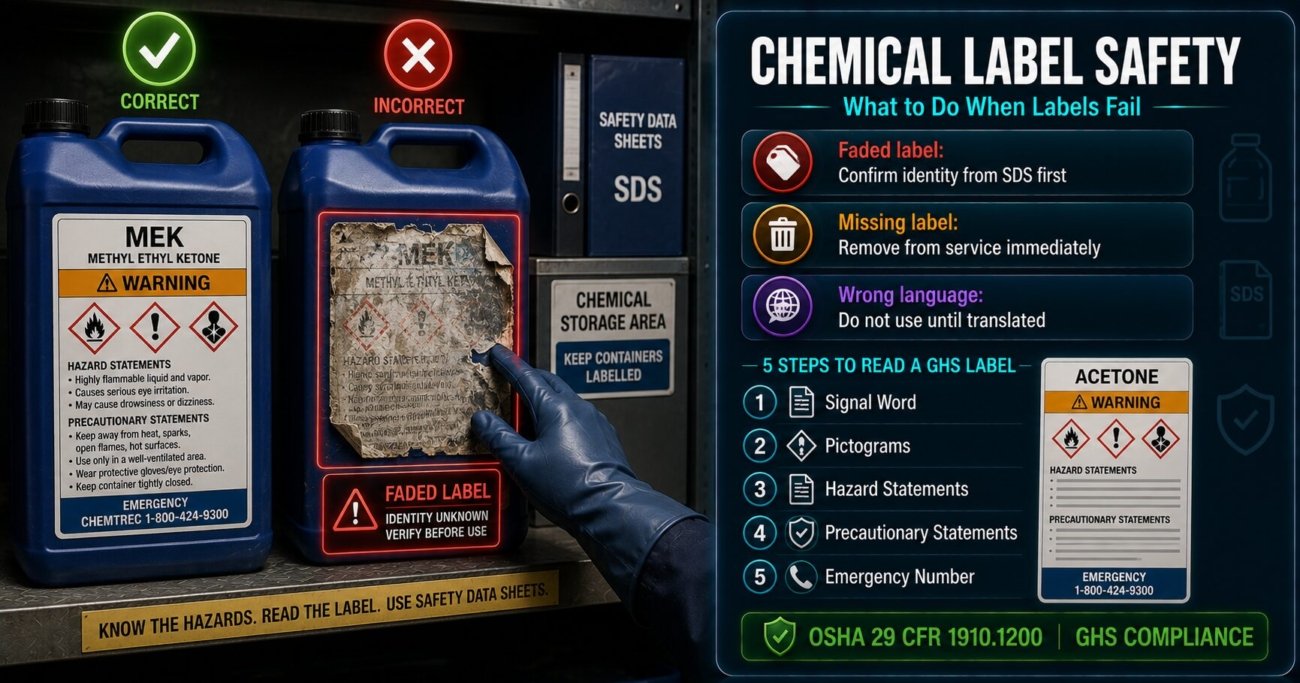
He goes to the chemical storage room and sees two containers side by side. Both are blue. Both are roughly the same size. One has a clear, legible GHS label. The other has a faded, partially peeled label he cannot fully read. He picks up the second one because it is slightly closer.
He pours the chemical into the coolant reservoir. It begins to foam immediately. He does not know why. He does not know what he has poured in because the label was unreadable.
This scenario illustrates the foundational importance of GHS chemical labels. The label is the first and often only line of information between a chemical and the person using it. This guide works through how to read labels correctly and what to do when labels are missing, damaged, or confusing.
Location: Industrial maintenance chemical storage room.
Task: Adding coolant additive to CNC machine reservoir.
Hazard: Two similar containers; one with legible GHS label, one with faded, unreadable label.
What went wrong: The technician chose the unreadable container, used an unknown chemical, and had no information for responding when the chemical reacted unexpectedly.
Think about the chemical storage areas in your workplace right now. Are there any containers with faded, damaged, or missing labels? What is the procedure when you find one? If you do not know the answer to that second question, this guide is for you.
Decision Point 1: Two Containers, One Unreadable Label
The technician stands in front of two blue containers. He cannot read the label on one of them.
Response A: Use the container with the readable label since it is clearly identified.
Response B: Use the container that is closer because the task is routine.
Response C: Do not use either container until the unreadable label is replaced, and report it to the supervisor before starting the task.
Response D: Ask a colleague if they know what is in the unlabelled container and use it if they confirm it.
Response A is correct for the immediate task. Use only the container with the readable, compliant label. Do not use a container whose contents cannot be confirmed from the label.
Response C is correct for the compliance obligation. A container with an unreadable or missing label must be relabelled or removed from service before anyone uses it. Report it before starting the task, not after.
Response B is the most common real-world error. Proximity and habit override label verification. This is how wrong chemicals get used and how reactions, equipment damage, and exposures occur.
Response D fails because a colleague’s verbal identification is not a label. Even if correct, their knowledge is not transferable to the next person who picks up that container.
How to Read a GHS Label in an Unfamiliar Situation
The GHS label communicates in a specific sequence. Reading it correctly takes under 30 seconds for a familiar product and under two minutes for an unfamiliar one.
DANGER or WARNING. DANGER means the hazard is severe. WARNING means less severe. This single word gives you an immediate calibration of how carefully you need to read the rest of the label.
How many red diamond pictograms are on the label? A flame means flammable. A skull means acutely toxic. An exclamation mark means irritant or mild hazard. A person with a starburst means serious health hazard such as carcinogen or respiratory sensitiser.
These begin with H-codes (H225, H301, etc.). H225 indicates the product is a highly flammable liquid and vapour. H301 indicates the product is toxic if swallowed. Read every hazard statement before touching the container.
These begin with P-codes. P260 indicates you must not breathe the vapours. P280 indicates you must wear protective gloves and eye protection. These are action instructions, not suggestions.
In Section 1 of the SDS and sometimes on the label itself, there is an emergency contact number. Before using an unfamiliar chemical, know where this number is. If you have an exposure or spill and the SDS is not immediately accessible, this number connects you to technical assistance.
Decision Point 2: The Faded Label - Three Scenarios
Faded, damaged, and missing labels are common in industrial environments. Each situation requires a specific response.
Response: Locate the SDS for the identified product before using it. If the product name is readable but the hazard statements are not, the label does not satisfy the regulatory requirement. Report the faded label for replacement. You may use the product only after confirming the hazards from the SDS, and the label must be replaced before the container returns to general storage.
Response: Remove the container from service immediately. Tag it as unidentified and do not use it. Do not attempt to identify the contents by smell, colour, or consistency. Report it to your supervisor and the safety officer. The container must be positively identified and relabelled, or disposed of as an unknown hazardous chemical through your site’s hazardous waste programme.
Response: Do not use the chemical until you have access to hazard information in a language you can understand. Employers are required under OSHA 29 CFR 1910.1200 to provide chemical hazard information in a manner workers can understand. A label in a language the worker does not read is effectively no label for that worker. Request the SDS in your language or a bilingual colleague to translate the key hazard and precautionary information before proceeding.
What the Investigation Found
Why Was the Faded Label Still in Service?
The container with the faded label had been in the storage room for approximately four months. Several workers had noticed the label was difficult to read but had not reported it because there was no clear procedure and no one wanted to hold up production.
The chemical in the faded container was a degreaser concentrate, not a coolant additive. The foaming was the degreaser reacting with oil-based residue in the coolant reservoir. The equipment required a full flush and coolant system replacement: approximately four hours of production downtime.
What Would Have Prevented It?
A label inspection procedure. A monthly check of all chemical storage areas specifically for label condition would have identified the faded label months before this incident.
A clear procedure for faded or missing labels. Workers need to know what to do: remove from service, tag it, report it. Without a clear procedure, workers default to continuing to use familiar containers.
Separation of similar-looking containers. Two products used on the same equipment but with different applications should not be stored side by side in similar containers.
Lessons Learned
For Workers
A label you cannot fully read is a label that does not exist for you. Do not use any chemical without confirming its identity and hazards from a source you can actually read. Report every damaged, faded, or missing label in writing before the end of your shift.
For Supervisors
Build label inspection into your regular housekeeping or safety inspection cycles. A 10-minute label audit of chemical storage areas once a month catches faded and missing labels before they cause incidents. Also review how similar products are stored and separate them where confusion is possible.
Knowledge Check
Test your understanding of chemical label requirements and correct responses.
No. Colour and smell are not reliable chemical identification methods and do not satisfy any regulatory requirement. Many chemicals are colourless or similar in colour to other products. Odour thresholds for many hazardous chemicals are above their exposure limits, meaning you may smell nothing even at dangerous concentrations. The container must be positively identified through its label or SDS, not through sensory characteristics. Remove it from service and report it.
No. P260 requires the worker to avoid inhalation exposure. Spraying in a small enclosed room with the door closed creates high vapour or aerosol concentrations. To comply with P260, the worker must use the product in a well-ventilated area, use engineering controls such as local exhaust ventilation, or wear respiratory protection as specified in SDS Section 8. The precautionary statement is an instruction, not a suggestion.
Document and report it through the appropriate channel. If the worker has raised the concern verbally and been told to proceed, the next step is to put the concern in writing to a safety officer or HR. If no internal process resolves the issue, the worker may file a complaint with OSHA. Workers are legally protected from retaliation for raising safety concerns. A faded label that cannot be read does not satisfy OSHA’s labelling requirements regardless of how long the container has been in use.
Back to the Storage Room
The technician who chose the container with the faded label was not careless. He was new, under time pressure, and had no procedure to follow when he found a label he could not read. Those are system failures.
But the individual decision, choosing the unreadable container over the readable one, was the point at which the outcome was determined. The same decision point exists in every chemical storage room, on every shift. The readable label and the unreadable one may look identical from a distance. The difference between them is the difference between knowing what you are handling and not knowing.