

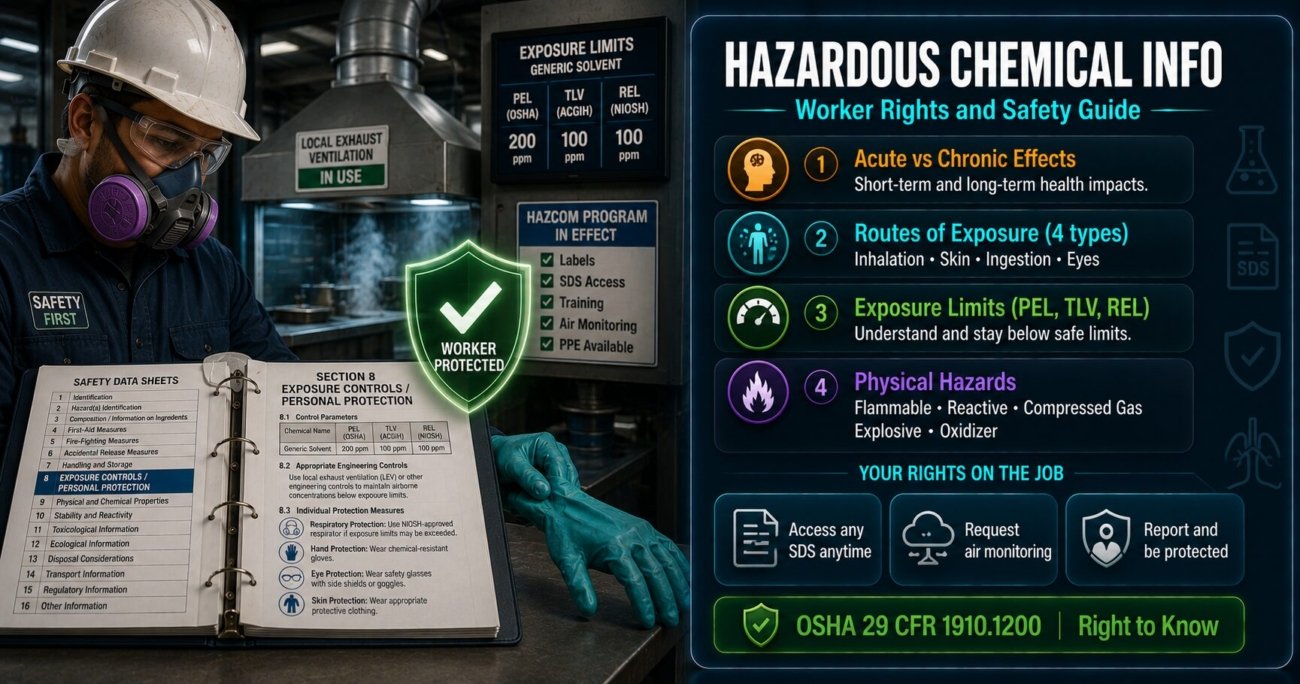
A production operator has worked with the same solvent for three years. He has never read the Safety Data Sheet. He does not know that the chemical is a reproductive toxin with a permissible exposure limit of 50 parts per million. The ventilation in his work area has not been working properly for the past six weeks. He has not reported it because he did not know it mattered.
The hazardous chemical information system that exists to protect him has failed at every point. The SDS was never made accessible in a way that reached him. The training he received three years ago did not make the health effects memorable or actionable. No one connected his ventilation problem to his chemical exposure.
This guide explains what hazardous chemical information workers are entitled to, where to find it, how to interpret it, and what to do when exposure controls are not working.
Chemical exposures in the workplace cause tens of thousands of occupational illnesses in the United States every year, including cancers, chronic lung diseases, reproductive harm, and neurological damage. Most of these outcomes develop over years of low-level exposure. By the time symptoms appear, the damage is often irreversible. The chemical information system, labels, SDS documents, and training, exists to give workers the information they need to protect themselves before the exposure accumulates.
What You Are Legally Entitled to Know About Every Chemical You Work With
Under OSHA’s Hazard Communication Standard (29 CFR 1910.1200) and Section 11(c) of the OSH Act, you have specific legal rights to chemical hazard information. These rights are not conditional on how long you have worked somewhere, how experienced you are, or whether your employer considers the chemical routine.
You have the right to know:
- The identity of every hazardous chemical you are exposed to or may be exposed to in your work area
- The physical and health hazards associated with each chemical
- The exposure limits that apply to each chemical (OSHA PEL, ACGIH TLV)
- The engineering controls, work practices, and PPE that reduce your exposure
- The symptoms of overexposure and the first aid measures that apply
- How to access the Safety Data Sheet for any chemical in your work area, at any time during your shift, without asking a supervisor
These rights are not employer courtesy. They are legal requirements. An employer who withholds chemical hazard information from workers is in violation of federal law.
If you are not sure what chemicals are in the products you work with, check Section 3 of the SDS (Composition and Ingredients). This section lists all hazardous ingredients with their Chemical Abstracts Service (CAS) numbers, which you can use to look up additional information on the OSHA Chemical Sampling Information database or the NIOSH Pocket Guide to Chemical Hazards.
Understanding the Four Types of Chemical Hazards
1. Acute vs Chronic Health Hazards
Acute hazards cause effects that appear rapidly after a single or short-term exposure, typically within 14 days. Examples include chemical burns, respiratory irritation, narcosis, and acute poisoning. Acute hazards are usually more apparent because the connection between the exposure and the effect is visible.
Chronic hazards cause effects that develop after repeated or long-term exposure over months or years. Examples include occupational cancer, silicosis, hearing loss from noise combined with chemical exposure, reproductive toxicity, and organ damage to the liver, kidneys, or nervous system. Chronic hazards are more dangerous in practice because the effects are not immediately visible and workers often do not associate their health problems with their chemical exposures years later.
The SDS Section 11 (Toxicological Information) distinguishes between acute and chronic effects. Read both sections, not just the acute effects section, to understand the full range of hazards from a chemical.
2. Routes of Exposure
How a chemical enters your body determines which controls protect you. The four routes of occupational chemical exposure are:
Inhalation is the most common route of occupational chemical exposure. Vapours, gases, dusts, fumes, and mists are inhaled and absorbed through the lungs. Engineering controls (ventilation, enclosure) and respiratory protection address inhalation exposure.
Skin absorption is significant for many solvents, pesticides, and other chemicals that can penetrate the skin without causing visible irritation. Gloves, skin protection, and prompt decontamination address dermal exposure.
Ingestion occurs when chemical contamination on hands, clothing, or surfaces reaches food, drink, or the mouth. Hand hygiene, prohibition of eating and drinking in chemical work areas, and contamination controls address ingestion exposure.
Injection is less common but occurs in high-pressure fluid systems, needlestick incidents in healthcare, and penetrating wounds contaminated with hazardous materials.
A worker who puts on gloves before handling a solvent has addressed skin absorption but not inhalation. If the solvent has a significant vapour pressure and an inhalation exposure limit, gloves alone are not adequate protection. Section 8 of the SDS specifies the required controls for each route of exposure. Never assume that one type of PPE addresses all routes.
3. Exposure Limits and What They Mean
Exposure limits are the concentrations of a chemical in workplace air below which most workers can be exposed without adverse health effects. The key limits you will see in SDS documents are:
OSHA PEL (Permissible Exposure Limit): The legally enforceable maximum concentration for an 8-hour workday, 40-hour workweek. Many OSHA PELs date from 1971 and are outdated relative to current scientific understanding of chemical hazards.
ACGIH TLV (Threshold Limit Value): Recommended by the American Conference of Governmental Industrial Hygienists. TLVs are updated more frequently than PELs and are generally considered more health-protective. Many SDS documents list both.
NIOSH REL (Recommended Exposure Limit): Published by the National Institute for Occupational Safety and Health. RELs are also generally more current and health-protective than many OSHA PELs.
If the air monitoring in your work area shows concentrations above the exposure limit for a chemical you work with, your employer is required to reduce that exposure through engineering controls or respiratory protection.
If you believe your exposure to a chemical may be above the limit because of poor ventilation, high usage rates, or visible fume or dust levels, you can request air monitoring from your employer. Under OSHA Section 8(c) and specific substance standards, you have the right to observe monitoring being conducted and receive the results. You do not need to wait for symptoms to request this information.
4. Physical Hazards
Physical hazards from chemicals include flammability, explosivity, oxidising properties, and reactivity with other chemicals or with air and water. These hazards are addressed by the GHS label and SDS Section 9 (Physical and Chemical Properties) and Section 10 (Stability and Reactivity).
Key information from these sections includes: the flash point of flammable liquids (the temperature at which vapours can ignite), incompatible materials that must not be stored or used together, and conditions that could trigger an exothermic decomposition or explosion. Workers who understand the physical hazards of the chemicals they use can identify when storage, handling, or workspace conditions create fire or explosion risks before an incident occurs.
What to Do When Exposure Controls Are Not Working
Exposure controls that are not functioning properly include broken or ineffective ventilation systems, missing or damaged guarding on enclosed processes, PPE that is damaged, expired, or incorrectly selected, and engineering controls that have been bypassed or disabled.
When you identify a control failure, the steps are:
Step 1: Report it immediately in writing. Notify your supervisor or safety officer and document the report. A text message, email, or written note with the date and description creates a record. Verbal-only reports can be denied.
Step 2: Assess your immediate exposure. If the control failure means you are currently above an exposure limit, increase your PPE to the level required by the SDS for the affected route of exposure until the control is restored.
Step 3: Do not continue work in conditions that are immediately dangerous. Under OSHA Section 13, workers have the right to refuse work that poses imminent danger of death or serious physical harm, where a reasonable person would believe the danger exists and there is not enough time for normal complaint procedures. This is a specific legal protection, not a general right to refuse any unsafe work, and it applies in limited circumstances.
Step 4: If the control failure is not corrected within a reasonable time, file an OSHA complaint. OSHA complaints can be filed online, by phone, or in writing. You are protected from retaliation for filing a complaint.
When a worker reports a failing ventilation system, damaged PPE, or an engineering control that is not functioning, the clock starts immediately. Continuing to assign workers to chemical tasks where the required controls are not functioning creates liability for the employer and harm to the worker. The correct response is to correct the control failure or temporarily reassign the worker until it is restored. Documenting both the report and the corrective action protects all parties.
Hazardous Chemical Information Checklist
✓ I know the names of the hazardous chemicals I am exposed to in my work area
✓ I know where the SDS for each chemical is located and can access it without assistance
✓ I know the acute and chronic health effects of the chemicals I work with (SDS Section 11)
✓ I know the routes of exposure and which controls protect me for each route
✓ I know the exposure limits (PEL/TLV) for my primary chemical exposures
✓ I have the PPE specified in SDS Section 8 for the work I am performing today
✓ The ventilation and engineering controls in my work area are functioning correctly
✓ I know the first aid procedures for the chemicals in my area (SDS Section 4)
✓ I know how to report a chemical exposure or control failure in writing
✓ I know my right to request air monitoring if I believe my exposure may exceed limits