

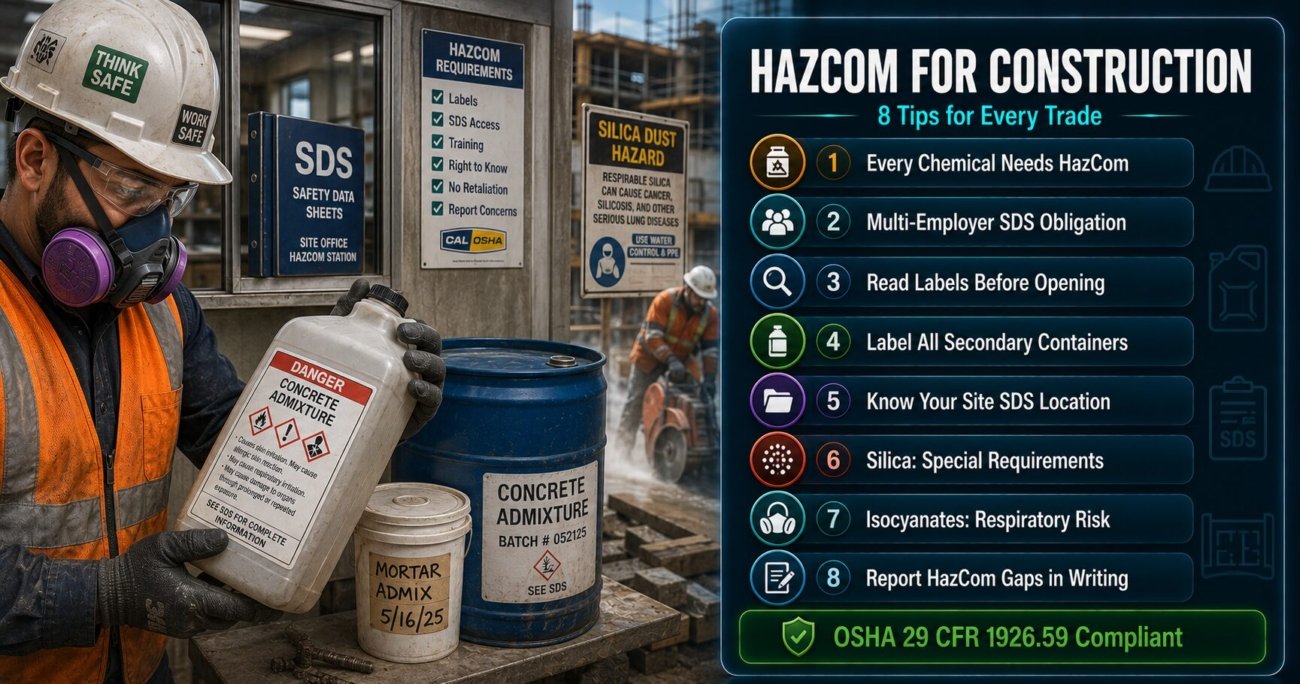
Construction sites use more hazardous chemicals than most workers realise. Concrete sealers, adhesives, epoxy coatings, wood preservatives, solvents, welding gases, hydraulic fluids, and cleaning agents are all present across a typical commercial or residential project. Many are used by multiple trades in shared spaces.
Hazard Communication on construction sites is governed by 29 CFR 1926.59, which adopts the general industry HazCom standard (29 CFR 1910.1200) in full. The multi-employer environment of construction adds complexity that does not exist in a single-employer factory. These tips address both the regulatory requirements and the practical challenges unique to construction.
Tip 1: Know That HazCom Applies to Every Chemical You Use on Site
Every hazardous chemical used on a construction site requires a compliant GHS label and a Safety Data Sheet accessible to every worker who may be exposed. This applies to chemicals brought to the site by the general contractor, subcontractors, and individual tradespeople.
Common chemicals that construction workers underestimate as requiring HazCom compliance include Portland cement (causes silica and alkali exposure), epoxy resins and hardeners (respiratory sensitisers), spray polyurethane foam (isocyanates), wood preservatives (chromium compounds), and fuel for equipment. If it has a manufacturer label with any hazard language, it is covered.
Before using any chemical product on site that you have not used before, locate its Safety Data Sheet and read Section 2 (hazard identification) and Section 8 (PPE requirements) before starting. This takes two minutes and tells you exactly what protection you need for that specific product.
Tip 2: Understand the Multi-Employer HazCom Obligation
Construction sites are multi-employer environments. Under 29 CFR 1926.59, employers who produce, use, or store hazardous chemicals on site must ensure that SDS documents for those chemicals are available and that their own employees are trained. The general contractor is responsible for coordinating HazCom information across all trades.
In practice this means: the general contractor must maintain a site-level SDS library covering all chemicals used on the project, regardless of which subcontractor brought them; subcontractors must train their own workers on the hazards of chemicals used in their scope of work; and any worker on site should be able to access the SDS for any chemical present in their work area without leaving the site.
If you are the GC or site safety manager, conduct a weekly chemical inventory check. New chemicals arrive on site without announcement as subcontractors begin new phases of work. A chemical that arrived Monday without an SDS in your site library is a compliance gap and a potential exposure hazard by Wednesday if no one caught it.
Tip 3: Read Labels Before You Open the Container, Not After
The sequence matters. Opening a container before reading the label means the first thing you learn about the chemical is its smell, not its hazards. By the time you read that the product requires respiratory protection, you have already inhaled it.
The correct sequence is: read the signal word first (DANGER or WARNING), identify the pictograms, check the precautionary statements for required PPE, put on that PPE, then open the container. For a product you use regularly, this takes under 30 seconds. For a new product, it takes two minutes including a quick SDS check.
Do: Make label-reading before opening a standard habit. Post a reminder at the chemical storage area: Read Before You Open.
Avoid: Assuming that a familiar brand name means you already know the hazards. Manufacturers reformulate products. A product you used safely for years may have a new hazard statement if the formulation has changed.
Tip 4: Manage Secondary Containers Consistently
Construction workers frequently transfer chemicals from original containers into spray bottles, buckets, and smaller dispensing containers for convenience. Every secondary container must be labelled with at least the product name and appropriate hazard warnings.
On a busy construction site where multiple trades share work areas, an unlabelled spray bottle left on a surface can be picked up by a worker from a different trade who has no idea what it contains. This is the most common chemical exposure scenario on multi-trade sites and one of the most preventable.
Keep a roll of adhesive labels and a permanent marker in every chemical kit. Any container that leaves the original packaging gets labelled before it leaves your hands. One label takes 10 seconds and prevents the next trade from picking up an unlabelled container of contact adhesive thinking it is water-based cleaner.
Tip 5: Know Where the Site SDS Library Is Before You Need It
On construction sites, the SDS library is often a binder in the site office or a tablet device maintained by the GC’s safety team. Every worker on site should know where it is on their first day. If you do not know where the SDS library is and you need one during a chemical exposure, you are already in a problem.
At your next site orientation or toolbox talk, ask specifically where the SDS for the chemicals you use can be found and confirm you can access them independently. On large sites, each trade area should have a local SDS resource, not just a central binder that requires walking across the site.
In a chemical emergency on a construction site, the three things you need in the first 60 seconds are: the SDS (Section 4 for first aid, Section 1 for emergency phone), running water for skin or eye flushing, and a way to call for help. Know where all three are before you need them.
Tip 6: Silica Deserves Special Attention on Every Construction Site
Crystalline silica is present in concrete, mortar, brick, tile, sandstone, and many other construction materials. Cutting, grinding, drilling, and demolishing these materials generates respirable silica dust. OSHA’s Silica Standard for Construction (29 CFR 1926.1153) has specific requirements beyond the general HazCom standard, but HazCom obligations still apply.
Silica-containing materials must have SDS documents that accurately reflect silica hazards. Workers exposed to silica must be trained on the health effects, including silicosis and lung cancer, and on the engineering controls required: wet methods, vacuum systems, and respiratory protection. Silica is one of the leading causes of occupational lung disease in construction workers.
Do: Confirm that your PPE for silica work includes at minimum an N95 respirator, and a higher-level respirator for high-exposure tasks. Confirm that engineering controls (wet cutting, vacuum shrouds) are in place before beginning any cutting or grinding of silica-containing materials.
Avoid: Treating silica exposure as a dust nuisance rather than a serious health hazard. Silicosis is irreversible. Exposure limits exist precisely because the damage accumulates without symptoms until it is too late to prevent.
Tip 7: Isocyanates in Construction: The Respiratory Hazard You May Not Know About
Spray polyurethane foam (SPF), two-part epoxy coatings, and some adhesives used in construction contain isocyanates, which are among the most potent respiratory sensitisers in occupational use. A single high-exposure event can cause permanent occupational asthma. Once sensitised, a worker may react to even trace isocyanate concentrations.
Products containing isocyanates show the health hazard pictogram (person with starburst on chest) on their labels. The SDS Section 8 will specify that respiratory protection is required, typically a supplied-air respirator or a full-face respirator with appropriate cartridges, not simply a dust mask. Workers applying SPF or two-part coatings without appropriate respiratory protection are at serious and irreversible risk.
Before any spray application of two-part products on your site, confirm that the applicator has the correct respiratory protection for isocyanate exposure, that the work area is isolated from other trades, and that bystander exposure is controlled. Isocyanate sensitisation claims are among the most serious occupational disease outcomes in the construction industry.
Tip 8: Report HazCom Gaps Immediately and in Writing
If you observe a HazCom gap on a construction site, including missing labels, unavailable SDS documents, chemicals being used by workers with no apparent knowledge of the hazards, or secondary containers with no labelling, report it to the site safety officer or GC superintendent in writing, even if only by text message.
Written reports create a record that the hazard was identified and reported. If an exposure incident follows and the hazard was not corrected after being reported, that record protects you and demonstrates the employer’s failure to act on notice. Verbal-only reports can be denied or forgotten. A text message with the date, time, and description of the gap cannot.
At the end of every shift, take 60 seconds to mentally replay the chemical exposures of the day. Was everything labelled? Did you have the PPE the SDS required? Was the SDS accessible? If any answer is no, report it before leaving site. The next shift starts where the last one left off, and the next worker in that area deserves the same protection you deserved.
HazCom Checklist for Construction Workers
✓ I know where the site SDS library is and can access it without assistance
✓ I have an SDS for every chemical I will use today
✓ I read the label before opening any chemical container
✓ I have labelled every secondary container with product name and hazard warnings
✓ I have the PPE specified in Section 8 of the SDS for each chemical I use
✓ I know the first aid procedures for the chemicals in my work area (SDS Section 4)
✓ For silica work: wet methods or vacuum controls are in place before I begin cutting
✓ For isocyanate products: I have the correct respiratory protection, not just a dust mask
✓ I report unlabelled containers and missing SDS documents in writing before leaving site
✓ I know the site emergency phone number and the location of the nearest eyewash or water source