
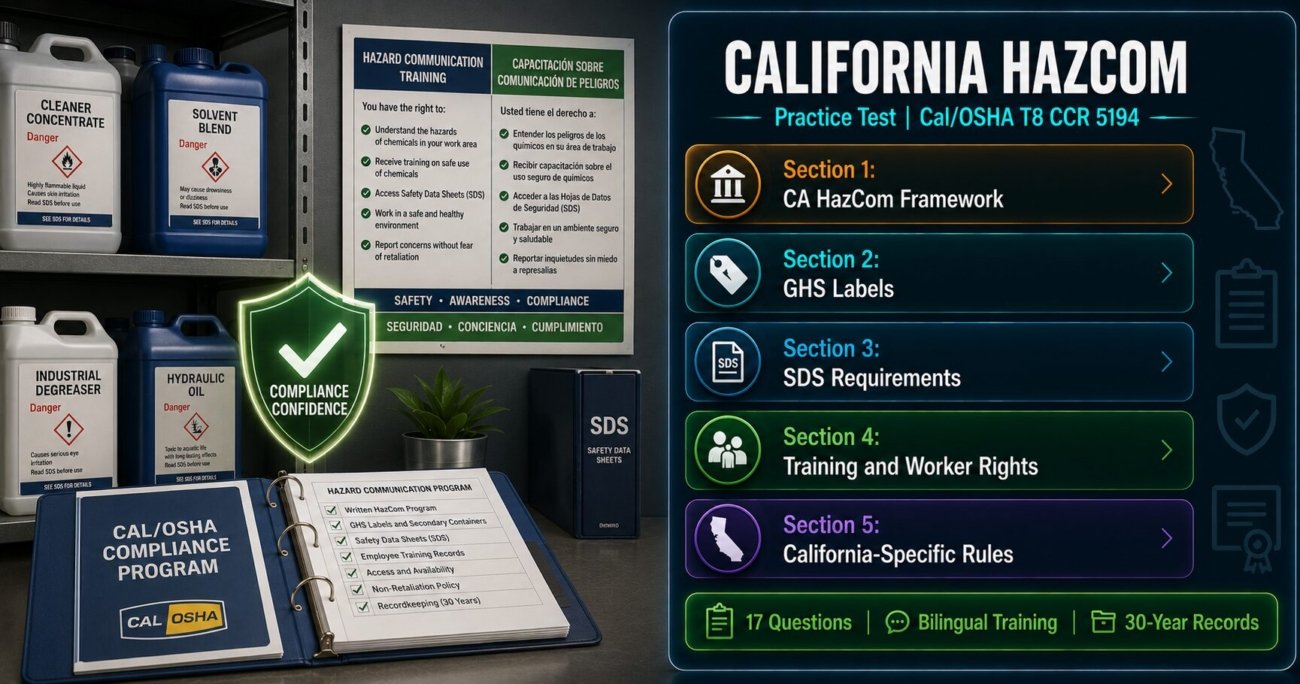
This practice test covers California’s Hazard Communication regulation under Cal/OSHA Title 8, Section 5194, which mirrors the federal OSHA HazCom standard (29 CFR 1910.1200) with additional California-specific requirements. Questions address GHS labels, SDS requirements, worker training obligations, Proposition 65 interactions, and employer duties unique to California workplaces. Each answer includes a detailed explanation.
Section 1: California HazCom Framework and Cal/OSHA
Answer: California Title 8, Section 5194 (T8 CCR 5194).
Explanation: California has its own occupational safety and health agency, Cal/OSHA, operating under the Division of Occupational Safety and Health (DOSH). California’s HazCom standard is at Title 8, California Code of Regulations, Section 5194. It adopts the federal GHS-aligned Hazard Communication Standard substantially but California, as a state-plan state, may adopt standards that are at least as effective as the federal standard and may add additional requirements. California employers must comply with T8 CCR 5194 rather than directly with 29 CFR 1910.1200, though the content is nearly identical in most respects.
Answer: Yes. The written HazCom programme requirement applies regardless of establishment size or number of chemicals used.
Explanation: Title 8 CCR Section 5194(e) requires every employer to develop, implement, and maintain a written hazard communication programme. There is no exemption based on the number of employees or the number of hazardous chemicals present. The written programme must describe how the employer will meet the labelling, SDS, and training requirements. A small employer using a single hazardous cleaning product is required to have a written programme that covers that product.
Answer: They operate independently. SDS documents do not satisfy Proposition 65 warning obligations.
Explanation: Proposition 65 requires businesses with 10 or more employees to provide clear and reasonable warnings before knowingly exposing individuals to chemicals listed as known to cause cancer, birth defects, or other reproductive harm. The Prop 65 list, maintained by the California Office of Environmental Health Hazard Assessment (OEHHA), contains over 900 substances. The HazCom standard addresses workplace chemical hazard communication to employees. Prop 65 addresses public and consumer warnings in addition to occupational exposures. An SDS that lists a Prop 65 chemical does not automatically satisfy the Prop 65 warning requirement, which has its own specific format, content, and placement standards.
Answer: Not necessarily. The written programme must comply with the applicable state regulation for each location.
Explanation: Nevada is a federal OSHA state, so Nevada operations are governed by 29 CFR 1910.1200. California operations are governed by T8 CCR 5194. While the two standards are substantially similar, any California-specific requirements must be addressed in the programme covering California facilities. A single programme can cover both if it is written to satisfy both regulations. Employers should specifically confirm that any California-only provisions, such as Prop 65 considerations and Cal/OSHA’s specific training content requirements, are addressed for the California locations.
Section 2: GHS Labels Under California Requirements
Answer: No, if they meet the portable container exemption criteria.
Explanation: Under T8 CCR 5194(f)(7), employers are not required to label portable containers if the chemical is transferred from a labelled container by the employee who will use it immediately and the container is for immediate use during the employee’s shift. All three conditions must be met: transferred by the employee who will use it, for their own immediate use, and used during that shift. If the container is left over at the end of the shift, passed to another employee, or stored for future use, the exemption does not apply and the container must be labelled.
Answer: No. Chemicals in California workplaces must have GHS-aligned labels as required by T8 CCR 5194.
Explanation: T8 CCR 5194(f) requires that containers of hazardous chemicals have labels containing the six GHS-required elements: product identifier, signal word, hazard statements, precautionary statements, pictograms, and supplier information. A European CLP-compliant label shares GHS origins but may differ in specific classification criteria, signal words, or statement formats. The employer must ensure that the chemical has a compliant label before allowing employee use. If the existing label is not compliant, the employer must apply a compliant workplace label before the chemical is made available to workers.
Answer: Remove the container from service and relabel it before returning it to use.
Explanation: T8 CCR 5194(f)(9) requires employers to ensure that labels on containers of hazardous chemicals are not removed or defaced. A label that is partially damaged and has illegible required elements is effectively defaced. The container must be removed from service until a new compliant label is applied. The employer cannot rely on workers’ knowledge of the chemical or on the SDS to substitute for a required label. Every container must independently satisfy the labelling requirements.
Section 3: Safety Data Sheets in California
Answer: No. Employees have the right to access SDS documents under California law.
Explanation: T8 CCR 5194(g)(8) requires that SDS documents be readily accessible to employees in their work area during each work shift. This is a worker right, not a management privilege. Restricting SDS access to management violates the standard. Additionally, California Labor Code Section 6408 provides workers with the right to information about safety hazards in their workplace. An employer who restricts SDS access to management is in violation of both the HazCom standard and the broader Labor Code worker information rights.
Answer: No, if production workers cannot access the server room during their shifts without special assistance.
Explanation: Ready access means an employee can retrieve the SDS without significant delay or requiring supervisor or security assistance. A central server room requiring a security badge that production workers do not have does not meet the ready access standard for those workers. Each work area must have a means of SDS access appropriate to the workers in that area. This may be a physical binder, a workstation-accessible electronic system, or another method, but it must be immediately usable by the employees in that area without requiring them to leave their work area or obtain special access.
Answer: No. Records for discontinued chemicals must be retained for 30 years.
Explanation: Under T8 CCR 3204 (which incorporates OSHA’s employee exposure records standard, 29 CFR 1910.1020), SDS documents for chemicals to which employees were exposed must be retained for 30 years after the last date of employee exposure. This requirement exists because many occupational diseases caused by chemical exposure have long latency periods. An SDS that was discarded when a chemical was discontinued may be needed decades later to evaluate a worker’s occupational disease claim. Employers must maintain SDS records for discontinued chemicals even when those chemicals are no longer in use.
Section 4: Training Requirements and Worker Rights
Answer: No. Training must be provided in a manner that employees can understand.
Explanation: T8 CCR 5194(h)(1) requires that employees be trained at the time of their initial assignment to a work area where hazardous chemicals are present, and whenever a new physical or health hazard is introduced. The training must be presented in a manner that employees can understand. For workers whose primary language is Spanish, English-only training does not satisfy this requirement. California employers must provide training in the language or languages of their workforce, or use qualified bilingual interpreters to ensure comprehension. An attendance record for English-only training signed by a Spanish-speaking worker does not demonstrate that the required training occurred.
Answer: Before the employee’s initial work assignment in that area.
Explanation: T8 CCR 5194(h)(1) specifies that training must be provided at the time of initial assignment. California does not permit employers to defer training while a new employee observes, shadows, or assists other workers in a chemical work area. The moment the employee is assigned to work in an area with hazardous chemicals, the training obligation is triggered. The training must precede the assignment, not follow it. California also requires retraining whenever a new chemical hazard is introduced to the work area, regardless of how long the employee has worked there.
Answer: Significant protections under both federal and California law.
Explanation: Section 11(c) of the federal OSH Act prohibits retaliation against workers who exercise their safety rights, including filing safety complaints. California Labor Code Section 6310 provides parallel protections under state law and generally allows a worker to file a retaliation complaint with the California Labor Commissioner. Additionally, California Labor Code Section 98.6 prohibits retaliation for filing a complaint under any provision of the Labor Code. The worker may file a complaint with Cal/OSHA, the California Labor Commissioner, or pursue a civil action. California’s anti-retaliation protections are among the strongest in the country.
Section 5: California-Specific Situations
Answer: Both the general contractor and the subcontractor share responsibility, with specific obligations allocated by the multi-employer worksite rules.
Explanation: On California construction sites, T8 CCR 5194(b)(3) addresses multi-employer situations. Employers who produce, use, or store hazardous chemicals must ensure that SDS documents are available and that their own employees receive required training. The general contractor must ensure that SDS documents for chemicals used on the site are accessible to all workers and must coordinate hazard communication efforts across trades. Each subcontractor must train their own employees. If a chemical is used by multiple trades, the creating or importing employer’s SDS satisfies the documentation requirement, but each employer must train their workers on the hazards present in their work area.
Answer: Yes. Employers must obtain updated SDS documents when they are available.
Explanation: T8 CCR 5194(g)(6) requires chemical manufacturers, importers, and distributors to provide revised SDS documents to their customers within three months when significant new information about a chemical’s hazards becomes available. Employers who become aware that an updated SDS is available from a supplier should obtain the updated version. Using a known-outdated SDS when a current version is available means the employer may be providing workers with incorrect hazard information, which undermines the purpose of the HazCom programme. Maintaining current SDS documents is both a compliance obligation and a practical safety requirement.
Answer: They operate independently but are complementary. Both may apply simultaneously for lead-containing chemicals.
Explanation: California’s OLPPP requires employers with workers who may be occupationally exposed to lead above the action level to report to CDPH and to follow specific blood lead monitoring and medical surveillance requirements. Cal/OSHA has a separate lead standard at T8 CCR 5198 with exposure limits and protective requirements. The HazCom standard requires that lead-containing chemicals have compliant labels and SDS documents. All three regulatory schemes may apply simultaneously to a California employer whose workers are exposed to lead. Compliance with one does not substitute for compliance with the others. California employers with lead exposures should identify all applicable regulations before designing their compliance programme.
Answer: No. Requiring workers to ask a supervisor defeats the purpose of ready access.
Explanation: The ready-access requirement means employees can access SDS documents independently, without intermediary assistance, during their work shift. A system where workers must locate a supervisor, request the tablet, and wait for the supervisor to provide it does not satisfy ready access. In a chemical emergency, the seconds spent locating a supervisor are exactly the seconds that Section 5194(g)(8) is designed to eliminate. The SDS system must allow workers to go directly to the hazard information they need. The tablet approach is acceptable only if the tablet is in an accessible, known location that workers can access directly without supervisor involvement.
Knowledge Summary
California operates under Cal/OSHA (T8 CCR 5194), not directly under federal OSHA (29 CFR 1910.1200), though the standards are substantially aligned.
Proposition 65 warning requirements operate independently from HazCom SDS requirements and must be addressed separately.
SDS records for discontinued chemicals must be retained for 30 years after last employee exposure under T8 CCR 3204.
Training must be provided in a language workers can understand. English-only training for Spanish-speaking workers is non-compliant.
Ready access means workers can retrieve an SDS independently without supervisor assistance during any work shift.
California anti-retaliation protections for workers who raise safety concerns are among the strongest in the country.