
Every year, workers are injured by chemicals they handle daily. Not because the hazards were unknown. Not because no safety information existed. Because no one connected the chemical in the worker’s hand to the information on the label and in the Safety Data Sheet.
Hazard Communication awareness is the bridge between regulatory compliance and genuine worker protection. This guide walks through the complete HazCom awareness framework, designed for workers at every level across every industry that uses chemicals.
By the end of this guide, you will understand the purpose and scope of OSHA’s Hazard Communication Standard under 29 CFR 1910.1200; the three pillars of a compliant HazCom programme (labels, SDS, and training); your rights as a worker under the Right-to-Know framework; how to read a GHS label in under 30 seconds; which SDS sections matter most in an emergency; and what to do if you believe HazCom requirements are not being met at your workplace.
What Hazard Communication Is and Why It Exists
OSHA’s Hazard Communication Standard (HCS), codified at 29 CFR 1910.1200, is one of the most significant worker protection regulations in US history. Before its introduction, workers frequently handled hazardous chemicals with no information about what those chemicals could do to their health or what to do in an emergency.
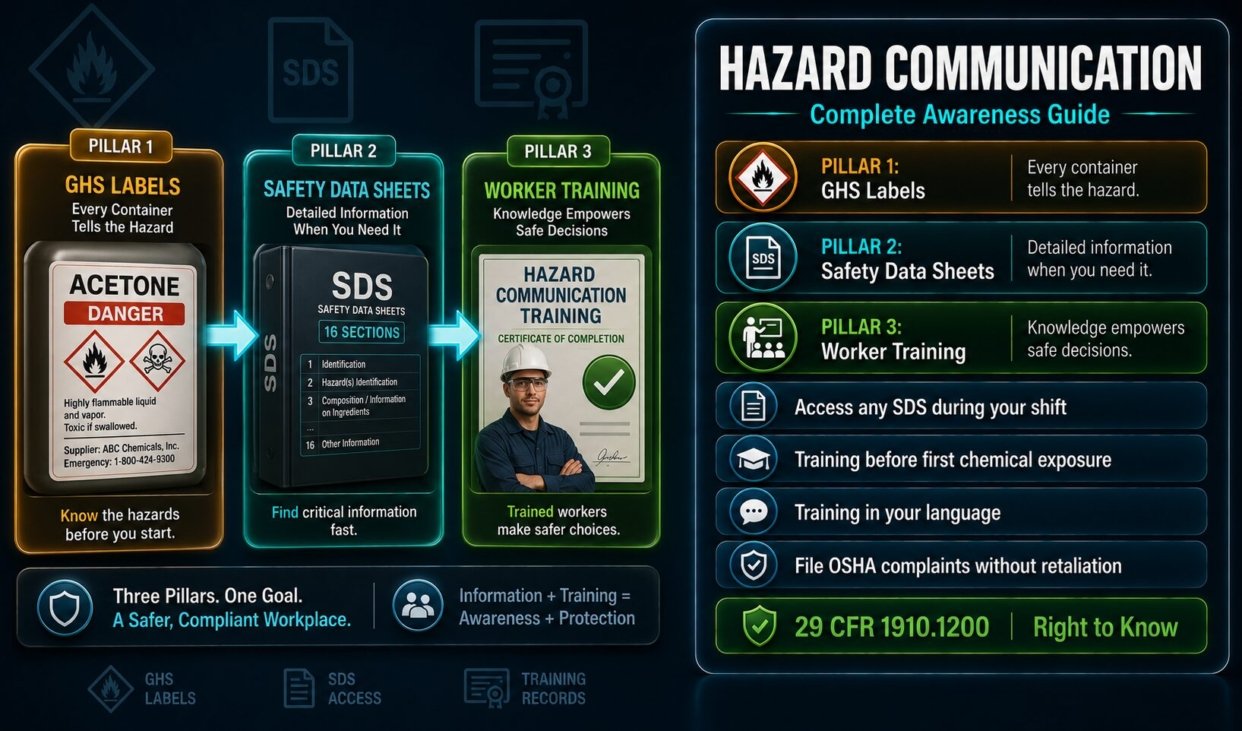
The standard is built on a simple premise: workers have a right to know about the hazards of the chemicals they work with. Employers have an obligation to tell them. That exchange of information happens through three channels: chemical labels, Safety Data Sheets, and training.
In 2012, OSHA aligned the HCS with the United Nations Globally Harmonised System of Classification and Labelling of Chemicals (GHS), creating a standardised format for labels and SDS documents that is recognised internationally. This means a worker trained on GHS in the United States can read a GHS-aligned label from a chemical manufactured anywhere in the world.
29 CFR 1910.1200 applies to virtually every workplace in the United States where hazardous chemicals are used, handled, or stored. This includes manufacturing, construction (through 29 CFR 1926.59), healthcare, agriculture, laboratories, and office environments where cleaning chemicals are used. There is no minimum size threshold. A two-person operation that uses a hazardous cleaner is subject to HazCom requirements.
The Three Pillars of Hazard Communication
Pillar 1: Chemical Labels
Every hazardous chemical in the workplace must have a label containing six required elements: the product identifier, a signal word (DANGER or WARNING), hazard statements, precautionary statements, pictograms, and supplier information. These elements tell you what the chemical is, how dangerous it is, what can go wrong, what to do to stay safe, and who to call.
Labels must be maintained. A container with a damaged, missing, or illegible label must be relabelled or removed from service. Secondary containers used for transferring chemicals must also be labelled. A spray bottle with no label is a violation and a hazard, regardless of how familiar the contents are to the workers using it.
The signal words are a fast-read hazard indicator. DANGER means the hazard is more severe. WARNING means the hazard is present but less severe. Reading the signal word in the first second of picking up a container tells you immediately how seriously to approach the next steps.
Step 1 (5 seconds): Read the signal word. DANGER or WARNING?
Step 2 (10 seconds): Identify the pictograms. Flame, skull, corrosion, health hazard?
Step 3 (10 seconds): Read the precautionary statements. What PPE is required? What must you avoid?
Step 4 (5 seconds): Confirm the supplier phone number is accessible if something goes wrong.
Thirty seconds before handling an unfamiliar chemical. That is the habit that prevents most label-related exposure incidents.
Pillar 2: Safety Data Sheets
The Safety Data Sheet is the comprehensive technical document for a hazardous chemical. Every compliant SDS follows the 16-section GHS format. The SDS tells you everything the label cannot fit: detailed health effects, exposure limits, engineering controls, PPE specifications, spill response procedures, disposal requirements, and emergency contact information.
Every employer must have an SDS for every hazardous chemical used in the workplace. The SDS must be readily accessible to workers during every work shift without requiring supervisor assistance. Knowing where the SDS library is located in your workplace is a basic safety competency, not optional knowledge.
The four sections most critical in an emergency are Section 1 (emergency phone), Section 4 (first aid), Section 6 (spill response), and Section 8 (PPE requirements). Knowing these section numbers before you need them saves time when time matters.
The label contains the minimum information required for safe handling. The SDS contains the complete information required for safe handling in all situations, including emergencies, spills, and long-term exposure management. A worker who reads only the label and never consults the SDS may be wearing inadequate PPE, unaware of chronic health effects, or unprepared for a spill response. Both documents serve different purposes and both must be used.
Pillar 3: Training
Training is the pillar that connects the other two. A label that a worker cannot read, and an SDS that a worker cannot locate or interpret, provide no protection. OSHA requires that all workers who may be exposed to hazardous chemicals receive HazCom training before their initial work assignment and whenever a new chemical hazard is introduced to their work area.
Training must cover: the requirements of the HazCom standard; the location and availability of the written HazCom programme; the methods and observations used to detect the presence or release of hazardous chemicals; the physical, health, and other hazards of the chemicals in the work area; and the measures workers can take to protect themselves.
Training must be delivered in a manner the worker can understand. For multilingual workforces, this means training in the worker’s primary language. A sign-in sheet in a language the worker does not read does not demonstrate that training was understood.
Your Rights Under the Right-to-Know Framework
HazCom is built on the legal principle that workers have a right to know about the hazards they face. This right is enforceable. Under Section 11(c) of the OSH Act, employers cannot retaliate against workers who exercise their safety rights, including the right to request hazard information, access SDS documents, or raise HazCom concerns.
You have the right to:
- Access the Safety Data Sheet for any chemical you work with or near, during your work shift, without delay
- Receive training on the hazards of the chemicals in your work area before you begin working with them
- Receive HazCom training in a language you can understand
- Request information about chemical hazards from your employer without fear of retaliation
- File a complaint with OSHA if you believe HazCom requirements are not being met
If your employer denies access to an SDS for a chemical you are currently handling, or if you have never received HazCom training despite working with hazardous chemicals, these are reportable conditions. OSHA’s complaint process is available at osha.gov and can be initiated anonymously.
Workers who identify HazCom gaps, unlabelled containers, missing SDS documents, or untrained colleagues, and say nothing, are not protecting themselves or their colleagues. Raising a HazCom concern with a supervisor is a protected activity. If the concern is not addressed, filing an OSHA complaint is the appropriate next step. The same system that protects you from chemical hazards protects you from retaliation for reporting those hazards.
The Written HazCom Programme: What Employers Must Document
Under 29 CFR 1910.1200(e), every employer must develop, implement, and maintain a written Hazard Communication Programme. The programme must describe how the employer will meet each requirement of the standard and must be available to workers and OSHA inspectors.
The written programme must address: how labels are maintained on containers; how the SDS library is organised and accessed; how training is delivered and documented; how the chemical inventory is maintained; and how new chemicals are introduced into the workplace with required labelling and SDS availability before first use.
A written programme that sits in a filing cabinet and is never referenced, updated, or used to guide actual workplace practice does not satisfy the regulation. OSHA inspectors evaluate whether the written programme describes what actually happens in the facility, not just what theoretically should happen.
Knowledge Check
Test your HazCom awareness across all three pillars.
No. 29 CFR 1910.1200(h) requires that HazCom training be provided to workers before their initial work assignment in areas where they may be exposed to hazardous chemicals. Training cannot be deferred until after work begins. The supervisor’s instruction to start work without training puts the employee at risk and places the employer in violation of the standard. If an incident occurred before the training was conducted, the absence of pre-assignment training would significantly increase the employer’s compliance exposure.
Only if the intranet is accessible without delay during the work shift. 29 CFR 1910.1200(g)(8) requires that SDS documents be readily accessible to employees during their work shifts. If the worker has immediate, unrestricted access to a workstation with internet connectivity where the SDS is accessible, the electronic system may satisfy the requirement. However, if the intranet requires a separate login, is located in a different building, or is routinely unavailable due to system outages, it does not meet the readily accessible standard. Additionally, the employer must have a backup system for system outages.
Possibly not, and she should verify against Section 8 of the SDS before proceeding. The skull and crossbones indicates acute toxicity at a severe level. The health hazard pictogram indicates a serious long-term health hazard such as carcinogenicity or respiratory sensitisation. Nitrile gloves and safety glasses may or may not be appropriate depending on the specific chemical, its routes of exposure, and the tasks being performed. Section 8 of the SDS specifies the exact PPE required, including glove material and thickness, eye protection type, respiratory protection if needed, and skin protection. The label provides the signal; the SDS provides the specific protective action required.
They can file a complaint with OSHA. OSHA accepts complaints from workers who believe safety standards are being violated. Complaints can be submitted online at osha.gov, by phone at 1-800-321-OSHA (6742), or in writing to the nearest OSHA area office. Complaints can be filed anonymously. Under Section 11(c) of the OSH Act, employers cannot retaliate against workers who file safety complaints. If retaliation occurs, the worker can file a separate Section 11(c) complaint within 30 days of the retaliatory action.
HazCom Awareness Checklist
✓ I know the location of the SDS library in my work area and can access it without supervisor assistance
✓ I have received HazCom training before starting work with hazardous chemicals
✓ I can identify the six required elements on a GHS label
✓ I can recognise all nine GHS pictograms and know what hazard category each represents
✓ I know the difference between DANGER and WARNING signal words
✓ I know which SDS sections to go to in an emergency (Sections 1, 4, 6, 8)
✓ I know that secondary containers must be labelled and I label them when I transfer chemicals
✓ I know I can access any SDS for any chemical I work with at any time during my shift
✓ I know that requesting hazard information and raising HazCom concerns are protected activities
✓ I know how to file an OSHA complaint if HazCom requirements are not being met