
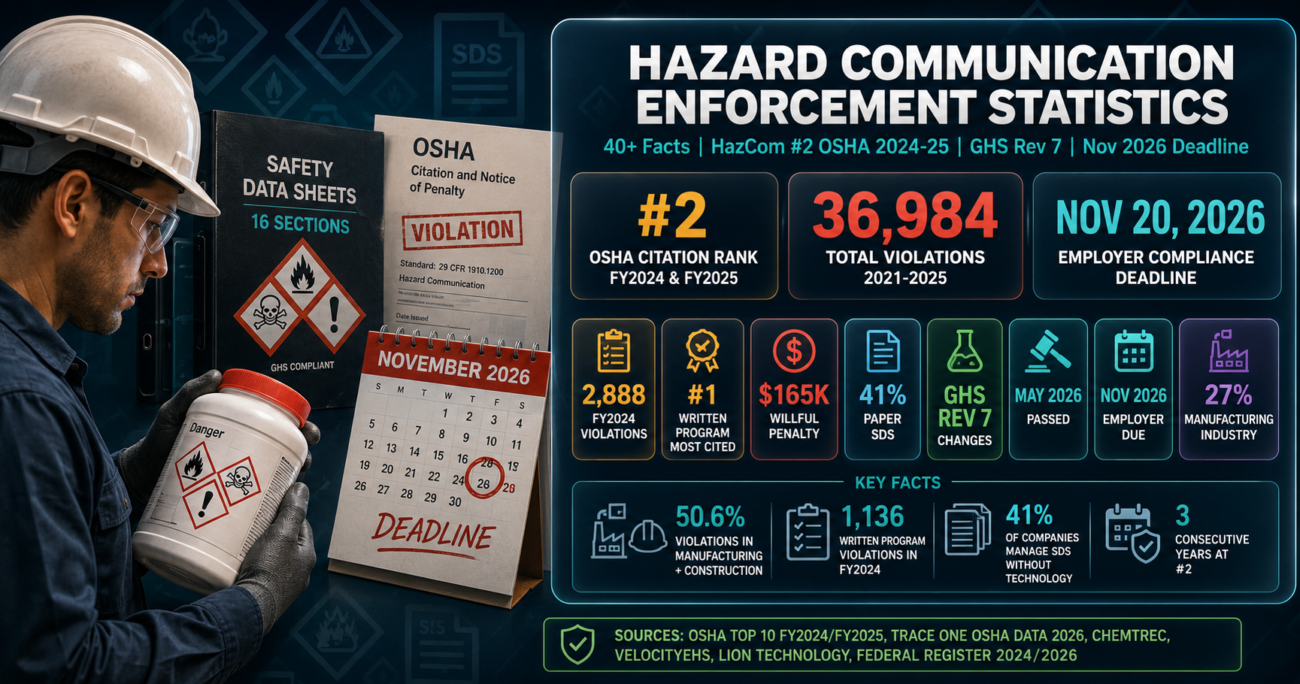
Hazard Communication is the most cited general industry OSHA standard. It has held its place in the top five for over a decade and has ranked #2 overall for three consecutive years – FY2023, FY2024, and FY2025. The violations it generates are not exotic compliance failures. They are the same four recurring gaps year after year: failure to maintain a written HazCom program (1910.1200(e)(1)); inadequate or missing employee training (1910.1200(h)(1)); SDS not maintained or accessible (1910.1200(g)(8)); and missing or improper labels on chemical containers (1910.1200(f)(6)(ii)). Over 3,100 citations and nearly $5 million in penalties in 2024 alone. Willful violations at $165,514 each in 2025.
Against this enforcement backdrop, OSHA published a major revision to the Hazard Communication Standard in May 2024 – the first comprehensive update since the 2012 GHS alignment. The 2024 final rule aligns HazCom with GHS Revision 7, introducing new hazard classes (desensitized explosives, chemicals under pressure), revised criteria for existing classes, updated SDS and label requirements, and new small-container labeling provisions. OSHA extended all compliance deadlines by four months in January 2026, creating a specific deadline framework running from May 2026 through May 2028. Employers who are not tracking this deadline framework are accumulating compliance exposure on top of the baseline citation risk. This article compiles 40+ statistics on the enforcement record, the 2024 rule changes, the SDS and training management gaps driving most citations, and what effective HazCom programs do to close them.
Editor's Choice: Key HazCom Enforcement and Compliance Statistics for 2024-26
1. The HazCom Enforcement Record: What 36,984 Violations Over Five Years Reveal
- OSHA recorded 36,984 HazCom violations from 2021 through 2025, equal to 5.6 violations per 100,000 workers, per Trace One’s analysis of OSHA Enforcement Data published March 2026. Manufacturing (10,021) and construction (8,678) together account for 50.6% of all HazCom citations nationwide. (Trace One, March 2026)
- HazCom’s enforcement trajectory shows a long-term decline from a peak of 37,134 citations in 1989 to current levels – a reduction attributable primarily to the 2012 GHS alignment that standardized SDS and label requirements. However, the current plateau at approximately 2,500-2,900 citations per year suggests the easy compliance gains from GHS adoption have been exhausted and the remaining violations reflect structural program deficiencies, not unfamiliarity with requirements. (Trace One / OSHA historical data, March 2026)
- The four most-cited HazCom subsections in FY2024 reflect predictable, recurring program gaps rather than technical ambiguity: written program 1910.1200(e)(1) with 1,136 violations; training 1910.1200(h)(1); SDS accessibility 1910.1200(g)(8); and workplace labeling 1910.1200(f)(6)(ii). These four elements – program, training, SDS, and labels – are also the four core compliance elements of any HazCom program. Citations appear where program maintenance has lapsed, not where requirements are unclear. (OSHA FY2024 Top 10; CHEMTREC, October 2025)
- For FY2025, HazCom remained the most cited standard for general industry specifically – even as it held the #2 overall position behind construction’s fall protection violations. EHSLeaders (June 2026) notes that HazCom is “sometimes referred to as worker right to know” – covering product labels, SDS, and training requirements for workplace chemical hazards. (Lion Technology, December 2025; EHSLeaders, June 2026)
- CHEMTREC’s October 2025 analysis notes that in 2024, over 3,100 citations were issued and nearly $5 million in penalties assessed for HazCom violations specifically. For willful violations in 2025, the maximum per-violation penalty is $165,514 – adjusted annually for inflation. A single inspection that identifies missing SDSs, inadequate training records, and unlabeled secondary containers can generate multiple separately citable items, compounding rapidly. (CHEMTREC, October 2025; Trace One, March 2026)
2. The HazCom 2024 Final Rule: GHS Revision 7, New Hazard Classes, and the Deadline Framework
- OSHA published the HazCom 2024 final rule on May 20, 2024, and it took effect July 19, 2024. The rule aligns the Hazard Communication Standard with GHS Revision 7, with select elements from GHS Revision 8 (specifically the chemicals under pressure hazard class). On January 15, 2026, OSHA published a Federal Register notice extending all compliance deadlines by four months – shifting them from the original January 2026/2028 framework to the current May/November 2026 and 2027/2028 framework. (Quantum Compliance, April 2026; Lion Technology; ERA Environmental)
- Key changes introduced by HazCom 2024: a new “Desensitized Explosives” hazard class; a new “Chemicals Under Pressure” category (from GHS Rev 8); revised criteria for flammable gases; renaming “flammable aerosols” to “aerosols” to include non-flammable varieties; updated SDS content requirements; new provisions allowing standardized concentration ranges instead of exact percentages for trade secret protection; and reduced labeling requirements for very small containers (under 3 ml) and small containers (under 100 ml). (ERA Environmental, May 2026; Quantum Compliance, April 2026)
- The four-month extension granted in January 2026 reflects a practical compliance reality that OSHA acknowledged explicitly: guidance documents to help employers navigate the new requirements were not yet finalized. The extension shifted timelines but did not change the scope of work required. Quantum Compliance (April 2026) notes that “the extension shifts the timeline, not the work required” – the same SDS library review, label revision, program update, and training delivery must still occur. (Quantum Compliance, April 2026; OSHA January 15, 2026)
- The November 20, 2026 employer deadline is the most operationally complex HazCom deadline most employers will face since the 2012 GHS transition. It requires simultaneous action across all four core HazCom program elements: workplace labels must be updated, written programs must be revised to reflect new hazard classifications, and workers must be retrained on what has changed – including new pictograms, SDS sections, and labeling formats. UT Center for Industrial Services (January 2026) identifies “meaningful, site-specific training” as a critical enforcement focus for this deadline. (UT CIS, January 2026; Workplace Compliance Insights, May 2026)
3. The Written HazCom Program: The Most-Cited Element and What It Must Cover
- The most-cited HazCom subsection in FY2024 was 1910.1200(e)(1) with 1,136 violations – more than any single SDS or labeling subsection. The pattern is consistent: written programs that exist on paper but are not maintained to reflect current chemical inventories, current hazards, or updated regulatory requirements. A program written in 2012 and never updated is not a compliant program in 2026. (OSHA FY2024 data; Safety and Health Magazine; Advanced Safety Supply)
- The HazCom 2024 final rule creates a specific written program update obligation: employers must revise their written HazCom programs by November 20, 2026 to reflect the new GHS Rev 7 hazard classifications and any new labeling or SDS requirements introduced by the 2024 rule. Written programs that reference the old hazard classification framework – particularly for flammable gases, aerosols, and any product that would be reclassified under desensitized explosives or chemicals under pressure criteria – are non-compliant after this date. (SafetyRegulatory.com, February 2026; UT CIS, January 2026)
- Advanced Safety Supply (December 2025) identifies the most common written program deficiencies they encounter: generic templates not tailored to the facility’s specific chemicals; programs that list chemicals by category rather than specific product; programs that do not address non-routine tasks; and programs stored in locations inaccessible to workers. The written program must be site-specific – not a generic document downloaded from the internet. (Advanced Safety Supply, December 2025)
- The written program must also address how the employer will inform employees of hazards of non-routine tasks (cleaning, maintenance, breakdown procedures) and hazards from chemicals in unlabeled pipes. These are enforcement focus areas specifically because they are the highest-consequence chemical exposure scenarios – workers performing unfamiliar tasks with chemicals they have not been specifically trained on. (OSHA 1910.1200(e)(1)(ii); HazCom compliance guidance)
4. SDS Management: The 41% Technology Gap and What Adequate Accessibility Requires
- BLS data for 2023 recorded 63 chemical-related fatalities and identified respiratory illness as the number one reported workplace injury category in 2024. HazCom’s protective function – ensuring workers know what chemicals they are handling, what the hazards are, and what protective measures are required – is the primary mechanism for reducing this harm. An SDS that is not accessible when a worker needs it is an SDS that cannot prevent the exposure it was meant to warn against. (Trace One / BLS data, March 2026)
- OSHA’s accessibility standard for SDS (1910.1200(g)(8)) is explicit: SDS must be immediately accessible to employees during their work shift. The most common accessibility violation is physical rather than documentary – SDS files exist but are stored in a supervisor’s office, a locked cabinet, or a building workers do not have access to during their shift. Technology solutions that provide mobile SDS access address the most common accessibility failure mode. (OSHA 1910.1200(g)(8); CHEMTREC, October 2025)
- The VelocityEHS / EHSToday State of the Market Report finding that 41% of companies rely on spreadsheets, email, and paper for SDS management explains much of the persistent SDS citation rate. Manual SDS systems cannot maintain version control when suppliers update SDS, cannot alert EHS managers when SDS revisions arrive, and cannot provide immediate mobile access for workers during chemical exposures. For the HazCom 2024 deadline, manual SDS systems also cannot systematically flag which SDS need to be replaced with GHS Rev 7-compliant versions. (Trace One / VelocityEHS, 2026)
- HazCom 2024 introduces specific SDS content changes that require review and updating of existing SDS libraries: the new desensitized explosives and chemicals under pressure hazard classes may require reclassification of products previously classified under other categories; flammable gas classification criteria have been revised; and aerosol classification now includes non-flammable varieties. SDS that were accurate under the pre-2024 standard may be inaccurate under GHS Rev 7 criteria for the same product. (ERA Environmental, May 2026; Quantum Compliance, April 2026)
- The SDS update obligation flows down from supplier to employer. Chemical manufacturers and importers must update substance SDS by May 19, 2026 (already passed). Employers must then ensure their SDS libraries reflect these updated documents by November 20, 2026 – and update workplace labels, written programs, and training to match. Employers who simply wait for updated SDS to arrive passively without auditing their SDS libraries against the updated versions will not meet the November 2026 deadline. (Workplace Compliance Insights, May 2026; mSDS Source)
5. Chemical Labeling: GHS Requirements, Secondary Containers, and the 2024 Changes
- The most common labeling citation source is secondary containers – spray bottles, buckets, mixing vessels, and transfer containers – that do not have labels identifying the chemical and its hazards. OSHA’s labeling requirement applies to every container of a hazardous chemical in the workplace, not only to the original manufacturer containers. Unlabeled secondary containers remain a major citation source per Advanced Safety Supply (December 2025). (OSHA 1910.1200(f)(6)(ii); Advanced Safety Supply, December 2025)
- HazCom 2024 introduces label relief for small containers: labels for containers of 100 ml or less may use abbreviated format; labels for containers of 3 ml or less have further reduced requirements. This addresses a practical challenge for laboratory and industrial settings where very small chemical containers cannot physically accommodate full GHS label content. (ERA Environmental, May 2026)
- HazCom 2024’s trade secret provision allows chemical producers to use standardized concentration ranges for ingredients instead of exact percentages on SDS and labels. This provides confidential business information protection for manufacturers without eliminating the hazard communication content workers need. Employers should note that this is a manufacturer provision – it does not change what employers must communicate to workers about chemicals they use. (ERA Environmental, May 2026; Quantum Compliance, April 2026)
- The November 20, 2026 employer labeling deadline requires that workplace labels for substances are updated to reflect GHS Rev 7 requirements – including updated hazard statements, precautionary statements, and pictograms where reclassification has changed the required label content. Employers who use pre-printed label stock from manufacturers should verify that their supplier labels have been updated before the May 19, 2026 substance deadline and that updated labels are in use at the workplace before November 20, 2026. (Workplace Compliance Insights, May 2026; mSDS Source)
6. HazCom Training: What OSHA Requires and Why Generic Training Does Not Satisfy It
- OSHA’s HazCom training requirement (1910.1200(h)) is outcome-based, not format-based: the standard requires that employees be able to demonstrate knowledge of the chemical hazards they work with and the appropriate protective measures. A sign-off sheet proving an employee attended a generic online module does not satisfy this requirement if the employee cannot identify the hazards of the specific chemicals they handle or explain how to use the SDS for those chemicals. (OSHA 1910.1200(h); HazCom training guidance)
- OSHA’s training standard explicitly requires that training be provided “in a manner that employees can understand.” In multilingual workplaces, this means training must be available in the languages spoken by workers – not delivered in English to workers whose primary language is Spanish, Vietnamese, or another language. 29 CFR 1910.1200 does not specify English-only; it specifies comprehension. Multilingual workforces require multilingual HazCom programs. (OSHA 1910.1200(h)(1); EHSLeaders, June 2026)
- The HazCom 2024 deadline framework creates a specific new training obligation for employers: workers must be trained on what has changed under GHS Rev 7 before the November 20, 2026 employer deadline. This includes new pictograms for products that have been reclassified, new SDS sections or content changes, and new or revised precautionary statements. UT CIS (January 2026) specifically identifies “meaningful, site-specific training on what has changed” as an enforcement focus for the 2026 deadline. (UT CIS, January 2026; Workplace Compliance Insights, May 2026)
- Training records and rosters must be retained and available for OSHA inspection. Advanced Safety Supply (December 2025) identifies out-of-date inventories and inadequate training documentation as common HazCom deficiencies. The training record must typically show: the employee’s name, date of training, the trainer’s identity, and the content covered. A training program without documentation is invisible to OSHA during an investigation. (Advanced Safety Supply, December 2025; OSHA 1910.1200(h))
- Training must be repeated whenever a new chemical hazard is introduced to the work area – not only at initial hire and annual refresher cycles. Facilities that continuously introduce new chemical products without updating their HazCom training or adding the new products to their chemical inventory list are generating ongoing training violations for every new product not covered in their existing training program. (OSHA 1910.1200(h)(1))
7. What Effective HazCom Programs Do Differently: Closing the Persistent Compliance Gap
- The pattern underlying persistent HazCom violations is not ignorance of the standard – most employers know they are required to maintain a written program, SDS files, labels, and training records. The pattern is program maintenance failure: programs written once and not updated as chemical inventories change, as regulatory requirements evolve, or as the workforce changes. The November 2026 HazCom 2024 deadline is the most significant program maintenance trigger since 2012, and it requires deliberate action across all four program elements simultaneously. (Trace One, March 2026; Quantum Compliance, April 2026)
- For the HazCom 2024 November 2026 deadline specifically, Workplace Compliance Insights (May 2026) identifies the required employer workflow: compare current SDS with updated versions from manufacturers that should have been updated by May 19, 2026; identify which products have changed hazard classifications; update workplace labels for those products; revise the written HazCom program to reflect new classification criteria; and deliver training on what has changed before November 20, 2026. This is a sequential process that takes time – employers who have not started are operating with limited runway. (Workplace Compliance Insights, May 2026; UT CIS, January 2026)
- The construction sector – which accounts for 23.5% of all HazCom violations (2021-2025) – faces compounding HazCom challenges: multiple subcontractors bringing different chemicals to the same site, short-term workers who may not receive initial HazCom training before chemical exposure, and multi-employer worksite complexity that makes SDS accessibility and label consistency harder to maintain. The multi-employer citation doctrine means that the controlling employer on a construction site can be cited for HazCom violations by subcontractors whose workers are exposed to the hazard. (Trace One, March 2026; OSHA multi-employer citation policy)
Key Takeaways for EHS Managers and Safety Programs
Sources
Government and Regulatory Sources
- OSHA 29 CFR 1910.1200 – Hazard Communication Standard: written program (e)(1); labeling (f); SDS (g); training (h); definitions; scope and application
- Federal Register May 20, 2024 – HazCom 2024 Final Rule: GHS Revision 7 alignment; new hazard classes (desensitized explosives, chemicals under pressure); revised flammable gas criteria; small container labeling provisions; rule took effect July 19, 2024
- Federal Register January 15, 2026 – HazCom Compliance Date Extension: all deadlines extended four months; rationale (guidance documents not finalized); updated compliance date framework
Enforcement Data and Analysis Sources
- Trace One (March 2026) – Where U.S. Employers Fail to Warn Workers About Chemical Dangers: 36,984 HazCom violations 2021-2025; 5.6 per 100K workers; Maryland 4,370 total / 39.0 per 100K; manufacturing 10,021 / construction 8,678 (50.6% combined); 2024 citation peak 37,134
- Trace One (March 2026) – OSHA HazCom Violations 2024 Enforcement Data: 2,888 FY2024 citations; $165,514 willful penalty 2025; respiratory illness #1 workplace injury category 2024; 63 chemical fatalities 2023; 41% companies no SDS technology
- VelocityEHS (December 2025) – OSHA Top 10 Most Frequently Cited Standards for 2024: HazCom #2 for third consecutive year (2022-2024); 2,888 violations; 14th consecutive year fall protection at #1
- Lion Technology (September 2025) – 10 Most Cited OSHA Violations of 2025: HazCom #2 overall; most cited for general industry in FY2025; 2,546 violations (down 342 from 2024); fewer citations generally across Top 10
- CHEMTREC (October 2025) – OSHA HazCom: Second Most Cited Regulation 2024: over 3,100 citations; nearly $5M in penalties 2024; four most common violation subsections; written program, training, SDS, labeling
- Safety and Health Magazine (November 2024) – OSHA Top 10 for 2024: 1910.1200(e)(1) 1,136 violations; full subsection breakdown for HazCom citations; Ketcham interview on compliance culture
- Advanced Safety Supply (December 2025) – HazCom #2 Most Cited 2025: 2,546 FY2025 citations; secondary containers as major source; generic templates as deficiency; out-of-date inventories; training records and rosters
- EHSLeaders (June 2026) – HazCom Enforcement 2024 Updates: FY2025 2,546 violations; May 20, 2024 final rule; GHS Revision 7; EPA WPS preemption for agricultural pesticides; HCS as “worker right to know”
HazCom 2024 Deadline and Compliance Sources
- Workplace Compliance Insights (May 2026) – May 2026 Deadline: substance SDS/label update obligation; November 20, 2026 employer deadline; new hazard classes; non-animal testing methods from GHS Rev 8; SDS library review workflow
- Quantum Compliance (April 2026) – 2026 HazCom Deadline: four-month extension history; GHS Rev 7 new hazard classes; chemicals under pressure (Rev 8); SDS library update scope; “extension shifts the timeline, not the work”
- mSDS Source – HazCom GHS Rev 7 Compliance Guide: May 19, 2026 substance deadline; November 20, 2026 employer deadline; November 19, 2027 mixture SDS/labels; May 19, 2028 final employer deadline; reclassification scope
- ERA Environmental (May 2026) – HazCom Update: new desensitized explosives class; chemicals under pressure (GHS Rev 8 element); revised flammable gas criteria; aerosols rename; concentration ranges for trade secrets; small container label relief
- UT Center for Industrial Services (January 2026) – HazCom 2026: SDS update coordination requirements; label matching to updated manufacturer SDS; site-specific training as critical enforcement focus for 2026 deadline
- Safety Regulatory (February 2026) – OSHA Updates 2026: May 19, 2026 substance deadline; November 20, 2026 employer deadline; programs not updated since 2012 need revision before November 2026; classification criteria differences under GHS Rev 7