

A worker is exposed to a chemical splash in her eye. The emergency coordinator runs to the chemical storage area to find the Safety Data Sheet. The SDS folder on the shelf is missing the sheet for the chemical in question. No one knows who removed it or when. The poison control centre is called instead.
Under 29 CFR 1910.1200(g), the employer was required to have an SDS for every hazardous chemical used in the workplace, readily accessible to employees during their work shift. The missing SDS is not only a compliance violation. In an eye injury situation, it cost the emergency responder the specific first aid instructions for that particular chemical.
Safety Data Sheets are the most detailed source of hazard information for any chemical. Understanding what OSHA requires, what each SDS section contains, and how to find and use the right information under pressure is a compliance and safety competency that every employer and worker needs.
The Legal Framework: What 29 CFR 1910.1200(g) Requires
The SDS obligations under OSHA’s Hazard Communication Standard (HCS) fall into four categories: availability, format, content, and training.
Availability: Employers must have an SDS for each hazardous chemical they use. The SDS must be readily accessible to employees during each work shift in their work area. Ready access means an employee who needs the SDS can locate it immediately without delay or assistance. A locked filing cabinet that requires a supervisor’s key is not readily accessible. A shared drive that requires a computer login during an emergency is arguably not readily accessible. The standard is immediate access when needed.
Format: SDS documents must follow the 16-section format established by OSHA’s alignment with the GHS. This format has been mandatory since June 1, 2015. Older Material Safety Data Sheets (MSDS) in varied formats are no longer compliant. If your SDS library contains pre-2015 MSDS documents, they must be replaced with current 16-section SDS documents.
Content: Each section must contain the required information as specified in 29 CFR 1910.1200 Appendix D. Incomplete SDS documents, or documents where required sections are left blank without justification, are non-compliant.
Training: Employees must be trained on how to read and use an SDS. The existence of SDS documents in the workplace does not satisfy the training requirement. Workers must be able to locate the relevant SDS, find the section applicable to their situation, and act on the information it contains.
During HazCom inspections, OSHA investigators verify SDS accessibility by asking workers to locate the SDS for a chemical they are currently working with. If the worker cannot locate the SDS within a reasonable time, or does not know where the SDS library is located, this demonstrates an accessibility failure regardless of whether the documents exist. The standard is not that SDS documents exist somewhere. It is that workers can find them when they need them.
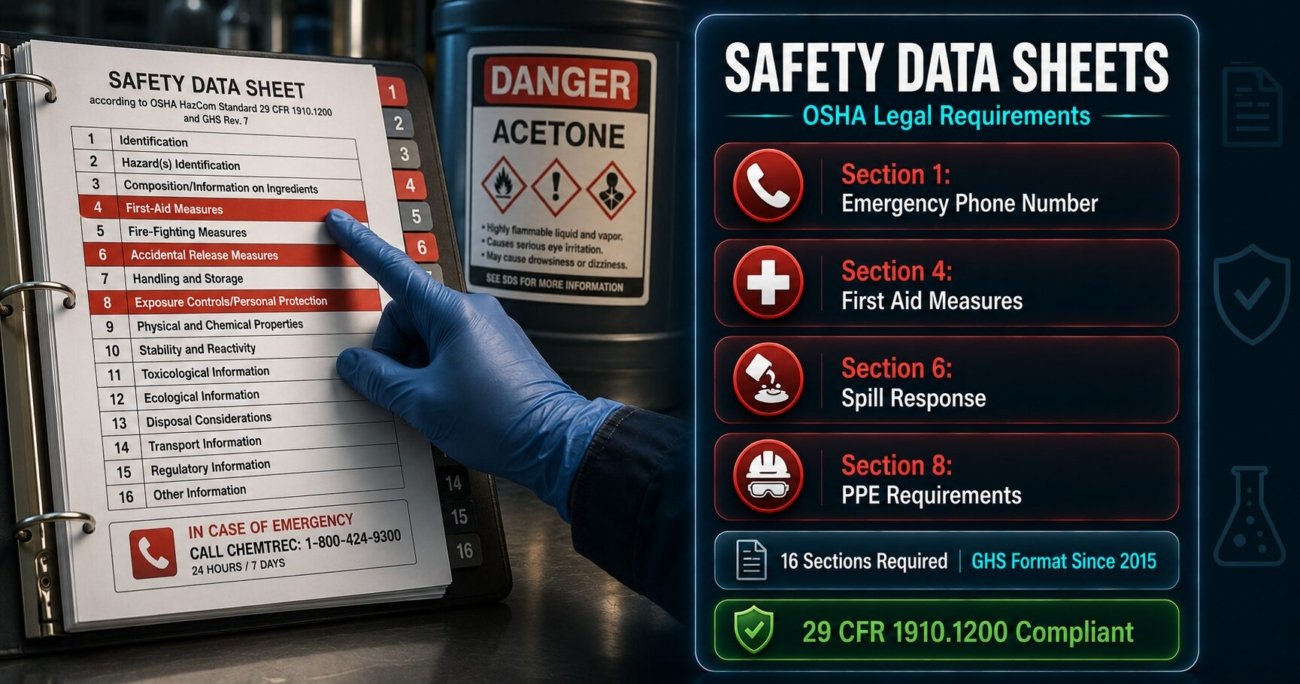
The 16 SDS Sections: What Each One Tells You
Every compliant SDS must contain these 16 sections in order. Knowing what information is in each section allows you to go directly to what you need in an emergency rather than reading the entire document.
In an emergency, you will not have time to read all 16 sections. The four sections you need immediately in a chemical exposure emergency are: Section 4 (First Aid), Section 1 (emergency phone number), Section 8 (PPE for responders), and Section 6 (spill containment if applicable). Know these section numbers before you need them.
Employer Obligations Beyond Maintaining SDS Documents
Obtaining SDS for New Chemicals
When a new hazardous chemical enters the workplace, the employer must obtain the SDS before the chemical is used by employees. SDS documents must accompany or precede the first shipment of a hazardous chemical from a manufacturer or distributor. If an SDS is not provided with a shipment, the employer must obtain one from the supplier before allowing employees to use the chemical.
Employees cannot work with a hazardous chemical for which no SDS is available. This is not a documentation requirement that can be temporarily set aside while awaiting paperwork. It is a condition of lawful use.
Keeping SDS Documents Current
When a supplier provides an updated SDS for a chemical, the employer must update their SDS library. Outdated SDS documents may contain incorrect hazard classifications, obsolete exposure limits, or first aid instructions that do not reflect current medical knowledge. Using an outdated SDS can provide dangerously incorrect guidance during an emergency.
A practical approach is to compare new SDS documents against the version on file whenever a chemical is re-ordered. If the revision date in Section 16 is newer than the document on file, replace it. Automated SDS management systems can track revision dates and alert employers when updates are available.
Material Safety Data Sheets (MSDS) from before the June 2015 GHS alignment deadline are not compliant SDS documents. They use different formats, may use different hazard classifications, and do not follow the 16-section structure required by 29 CFR 1910.1200. If your SDS library contains any document that does not have the 16-section GHS format with a revision date of June 2015 or later, it must be replaced. Many employers discovered during the transition period that their MSDS libraries contained documents that were 10 to 20 years old.
Electronic SDS Systems and Backup Requirements
OSHA permits employers to maintain SDS documents electronically rather than in paper format, but only if the electronic system provides immediate access during all work shifts. If a power outage, system failure, or internet connectivity issue would prevent access to SDS documents, the electronic system alone does not satisfy the ready-access requirement. Employers using electronic SDS systems must have a backup system, such as a paper copy of the most critical SDS documents or an offline-accessible database, to maintain compliance during system outages.
A cloud-based SDS management system that requires internet connectivity provides no access during a network outage. In a chemical emergency during a network outage, the electronic system fails precisely when it is needed most. Employers must ensure that their backup access plan is documented, tested, and known to all employees who may need SDS access during an emergency.
Knowledge Check
Test your understanding of SDS requirements under 29 CFR 1910.1200.
Not necessarily, and likely not for an emergency situation. 29 CFR 1910.1200(g)(8) requires that SDS documents be readily accessible to employees during each work shift in their work area. A five-minute walk to a separate location does not constitute ready access during a chemical emergency. OSHA’s intent is that an employee can retrieve the SDS without significant delay when needed. SDS documents should be located in or immediately adjacent to the work area where the chemical is used, or accessible via an electronic terminal in the immediate work area.
No. Employers must obtain an SDS before allowing employees to use a hazardous chemical. If an SDS was not provided with the shipment, the employer must contact the supplier to obtain one before use begins. Employees may not be required to work with a hazardous chemical for which no SDS is available. The supervisor’s instruction to proceed without an SDS exposes both the employees and the employer to unacceptable risk and constitutes a violation of 29 CFR 1910.1200(g)(6).
The 16-section GHS format became mandatory in June 2015. An SDS dated 2012 in the 16-section format would be unusual and may indicate the date was not updated correctly. However, the more significant question is whether these SDS documents represent the current version of the chemical’s hazard information. Section 16 contains the revision date, and an SDS that has not been revised since 2012 may not reflect updated hazard classifications under GHS, current exposure limits, or revised first aid guidance. The employer should verify with the supplier whether updated SDS documents are available and replace any that are not current.
Section 8 is Exposure Controls and Personal Protective Equipment. It contains the OSHA Permissible Exposure Limits (PELs), ACGIH Threshold Limit Values (TLVs), engineering controls required for the chemical, and specific PPE requirements including the type of gloves, eye protection, respiratory protection, and skin protection required for working with this substance. This is the section that tells a worker exactly what protection they need before handling the chemical. She should find it in the SDS library located in or adjacent to her work area, accessible without supervisor assistance.
SDS Compliance Checklist
✓ An SDS exists for every hazardous chemical used in the workplace
✓ All SDS documents use the 16-section GHS format with revision date of June 2015 or later
✓ SDS documents are readily accessible in or adjacent to each work area during all work shifts
✓ Employees know where the SDS library is located and can access it without delay
✓ SDS documents are obtained before any new hazardous chemical is used by employees
✓ SDS documents are updated when the supplier provides revised versions
✓ Electronic SDS systems have a documented and tested offline backup access plan
✓ Employees are trained to locate the SDS, identify emergency sections, and act on the information
✓ No pre-2015 MSDS documents remain in the SDS library as replacements for compliant SDS
✓ SDS documents for discontinued chemicals are retained for 30 years per OSHA recordkeeping requirements