

A new employee in a chemical blending facility picks up a container from the shelf. She recognises the signal word DANGER but has never been formally trained on GHS pictograms. She sees a red diamond with a black symbol she does not recognise. She proceeds with the task using her usual gloves.
The pictogram was the health hazard symbol, indicating the substance is a respiratory sensitiser. Her usual gloves offered no respiratory protection. By the end of the shift she is coughing. By the following week she has developed occupational asthma, a permanent condition.
The pictogram told her everything she needed to know. She did not know how to read it.
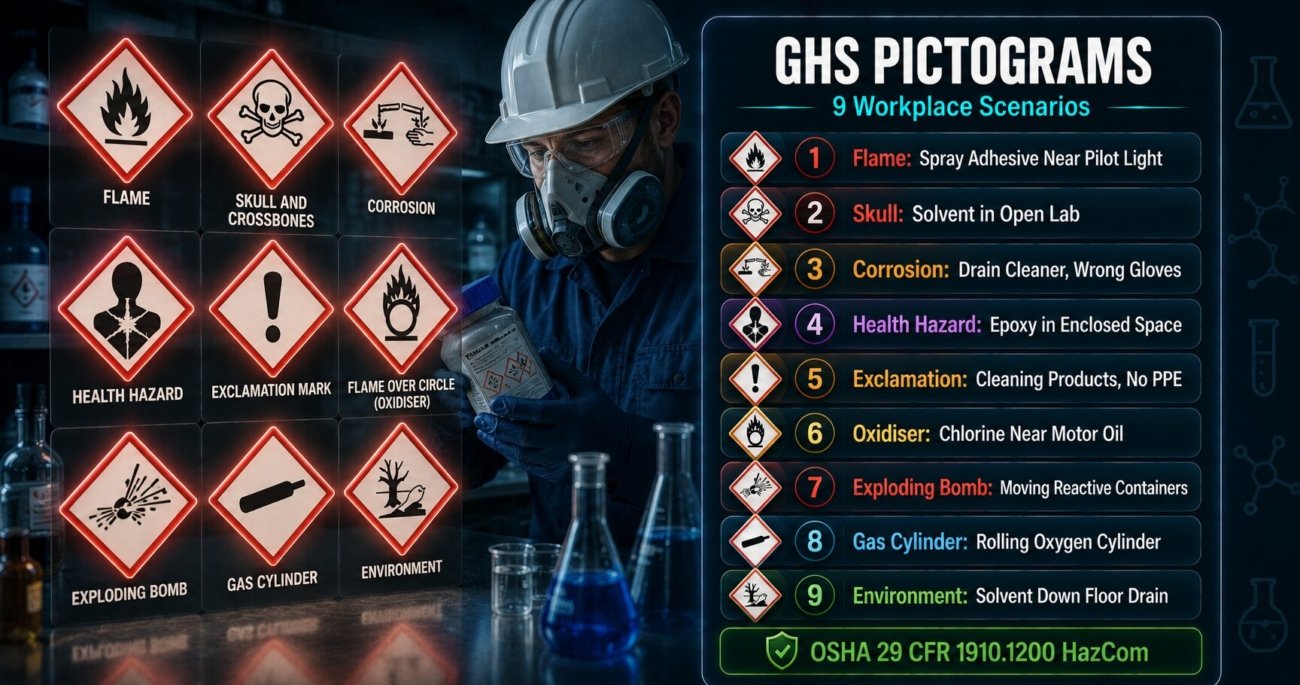
This scenario illustrates what OSHA’s Hazard Communication training requirement under 29 CFR 1910.1200 exists to prevent. Workers who handle chemicals must be able to identify each GHS pictogram, understand what it means, and connect it to the right protective response. These scenarios test that knowledge across nine common workplace situations.
Nine workplace scenarios, one for each GHS pictogram. Each scenario presents a real chemical handling situation, the pictogram that applies, and the correct response. Work through each scenario and check your answers before continuing to the next.
Scenario 1: The Flame Pictogram
A maintenance technician is about to use a spray adhesive in a poorly ventilated equipment room. The label shows the flame pictogram. The room has a pilot light for a heating unit approximately two metres away.
What does the flame pictogram indicate and what must the technician do before applying the adhesive?
The flame pictogram indicates a flammable substance. The spray adhesive is highly flammable, meaning its vapours can ignite in the presence of an ignition source such as the nearby pilot light.
The technician must: Stop and not proceed in this location. Move the work to a well-ventilated area free of ignition sources. Check the precautionary statements on the label for specific guidance (likely P210: Keep away from heat, sparks, and open flames). Ensure adequate ventilation wherever the work is performed. The proximity of a pilot light to a flammable aerosol is a fire and explosion hazard that must be eliminated before the task begins.
Scenario 2: The Skull and Crossbones Pictogram
A laboratory technician receives a new solvent shipment. The container has the skull and crossbones pictogram with the signal word DANGER. A colleague suggests it is fine to work with in the open lab because the amount is small.
What does the skull and crossbones pictogram indicate and does the quantity change the hazard?
The skull and crossbones pictogram indicates acute toxicity at the fatal or toxic level. The substance is classified as highly toxic by one or more routes of exposure (inhalation, skin absorption, or ingestion). DANGER paired with this pictogram indicates the highest severity category of acute toxicity.
The quantity does not change the hazard classification. Small quantities of acutely toxic substances can cause serious harm or death. The technician must consult the precautionary statements and the SDS before proceeding, use a fume hood or other engineering control, wear appropriate PPE including gloves rated for chemical resistance to the specific substance, and follow all exposure precautions regardless of the amount being handled.
Scenario 3: The Corrosion Pictogram
A cleaning crew member is about to use an industrial drain cleaner. The label shows the corrosion pictogram. She is wearing thin latex examination gloves and open-toed shoes.
What does the corrosion pictogram indicate and what PPE is appropriate?
The corrosion pictogram indicates that the substance is corrosive to skin, eyes, or both, and may also be corrosive to metals. Contact with skin or eyes can cause severe chemical burns. The corrosion pictogram requires immediate and serious PPE assessment.
Thin latex examination gloves are not appropriate for corrosive chemicals. Chemical-resistant gloves rated for the specific substance (often thick rubber, neoprene, or PVC) are required. Open-toed shoes must never be worn when handling corrosives. The crew member must also wear face and eye protection (safety goggles or face shield, not just safety glasses) because splash risk is high with drain cleaners. She must not proceed with her current PPE.
Scenario 4: The Health Hazard Pictogram
A painter is applying a two-part epoxy coating in an enclosed stairwell. The hardener component has the health hazard pictogram. He is wearing a dust mask.
What does the health hazard pictogram indicate and is a dust mask sufficient protection?
The health hazard pictogram indicates a serious health hazard, which in the context of epoxy hardeners typically means a respiratory sensitiser or potential carcinogen. Isocyanates and amine hardeners commonly used in two-part epoxy systems are among the most potent respiratory sensitisers in industrial use. Sensitisation is permanent: once sensitised, a worker may develop severe asthma-like reactions to even trace exposures.
A dust mask (filtering facepiece respirator rated for particles only) provides no protection against chemical vapours or reactive chemicals. The painter requires a supplied-air respirator or a full-face respirator with cartridges specifically rated for the vapours in question, based on the SDS for the specific product. Work in an enclosed stairwell without this protection is a serious and irreversible health risk.
Scenario 5: The Exclamation Mark Pictogram
A warehouse worker is restocking shelves with cleaning products. Several containers show the exclamation mark pictogram. He assumes it means minor caution and handles them without gloves.
What does the exclamation mark pictogram indicate and is it safe to handle without PPE?
The exclamation mark pictogram indicates irritants, skin or respiratory sensitisers at lower severity levels, acute toxicity at less severe categories, narcotic effects, or hazards to the ozone layer. It does not mean the chemical is harmless. It means the hazard is less severe than those warranting the skull and crossbones or health hazard pictogram.
Many common cleaning products with the exclamation mark cause significant skin and eye irritation with repeated or prolonged contact. The precautionary statements on the label will specify whether gloves and eye protection are required. For most cleaning products with this pictogram, gloves and eye protection are recommended or required, particularly for repeated or prolonged handling. Assuming safety based on pictogram severity without reading the precautionary statements is not appropriate.
Scenario 6: The Oxidiser Pictogram (Flame Over Circle)
A pool maintenance worker stores containers of chlorine tablets next to cans of motor oil in a small chemical shed. The chlorine containers have the flame-over-circle pictogram. He does not think the chemicals will be used together so sees no problem.
What does the oxidiser pictogram indicate and why is this storage arrangement hazardous?
The flame-over-circle pictogram indicates an oxidising substance. Oxidisers intensify combustion in other materials. They do not need to be used together with a fuel to create a hazard. Their proximity is sufficient to create a risk.
Chlorine tablets stored near combustible materials such as motor oil create a serious fire and explosion risk. If a container is damaged, leaks, or the shed gets hot, the oxidiser can dramatically accelerate the ignition and burning of adjacent combustible materials. Oxidisers must be stored separately from flammable and combustible materials in a cool, dry location with adequate ventilation. The storage arrangement must be corrected immediately regardless of whether the chemicals will ever be used together.
Scenario 7: The Exploding Bomb Pictogram
A worker in a chemical distribution facility is asked to move several containers labelled with the exploding bomb pictogram to a different rack. He plans to use a standard metal hand truck.
What does the exploding bomb pictogram indicate and what handling precautions apply?
The exploding bomb pictogram indicates explosives, self-reactive substances, or organic peroxides capable of explosion or rapid decomposition. This is among the most severe hazard classifications in GHS.
Containers with this pictogram must be handled with extreme care to avoid shock, friction, heat, and sparks. A standard metal hand truck that could drop, tip, or allow containers to knock against each other is not appropriate for these materials without additional precautions. The worker should consult the SDS and site-specific handling procedures before moving these containers. Some materials with this pictogram require specialised handling equipment, temperature control during transport, and specific regulatory authorisation. This is not a standard material movement task.
Scenario 8: The Gas Cylinder Pictogram
A welder’s assistant moves a compressed oxygen cylinder by laying it on its side and rolling it across the floor because the cylinder cart is in use.
What does the gas cylinder pictogram indicate and what is wrong with this handling method?
The gas cylinder pictogram indicates compressed gases, which present both a physical hazard from the pressure inside the cylinder and, depending on the gas, a fire, toxicity, or asphyxiation hazard.
Rolling a compressed gas cylinder on its side is an unsafe handling practice for several reasons. The cylinder valve is the most vulnerable component and can be damaged or sheared off during rolling, causing sudden release of high-pressure gas. An uncontrolled release of compressed oxygen can create a fire accelerant in the surrounding area. Compressed gas cylinders must always be transported in an upright position using a proper cylinder cart, secured with a chain or strap. If the cart is unavailable, the movement should wait until it is available.
Scenario 9: The Environment Pictogram
A technician is disposing of waste solvent by pouring it down a floor drain. The containers have the environment pictogram. She believes it only applies to outdoor handling.
What does the environment pictogram indicate and is floor drain disposal appropriate?
The environment pictogram indicates aquatic environmental hazard, meaning the substance is acutely or chronically toxic to aquatic organisms. Floor drains typically connect to the municipal sewer system, which connects to waterways. Disposing of aquatically toxic chemicals via floor drain is environmental disposal that may violate the Clean Water Act, EPA regulations, and local sewer ordinances, in addition to OSHA’s Hazard Communication requirements.
The precautionary statement P501 (Dispose of contents and container in accordance with local regulations) appears on many containers with this pictogram for exactly this reason. The technician must consult the SDS for disposal requirements, follow the site’s chemical waste disposal procedure, and use an appropriate waste container for hazardous waste pickup. The environment pictogram applies to disposal regardless of whether handling occurs indoors or outdoors.
Lessons Learned Across All Nine Scenarios
Each of the nine scenarios above demonstrates the same underlying principle: the pictogram is not decoration. It is a compressed communication of hazard type and severity that should directly trigger a specific protective response.
Workers who can identify a flame pictogram, immediately think ignition source control, change task location if needed, and verify ventilation are applying the label correctly. Workers who see an oxidiser pictogram and immediately think storage segregation are applying it correctly. Workers who see a health hazard pictogram and think respiratory protection, not just gloves, are applying it correctly.
The nine scenarios also reveal the most common failure mode: assuming that familiarity with a task or a product reduces the need to read and respond to the label. In each scenario, the hazardous outcome was visible in the label information that was available before the task began.
OSHA inspectors evaluating HazCom compliance routinely ask workers to identify pictograms on containers in their immediate work area. A worker who can point to the health hazard pictogram and explain that it means the chemical may be a carcinogen or respiratory sensitiser demonstrates genuine training effectiveness. A worker who says only that it means the chemical is dangerous has not received training that meets the standard’s intent.