
A maintenance worker opens a chemical cabinet to retrieve a cleaner for a floor spill. The original label fell off three weeks ago and was never replaced. The container looks similar to two others on the shelf. He picks the wrong one.
The chemical he applies to the spill reacts with a residue already on the floor. Within seconds, fumes fill the room. Three workers are evacuated. One requires medical attention for respiratory irritation.
The container without a label was a OSHA Hazard Communication violation before it caused any harm. After the incident, it became the centre of a citation package that also covered inadequate training and missing Safety Data Sheets.
Chemical labels are not administrative paperwork. They are the first line of communication between a hazardous substance and the worker handling it. Understanding what every element of a GHS-aligned label means is a foundational worker safety competency.
OSHA’s Hazard Communication Standard (HCS), 29 CFR 1910.1200, aligns with the United Nations Globally Harmonised System of Classification and Labelling of Chemicals (GHS). Any container of a hazardous chemical in the workplace must have a compliant label. A worker who cannot read and interpret that label cannot make informed decisions about handling, PPE selection, or emergency response.
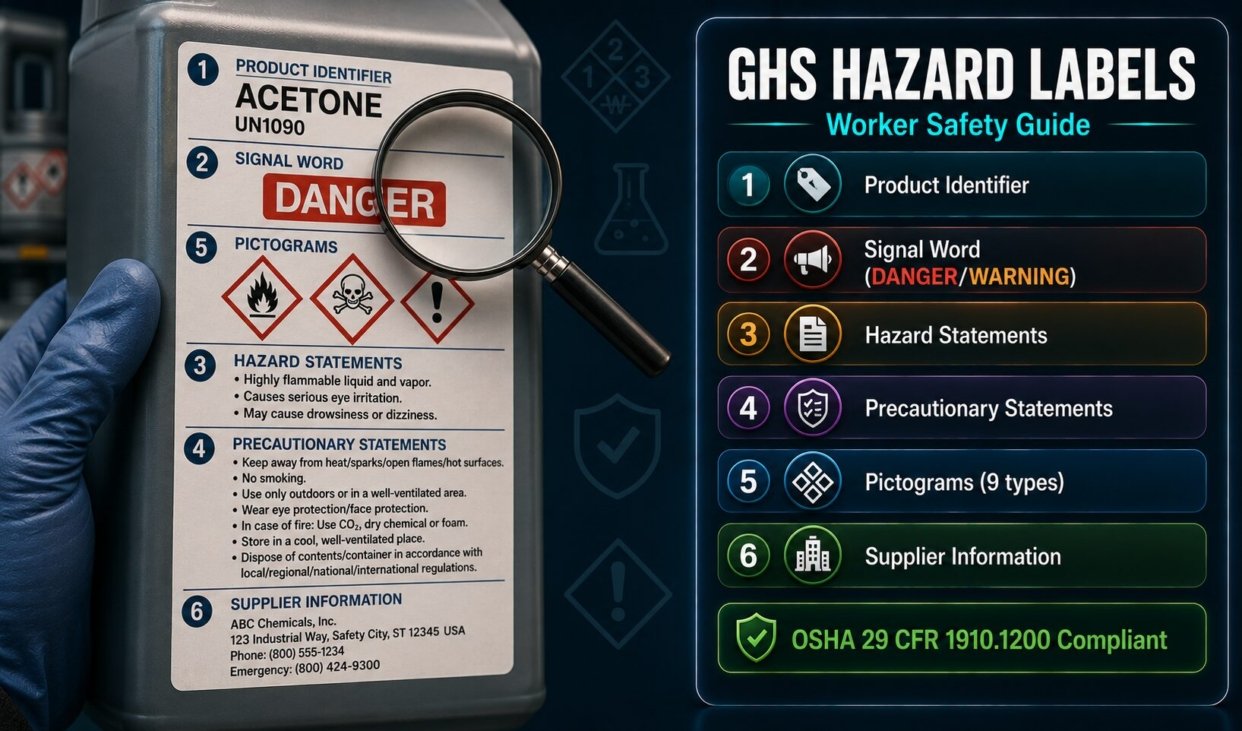
The Six Required GHS Label Elements
Under 29 CFR 1910.1200(f), every label on a hazardous chemical shipped after June 1, 2015 must contain six required elements. Understanding each one tells you what the chemical is, how dangerous it is, and what to do if something goes wrong.
The product identifier is the name or number used for the hazardous chemical on the label and in Section 1 of the Safety Data Sheet. It allows the worker and emergency responders to quickly cross-reference the SDS for detailed hazard information. The product identifier may be a chemical name, code number, or batch number, but it must match the identifier used in the SDS. If the product identifier on the label does not match any SDS in your workplace file, that is a compliance gap.
The signal word indicates the severity of the hazard. There are only two GHS signal words: DANGER and WARNING. DANGER is used for more severe hazards. WARNING is used for less severe hazards. A chemical can only have one signal word. If a chemical has multiple hazards, the more severe signal word is used. Workers should treat DANGER labels with heightened precaution even before reading the full label.
Hazard statements describe the nature and degree of the hazard in standardised language. Each hazard statement is assigned a unique alphanumeric code (H-codes). For example, H225 means Highly flammable liquid and vapour and H301 means Toxic if swallowed. A label may include multiple hazard statements if the chemical has multiple hazards. Reading the hazard statements before working with a chemical tells you exactly what can go wrong and how serious it is.
Precautionary statements describe recommended measures to minimise or prevent adverse effects from exposure or improper storage and disposal. They are assigned P-codes. Examples include P210 (Keep away from heat, sparks, and open flames), P260 (Do not breathe dust, fumes, gas, mist, vapours, or spray), and P501 (Dispose of contents and container in accordance with local regulations). Precautionary statements directly tell the worker what to do and what not to do when handling the chemical.
GHS pictograms are black symbols inside a red diamond border on a white background. There are nine GHS pictograms, each representing a category of hazard. The flame indicates flammable materials. The skull and crossbones indicates acute toxicity. The exclamation mark indicates irritants, sensitisers, and less severe toxicity. The health hazard symbol (person with starburst on chest) indicates serious health hazards such as carcinogens and respiratory sensitisers. The corrosion symbol indicates materials that destroy skin or metals. Workers who can identify pictograms at a glance can assess hazard type instantly, even before reading the text.
The label must include the name, address, and telephone number of the manufacturer, importer, or other responsible party. This information allows workers and emergency responders to contact the supplier for additional information in the event of an exposure, spill, or fire involving the chemical. In an emergency, this contact information can provide guidance beyond what is on the label itself.
The Nine GHS Pictograms and What They Mean
You do not need to memorise every H-code and P-code on a label. You do need to recognise each of the nine pictograms and know which hazard category each one represents. That instant visual recognition is what allows you to make fast, safe decisions when handling unfamiliar chemicals.
Workplace Labels: What Changes Once the Chemical Is on Site
Secondary Container Labelling
When a chemical is transferred from its original manufacturer container into a secondary container for workplace use, the secondary container must also be labelled. The label does not need to replicate every element of the original GHS label, but it must identify the product and include any hazard warnings necessary to protect workers using it.
A worker who pours a chemical from its original labelled container into an unlabelled spray bottle has created a compliance violation and a safety hazard. If that spray bottle is left on a shelf, the next person to pick it up has no information about what it contains.
Unlabelled secondary containers are the most common HazCom labelling violation found during OSHA inspections. The incident in the opening of this article began with exactly this situation. Every container of a hazardous chemical in the workplace must be labelled, including spray bottles, buckets, and any other transfer containers. The minimum information required is the product identifier and appropriate hazard warnings.
Damaged or Missing Labels
A container with a damaged label that cannot be read, or a container from which the label has been removed, must be relabelled before it is used or returned to storage. If the chemical cannot be positively identified, it must be treated as an unknown hazardous chemical and handled accordingly, which typically means isolating it and contacting the supplier or safety officer before proceeding.
Never remove a label from a chemical container. Never allow a container with an unreadable label to remain in service. The label is the primary hazard communication tool for that container. Without it, workers cannot make informed decisions about handling, PPE, or emergency response.
Conduct a periodic label audit of all chemical storage areas. Check that every container has a legible label, that secondary containers are labelled, and that no unlabelled containers are present. A quarterly walk-through of chemical storage areas specifically to check label integrity takes less than thirty minutes and prevents the compliance and safety failures that unlabelled containers create.
Common Labelling Mistakes That Create Hazards
Adding stickers, price tags, or tape over any portion of a chemical label obscures required hazard information. If additional information must be added to a container, it must be placed in a location that does not cover any of the six required label elements.
Every element of a GHS label is intended for use by workers handling the chemical in normal operations, not just in emergencies. Precautionary statements tell you what PPE to wear, how to store the chemical safely, and what to do if it contacts skin or eyes. Reading the label before each new chemical use is a basic safety practice.
Supplier reformulations, reclassifications, and label updates mean that a chemical you have used for years may have a different label than it had previously. When a new shipment of a familiar chemical arrives, compare the new label to the previous one. If the hazard statements or precautionary statements have changed, workers need to know.
Hazard Communication Label Checklist
✓ The container has a legible label with all six required GHS elements
✓ I have read the signal word (DANGER or WARNING) and understand its significance
✓ I have identified the pictograms and know what hazard categories they represent
✓ I have read the hazard statements and understand what hazards this chemical presents
✓ I have read the precautionary statements and know what PPE is required
✓ If I transferred the chemical to a secondary container, that container is labelled
✓ I know the location of the SDS for this chemical
✓ Any damaged or missing labels have been reported and the container removed from service
✓ I have not covered any label information with tape, stickers, or other materials