

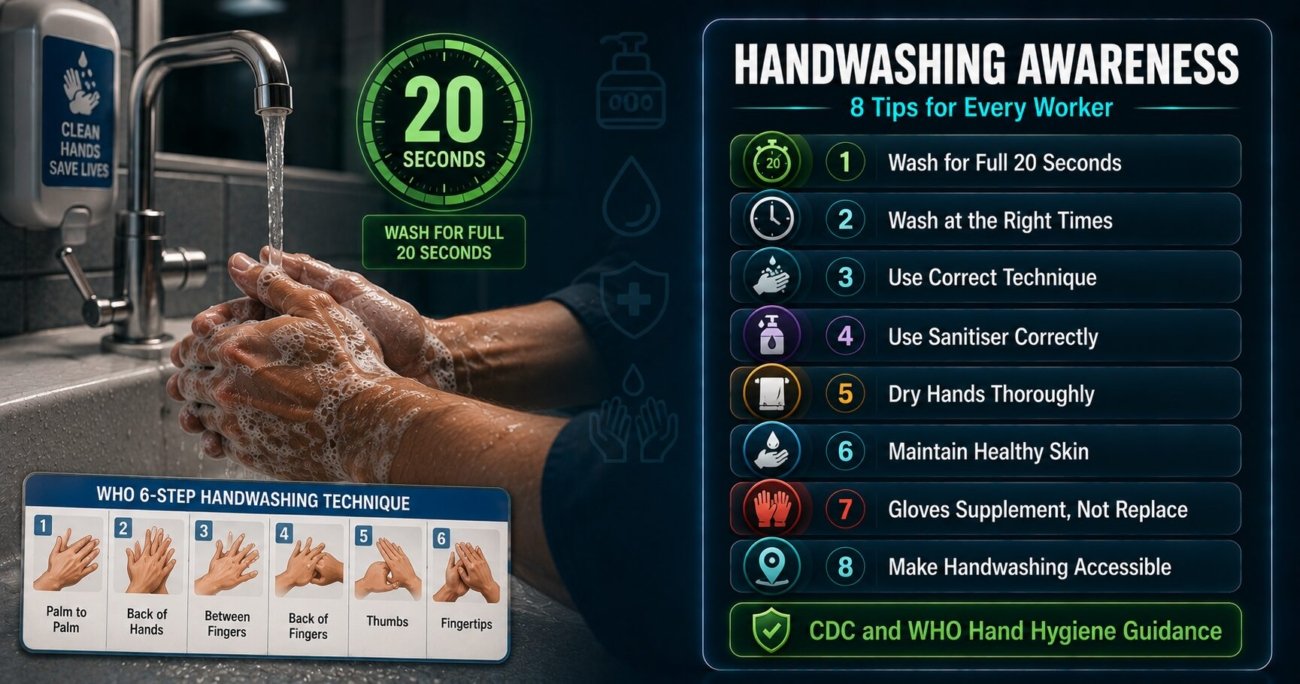
Handwashing is the single most effective infection control measure available to every worker in every workplace. It costs nothing, takes less than 20 seconds, and prevents the transmission of bacteria, viruses, and other pathogens that cause illness, lost workdays, and serious health complications.
Most workplaces have soap and water. Most workers know they should wash their hands. The gap between knowing and doing consistently is what these tips address.
Tip 1: Wash for the Full 20 Seconds Every Time
The duration of handwashing matters. Hands that are rinsed briefly under water for three or four seconds are not effectively decontaminated. The CDC and WHO both recommend lathering with soap and scrubbing all surfaces of the hands for at least 20 seconds before rinsing.
Twenty seconds is approximately the time it takes to hum the Happy Birthday song twice from beginning to end. This is not a guideline that can be shortened without reducing effectiveness. Studies of hand hygiene compliance consistently show that the most common deviation from proper technique is insufficient duration.
Post a visible timer or a 20-second reminder near every handwashing station in your workplace. Workers who see a visual cue at the sink are measurably more likely to wash for the recommended duration than those who rely on their own sense of time.
Tip 2: Wash at the Right Times, Not Just When Hands Look Dirty
Invisible contamination is the primary handwashing concern in most workplaces. Hands that look and feel clean can carry thousands of bacteria and viral particles capable of causing illness. Basing handwashing decisions on whether hands look dirty will consistently underestimate actual contamination levels.
The moments that require handwashing regardless of visible contamination include: before eating or drinking, after using the restroom, after coughing or sneezing into hands, after touching shared surfaces such as door handles, keyboards, and phones, after removing gloves, before and after patient contact in healthcare settings, and after handling waste or cleaning materials.
Do: Wash hands after removing gloves. Gloves develop micro-perforations during use, and the inside of a glove is a warm, moist environment that supports bacterial growth. Hands are not clean simply because they were gloved.
Avoid: Using hand sanitiser as a routine substitute for soap and water when soap is available. Alcohol-based sanitisers are effective against many pathogens but do not remove physical contamination, spores, or certain resistant organisms such as Clostridioides difficile.
Tip 3: Use the Correct Technique, Not Just Soap and Water
Soap and water alone do not decontaminate hands. The mechanical action of rubbing, the coverage of all surfaces, and the rinsing action are what remove pathogens. Washing only the palms while neglecting the backs of hands, between fingers, around the thumbs, and under the fingernails leaves significant contamination in place.
The WHO’s six-step handwashing technique covers all surfaces systematically: palm to palm, backs of hands, interlaced fingers, backs of fingers, rotational rubbing of thumbs, and rotational rubbing of fingertips against palm. Any technique that consistently neglects the same surfaces leaves a predictable contamination pathway.
Under-nail areas are among the most heavily colonised surfaces on the hands and among the most consistently missed during handwashing. If your work involves direct contact with food, patients, or vulnerable individuals, use a nail brush as part of your handwashing routine. Keep fingernails short and avoid artificial nails if hand hygiene is a critical part of your role.
Tip 4: When Soap and Water Are Not Available, Use Alcohol-Based Hand Sanitiser Correctly
Alcohol-based hand sanitisers containing at least 60% alcohol are effective against most bacteria and viruses when soap and water are not available. They are appropriate for hands that are not visibly soiled and in situations where a sink is not immediately accessible.
The correct technique for sanitiser use is to apply enough product to cover all hand surfaces (typically 1.5 to 3 mL), rub all surfaces together using the same coverage pattern as handwashing, and continue rubbing until the hands are dry. Rubbing for only two or three seconds before the hands are dry, or wiping the sanitiser off before it dries, significantly reduces its effectiveness.
Do: Return to soap and water as soon as a sink is available if you have been relying on sanitiser for multiple applications. Repeated sanitiser use without periodic soap-and-water washing can allow accumulation of inactive ingredients, dirt, and some resistant organisms.
Avoid: Using sanitiser after contact with blood, body fluids, or chemical contamination. These situations require soap and water to remove physical contamination before any residual antimicrobial protection is meaningful.
Tip 5: Dry Hands Thoroughly After Washing
Wet hands transfer pathogens more effectively than dry hands. The drying step is not optional. Studies of hand hygiene in clinical and food handling environments consistently show that inadequately dried hands recontaminate contact surfaces and undermine the decontamination achieved by washing.
Paper towels are preferred in healthcare and food handling settings because they physically remove residual organisms during the drying action and do not recirculate air over the hands. If air dryers are used, hands should be dried completely before leaving the sink area. Wiping hands on clothing after washing negates much of the benefit of the wash.
Ensure that handwashing stations in your workplace have adequate paper towel or dryer access at all times. A sink without drying materials nearby will consistently result in workers skipping the drying step or drying hands on clothing. Restocking drying materials is as important as restocking soap.
Tip 6: Maintain Healthy Skin to Support Effective Hand Hygiene
Frequent handwashing and sanitiser use can dry and crack the skin on the hands. Damaged skin is both more susceptible to infection and a source of contamination. Cracks and fissures in the skin harbour bacteria in ways that handwashing cannot fully address.
Using skin-compatible, fragrance-free hand lotion after handwashing in environments with high wash frequency supports skin integrity without reducing hand hygiene effectiveness. Employers in healthcare, food service, and other high-frequency handwashing settings should provide hand lotion at or near handwashing stations as part of their hand hygiene programme.
If your hands are regularly cracked or broken due to frequent washing, speak with your occupational health provider or a dermatologist. Occupational contact dermatitis from repeated handwashing is a recognised workplace health condition. Appropriate moisturiser selection and skin protection protocols are part of a complete hand hygiene programme, not an afterthought.
Tip 7: Know When Gloves Supplement Hand Hygiene, Not Replace It
Gloves protect against specific contamination exposures but do not eliminate the need for handwashing. Hands must be washed before putting on gloves and immediately after removing them. Gloves are single-use items in clinical and food handling contexts and must be changed between tasks to prevent cross-contamination.
Wearing the same pair of gloves across multiple tasks, or wearing gloves as a substitute for handwashing, creates a false sense of cleanliness while potentially spreading contamination more widely than bare ungloved hands would. The glove exterior picks up contamination from every surface it contacts and transfers it to the next surface touched.
Train staff that gloves are a contamination barrier for a specific task, not a hygiene shortcut. In food handling, healthcare, and laboratory settings, glove change and hand hygiene protocols are regulatory requirements under OSHA, FDA Food Code, and accreditation standards. Supervisors who observe staff reusing disposable gloves across multiple tasks should intervene and retrain immediately.
Tip 8: Make Handwashing Easy and Visible in Your Workspace
Handwashing compliance in workplaces is directly correlated with how accessible and convenient the handwashing facilities are. Sinks that require a long walk, soap dispensers that are frequently empty, and paper towel holders that are routinely out of stock all reduce compliance predictably and measurably.
Where fixed sinks are not available, portable handwashing stations or readily accessible hand sanitiser dispensers near task areas significantly increase compliance without requiring behaviour change. Placing hand hygiene materials at the point of need removes the friction that causes people to skip the step.
Check the handwashing supplies in your immediate work area at the start of every shift: soap level, paper towel supply, hand sanitiser if applicable. Reporting a low or empty dispenser at the start of the day prevents compliance failures later in the shift. Hand hygiene infrastructure is a shared responsibility, not just a facilities management function.
Handwashing Compliance Checklist
✓ Wash hands for a full 20 seconds with soap and water at key moments throughout the shift
✓ Cover all surfaces: palms, backs, between fingers, thumbs, and under nails
✓ Wash after using the restroom, before eating, after removing gloves, and after contact with shared surfaces
✓ Dry hands completely with paper towel or air dryer before leaving the sink
✓ Use alcohol-based sanitiser (min 60% alcohol) when soap and water are not immediately available
✓ Apply sanitiser to all surfaces and rub until fully dry, not wiped off
✓ Change gloves between tasks and wash hands before and after glove use
✓ Apply hand lotion as needed to prevent cracking from frequent washing
✓ Check and report low soap and paper towel supplies at the start of each shift