LAW — Medicare Compliance
CMS Compliance Programme Requirements
for Medicare Advantage and Part D Plans
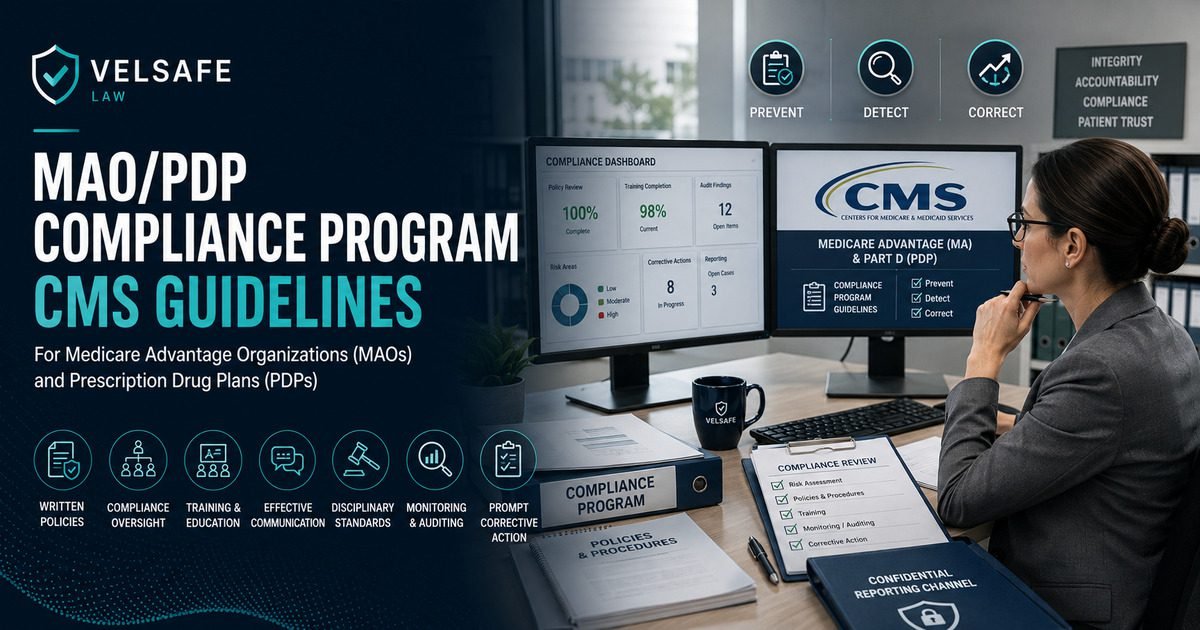
Medicare Advantage Organisations and Part D sponsors face civil monetary penalties and contract termination for compliance programme failures under 42 CFR 422.503 and 423.504. Seven required programme elements define what CMS expects of every plan.
$25,000
Max CMP Per Violation
Civil monetary penalty per violation under 42 CFR 422.752 for compliance deficiencies directly controlled by the plan.
42 CFR 422.752, CMS
7
Required Programme Elements
Core elements required by CMS and the OIG for an effective compliance programme in every Medicare Advantage and Part D plan.
OIG Compliance Guidance, HHS
Annual
CMS Programme Audits
CMS conducts annual programme audits of MA and Part D plans, with compliance programme deficiencies among the most commonly cited findings.
CMS Programme Audit Division
CMS mandates a formal compliance programme for every Medicare Advantage Organisation (MAO) and Prescription Drug Plan (PDP) sponsor under 42 CFR 422.503 and 42 CFR 423.504. These are not general best-practice recommendations. They are enforceable regulatory requirements tied directly to plan contract authority. A plan operating without the seven required programme elements is non-compliant by definition and subject to enforcement action regardless of its claims experience or beneficiary satisfaction scores.
Enforcement consequences include civil monetary penalties (CMPs), enrollment suspensions, and contract termination. CMS also requires plans to flow compliance obligations down to all First Tier, Downstream, and Related Entities (FDRs) that perform administrative or health care functions on the plan’s behalf. A vendor’s compliance failure is the plan’s regulatory failure. This article covers the legal framework, the seven required elements, penalty exposure, and the programme gaps CMS most commonly cites during audits.
Compliance officers reviewing this article should read it alongside the applicable Parts of 42 CFR, the CMS Medicare Managed Care Manual (Chapter 21), and the relevant HPMS memoranda for the current contract year. Requirements are updated annually.
1. The Legal Framework: Why Compliance Programmes Are Mandatory
CMS derives its compliance programme authority from the Social Security Act, specifically the provisions governing Medicare Advantage contracts under Part C and prescription drug benefit contracts under Part D. The regulatory implementation appears at 42 CFR 422.503(b)(4)(vi) for MAOs and 42 CFR 423.504(b)(4)(vi) for PDP sponsors. Both provisions require the plan to have an effective compliance programme that includes specific required elements and applies to the plan’s first-tier, downstream, and related entities.
The OIG’s Compliance Program Guidance for Medicare Advantage Organisations and Prescription Drug Plan Sponsors forms the practical foundation for these requirements. While OIG guidance is advisory rather than regulatory, CMS adopts its structure in programme audit protocols. Plans audited without programme elements that track to OIG guidance face findings even when they argue an alternative approach. Compliance officers should treat OIG guidance as the de facto minimum standard.
Key Statistics — Compliance Programme Enforcement
$100,000
Maximum CMP per beneficiary for misrepresentations by an MAO under 42 CFR 422.752(a)(1). Applies to each false statement or misleading representation to current or prospective beneficiaries.
42 CFR 422.752(a)(1), CMS
Chapter 21
CMS Medicare Managed Care Manual Chapter 21 contains detailed compliance programme guidance that CMS uses during programme audits. Plans must demonstrate alignment with its requirements at audit.
CMS Medicare Managed Care Manual
FDR Flow-Down
Plans must contractually require all FDRs to comply with the plan’s compliance programme requirements. A vendor’s non-compliance is treated as the plan’s non-compliance during CMS programme audits.
42 CFR 422.503(b)(4)(vi)
Contract Termination
CMS may terminate a plan’s contract for compliance programme failures under 42 CFR 422.510. Non-renewal is also available where programme deficiencies are uncorrected across contract years.
42 CFR 422.510, CMS
2. Who Must Comply: MAOs, PDPs, and FDRs Under 42 CFR Part 422
Entity Type
Applicable Standard
Compliance Obligation
Medicare Advantage Organisation (MAO)
42 CFR 422.503(b)(4)(vi)
Must maintain an effective compliance programme with all 7 required elements. Direct regulatory obligation as a contracted plan sponsor.
PDP Sponsor (Part D)
42 CFR 423.504(b)(4)(vi)
Parallel obligation to MAOs. PDP sponsors must maintain an effective compliance programme covering Part D benefit administration, formulary management, and sponsor operations.
First Tier Entities (FTEs)
42 CFR 422.503(b)(4)(vi)
Plans must contractually require FTEs (such as PBMs, TPAs, and provider networks) to comply with relevant elements of the plan’s compliance programme.
Downstream and Related Entities
42 CFR 422.503(b)(4)(vi)
Entities contracted with FTEs that perform delegated administrative or health care functions must also comply. The compliance obligation flows through the contracting chain.
Source: 42 CFR 422.503 | 42 CFR 423.504
The FDR obligation is one of the most frequently misunderstood aspects of Medicare compliance requirements. A plan’s compliance programme does not stop at the plan’s own employees. When a PBM processes pharmacy claims, when a TPA handles appeals and grievances, or when a vendor conducts member outreach, those activities are subject to the plan’s compliance requirements. The plan must contractually flow this obligation down and must monitor FDR compliance through an ongoing oversight programme.
3. The Seven Required Elements of a CMS-Compliant Programme
CMS requires every MAO and PDP sponsor to implement and maintain an effective compliance programme covering seven core elements, drawn from OIG compliance programme guidance and embedded in the conditions for contract award and retention. The absence of any single element constitutes a programme deficiency that CMS auditors will document as a finding.
Element 1: Written Policies, Procedures, and Standards of Conduct
Plans must maintain written policies that define expected conduct, prohibit fraud and abuse, address legal and ethical obligations under the Medicare programme, and establish clear accountability. These documents must be reviewed and updated at least annually and made accessible to all employees and FDRs. Policies must address the plan’s obligations under Parts 422 and 423, CMS marketing rules, and applicable OIG guidance.
Element 2: Compliance Officer and Compliance Committee
The plan must designate a Chief Compliance Officer (CCO) with sufficient authority, resources, and independence to implement the compliance programme. The CCO must report directly to the plan’s board of directors or CEO and must have direct access to the board’s audit committee. A compliance committee composed of senior leadership must oversee programme implementation and review audit findings. CMS assesses whether the CCO has genuine authority or is a nominal designation.
Element 3: Effective Training and Education
All employees, governing body members, and FDR staff who perform functions related to the Medicare programme must receive compliance training. CMS requires initial training within a defined period of hire and annual refresher training thereafter. Training must cover general compliance principles, the plan’s specific policies, FWA prevention, and applicable regulations. Documentation of training completion is a hard audit requirement.
Element 4: Effective Lines of Communication
Plans must establish accessible, confidential reporting mechanisms for employees, FDRs, and members to report compliance concerns, suspected FWA, and policy violations. This includes a toll-free compliance hotline or equivalent mechanism that allows anonymous reporting. The plan must demonstrate that reports are logged, investigated, resolved within appropriate timeframes, and that no retaliation occurs against individuals who report in good faith.
Element 5: Well-Publicised Disciplinary Standards
The compliance programme must include clear, documented disciplinary policies that define consequences for compliance violations. These standards must be communicated to all employees and contractors. Plans must demonstrate that disciplinary actions are actually taken for compliance violations and that similarly situated employees are treated consistently. A paper policy without evidence of enforcement will not satisfy this element during a programme audit.
Element 6: Effective Auditing and Monitoring
Plans must implement a systematic programme for identifying and assessing compliance risks through ongoing monitoring and periodic audits. This includes monitoring of claims data for FWA indicators, audits of appeals and grievances processing, review of marketing materials, and assessment of FDR compliance. The audit work plan must be risk-based, updated annually, and documented. Findings must be tracked through to resolution with corrective action plans.
Element 7: Response to Detected Offences and Corrective Action
When a compliance issue is identified, the plan must respond promptly. This means initiating an investigation, identifying root cause, implementing corrective action, and monitoring through completion. Where violations involve potential overpayments, the plan must address repayment obligations under applicable law. CMS assesses whether the corrective action programme reflects genuine remediation or merely documentation of problems without resolution.
4. Civil Monetary Penalties and Enforcement Actions
CMS enforcement authority derives from 42 CFR 422.750 through 422.758 for MAOs and 42 CFR 423.750 through 423.758 for PDP sponsors. These provisions establish a graduated enforcement framework ranging from warning letters and CMPs to enrollment suspension and contract termination. The severity of the sanction depends on the nature of the violation, whether the plan had prior notice, and whether corrective action was taken before or after CMS identified the issue.
Violation Type
Maximum Penalty
Regulatory Authority
Deficiencies directly controlled by the MAO
$25,000 per violation
42 CFR 422.752(a)(2)
Misrepresentation to beneficiaries or HHS
$100,000 per beneficiary
42 CFR 422.752(a)(1)
Discriminatory practices against beneficiaries
$100,000 per violation
42 CFR 422.752(a)(3)
Obstruction of CMS audit or investigation
$100,000 per violation
42 CFR 422.752(a)(4)
Contract termination
Loss of Medicare contract
42 CFR 422.510
Source: 42 CFR Part 422 Subpart O | 42 CFR Part 423 Subpart O
CMS also has authority to impose intermediate sanctions, including suspension of enrollment of new beneficiaries and suspension of marketing, when a plan’s deficiencies represent a serious risk to beneficiary health or access. These intermediate sanctions may be imposed while a corrective action plan is in place and are lifted once CMS determines the deficiencies have been corrected. Plans facing intermediate sanctions typically experience significant negative publicity that affects future enrollment.
5. Common Compliance Failures That Trigger CMS Action
CMS programme audits assess MAO and PDP compliance across multiple audit areas, including coverage determinations, appeals and grievances, and organisation determinations. Compliance programme deficiencies appear across virtually all audit areas because a weak programme fails to detect and correct operational problems before they become audit findings. These are the failures CMS most commonly documents.
Insufficient CCO Authority
CMS auditors review organisational charts, board minutes, and CCO reporting lines to determine whether the CCO has genuine independence and authority. A CCO who reports to the general counsel or CFO rather than the board or CEO fails this element. Plans that have designated compliance titles without delegating real oversight authority will receive an adverse finding. The CCO must be able to report to and access the board without filtering through operational leadership.
Incomplete FDR Training Documentation
Plans are routinely cited when they cannot produce training completion records for FDR employees who perform Medicare-related functions. The plan must either conduct FDR training directly or obtain attestations confirming that compliant training was completed. Relying on FDRs to self-attest without verifying the content and completion of training is a common programme gap that CMS auditors identify through FDR interviews and record review.
Hotline Without Investigation Documentation
Many plans establish a compliance hotline but fail to maintain auditable records of reports received, investigations conducted, and outcomes documented. CMS auditors request the compliance hotline log and trace selected reports through investigation to resolution. A hotline with low call volume combined with no investigation records suggests either that the hotline is not effectively publicised or that reports are not being handled through the compliance programme.
Audit Plan Without Evidence of Execution
CMS distinguishes between plans that have an annual audit work plan and plans that actually execute it. Work plans without corresponding audit reports, findings, and corrective action plans signal a compliance programme that exists on paper but not in practice. Auditors request work plans alongside evidence of work performed, including audit samples, methodologies, findings, and management responses. An unexecuted work plan is equivalent to no work plan under CMS audit standards.
6. Plan Responsibilities: What Compliance Officers Must Manage
The compliance officer carries direct accountability for ensuring the programme meets regulatory standards, but the responsibility for compliance is distributed across the organisation. The CCO must manage a structured oversight process that reaches every operational area with Medicare contract obligations. These areas require ongoing compliance attention regardless of plan size.
Compliance Programme Coverage Areas
FWA Detection and Reporting
Critical
Plans must detect, investigate, and report suspected FWA to CMS and law enforcement. This includes prospective and retrospective claims review and trending analysis.
Coverage Determinations and Appeals
High
CDAG and ODAG audit areas consistently generate audit findings. Compliance must monitor timeliness, denial rates, and reversal rates across all levels of review.
Marketing and Member Communications
High
All marketing materials must be approved by CMS or submitted through HPMS. Compliance must maintain a material approval and version-control process covering all channels.
FDR Oversight and Monitoring
High
Plans must conduct ongoing monitoring of FDR performance, including audit rights in contracts, annual attestations, and oversight of training completion across the vendor chain.
Exclusion Screening
Moderate
Plans must screen all employees, contractors, and providers against OIG and GSA exclusion lists at hire and monthly thereafter to prevent excluded individuals from billing Medicare.
Source: CMS Programme Audit Division | OIG Compliance Guidance
Exclusion screening deserves particular attention. OIG exclusion orders prohibit excluded individuals and entities from receiving payment from any federal health care programme, including Medicare. A plan that employs or contracts with an excluded individual may face CMPs, repayment demands, and potential exclusion from the Medicare programme. CMS expects monthly screening of all employees and FDRs against the OIG List of Excluded Individuals and Entities (LEIE) and the GSA System for Award Management (SAM) exclusion database.
Legal Disclaimer
This article provides educational information about regulations and legal requirements. It does not constitute legal advice. Requirements vary by industry, jurisdiction, and specific workplace conditions. Consult a qualified safety professional or employment attorney for guidance specific to your workplace.
Key Takeaways
The Compliance Programme Is a Contract Condition
An effective compliance programme under 42 CFR 422.503 and 423.504 is not optional for MAOs and PDPs. It is a condition for receiving and retaining a Medicare contract. CMS can terminate a contract for compliance programme failures. Plans must treat compliance programme maintenance as an operational priority equal to claims processing and member services.
FDR Compliance Is the Plan’s Responsibility
When a PBM, TPA, or provider network fails to meet compliance programme requirements, the MAO or PDP sponsor owns that failure in CMS’s assessment. Plans must build FDR oversight into contracts, conduct ongoing monitoring, and verify training completion. An undocumented FDR oversight programme is one of the most common causes of adverse audit findings across plan sizes.
Paper Programmes Do Not Pass CMS Audits
CMS auditors distinguish between compliance programmes that exist in policy documents and those that operate in practice. A plan with comprehensive written policies but no investigation logs, no executed audit reports, no documented disciplinary actions, and no training completion records will receive the same adverse findings as a plan with no programme at all. The programme must be operational, documented, and provably active. Evidence of implementation is the standard, not the existence of a policy manual.
Frequently Asked Questions
What is the difference between a Medicare Advantage Organisation compliance programme and a general healthcare compliance programme?
An MAO compliance programme must address specific CMS programme requirements under 42 CFR Part 422, including coverage determination timeliness, marketing material approval, Part C bid requirements, and FDR oversight. A general healthcare compliance programme typically follows OIG guidance for hospitals or physician practices and addresses different risk areas such as coding accuracy and clinical documentation. MAO compliance officers must be versed in Medicare Advantage-specific regulatory requirements.
Can a small Medicare Advantage plan meet compliance programme requirements with limited staff?
CMS does not provide a formal size exemption from compliance programme requirements. Smaller plans must meet the same seven-element standard as large national plans. However, CMS has acknowledged that the scope of activities can be scaled to reflect the plan’s size, complexity, and risk profile. A small plan may satisfy training requirements through shared resources, but the CCO must still have direct access to the board and genuine authority over compliance matters.
How often does CMS audit Medicare Advantage and Part D plans?
CMS conducts routine programme audits annually across a sample of Medicare Advantage and Part D plans. Plans selected for audit receive an audit notice and a defined audit period. CMS also conducts targeted audits triggered by complaint data, beneficiary grievances, or prior audit findings. Plans that received adverse findings in a prior audit cycle are more likely to be selected for follow-up in subsequent years.
What must a plan do when it self-identifies a compliance violation?
When a plan identifies a compliance violation, Element 7 requires a prompt investigation, root cause analysis, corrective action implementation, and ongoing monitoring of the corrective action. Where the violation involves potential overpayments from Medicare, the plan must assess its repayment obligations under applicable law. Voluntary self-disclosure to CMS or the OIG may be appropriate depending on the nature and scope of the violation. Plans should consult legal counsel before making self-disclosure decisions.
Are pharmacy benefit managers (PBMs) required to comply with MAO compliance programmes?
Yes. A PBM contracted by a PDP sponsor or MAO to administer pharmacy benefits is a First Tier Entity under CMS regulations. The plan must contractually require the PBM to comply with applicable elements of the compliance programme, including FWA training, exclusion screening, and reporting obligations. The plan must also conduct ongoing oversight of the PBM’s compliance programme activities. A PBM’s compliance failure is attributed to the plan during CMS programme audits.
What does CMS look for when assessing whether a compliance programme is effective?
CMS assesses effectiveness through evidence of actual programme operation. This includes review of investigation logs, audit work plans with corresponding audit reports, training completion records, hotline call logs, disciplinary action records, and board meeting minutes reflecting compliance committee reporting. A programme that cannot produce these records across the audit period is characterised as a programme deficiency regardless of the quality of written policies.
Can a civil monetary penalty be appealed after CMS issues a notice?
Yes. Plans have the right to appeal CMPs and other enforcement actions through the informal hearing process under 42 CFR 422.756 for MAOs and 42 CFR 423.756 for PDP sponsors. The plan may request a hearing before an Administrative Law Judge. Plans considering appeal should weigh the cost and duration of the process against the potential for penalty reduction or reversal. Legal counsel with Medicare enforcement experience is advisable for any CMP appeal.
Sources
Government and Regulatory Sources
- Centers for Medicare and Medicaid Services. 42 CFR 422.503 — Compliance programme requirements for Medicare Advantage Organisations, including all seven required elements and FDR obligations.
- Centers for Medicare and Medicaid Services. 42 CFR 423.504 — Compliance programme requirements for Part D prescription drug plan sponsors.
- Centers for Medicare and Medicaid Services. 42 CFR 422.752 — Civil monetary penalties applicable to Medicare Advantage Organisations for compliance violations.
- Centers for Medicare and Medicaid Services. Programme Audit Division — Annual programme audit results and enforcement actions for MA and Part D plans.
Research and Industry Sources
- HHS Office of Inspector General. Compliance Program Guidance for Medicare Advantage Organisations and Part D Sponsors — Foundational guidance on the seven required compliance programme elements adopted by CMS in audit protocols.
- HHS Office of Inspector General. List of Excluded Individuals and Entities (LEIE) — Database required for monthly exclusion screening of employees and contractors performing Medicare-related functions.
- Centers for Medicare and Medicaid Services. Medicare Managed Care Manual, Chapter 21 — Detailed compliance programme guidance used as the basis for CMS programme audits of MA and Part D plans.
Related VelSafe Articles
Law
Clinical Research Specimens: FDA and CLIA Obligations
A guide to FDA and CLIA regulatory requirements for clinical research specimen handling and compliance programme documentation.
Law
Introduction to ESG: Legal Framework for Employers
Understanding the legal and regulatory framework for ESG obligations, including compliance programme integration and employer accountability requirements.
Law
Job Hazard Analysis: Legal Requirements and OSHA
An in-depth look at the OSHA General Duty Clause and industry-specific standards that create binding obligations for hazard identification and documentation before work begins.
Strengthen Your Medicare Compliance Programme
VelSafe provides compliance training, audit preparation resources, and regulatory reference tools for Medicare Advantage and Part D compliance professionals.
Explore VelSafe Resources