

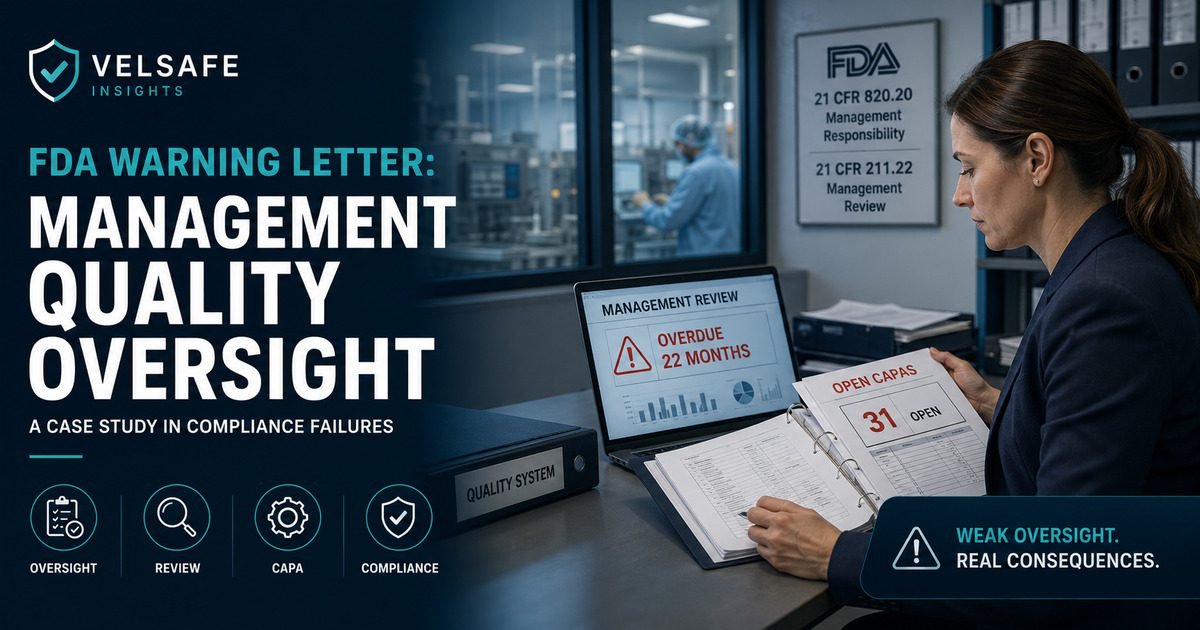
An FDA Warning Letter Case Study
FDA does not expect quality to manage itself. Under 21 CFR 820.20 and 21 CFR 211.22, management is personally responsible for establishing, implementing, and maintaining an effective quality system. When executives disengage from that obligation, Form 483 observations follow. When those observations go unaddressed, warning letters follow. When warning letters go unaddressed, consent decrees and import alerts follow.
This case study is drawn from patterns documented across multiple public FDA warning letters targeting dual-licensed manufacturers operating under both the Quality System Regulation (21 CFR Part 820) and pharmaceutical GMP (21 CFR Part 211). The scenario is composite. The regulatory findings, enforcement sequence, and corrective action requirements reflect real FDA enforcement actions.
The central question is straightforward: what does FDA actually expect from executive management, and what does a failure to meet those expectations look like in practice?
The Scenario: A Routine Inspection Uncovers Systemic Gaps
The FDA investigator arrived on a standard unannounced GMP inspection. No specific complaint had triggered it. The facility had passed its previous inspection three years earlier with two minor observations, both closed within 60 days. Senior leadership interpreted that outcome as confirmation the quality system was functioning adequately.
It was not. The three intervening years had seen significant personnel changes, two production line expansions, and a strategic shift toward higher-volume contract work. None of these changes had triggered a formal management review or a reassessment of quality system adequacy.
Timeline of Events
What Went Wrong: Three Critical Failures
Failure 1: Management Abdicated Quality System Oversight
Failure 2: CAPA System Operated Without Oversight or Accountability
Failure 3: Quality Unit Independence Was Structurally Eliminated
Investigation Findings: FDA Regulatory Violations
Root Cause Analysis
Corrective Actions Required by FDA
Appoint a Qualified, Independent Quality Director
Conduct a Comprehensive Management Review
Remediate All Open CAPA Investigations
Implement a CAPA Escalation Procedure
Assess and Recall Batches Released with Open Deviations
Lessons Learned
Management Review Is Not Optional
Personnel Changes Are Regulatory Events
A CAPA Backlog Is Evidence of a Management Failure
Prevention Checklist: Management Quality Obligations
Key Takeaways
Management Review Is a Regulatory Obligation
Quality Unit Independence Is Structural
A Silent CAPA System Is Not a Functioning CAPA System
Frequently Asked Questions
What does 21 CFR 820.20 require from executive management?
How often must management reviews be conducted under FDA regulations?
What makes a quality control unit “independent” under 21 CFR 211.22?
Can a company release batches while CAPA investigations remain open?
What happens after an FDA warning letter related to management responsibility?
What inputs are required in a compliant management review under 21 CFR 820.20?
How does FDA’s Quality Management System Regulation change management responsibility requirements?
Sources
Government and Regulatory Sources
- FDA. 21 CFR Part 820 — Quality System Regulation — Governs quality system requirements for medical device manufacturers including management responsibility under 820.20 and CAPA under 820.100.
- FDA. 21 CFR Part 211 — Current Good Manufacturing Practice for Finished Pharmaceuticals — Governs quality control unit responsibilities under 211.22 and production record review under 211.192.
- FDA. Medical Device Inspection Information — Published FDA data on device inspection findings and most commonly cited deficiency categories.
- FDA. (2023). Quality Management System Regulation (QMSR) Final Rule — The 2023 final rule aligning 21 CFR Part 820 with ISO 13485:2016, effective February 2026.
Research and Industry Sources
- FDA. (2006). Quality Systems Approach to Pharmaceutical CGMP Regulations — Foundational guidance connecting quality systems concepts to 21 CFR Part 211 management responsibilities.
- FDA. Quality System (QS) Regulation: Medical Device Good Manufacturing Practices — FDA’s official guidance on QSR implementation and management review compliance expectations.