
Effective meeting leadership is a core supervisor responsibility under OSHA’s General Duty Clause, and poor meeting structure directly contributes to missed safety communications and compliance failures. Workers who leave a meeting without clear action items or safety updates are more likely to take shortcuts or miss hazards during their shift. This article covers the leadership skills, meeting formats, and documentation practices that keep workplace meetings productive, compliant, and safety-focused.
A meeting where workers leave confused, distracted, or uninformed is not a neutral event. It is a communication failure with real safety consequences. Supervisors who cancel meetings, run them without an agenda, or skip follow-up create conditions where critical safety information does not reach the people who need it.
The General Duty Clause requires employers to provide a workplace free from recognised hazards. Communicating those hazards clearly through structured meetings is part of fulfilling that obligation, not a procedural nicety.
Common Meeting Failures That Create Safety Risks
Most meeting problems follow predictable patterns. The following failures appear across workplaces of all sizes and industries. Recognising them is the first step to correcting them.
No written agenda provided in advance
Workers arrive without context, safety topics compete for time with unplanned items, and no agenda means no time limits: discussions run past their purpose.
Action items not assigned to a named person
When “we will look into this” replaces a named owner with a deadline, nothing happens. The same issue reappears at the next meeting, and the one after.
Safety topics skipped or rushed for time
When safety is placed at the end of the agenda, it is the first thing cut when operational topics run over. Workers leave with no safety update for that shift.
No documentation of decisions or attendance
Without written records, the employer has no evidence of training delivery or corrective actions taken. In an OSHA inspection, this gap signals non-compliance.
Warning Signs Your Meetings Are Not Working
These signals indicate that meeting leadership is breaking down. If you recognise more than two of these patterns, restructure the meeting format immediately.
The same problems keep appearing meeting after meeting
When recurring issues are discussed but not resolved, action items are not being assigned, tracked, or completed. This breaks worker confidence in the meeting’s purpose and authority.
Workers do not know what was decided after the meeting ends
If workers walk out without a clear understanding of decisions, responsibilities, or next steps, the meeting produced no actionable outcome. Missing safety information is a direct hazard on the worksite.
Attendance is inconsistent and no one addresses it
When workers routinely arrive late or skip meetings without follow-up, the meeting has lost organisational authority. Attendance gaps create unequal exposure to safety information across the team.
No documentation exists from past meetings
The absence of written records means no evidence of training delivery, hazard communication, or corrective action. In a post-incident investigation, this gap is treated as evidence of non-compliance.
How to Lead an Effective Workplace Meeting: Step by Step
Follow this sequence for every team meeting. Each step has a specific purpose and a defined output. Skipping any step reduces the meeting’s safety and compliance value.
Distribute the agenda 24 hours before the meeting
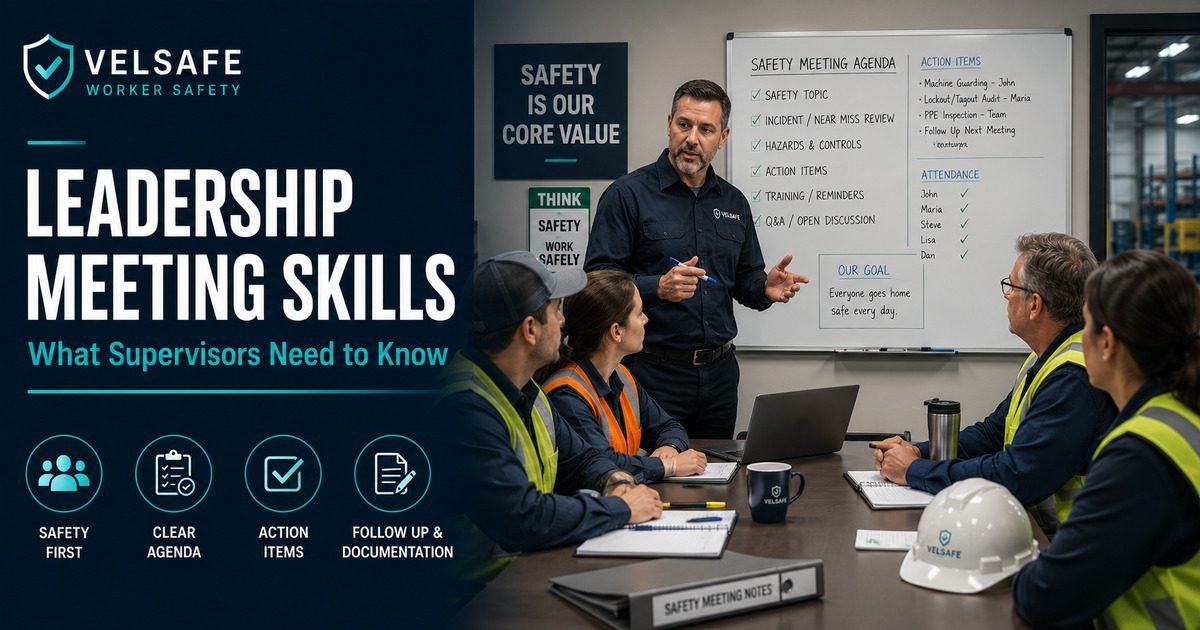
The agenda must include: meeting purpose, agenda items with time slots, the safety topic of the day, and any open action items from the previous meeting. Sending it 24 hours ahead gives workers time to prepare and flag conflicts before the room fills.
Start on time and open with the safety topic
Starting on time signals that the meeting has authority. Opening with safety (an incident review, a near-miss, or a toolbox topic) ensures critical content is covered before time runs out. Never put safety at the end of the agenda.
Assign a note-taker at the start of every meeting
The note-taker records attendance, agenda items covered, decisions made, and action items with owners and deadlines. This should not be the supervisor. Rotating the role builds shared ownership of the meeting record.
Apply a time limit to each agenda item
When an item cannot be resolved in its allotted time, pause it, assign a follow-up owner, and move on. Detailed discussions belong in smaller groups, not in a full team meeting where time is shared across all topics.
Assign action items with a named owner and a specific deadline
Every action item must have one person responsible, a clear deliverable, and a date. “We will look into this” is not an action item. “Maria will submit the equipment inspection report by Friday” is. Vague ownership means nothing gets done.
Close with a summary of decisions and next steps
In the final two minutes, read back the decisions made and the action items assigned. Confirm that everyone understands. This is the last chance to correct misunderstandings before workers return to the worksite.
Distribute written minutes within 24 hours
Minutes must include: date, time, attendees, decisions, and action items with owners and deadlines. Send to all attendees and to any workers who were absent. Post a printed copy on the safety board. File the original for at least three years.
Do and Do Not: Meeting Leadership Rules
DO
- Start and end on time, every meeting, without exception
- Put safety first on every agenda
- Document every decision and action item in writing
- Assign each action item to one named person
- Review open items at the start of the next meeting
- Confirm absent workers receive the minutes
DO NOT
- Hold a meeting without a written agenda
- Skip documentation because “everyone was there”
- Allow one topic to consume time for safety content
- Cancel a meeting without rescheduling immediately
- Tolerate repeated late arrivals without addressing them
- Close without summarising what was decided
When a Meeting Breaks Down: How to Respond
Conflict, grievances, or emotional escalation can derail a meeting and leave workers with unresolved safety concerns. Follow this protocol when a meeting becomes unproductive or confrontational.
Pause the agenda immediately
Do not continue through the conflict. Pausing shows respect for the concern being raised and for the rest of the group’s time.
Acknowledge the concern without judgment
State clearly that the concern has been heard and will be addressed. Do not dismiss, minimise, or debate it in front of the group.
Schedule a follow-up with the individuals involved
Set a specific time and confirm it before the meeting ends. A promised follow-up with no date is not a resolution: it is a deferral that breeds resentment.
Document what was raised and what was committed
Note the concern, who raised it, and what follow-up was promised. This protects both the worker and the employer, especially for safety-related disputes.
Resume or reschedule the remaining agenda items
If the group can refocus, continue. If the emotional temperature is too high, close the meeting and reschedule. Continuing in a charged environment produces poor communication and no usable outcomes.
Supervisor Tips for Better Meeting Leadership
Review the incident log before every meeting
Check for near-misses, equipment issues, or safety concerns logged since the last meeting. This ensures your safety agenda item is current and specific, not a generic topic recycled from last month.
Rotate the note-taker and facilitator roles
When senior workers take turns leading and documenting, they develop shared ownership of meeting quality. It signals that the meeting is a team responsibility, not just a supervisor obligation.
Post the agenda in a visible location
Print and post the agenda on the safety board, not only in a digital message. Workers without consistent access to email must have equal access to meeting information and outcomes.
Keep meetings to 30 minutes maximum
If 30 minutes is not enough, the agenda is overloaded. Split recurring operational topics into a separate session so safety content is never competing with administrative items for time on the clock.
Meeting Leadership Checklist
Before the Meeting
- ✓ Review incident log and near-miss reports
- ✓ Prepare written agenda with time slots
- ✓ Distribute agenda 24 hours in advance
- ✓ Identify note-taker for this meeting
- ✓ Review open action items from last meeting
- ✓ Confirm time, location, and attendance
During the Meeting
- ✓ Take and verify attendance at the start
- ✓ Open with the safety topic first
- ✓ Follow agenda and enforce time limits
- ✓ Assign action items with owner and date
- ✓ Document all decisions in real time
- ✓ Read back decisions and close on time
After the Meeting
- ✓ Distribute minutes within 24 hours
- ✓ Notify absent workers of decisions
- ✓ Post minutes on the safety board
- ✓ File signed attendance record
- ✓ Follow up with action item owners
- ✓ Begin planning next meeting agenda
Key Takeaways
Structure prevents safety topics from being skipped
A written agenda with safety first and time-limited items ensures critical information reaches workers before operational topics consume the meeting. Without structure, safety content is the first thing cut when time runs short.
Documentation is a compliance record and a legal protection
Written minutes with attendance records, decisions, and action items serve as evidence that safety communication occurred. In a post-incident investigation or OSHA inspection, these records are the difference between demonstrated compliance and an assumption of neglect.
Follow-up is what separates a productive meeting from a performance
Reviewing open action items at the start of each meeting holds team members accountable and closes the loop on identified hazards. A meeting that produces action items no one follows up on is indistinguishable from one that never happened. The follow-up is the meeting’s actual output.
Frequently Asked Questions
Does OSHA require employers to hold regular safety meetings?
OSHA does not have a single regulation titled “safety meetings required.” However, 29 CFR 1926.21 requires construction employers to instruct workers in hazard recognition and avoidance before work begins. The General Duty Clause requires all employers to communicate recognised hazards, which structured meetings directly support. Many state-plan OSHA programmes have more specific requirements.
What should every workplace safety meeting include?
Every safety meeting should include: a review of recent incidents or near-misses, a toolbox topic relevant to current work, a status update on open corrective actions, and a question period. Document all items with attendance, decisions, and action items. Meetings that skip the incident review are missing the most important element.
How long should a workplace safety meeting be?
A safety meeting should run no longer than 30 minutes for a standard team briefing. If the agenda consistently requires more time, it is overloaded: split recurring operational topics into a separate session. Toolbox talks can run as short as five to ten minutes when focused on a single specific topic.
What is the supervisor’s role in a workplace safety meeting?
The supervisor ensures the meeting happens on time, that safety content is covered first, and that every decision produces a named owner with a deadline. The supervisor does not have to facilitate or take notes. Separating these roles increases meeting quality and builds shared ownership among the team.
How should disputes or grievances be handled during a meeting?
Disputes should not be resolved in a group meeting. When a concern escalates, pause the agenda, acknowledge the concern publicly, and commit to a specific follow-up with the relevant parties. Document what was raised and what was promised. Resolving a complex grievance in front of the full team typically produces no resolution and damages trust.
What documentation is required after a workplace safety meeting?
At a minimum: date, time, attendees, agenda items covered, decisions made, and action items with assigned owners and due dates. Distribute within 24 hours, post on the safety board, and retain for at least three years. The signed attendance record is especially important for documenting training delivery.
How can supervisors improve worker participation in safety meetings?
Participation improves when the meeting is relevant to daily work, when worker input leads to visible action, and when the meeting starts and ends on time. Ask one worker per meeting to present the safety topic, review completed action items publicly so workers see follow-through, and invite agenda submissions in advance. Workers disengage when meetings feel like one-way communication with no impact on their actual working conditions.
Sources
- OSHA: 29 CFR 1926.21: Construction Safety Training and Education
- OSHA: OSH Act Section 5(a)(1): General Duty Clause
- BLS: Survey of Occupational Injuries and Illnesses 2022
- OSHA: Training Requirements in OSHA Standards (Publication 2254)
- National Safety Council: Workplace Safety Resources and Research
- SHRM: Workplace Communication and Meetings Research
Related VelSafe Articles
What every worker must know about GHS hazard labels, SDS sheets, and their right to information on chemical hazards in the workplace.
A practical breakdown of who HAZWOPER applies to, what training is required, and how supervisors manage compliance for workers handling hazardous substances.
How leading organisations are integrating safety communication into broader HR compliance frameworks, and what the data shows about what actually works.
VelSafe covers the workplace safety and compliance topics your team needs to stay informed, protected, and audit-ready.
Explore VelSafe