
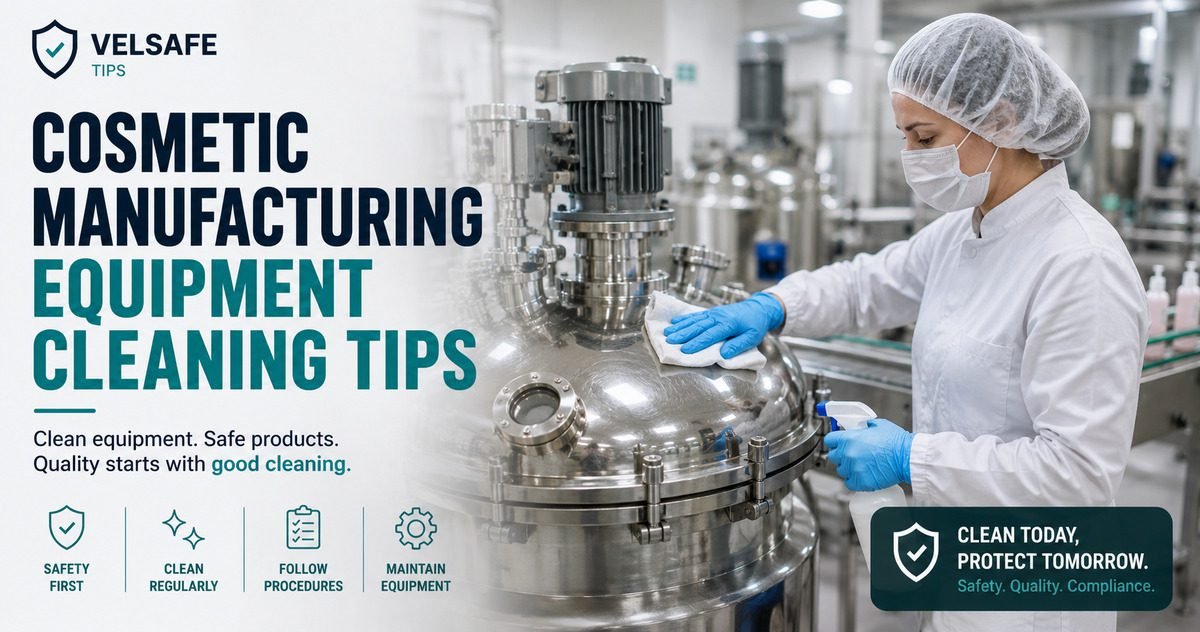
Eight practical tips to keep equipment compliant with FDA cosmetic GMP guidance and the Modernization of Cosmetics Regulation Act.
MoCRA 2022 was the first major update to US cosmetics law since the 1938 Federal Food, Drug, and Cosmetic Act.
MoCRA requires FDA to issue mandatory GMP regulations for cosmetics, covering equipment design, cleaning, and maintenance.
Inadequate equipment cleaning is a primary cause of microbial and cross-contamination cited in FDA cosmetics warning letters and recalls.
Cosmetic manufacturing equipment that is not properly cleaned and maintained puts products at risk of microbial contamination, cross-contamination between formulations, and ingredient carryover. Each of these failures can trigger a recall, a warning letter, or product liability exposure. The Modernization of Cosmetics Regulation Act of 2022 (MoCRA) has made GMP requirements mandatory for the first time, and FDA’s forthcoming regulations will include specific requirements for equipment cleaning and maintenance.
The eight tips below are drawn from FDA’s existing Cosmetics GMP Guidelines and the requirements of MoCRA. They address the most commonly cited gaps in cosmetic equipment cleaning programmes, from SOP development to personnel qualification.
Quick Tip Summary
8 Equipment Cleaning Tips at a Glance
The 8 Tips
Write and Follow Equipment-Specific Cleaning SOPs
FDA’s Cosmetics GMP Guidelines state that cleaning procedures must be established in writing and followed. A verbal instruction or general cleaning guide applied to all equipment is not sufficient. Each piece of equipment has a different surface type, product contact area, and contamination risk profile. A single generic SOP cannot adequately cover a blending tank, a filling line, and a milling machine.
Create a separate written SOP for each major piece of equipment or equipment category. Each SOP should specify: the cleaning agent, concentration, contact time, water temperature, rinsing method, drying requirements, and the criteria for passing a post-clean inspection. Assign ownership of each SOP to a named role, not an individual, and establish a review cycle of at least once every two years or after any process change.
Using one general cleaning SOP for all equipment. This creates gaps where product-specific residues are not adequately addressed, particularly in equipment with complex geometry or multiple material zones.
Add a diagram or photograph of each equipment item directly into the SOP, highlighting the high-risk contact zones that require extra attention during cleaning. This reduces ambiguity for operators working across multiple product lines.
Select the Right Cleaning Agents for Each Product Type
The wrong cleaning agent can leave residues that compromise the next batch, damage equipment surfaces, or introduce contaminants that are harder to detect than the original formulation. Anhydrous formulations, oil-heavy emulsions, and water-based products each require different cleaning chemistry. Using a water-only rinse to remove a silicone-based product, for example, will not achieve adequate removal.
Review the formulation of each product manufactured on shared equipment and select cleaning agents based on the solubility and chemistry of the residues to be removed. Surfactant-based cleaners suit most emulsion and water-based products. Alkaline cleaners address heavy oil, wax, and silicone residues. Confirm that the cleaning agent itself can be fully rinsed from equipment and does not leave detectable levels of residue on product contact surfaces.
Selecting cleaning agents based on availability or cost rather than compatibility with the product chemistry. This is particularly common in facilities manufacturing both aqueous and anhydrous products on the same line.
Maintain a cleaning agent compatibility matrix that cross-references each product type with the approved cleaning agent, approved concentration range, and contact time. Store this as a controlled document linked to each equipment SOP.
Validate Your Cleaning Process Before Production Begins
A cleaning SOP that has not been validated is an assumption, not a control. Cleaning validation demonstrates that the procedure consistently removes product residues and microbial contamination to acceptable levels. Without it, you cannot confirm that the cleaning process is working, and you cannot respond effectively when a contamination event occurs.
Establish a cleaning validation protocol for each product-equipment combination that presents a contamination risk. At minimum, validate the worst-case scenario: the product with the highest residue challenge, the equipment with the most complex geometry, and the shortest cleaning interval used in production. Acceptance criteria should address both chemical residue (product carryover) and microbial levels. Document the results formally and attach them to the equipment qualification record.
Assuming that if equipment looks clean, it is clean. Visual inspection cannot detect residues below a certain concentration or microbial contamination at any level. Unvalidated processes regularly pass visual inspection while still failing swab or rinse sample testing.
Use total organic carbon (TOC) testing or product-specific analytical methods for residue detection during validation. Swab sampling of the hardest-to-clean locations provides stronger validation evidence than rinse water testing alone.
Fully Disassemble Equipment Before Every Cleaning Cycle
Product residue accumulates in joints, seals, fittings, and internal passages that cannot be reached during a surface-level clean. Failure to disassemble equipment before cleaning is one of the most common contributors to persistent contamination in cosmetic manufacturing. Partially disassembled equipment provides a protected environment where biofilm can establish itself over time.
Define the required disassembly level for each piece of equipment in the cleaning SOP. Include a pre-cleaning disassembly checklist that operators sign off before starting the clean. For complex equipment with many sub-components, assign disassembly to a trained operator, not a general cleaning operative. Reassembly after cleaning should be equally controlled and documented.
Removing only the major components and wiping accessible surfaces. Internal pipework, valve seats, agitator shafts, and seal housings are frequently skipped, particularly under time pressure.
Photograph equipment in its disassembled state as part of a visual disassembly guide and include this in the SOP. This is especially useful for onboarding new operators and reducing errors during shift changeovers.
Record Every Cleaning Event in a Formal Log
FDA’s Cosmetics GMP Guidelines require that records be kept of all manufacturing and control procedures, including cleaning. A cleaning log provides evidence that the procedure was followed, who performed it, what was used, and when it was done. Without a cleaning log, you cannot demonstrate compliance during an FDA inspection or investigate the source of a contamination event.
Use a controlled cleaning record form for each piece of equipment. The form should capture: date and time of cleaning, product previously manufactured, cleaning agent and lot number, operator name and signature, supervisor verification signature, and the result of any post-clean inspection or test. Retain cleaning records for a period consistent with your product shelf life and your document retention policy. Under MoCRA, FDA is developing record retention requirements that cosmetic manufacturers should monitor.
Relying on a shared whiteboard or verbal confirmation to track when equipment was last cleaned. This provides no verifiable evidence and cannot support an investigation or audit response.
Link the cleaning record to the batch record for the next production run. This creates a documented chain connecting product quality to equipment cleaning status and supports traceability during any quality investigation.
Inspect Equipment After Cleaning Before Releasing to Production
Cleaning is not complete until someone has verified that the equipment meets the release criteria defined in the SOP. An uninspected clean is an incomplete clean. Inspection catches missed areas, inadequate rinsing, and mechanical damage to seals or surfaces that could compromise the next batch.
Establish formal release criteria for each equipment item and train a designated inspector to apply them consistently. Criteria should include: visual absence of residue, absence of cleaning agent odour or film, dry surfaces where required, and intact seals and gaskets. For equipment where visual inspection is insufficient, specify a swab or rinse sample test as part of the release gate. Document the inspection result on the cleaning record and require a signature before the equipment is released for production use.
Releasing equipment for production immediately after cleaning without a documented inspection step. This is especially common during high-volume production periods when pressure to minimise downtime is highest.
Implement a physical tag or lock system for equipment status: Cleaning In Progress, Awaiting Inspection, Released for Production. A physical status indicator prevents equipment from being used before it has passed the post-clean inspection.
Address Hard-to-Reach Areas: Gaskets, Seals, and Dead Legs
The areas that are hardest to clean are also the areas where contamination is most likely to persist and accumulate. Gaskets and seals trap product residue in their edges and folds. Dead legs in pipework allow liquid to stagnate between batches. Agitator shaft seals accumulate product on both the shaft and housing. These areas are consistently cited in FDA inspection observations for cosmetic manufacturers.
Map the high-risk zones on each piece of equipment and include them explicitly in the cleaning SOP with specific instructions. Replace gaskets and seals on a scheduled basis rather than waiting for visible deterioration. For pipework, review the installation for unnecessary dead legs and consider design changes that eliminate them. During cleaning validation, target swab samples specifically at these high-risk locations to generate evidence that the procedure is effective where it matters most.
Cleaning the accessible surfaces of equipment thoroughly while neglecting disassembly of seals, valves, and fittings. This passes a surface-level visual inspection while allowing contamination to persist in the areas where it is most likely to contact product.
During your next equipment qualification review, walk the line with your maintenance team and identify every location where residue could accumulate between cleaning cycles. Mark these on a schematic and add them to the SOP with a photograph. This turns institutional knowledge into a controlled document.
Train and Requalify All Personnel Who Perform Cleaning
A cleaning SOP is only effective if the person following it has been trained to the required standard and understands why each step matters. Untrained or undertrained cleaning operators are a primary source of procedure deviation. Under MoCRA, FDA’s forthcoming GMP regulations are expected to include personnel qualification requirements that extend to cleaning and maintenance activities.
Establish a formal training programme for all personnel who perform equipment cleaning. Training should cover the SOP content, the reason for each step, common mistakes and their consequences, and how to complete the cleaning record. Require a practical competency assessment before an operator is qualified to clean independently. Establish a requalification interval, typically annually or following a significant procedure change, and document all training events in personnel records.
Providing a one-time verbal walkthrough and assuming the operator is qualified. This approach produces inconsistent cleaning results, particularly when trained operators leave and new staff take over without formal onboarding.
Pair new cleaning operators with a qualified mentor for their first three to five independent cleaning cycles. The mentor observes without intervening unless a safety or compliance issue arises, then provides documented feedback. This builds practical competence and identifies gaps that classroom training does not catch.
Pre-Cleaning Checklist
Before You Start
- Confirm equipment is tagged as Awaiting Clean
- Identify the previous product manufactured
- Retrieve the correct equipment-specific cleaning SOP
- Confirm cleaning agent, lot number, and concentration
- Gather all required PPE for the cleaning agents in use
- Confirm all disassembly tools are available
During Cleaning
- Disassemble to the level specified in the SOP
- Apply cleaning agent at the correct concentration and contact time
- Pay specific attention to gaskets, seals, and identified high-risk zones
- Rinse thoroughly to the specified endpoint
- Dry where required by the SOP
- Reassemble and label as Awaiting Inspection
Post-Cleaning Inspection
- Inspect all product contact surfaces visually
- Confirm absence of residue, film, or odour
- Inspect seals and gaskets for integrity
- Complete swab or rinse test if required by SOP
- Sign off the cleaning record
- Update equipment tag to Released for Production
Documentation Requirements
- Complete cleaning record with date, time, operator, and product previously run
- Record cleaning agent lot number and concentration used
- Record inspection outcome and inspector name
- Attach any swab or rinse test results
- File cleaning record with the next production batch record
- Escalate any out-of-specification result before releasing equipment
Key Takeaways
SOPs, Validation, and Records Are Non-Negotiable
A cleaning procedure that is not written, not validated, and not recorded is not a controlled procedure. FDA’s Cosmetics GMP Guidelines and MoCRA’s forthcoming regulations require documented evidence that cleaning is performed consistently and effectively. All three elements must be in place before a facility can claim compliance.
The Hardest Areas to Clean Are the Most Important
Gaskets, seals, dead legs, and internal pipework are consistently the source of persistent contamination in cosmetic manufacturing. A cleaning programme that passes visual inspection on accessible surfaces while neglecting these areas is creating a contamination risk that will eventually manifest as a product quality failure or an FDA citation.
MoCRA Has Changed the Compliance Baseline
The Modernization of Cosmetics Regulation Act of 2022 has elevated cosmetics from a lightly regulated category to one with mandatory GMP requirements, facility registration, and product listing obligations. FDA is developing GMP regulations that will specify equipment, cleaning, and personnel qualification requirements. Facilities that have not yet formalised their cleaning programmes should treat MoCRA as the trigger to do so now, before the regulations are finalised and enforcement begins.
Frequently Asked Questions
What does FDA require for equipment cleaning in cosmetic manufacturing?
FDA’s Cosmetics GMP Guidelines state that equipment used in cosmetic manufacturing should be maintained in a clean and orderly condition and should be cleaned and sanitized at appropriate intervals to prevent contamination. The guidelines also require that cleaning procedures be established in writing. MoCRA, signed in December 2022, requires FDA to issue mandatory GMP regulations for cosmetics that will formalise these requirements.
How often should cosmetic manufacturing equipment be cleaned?
Cleaning frequency depends on the type of product, the equipment, and the production schedule. At minimum, equipment should be cleaned between product changeovers, between manufacturing campaigns for different formulations, and whenever there is a risk of cross-contamination. The specific frequency for each piece of equipment should be defined in the equipment-specific cleaning SOP and reviewed as part of your quality management programme.
What is cleaning validation and is it required for cosmetics?
Cleaning validation is the documented process of demonstrating that a cleaning procedure consistently removes product residues and microbial contamination to acceptable levels. While FDA’s current Cosmetics GMP Guidelines do not mandate cleaning validation by that name, they require that procedures be adequate and effective. MoCRA’s forthcoming GMP regulations are expected to strengthen these requirements. Facilities that have validated their cleaning processes will be better positioned for compliance when the regulations take effect.
What cleaning agents are appropriate for cosmetic manufacturing equipment?
The appropriate cleaning agent depends on the product formulation and the equipment surface material. Water-based and emulsion products are generally addressed with surfactant-based cleaners. Anhydrous products, including waxes, oils, and silicones, typically require alkaline or solvent-based cleaners. The cleaning agent must be compatible with equipment surface materials and must itself be fully removable from the equipment by rinsing. Cleaning agent selection should be documented in the SOP and validated as part of the cleaning validation programme.
What records does FDA expect for equipment cleaning?
FDA’s Cosmetics GMP Guidelines require records of manufacturing and control procedures, which includes cleaning. At minimum, cleaning records should capture the date and time of cleaning, the product previously manufactured, the cleaning agent and concentration used, the operator performing the cleaning, the result of any post-clean inspection, and the signature of the person verifying the clean. MoCRA is expected to include specific record-keeping requirements when FDA finalises the mandatory GMP regulations.
How does MoCRA affect equipment cleaning requirements for cosmetics?
MoCRA, signed December 29, 2022, requires FDA to issue mandatory GMP regulations for cosmetics. These regulations are expected to include requirements for equipment design, cleaning, maintenance, and personnel qualification. Until the regulations are finalised, FDA’s existing voluntary Cosmetics GMP Guidelines remain the primary reference. Facilities should treat the forthcoming regulations as the compliance baseline and build their cleaning programmes to meet or exceed the current guideline standards.
What are the consequences of inadequate equipment cleaning in cosmetic manufacturing?
Inadequate cleaning can result in microbial contamination of finished products, cross-contamination between formulations, ingredient carryover that alters product chemistry, and product quality failures. From a regulatory perspective, evidence of inadequate cleaning can trigger FDA warning letters, voluntary recalls, and import alerts. Under MoCRA, FDA has expanded enforcement authority over cosmetics, making contamination-related failures a higher compliance risk than under the previous regulatory framework.
Sources
Government and Regulatory
Industry and Standards
Related VelSafe Articles
What FDA expects when a product defect or contamination event triggers a formal investigation in a cosmetics facility.
A scenario-based walkthrough of the labelling requirements that apply to cosmetics under FDA regulations and MoCRA.
A step-by-step guide to conducting failure investigations under FDA requirements, with parallels applicable to cosmetics quality management.
VelSafe offers cosmetics manufacturing compliance training covering GMP requirements, cleaning practices, documentation, and MoCRA readiness.
Explore VelSafe Training