

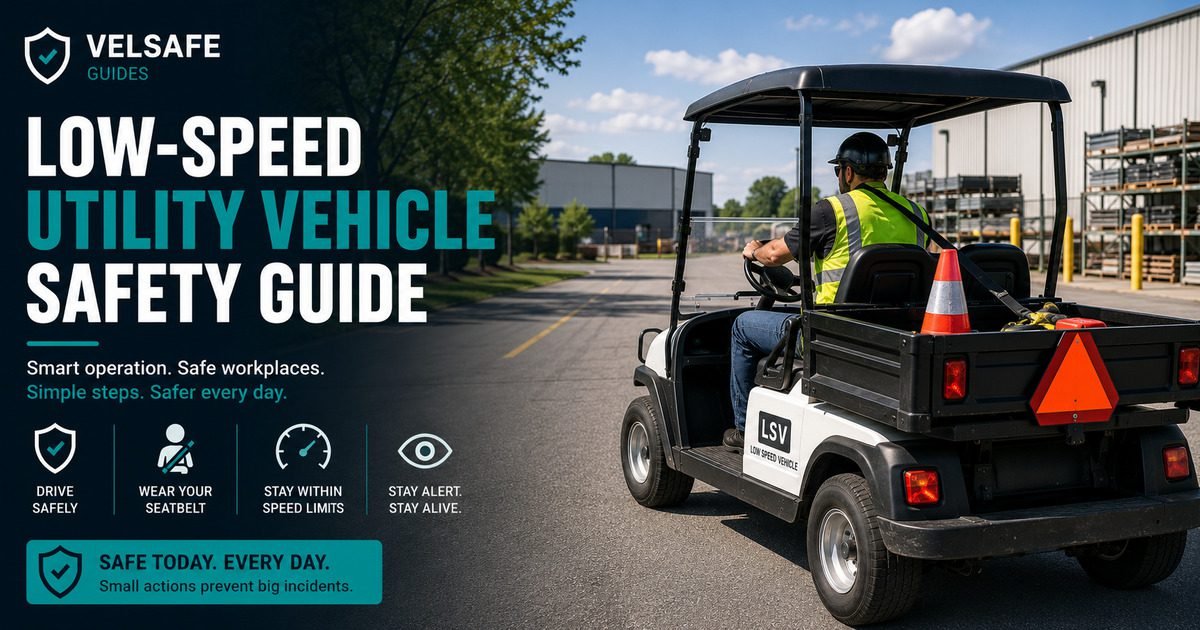
Low-speed and utility vehicles have no dedicated OSHA standard. That does not mean they fall outside the regulatory framework. The General Duty Clause (Section 5(a)(1) of the Occupational Safety and Health Act, 29 USC 654(a)(1)) requires employers to maintain a workplace free of recognised hazards that cause or are likely to cause death or serious physical harm. When an employee is injured by a golf cart, a personnel carrier, or a utility task vehicle, OSHA investigators will apply this clause, and the employer’s lack of a written programme, training records, and inspection logs will serve as primary evidence of a recognised hazard left uncontrolled.
This guide covers the legal framework that applies to low-speed and utility vehicles in general industry and warehouse settings, the prerequisite controls that must be in place before operators take the wheel, and the step-by-step operating procedure that forms the backbone of any defensible safety programme.
1. Vehicle Types: Understanding What Falls Under This Guide
The term “low-speed vehicle” covers a wide range of equipment found in warehouses, manufacturing plants, campuses, airports, and outdoor maintenance operations. Each vehicle type carries a distinct hazard profile and may fall under a different regulatory pathway. Misidentifying the vehicle type is one of the most common reasons employers build an inadequate programme.
Golf Carts and Personnel Carriers
Typically 2-4 passenger capacity, maximum speed 15-20 mph on flat terrain. Common in warehouses, healthcare campuses, airports, and event venues. Governed primarily by ANSI/ITSDF B56.8 in workplace settings. Rollover, passenger ejection, and pedestrian strike are the primary incident types.
Utility Task Vehicles (UTVs) and Side-by-Sides
Higher ground clearance, wider stance, cargo bed capacity. Used in outdoor maintenance, agriculture, construction staging areas, and large industrial sites. Maximum speeds typically 25-45 mph. Centre of gravity shifts significantly under load, making slope operation a leading rollover risk. OSHA’s General Duty Clause applies in general industry; 29 CFR 1926.600 applies on construction sites.
Neighbourhood Electric Vehicles (NEVs) and Low-Speed Vehicles
NEVs and LSVs defined under FMVSS 500 (49 CFR 571.500) have a maximum speed of 20-25 mph and must meet federal safety equipment standards when operated on public roads. Inside a private facility they are not subject to FMVSS 500, but that regulatory exemption does not eliminate the General Duty Clause obligation to control vehicle hazards.
Burden Carriers and Motorised Tow Tractors
Designed to pull or carry loads rather than passengers, these vehicles may fall under 29 CFR 1910.178 if their design and use match the powered industrial truck definition. ANSI/ITSDF B56.9 covers operator-controlled industrial tow tractors. Employers should confirm the applicable standard before building a training programme.
2. OSHA Applicability: The Legal Framework for Low-Speed Vehicles
OSHA does not have a single standard titled “low-speed vehicle” or “golf cart safety.” The applicable regulatory path depends on vehicle type, industry setting, and use. Employers who assume the absence of a dedicated standard means OSHA cannot cite them are wrong. The General Duty Clause fills every regulatory gap, and OSHA has issued General Duty Clause citations for golf cart and UTV incidents in warehousing, manufacturing, and campus settings.
| Vehicle / Setting | Primary Standard | Key Obligation |
|---|---|---|
| Golf carts and personnel carriers (general industry) | OSH Act Section 5(a)(1) (General Duty Clause); ANSI/ITSDF B56.8 as recognised standard | Written programme, operator training, pre-use inspection, hazard assessment |
| Powered burden carriers and personnel carriers (general industry, if classified as PITs) | 29 CFR 1910.178 (Powered Industrial Trucks) | Formal operator evaluation and certification every 3 years, written authorisation, PIT inspection programme |
| UTVs and off-road vehicles (construction sites) | 29 CFR 1926.600 (Motor Vehicles and Mechanised Equipment) | Seat belts, rollover protection, no riders outside designated positions, lights when visibility is limited |
| Electric NEVs / LSVs operated on public roads | NHTSA FMVSS 500 (49 CFR 571.500) + state motor vehicle law | Required safety equipment includes headlamps, tail lamps, stop lamps, turn signals, windshield, mirrors, and seat belts |
When an employer cannot clearly classify a vehicle under 29 CFR 1910.178, the safest approach is to treat it as a powered industrial truck for training and inspection purposes while also confirming the classification in writing with your OSHA area office or qualified safety professional. Overprotection does not expose employers to liability. Under-classification does.
3. Prerequisites: What Must Be in Place Before Operating
Three programme elements must exist before any operator is authorised to drive a low-speed or utility vehicle at your facility. These are not one-time setup tasks. Each requires periodic review and is documented so it is available to OSHA inspectors after an incident.
Written Vehicle Safety Programme
The programme must name the vehicles it covers, the routes they are permitted to travel, passenger limits, load limits, speed limits by zone, and the authorisation process for new operators. It must also include the inspection schedule, maintenance procedures, and the process for taking a defective vehicle out of service.
Operator Training and Authorisation Records
Training must cover the specific vehicles the operator will drive, the facility layout, hazard recognition, pre-shift inspection procedure, emergency response (including rollover), and the employer’s rules on speed, passengers, and loads. Completion must be documented with date, trainer name, and operator signature. Authorisation to operate must be revocable by a supervisor.
Under ANSI/ITSDF B56.8, operators must be evaluated and found competent before independent operation. The evaluation must cover both knowledge (written or verbal test) and practical skill (observed operation). Refresher training is required when the operator is involved in an incident, observed operating unsafely, or a significant change occurs in the workplace or equipment.
Hazard Assessment and Route Design
Before vehicles operate in a shared space, the employer must assess the facility for pedestrian-vehicle conflict zones, slope gradients, sightline obstructions, surface conditions, and load-bearing capacity of elevated floors. Routes must be designated and marked. Pedestrian-only zones must be physically separated or clearly delineated with signage, barriers, and floor markings where vehicles and foot traffic intersect.
This assessment is a living document. It must be reviewed after any incident, after facility layout changes, and at least annually.
4. Step-by-Step Safe Operation Procedure
This six-step procedure covers the full operating cycle: from pre-shift inspection through parking and shutdown. Each step includes the objective, the reason it matters, the specific actions required, and a pro tip drawn from common failure patterns observed in incident investigations.
Conduct the Pre-Shift Inspection
Assess Route and Site Conditions Before Moving
Load and Seat Passengers Correctly
Operate at Safe Speed and Maintain Following Distance
Manage Slope and Surface Hazards
Park Safely and Complete Post-Shift Shutdown
5. Do and Do Not: Operating Rules Every Operator Must Know
Do
- Complete the pre-shift inspection and sign the checklist before every use
- Wear seat belts and require all passengers to do the same
- Use the horn before blind corners, intersections, and dock doors
- Yield to pedestrians at all times and in all circumstances
- Report defects on the inspection form immediately
- Travel straight up and down slopes, never across them
Do Not
- Allow passengers on the cargo deck or hanging off the vehicle
- Exceed the vehicle’s rated speed, passenger capacity, or load limit
- Operate on a slope that exceeds the manufacturer’s rated grade
- Deviate from designated routes without supervisor authorisation
- Use a vehicle with a known defect until it has been repaired and cleared
- Leave a vehicle unattended without applying the parking brake and removing the key
6. Compliance Checklist for Low-Speed Vehicle Operations
Use this checklist as the basis for your facility’s LSV inspection and operations record. Each section is a distinct checkpoint. Missing items are programme gaps that can support a General Duty Clause citation.
Before Each Shift
- Brakes tested and holding
- Tires inflated and undamaged
- Horn functional
- Lights functional (if applicable)
- Seat belts present and latching
- Battery or fuel level adequate
- No visible fluid leaks
During Operations
- All passengers seated with feet inside vehicle
- Seat belts worn
- Speed limits observed in all zones
- Horn used at all blind corners and intersections
- Designated routes followed
- Pedestrians yield priority given
- Load within rated capacity and secured
After Each Shift
- Vehicle parked in designated area
- Parking brake applied
- Key removed or vehicle disabled
- Any defects noted on inspection form
- Electric vehicle connected to charger in designated area
- Inspection form signed and submitted
Training and Administration
- Written safety programme current and accessible
- All operators trained and evaluated before authorisation
- Training records retained with operator name, date, trainer
- Facility hazard assessment completed and reviewed annually
- Vehicle maintenance records current
- Route designations posted and marked in facility
7. Common Problems and Troubleshooting
These are the programme gaps and operational conditions that most frequently contribute to LSV incidents. Each one has a documented corrective path.
Problem: Operators Not Following Posted Speed Limits
Root cause: Speed limits are posted but enforcement is inconsistent, and operators have not experienced a consequence for non-compliance. Fix: Establish a written policy stating that speed violations result in revocation of operating authorisation. Conduct observed evaluations periodically. Install proximity warning systems at high-risk intersections. Review incident reports for speed as a contributing factor.
Problem: Passengers Riding on Cargo Decks
Root cause: Insufficient seating for the number of workers who need to travel between locations, so workers use the cargo area as improvised seating. Fix: Assess travel demand against vehicle seating capacity. Add vehicles or scheduled trips if demand exceeds capacity. Post passenger limits visibly on the vehicle. Add the prohibition explicitly to training and written policy.
Problem: Vehicles Operated on Unauthorised Routes
Root cause: Designated routes add travel time, and operators choose shortcuts. Fix: Review route design. If shortcuts are consistently taken, the designated route may be inefficient and should be revised through a formal hazard assessment. Where the shortcut itself is unsafe (uneven surface, pedestrian zone), add physical barriers to prevent vehicle entry.
Problem: Pre-Shift Inspection Forms Not Being Completed
Root cause: Forms exist on paper but are not located near the vehicle, or operators have not been held accountable for skipping them. Fix: Attach a weatherproof inspection form holder directly to each vehicle. Make a completed and signed form a condition of vehicle use. Supervisors should audit form completion weekly, not after incidents.
Problem: Electric Vehicle Battery Issues Creating Secondary Hazards
Root cause: Charging is done in undesignated areas, or battery condition monitoring is not part of the inspection programme. Fix: Designate a specific charging area with adequate ventilation (for lead-acid batteries) and fire suppression access (for lithium-ion batteries). Include battery condition as an inspection item. Establish a battery replacement schedule based on manufacturer recommendations. Review the VelSafe Lithium-Ion Battery Safety Guide for detailed battery programme requirements.
No Dedicated OSHA Standard Means Greater Programme Responsibility
The absence of a specific OSHA low-speed vehicle standard does not create a safe harbour. The General Duty Clause applies to any recognised hazard, and ANSI/ITSDF B56.8 is the consensus standard inspectors reference. Employers must build a programme as if a specific standard existed.
Training Records and Inspection Logs Are the Programme’s Legal Foundation
After an incident, OSHA investigators will ask for training records first and inspection logs second. If either is absent, the programme did not legally exist. Training must be documented with operator name, date, trainer, and the scope of vehicles covered.
Route Design and Pedestrian Separation Are Facility Controls That Outlast Any Individual Operator
Operator behaviour is the most visible control, but facility design is the most durable. Marked vehicle lanes, physical barriers at pedestrian crossings, mirrors at blind corners, and posted speed limits in every zone reduce incident frequency before any individual operator makes a decision. Review route design after every incident and annually regardless of incidents.
Frequently Asked Questions
Does OSHA have a specific standard for golf carts and utility vehicles?
OSHA does not have a dedicated standard titled “golf cart” or “low-speed vehicle.” The General Duty Clause (Section 5(a)(1) of the OSH Act) applies to these vehicles in general industry settings. OSHA inspectors use ANSI/ITSDF B56.8 as the recognised industry standard when evaluating employer programmes. Burden carriers and some personnel carriers may fall under 29 CFR 1910.178 (Powered Industrial Trucks) depending on their design and use.
What operator training is required for low-speed vehicle operators?
Under ANSI/ITSDF B56.8, operators must complete training specific to the vehicles they will use and the facility where they will operate. Training must cover vehicle controls, pre-shift inspection, load and passenger limits, safe operating procedures, hazard recognition, and emergency response. A practical evaluation (observed operation) must confirm competency before the operator is authorised to drive independently. Training records must be retained.
What is the difference between a Low-Speed Vehicle (LSV) and a Utility Task Vehicle (UTV)?
An LSV is defined under NHTSA’s Federal Motor Vehicle Safety Standard 500 (49 CFR 571.500) as a 4-wheeled vehicle with a maximum speed of 20-25 mph. LSVs must meet specific safety equipment requirements when operated on public roads. A UTV (Utility Task Vehicle or side-by-side) is an off-road vehicle category with no NHTSA road classification, typically capable of higher speeds and greater load capacity. UTVs may have rollover protection structures (ROPS) while golf carts typically do not.
Can low-speed vehicles be used to transport passengers in a warehouse?
Yes, provided the vehicle is rated for passenger transport, operators are trained and authorised, passengers are seated in designated positions with seat belts where provided, and the facility has designated routes with pedestrian separation. The number of passengers must not exceed the vehicle’s stated capacity. Carrying passengers on a cargo deck or outside the designated seating area is a recognised hazard and must be prohibited in the written programme.
What are the most common causes of golf cart and utility vehicle incidents in the workplace?
The most frequently identified contributing factors are: pedestrian-vehicle conflicts in shared spaces, rollover on slopes or uneven surfaces, passenger ejection from unenclosed vehicles, operation at excessive speed, and overloaded vehicles with shifted cargo. Facility-level factors such as inadequate pedestrian separation, unmarked routes, and blind corners are common in investigations as enabling conditions that individual operator decisions could not overcome.
Do employers need a written safe operating procedure for low-speed vehicles?
A written programme is not explicitly required by the General Duty Clause the way it is for some specific standards, but it is functionally necessary. OSHA’s General Duty Clause requires that a recognised hazard be controlled with feasible controls. Written procedures, route designations, and training records are the documented evidence that controls exist. An employer without written procedures has no evidence of a programme when OSHA investigates after an incident.
When should a low-speed vehicle be taken out of service?
A vehicle must be removed from service immediately when the pre-shift inspection identifies any defect affecting safe operation, including brake deficiency, tire damage, non-functional horn, damaged seat belt, or battery fault on an electric vehicle. The vehicle must be tagged out of service clearly so it cannot be taken by another operator, and it must not return to service until the defect has been repaired and the repair documented. Under no circumstances should a defective vehicle be operated pending repair.
Sources
Government and Regulatory Sources
- OSHA: OSH Act Section 5(a)(1), General Duty Clause: the legal basis for OSHA enforcement of LSV and utility vehicle hazards where no specific standard directly applies to the vehicle type in question.
- OSHA 29 CFR 1910.178: Powered Industrial Trucks: federal standard applicable to burden carriers and personnel carriers that meet the powered industrial truck definition, covering operator training, inspection, and safe operation requirements.
- NHTSA 49 CFR 571.500 (FMVSS No. 500): federal definition and minimum safety equipment requirements for Low-Speed Vehicles (LSVs) operated on public roads, including speed limits, lighting, and restraint system specifications.
- OSHA 29 CFR 1910.132: Personal Protective Equipment: PPE hazard assessment and selection requirements applicable to LSV operators where traffic, weather, or task hazards require protective equipment beyond the vehicle cab.
Research and Industry Sources
- ANSI/ITSDF B56.1: Safety Standard for Low Lift and High Lift Trucks: American National Standard covering design, operation, and maintenance of powered industrial trucks including utility vehicles used in industrial and warehouse settings.
- NIOSH: Powered Industrial Truck Safety Research: National Institute for Occupational Safety and Health research on powered vehicle incidents in industrial settings, including utility and burden carrier incidents.
Related VelSafe Articles
Practical tips for securing loads on vehicles and equipment to prevent cargo shift, spills, and incidents during transport.
Covers battery storage, charging, inspection, and thermal runaway controls for electric vehicles and energy storage systems.
The legal framework for hazard identification before task commencement, including how the General Duty Clause creates JHA obligations across all operations.
VelSafe delivers workplace safety content built on real regulatory standards. Browse our Guides, Tips, and Law categories for the complete programme reference your team needs.
Explore VelSafe Safety Resources